
Once you notify HMRC of your intent to join the Let Property Campaign (LPC), the countdown begins. You are issued a unique Disclosure Reference Number (DRN) and a Payment Reference Number (PRN), and you have exactly 90 days to calculate your figures, submit your disclosure, and pay the balance. Tax Disclosure.
At Felix Accountants, we call this the “Execution Phase.” The 90-day window sounds generous, but when you are dealing with years of missing bank statements and complex tax rules, time disappears quickly. Here is your roadmap to a successful submission.
1. The Timeline: Notification to Settlement
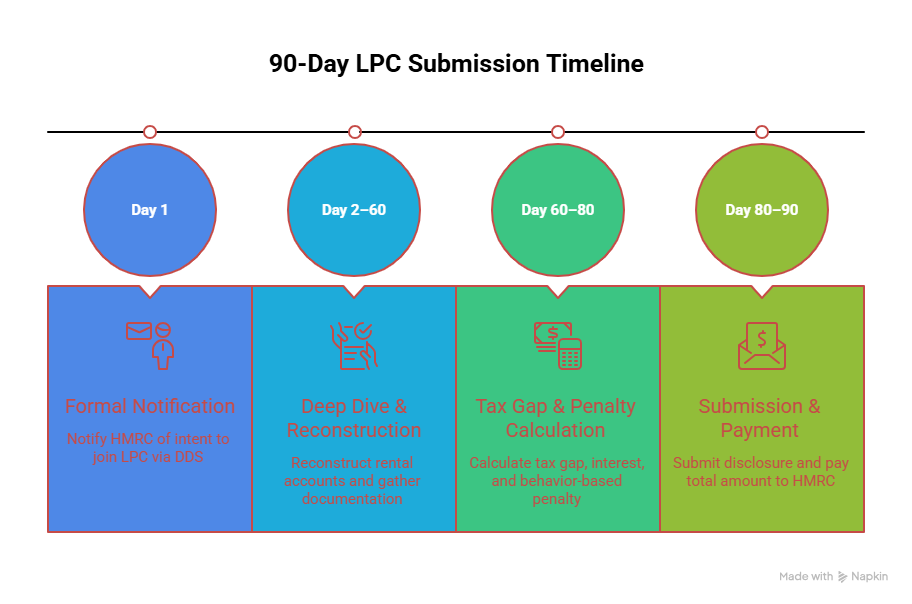
The LPC is a structured process. Missing the 90-day deadline can result in HMRC rejecting your disclosure and opening a formal (and much more expensive) enquiry.
-
Day 1: Formal Notification via the Digital Disclosure Service (DDS).
-
Day 2–60: The “Deep Dive.” This is when we reconstruct your rental accounts.
-
Day 60–80: We calculate the “Tax Gap,” statutory interest, and the behavior-based penalty.
-
Day 80–90: Formal submission of the disclosure and payment of the total amount.
2. Essential Documentation Checklist
To make an accurate disclosure, we need to move beyond “estimates” wherever possible. You should begin gathering:
-
Income Records: Tenancy agreements, letting agent annual statements, or bank statements showing rent deposits.
-
Expense Evidence: Invoices for repairs, insurance certificates, management fee statements, and utility bills for void periods.
-
Mortgage Data: Annual mortgage interest certificates (usually provided by your lender every January).
-
Other Income Info: Your P60 or P11D (if employed) or self-employed accounts. Your rental tax is determined by your total income, so we need the full picture to apply the correct tax bands.
3. Dealing with Missing Records
What if you don’t have bank statements from six years ago?
-
Bank Requests: Most banks can provide historic statements for a small fee, though this can take 2–3 weeks (hence the urgency).
-
Reasonable Estimates: If records are truly lost, HMRC allows for “Best Estimates.” We can use local rental market data and average maintenance costs for your property type to build a defensible set of figures.
-
The Narrative: We must include a note in your disclosure explaining why records are missing and how we reached our estimates.
4. Calculating the “Add-Ons”: Interest and Penalties
Your disclosure isn’t just about the tax. HMRC expects you to “Self-Assess” two other figures:
Statutory Interest
This is not a penalty; it is compensation to the government for not having the money on time. Interest rates for late tax have risen significantly in 2025 and 2026. We use specialized software to calculate interest from the date the tax should have been paid to the current date.
The Penalty Offer
You must make a “Formal Offer” of a penalty. As discussed in previous articles, this is based on your behavior:
-
Reasonable Care: 0%
-
Careless (Unprompted): 0% – 30%
-
Deliberate (Unprompted): 20% – 70%
5. Making the “Formal Offer”
A unique feature of the LPC is that it is a Contractual Tax Disclosure
. When we submit the form, we are making a “Formal Offer” to pay a specific amount. If HMRC accepts this offer, it becomes a legally binding contract that prevents them from re-opening those specific years in the future (provided your disclosure was honest).
6. What If You Can’t Pay Everything on Day 90?
If the final bill is larger than expected, do not wait until Day 90 to tell HMRC. * We can negotiate a “Time to Pay” (TTP) arrangement.
-
HMRC is generally more open to payment plans (spreading the cost over 6–12 months) if the request is made as part of a voluntary disclosure.
Frequently Asked Questions (FAQs)
Q1: Can I submit the disclosure before the 90 days are up?
Yes. You can submit as soon as your figures are ready. In fact, submitting early reduces the amount of statutory interest you have to pay.
Q2: What happens if I miss the 90-day deadline?
HMRC may remove you from the campaign. This means you lose the “favourable terms” and lower penalties. They may then open a formal enquiry into your affairs.
Q3: Does HMRC check every single disclosure?
HMRC “reviews” every submission. If your figures look sensible and match their “Connect” data, they usually issue an acceptance letter within 30–60 days. If the figures look suspiciously low, they will ask for evidence.
Q4: Do I need to send my receipts to HMRC with the disclosure?
No. You don’t send the receipts with the form, but you must keep them for 6 years after the disclosure. HMRC can ask to see your “working papers” at any time during that period.
Q5: Can Felix Accountants handle the payment for me?
You usually pay HMRC directly using your PRN (Payment Reference Number). However, we ensure you have the exact bank details and references to ensure your payment is allocated correctly to your disclosure.
Beat the Crock with Felix Accountants
The 90-day window is the final hurdle to tax peace of mind. Let Felix Accountants take the lead on the calculations and the paperwork, so you can focus on the future of your property investment.