Running a limited company comes with a specific set of legal record-keeping obligations that go beyond what’s expected of a sole trader — partly because a company is a separate legal entity from its directors and shareholders, and partly because Companies House and HMRC each have their own requirements. Getting organised early makes year-end accounts, Corporation Tax returns, and any future due diligence considerably smoother.
Want help setting up proper bookkeeping for your limited company? Book a free 15-minute consultation with Felix Accountants. Book your free call here.
Two Categories of Records: Statutory and Accounting
Limited company record-keeping falls into two related but distinct categories:
- Statutory records: company-level records required by Companies House, covering the company’s legal structure and governance
- Accounting records: financial records required by both Companies House (to prepare accurate statutory accounts) and HMRC (to support the Company Tax Return)
Directors are legally responsible for maintaining both, even where day-to-day bookkeeping is outsourced to an accountant or bookkeeper.
Statutory Records Every Company Must Maintain
- Register of members (shareholders)
- Register of directors and their service addresses
- Register of people with significant control (PSC register)
- Records of resolutions and minutes of general meetings and board decisions
- Register of charges, where the company has secured debt against its assets
Many of these are also filed at Companies House and kept up to date through the annual confirmation statement, but the company itself is still required to maintain its own internal registers, whether physically or digitally. Our company secretarial services cover the ongoing maintenance of these records if you’d rather not manage them in-house.
Accounting Records Every Company Must Maintain
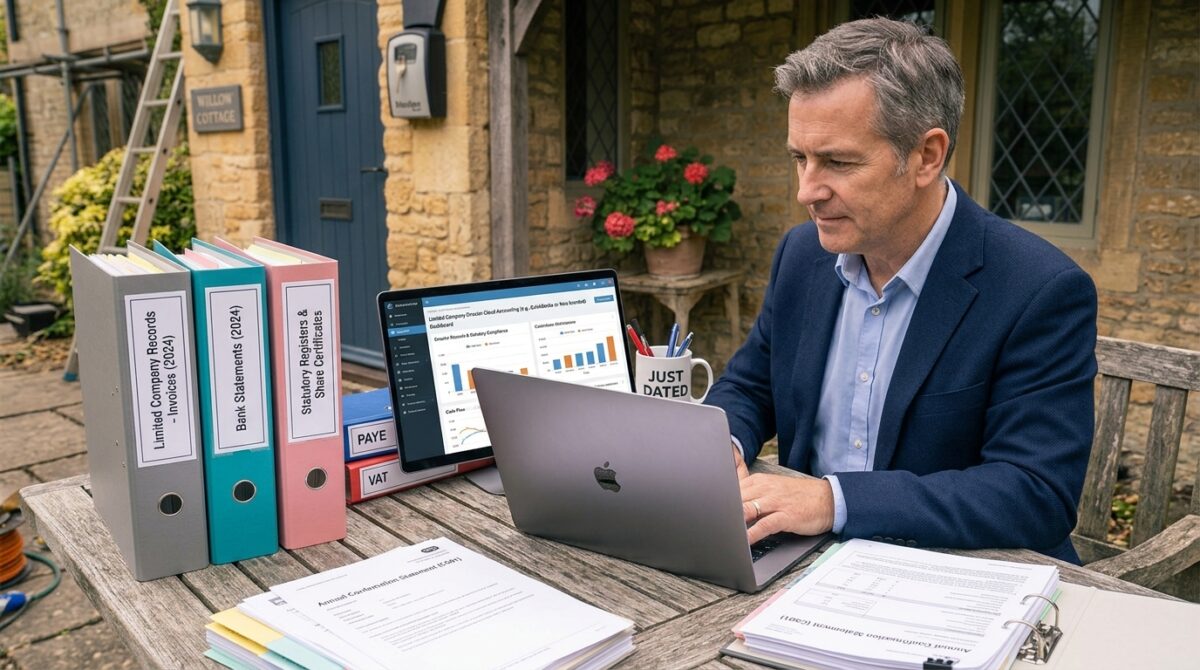
Separately from the statutory registers, companies must keep sufficient accounting records to show and explain the company’s transactions, and to allow accurate financial statements to be prepared. In practice, this generally includes:
- Records of all money received and spent by the company, including the reason for each transaction
- A record of the company’s assets and liabilities, including what the company owns and owes
- Records of goods bought and sold, including invoices issued and received, for companies dealing in goods
- Stock records at the end of each financial year, where the company holds stock
- Details of stocktaking used to arrive at stock figures, where applicable
- Records supporting all business expenses claimed, including receipts and invoices, particularly for allowable limited company expenses
Bank Records
Every limited company should operate through its own dedicated business bank account, entirely separate from any director’s personal finances — this isn’t just good practice, it’s essentially required by the legal separation between a company and its owners. Bank statements form a core part of the accounting record trail, and regular bank reconciliation against your bookkeeping software helps catch errors early rather than at year end.
Director’s Loan Account Records
Where money moves between a director personally and the company outside of salary or dividends — for example, a director lending money to the company, or drawing money that isn’t yet formally declared as salary or dividend — this needs to be tracked carefully through a director’s loan account. Poor record-keeping here is a common source of problems, since an unclear or overdrawn director’s loan account can create unexpected tax charges, both for the company and the director personally.
Payroll Records
If the company has any employees, including directors paid a salary, payroll records need to be maintained separately, covering pay, tax and National Insurance deductions, and the underlying Real Time Information submissions made to HMRC. See our guide on small business payroll explained for what’s involved in running this correctly.
VAT Records, If Registered
VAT-registered companies have an additional layer of record-keeping requirements, including VAT invoices issued and received, and — under Making Tax Digital — digital records maintained through compatible software rather than manual spreadsheets alone. Our Making Tax Digital guide covers what this means in practice.
How Long Do Records Need to Be Kept?
For most companies, accounting records generally need to be retained for at least six years from the end of the relevant accounting period, though this can be longer in specific circumstances — for example, where the company buys something that it expects to last more than six years, such as equipment or property, or if the company is subject to an ongoing HMRC enquiry. It’s a sensible default to retain everything for at least six years even where a shorter minimum might technically apply, given how straightforward digital storage has become.
Choosing a Bookkeeping System
Beyond the legal minimum, most directors find that cloud accounting software, linked directly to the company bank account, makes ongoing compliance considerably easier than manual spreadsheets — particularly for VAT-registered companies needing Making Tax Digital compatibility, and for directors who want an accurate, real-time view of the company’s financial position rather than reconstructing it at year end.
What Happens If Records Aren’t Properly Maintained?
Failing to keep adequate accounting records is a company law offence, and directors can be personally liable for penalties or, in more serious cases, disqualification. Beyond the legal risk, poor records also make it far harder to prepare accurate statutory accounts and tax returns, increase accountancy costs (since more time is spent reconstructing information), and create real problems if the company is ever sold, audited, or subject to an HMRC enquiry.
How Felix Accountants Can Help
We help directors set up bookkeeping systems and statutory record-keeping processes that meet both Companies House and HMRC requirements from day one, whether that’s a fully managed bookkeeping service or guidance to help you manage it confidently yourself. See our wider business tax services for how well-organised records feed into accurate, efficient annual compliance.
Frequently Asked Questions
What’s the difference between statutory records and accounting records?
Statutory records relate to the company’s legal structure — shareholders, directors, and governance decisions. Accounting records relate to the company’s financial transactions, assets and liabilities, used to prepare accounts and tax returns.
How long must a limited company keep its accounting records?
Generally at least six years from the end of the relevant accounting period, though this can be longer in specific circumstances, such as an ongoing HMRC enquiry.
Do I need a separate bank account for my limited company?
Yes, effectively. A company is a separate legal entity from its directors, and its finances should be kept entirely separate from any director’s personal banking.
What is a director’s loan account and why does it need careful records?
It tracks money moving between a director personally and the company outside of formal salary or dividends. Poor record-keeping here can lead to unexpected tax charges if the account becomes unclear or overdrawn.
What happens if a company doesn’t keep proper accounting records?
It’s a company law offence, and directors can be held personally liable. It also makes accurate accounts and tax returns far harder to prepare, and creates problems for any future sale, audit or HMRC enquiry.
Let’s get your company’s records properly organised. Book your free 15-minute consultation with Felix Accountants.