Categories
Articles Blogs FAQs Guides News

How Do I Set Up My Personal Tax Account?

Table of Contents

How Do I Set Up My Personal Tax Account 

  1. What Can I Do with My Personal Tax Account? 
  2. What are the Benefits of setting up a Personal Tax Account? 
  3. Is it easy to Set up My Personal Tax Account in the UK? 
  4. How can I create my personal tax account?
  5. Can mPersonal Tax Account Help Review my National Insurance Record? 
  6. Can my Personal Tax Account Help Review my Employment Records? 
  7. Can Personal Tax Accounts Provide Information on PAYE codes? 
  8. Is your Personal Information Secure? 
  9. How Can I Ensure Nobody Accessed My Account? 
  10. Does HMRC Ask for Personal and Financial Detail? 
  11. Conclusion 
  12. Recent Posts

A personal tax account is an HMRC-initiated system to make the tax system in the UK more efficient and transparent. This system facilitates you to access all your tax-related personal information in one place. Through your tax account, you can solve your tax issues on time by yourself without writing or calling the HMRC. You are probably wondering, how do I set up my personal tax account? 

If you have access to your personal tax account, it means you can save a great deal of your time and energy. You can manage and handle your tax matters in a much better way. The personal tax account system was started in 2015 and it has been a splendid success since then as it saves countless hours by dealing with everything online. Surely, it is for the best that you set up your personal tax account.  

What Can I Do with My Personal Tax Account? 

The list of services for the personal tax account is constantly expanding and growing. Therefore, you can avail of many useful financial services from your personal tax account that include:  

  • Checking income tax code. 
  • Finding the national insurance number. 
  • Organising tax credits. 
  • Claiming a tax refund. 
  • Checking your income tax estimates. 
  • Paying overdue taxes. 
  • Updating or checking your marriage allowance. 
  • Checking the latest updates on the value of the state pension. 
  • Adding a family member or other trustworthy person to manage your account on your behalf. 
  • Viewing your self-assessment tax calculation, which might be helpful in applying for credit.  

If there is any error or miscalculation in anything like details or anything else, you can change it by yourself. This guide will help you comprehend how do I set up my personal tax account

What are the Benefits of setting up a Personal Tax Account? 

The personal tax account system is an attempt by the HMRC to make the taxation system more transparent and efficient. With the use of this taxation system, it becomes easier for you to update the HMRC about the changes to your circumstances, like getting married, having a baby, and changing your address. It enables you to change your child’s benefits circumstances, such as if the child joins or leaves education or training. If you are a parent, then you can keep track of child track credits. you can check or update the benefits you get from your work such as car insurance, or company car details.  

The major benefit of the personal tax account is that everything relating to your tax affairs will be online in one place. Hence, you will not have to spend time finding out different papers to get the details of your taxes.  

Also, creating your personal tax account enables you to monitor your tax-related affairs to make sure that your records are accurate and up to date.  

It is less time-consuming, more transparent, less difficult, more immediate, and entirely paperless. This process does not require lengthy letters but easy texting messages or emails- so you will be doing good for the environment too. Thus, it is an ideal situation.  

Is it easy to Set up My Personal Tax Account in the UK? 

Certainly, it is human nature to envisage every new thing as difficult until becoming familiar with it. But setting up your personal tax account with HMRC is like something easier done than said.  

Setting up a personal tax account is not time-taking or technicalities involving the job at all. According to HMRC, it should only take 5-10 minutes. 

Personal Tax Account

To start with, you must log in to your government gateway account.  

The form online available is itself much easier to follow as it simply involves inputting your information and setting up security protocol. At this stage, the time factor entirely depends on the organization of the paperwork you start with. The more your paperwork is organized, the less time will it takes. Let’s discuss the paperwork you require to understand how I set up my personal tax account.  

What do you need to Apply for the Paperwork?  

  • National insurance number. 
  • Recent pay slip. 
  • UK passport (must be on date) or most recent P60. 
  • Landline number or your mobile number, as part of the two-step security.  
  • Choose the email address you want to attach to the account.  

Now, you have acquired all the needed information to set up your personal account. Just go to the government gateway, and select either individual, (if you represent your own business) or agent (if you represent other people in financial matters to the government) to start the registration process.  

How can I create my personal tax account?

There are a few steps to set up your personal tax account. We share those steps one by one in a largely simplified way.  

1. Registration 

You will need to register online by using this link on the official website of the HMRC to access the personal tax account.  

Click the ‘create sign-in details’ link given below the sign-in button to begin the registration process.  
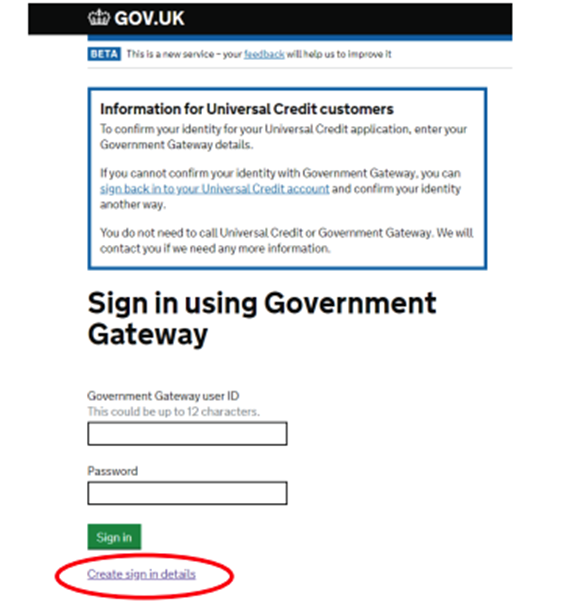
Then you will have to enter your email address. After doing so, select Continue. 
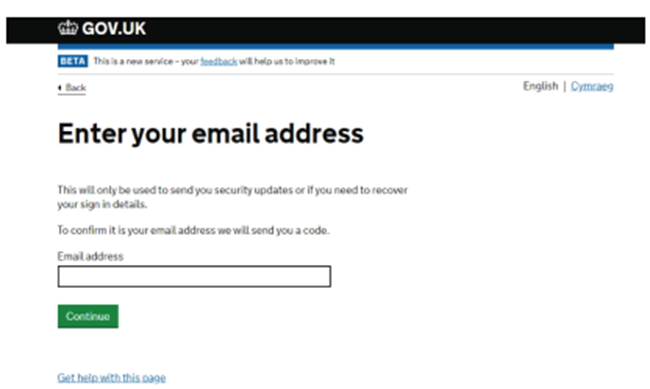
You will receive a code of 6 characters from HMRC at this email address. 
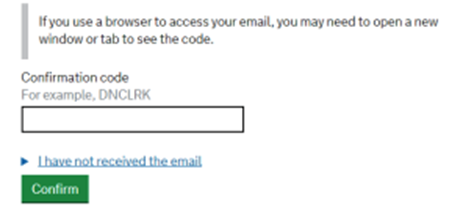
Once you have entered the details in the given box, HMRC will prompt you to enter your full name and create a password. Then you will see your Government Gateway ID number.  

2. Setting up your account 

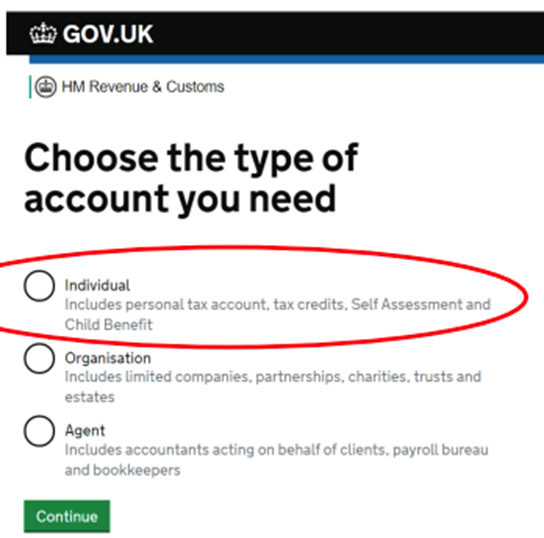
Here the HMRC will ask you to select the type of account you need. Please select “individual” and then click the green button of “continue”.
Now the HMRC will ask you to set up a method to receive an access code. It is important to know that select a method you are quite comfortable with because HMRC will use this method to send you an access code, every time you sign by using your Government Gateway user ID. 
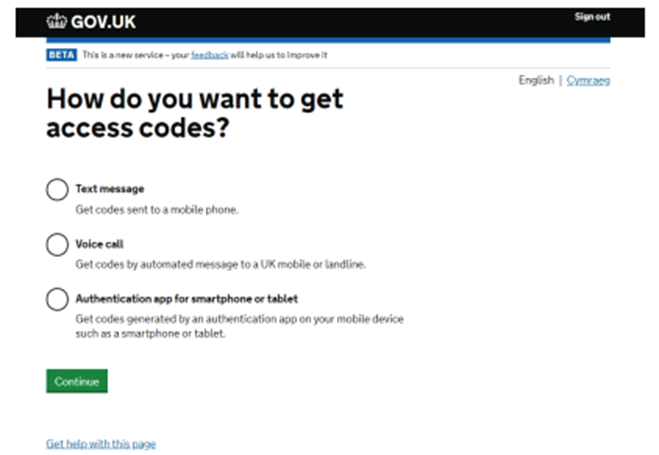
After selecting the method, you are most convenient with, click on the green button of “continue”.  

Then HMRC will ask you to enter the 6 digits access code it has provided you with.  

Kindly, enter the code and then click the green button “continue”.  

Now HMRC will ask you to confirm your identity, please provide the details where asked and then click the green button of “continue”. 
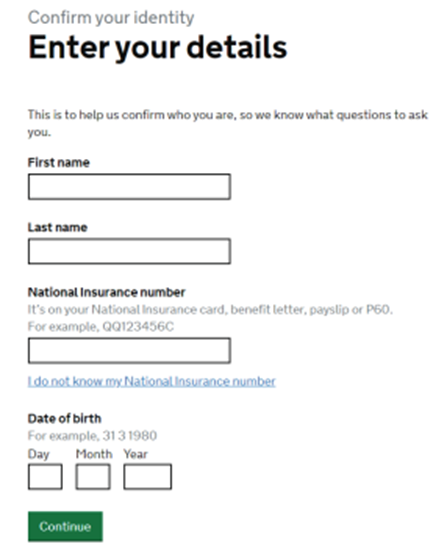
Now HMRC will ask you the way you want your identity o be confirmed by the HMRC. If you are a UK passport holder, you are recommended to use this option.  
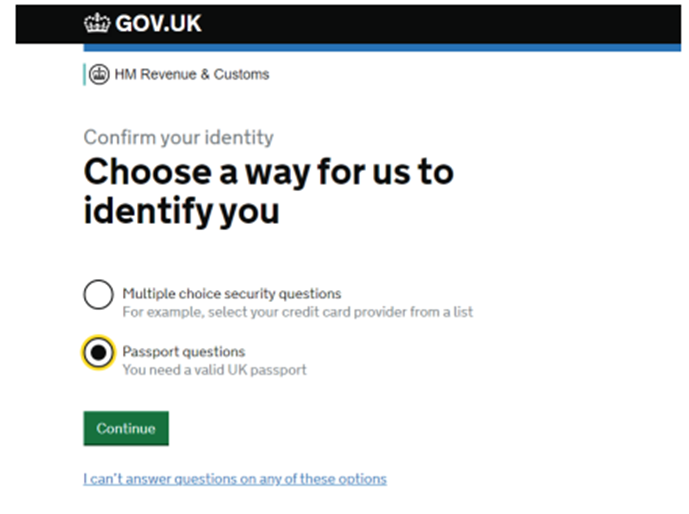
HMRC will ask you to share the same detail you have on your passport. Please enter the required details and then click the green button of “continue”.  

Now HMRC will confirm whether the details you entered are correct and whether the personal tax account has been successfully set up. After its confirmation, you will be asked whether you would like to receive your correspondence regarding your tax affairs electronically or post via your Personal Tax Account. please select the option which is most suitable to you and select the green “continue” button.  Now you will be taken to the Personal Tax Account home page.  

3. Recovering Login Details 

If you have previously used the online services of the government Gateway or HMRC to submit your tax returns electronically via the website of HMRC. You must log in by using those account details. But if you have forgotten the details of those accounts then please select one of the links given at the bottom of the sign-in page depending on the details you need to recover.  
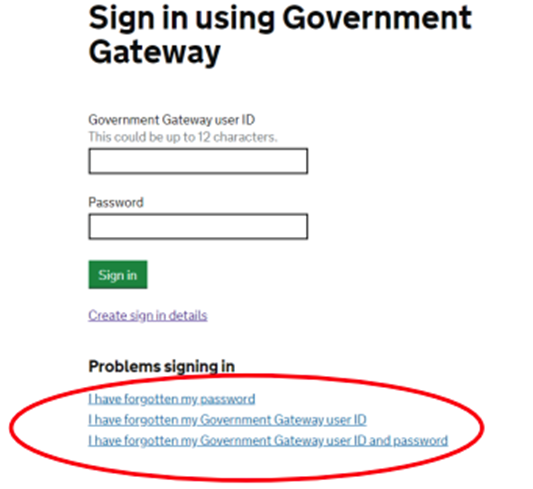
Now HMRC will take you, according to its process to recover your Government Gateway user ID or password. 

If you face any difficulty with the process, you can easily contact HMRC for help.  

Safety and security with your Personal Tax Account 

After completing the registration procedure, you are the only person to have access to your personal tax account with your user ID and password.  

Therefore, that answers your question, how do I set up my personal tax account? 

Can my Personal Tax Account Help Review my National Insurance Record? 

When it comes to reviewing your National Insurance record, your personal tax account can be particularly helpful. You can easily review your national insurance record that covers your entire working history by accessing your personal tax account. Reviewing your National Insurance record helps you ensure that your entire record is accurate and up to date. It also identifies any gaps in your contributions that might need to be addressed.  

After that, when you reach the pension age, you can ensure that you have the correct credits to receive a full pension. If you find any discrepancies and gaps, the best option is to contact HMRC for investigation.  

Can my Personal Tax Account Help Review my Employment Records? 

Yes, your personal tax account gives you the additional benefit of reviewing your employment records.  

It’s another benefit is that if you cannot obtain a copy of your P60 from your employer, you get it from your personal tax account. Once you understand how I set up my personal tax account, you can move forward with these steps.  

Can Personal Tax Accounts Provide Information on PAYE codes? 

Another useful feature of a personal tax account is that it enables you to view the PAYE codes use applied to your employment.  

Moreover, you also have the option to modify your PAYE code directly from your personal tax account.  

Is your Personal Information Secure? 

When it comes to security, HMRC takes it seriously and uses firewall protection for all its systems. This is like a bulwark to provide maximum protection for your information because its detective capacity is strong enough to detect any unauthorized entry. All the data that you share with HMRC is encrypted and nobody can see your data except yourself.  

Furthermore, you also must be conscious and vigilant of your online safety. Avoid sharing your user ID or password with anybody. If you cannot remember it and want to note it down, then ensure to keep it in a discrete place. Surely, you now have a clear idea of how I set up my personal tax account

How Can I Ensure Nobody Accessed My Account? 

One of the easiest ways, you must know whether someone accessed your account or not is the security measure of the system that shows you the time and date you logged into your personal tax account. Check this list frequently, if see any such thing that does not look right, immediately contact HMRC through their website.  

Another safety measure built into the system is automatic logging out of your account if it is not active after 15 minutes. If you are forgetful, don’t worry, the system will secure your account. 

Does HMRC Ask for Personal and Financial Detail? 

It is important to know, and HMRC often emphasizes to be mindful of the procedure of HMRC that it does not ask for any personal or financial details by email, phone, or text. Always be on watch to protect yourself from the scammer, if notice any such thing as suspicious, report it to the HMRC, even if you have not lost anything. Undoubtedly, it is in your best interest to do so.   

Shortly speaking, setting up a personal tax account offers a wide range of benefits by saving you a great deal of energy and time that you can utilize in something more productive and creative.  You can easily check state pensions, national insurance contributions, and many other tax affairs online without standing in long queues on helplines or doing related paperwork. It keeps you updated and informed about your tax status. And through it, you can also keep HMRC timely updated and informed about your circumstances. Most importantly, your financial information is safe and secure. 

FAQs

How do I activate my UTR number?

If your UTR (Unique Taxpayer Reference) is inactive, you can reactivate it by:

  1. Contacting HMRC – Call the Self Assessment helpline and request reactivation.
  2. Providing Personal Details – You may need to confirm your full name, address, National Insurance number, and date of birth.
  3. Waiting for Confirmation – HMRC will confirm reactivation, usually via letter or phone.

How to check income tax?

You can check your income tax by:

  1. Logging into your HMRC Personal Tax Account – View your tax payments, liabilities, and tax code.
  2. Using the HMRC App – Check your tax status on the go.
  3. Contacting HMRC – If you have queries about your tax records, call them for assistance.

How to file income tax?

To file your income tax return:

  1. Register for Self Assessment if you haven’t already.
  2. Gather Necessary Documents – Income records, expenses, and other tax-related details.
  3. Complete Your Tax Return – Log in to your HMRC account and fill out the SA100 form.
  4. Submit Before the Deadline – The deadline for online submissions is usually 31 January.

How do I create a UTR account?

To get a UTR number:

  1. Register for Self Assessment with HMRC.
  2. Provide Personal Information – Full name, address, date of birth, and National Insurance number.
  3. Wait for UTR to Arrive – It is usually sent by post within 10 working days in the UK.

How do I check if my UTR is active?

You can check if your UTR is active by:

  1. Logging into your HMRC account to view your Self Assessment status.
  2. Calling HMRC – Provide your UTR and ask if it is active.

How to set up self-employed?

  1. Register with HMRC for Self Assessment.
  2. Keep Records of your income and business expenses.
  3. Submit Your Tax Returns Annually to pay the correct amount of tax and National Insurance.

How do I check my UTR online?

You can find your UTR number by:

  1. Logging into your HMRC account – Your UTR is listed in your tax documents.
  2. Checking Previous HMRC Letters – It appears on tax returns and payment reminders.

How do I check my active tax status?

  1. Use Your HMRC Personal Tax Account – Check your tax payments and liabilities.
  2. Contact HMRC – If you’re unsure about your status, they can confirm it.

How long does it take to get a UTR?

HMRC usually issues a UTR within 10 working days if you’re in the UK or 21 days if you’re abroad.

How much money do you have to make as a self-employed person?

If you earn over £1,000 per tax year from self-employment, you must register with HMRC and file a tax return.

How do self-employed get money?

Self-employed individuals earn money by:

  • Charging clients/customers directly for services.
  • Selling products online or in-store.
  • Receiving payments through invoices, bank transfers, or platforms like PayPal.

How can I make money from home self-employed?

Options for making money from home include:

  • Freelancing – Writing, graphic design, programming, etc.
  • E-commerce – Selling on platforms like eBay, Etsy, or Amazon.
  • Affiliate Marketing – Promoting products for commissions.
  • Online Courses – Teaching skills through platforms like Udemy or Teachable.

How to earn $1,000 per day from home?

Earning $1,000 per day requires high-income skills or scalable businesses:

  • Dropshipping or E-commerce – Selling trending products online.
  • Stock Trading or Cryptocurrency – Requires experience and risk management.
  • Freelance Consulting – High-ticket services like business coaching.
  • Online Courses & Digital Products – Selling valuable knowledge at scale.

What is the fastest way to become self-employed?

  1. Identify a skill or service you can offer immediately.
  2. Register as self-employed with HMRC.
  3. Find clients through online platforms like Fiverr, Upwork, or LinkedIn.
  4. Start small and reinvest earnings to grow your business.

How to earn money from Google at home?

Google offers multiple ways to make money:

  • Google AdSense – Earn from ads on a blog or YouTube channel.
  • Google Play Store – Develop and sell apps.
  • Google Opinion Rewards – Get paid for surveys.
  • YouTube Partner Program – Monetize videos through ads and memberships.

click here for more

Categories
News

Last-Minute Tax Savings for the 2025-26 Tax Year: The Definitive Guide for Small Businesses

With the end of the tax year rapidly approaching, many business owners in the UK find themselves in a race against the clock. At Felix & Co. Chartered Accountants we are all about tax savings and we know that the difference between a “good” financial year and a “great” one often comes down to the small, strategic moves made in these final weeks.

Whether you are running a limited company, operating as a sole trader, or simply looking to protect your personal wealth, the 2025-26 tax year offers several avenues for relief. However, these opportunities disappear after April 5th. This guide breaks down the essential steps you must take to ensure you aren’t leaving money on the table.

1. Limited Company Strategies: Dividends and Payroll

If you are a limited company director, your remuneration strategy is one of your most powerful tax-saving tools.

The Dividend Allowance

Every individual has a dividend allowance. For the current tax year, it is vital to ensure you have utilized your £500 dividend allowance. If you haven’t drawn this amount yet, doing so before the deadline allows you to take that income tax-free. For further details on how dividends are taxed, you can refer to the HMRC Guidance on Tax on Dividends.

Director’s Payroll and Trivial Benefits

Reviewing your salary levels is equally important. Ensure your salary is optimized for National Insurance purposes while remaining tax-efficient. Additionally, don’t forget Trivial Benefits. Directors can receive non-cash gifts (up to £50 each, capped at £300 annually for directors of “close” companies) that are exempt from tax and NI. You can check the eligibility criteria at the HMRC Employment Income Manual on Trivial Benefits.

Expert Tip: If you’re feeling overwhelmed by the paperwork, check out our Last-Minute Tax Saving Checklist for Small Business Owners for a streamlined workflow.

Dividend and Trivial Benefits (Limited Company Owners) - - Tax Saving


2. Capital Investments and Equipment

The end of the tax year is the ideal time to look at your business’s physical needs. If you were planning to upgrade your office technology, machinery, or vehicles in the summer, consider bringing those purchases forward.

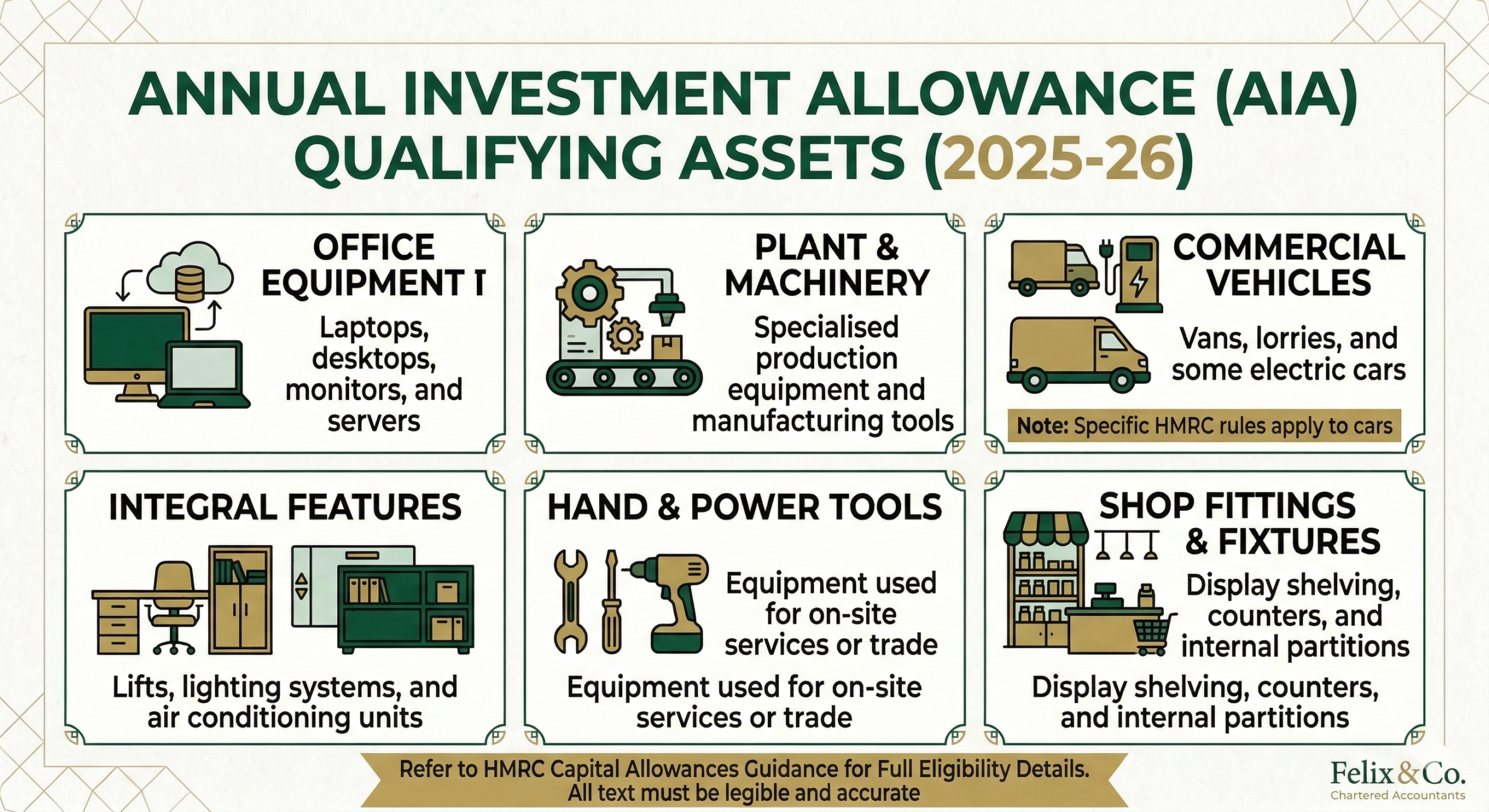
Under the Annual Investment Allowance (AIA), most businesses can claim 100% tax relief on qualifying plant and machinery investments. By making these purchases before the tax year ends, you can reduce your taxable profits for this period rather than waiting another year to see the benefit. View the full list of qualifying items on the HMRC Capital Allowances page.

Annual Investment Allowance (AIA) - Tax Saving


3. The Shift to ‘Making Tax Digital’ (MTD)

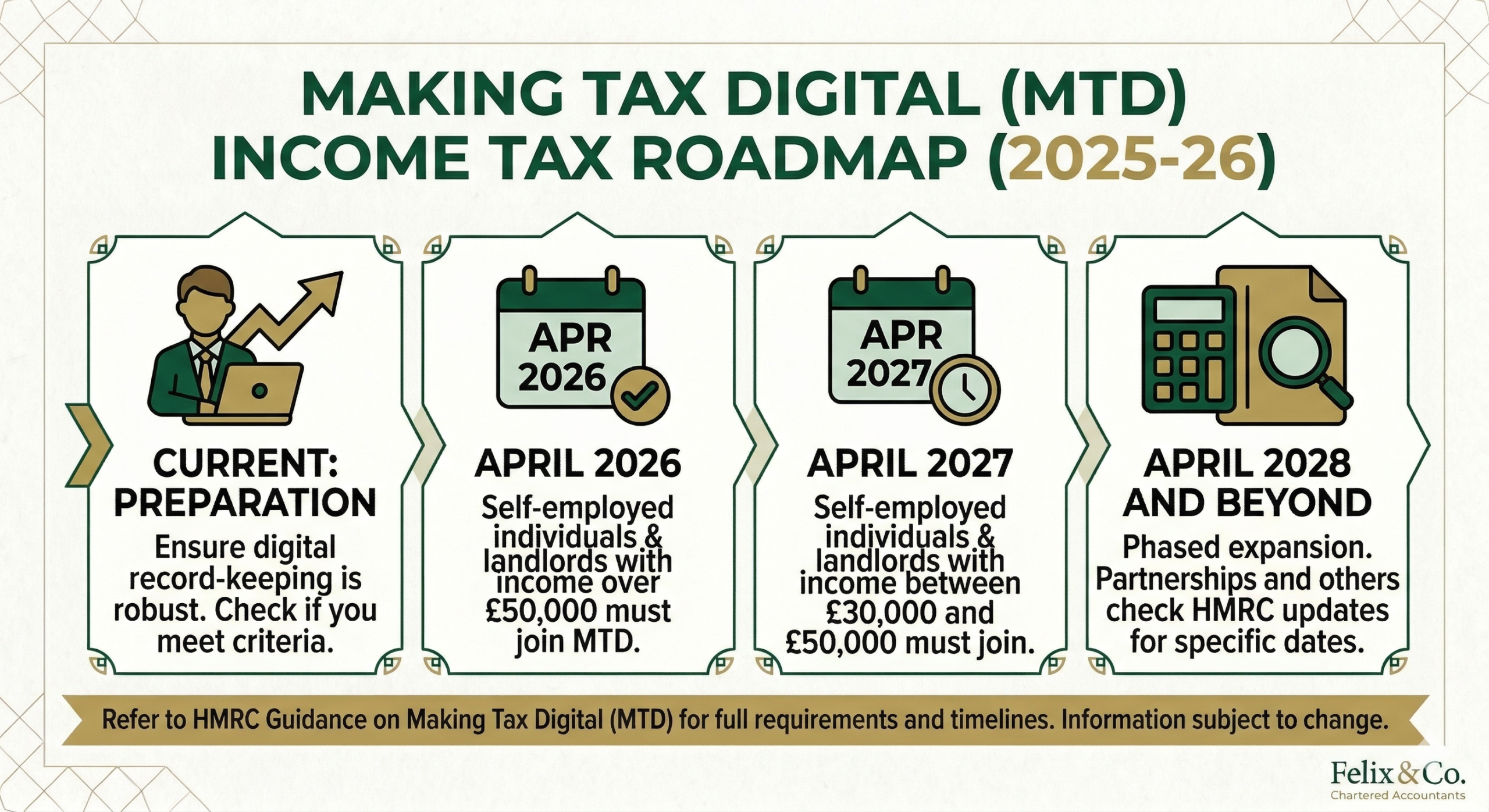
Digital transformation is no longer optional. Under the new HMRC roadmap, many landlords and sole traders are now required to report their income quarterly.

If your income exceeds the current thresholds, you must ensure your record-keeping is compliant with MTD-compatible software. Failing to transition can lead to penalties. You can check if you are required to join the scheme via the HMRC Making Tax Digital overview.

Making Tax Digital (MTD) Roadmap - Tax Saving


4. Personal Tax Planning: Protecting Your Wealth

Tax planning isn’t just for your business; it’s for your household.

Personal Allowances and ISA Limits

Most UK taxpayers have a standard Personal Allowance of £12,570, which is the amount of income you do not have to pay tax on. Furthermore, ensure you have maximized your ISA (Individual Savings Account) allowance. You can save up to £20,000 across various ISAs each year, and any interest or capital gains earned within the ISA are tax-free. Learn more at HMRC’s Individual Savings Accounts (ISAs) guide.

Capital Gains and Gift Aid

  • Capital Gains Tax (CGT): Consider using your annual CGT allowance. If you have assets (like shares or property) that you intend to sell, doing so before the deadline could utilize this year’s tax-free threshold.

  • Gift Aid: Donations to charity are not only a social good but also tax-efficient. If you are a higher-rate taxpayer, you can claim back the difference between the tax the charity recovers and the higher rate of tax you paid. Details are available on the HMRC Tax relief when you donate to a charity page.


5. Marriage Allowance and Family Claims

Are you and your partner making the most of your joint status? The Marriage Allowance allows you to transfer a portion of your unused personal allowance to your husband, wife, or civil partner, potentially reducing their tax bill by up to £252.

 The Marriage Allowance Transfer - Tax Saving   

Additionally, high-income households should review any Child Benefit claims. If one partner earns over a certain threshold, the High Income Child Benefit Charge may apply. Use the HMRC Child Benefit Tax Calculator to see how this affects you.


Don’t Wait Until April 6th

The “Heelan Herald” recently noted that this time of year is hectic, but speaking with an advisor is the only way to ensure you are maximizing these benefits. At Felix & Co., we specialize in helping small businesses in Maidenhead and beyond navigate these complexities with ease.

Ready to secure your tax savings?

Don’t leave your financial health to chance. Book a consultation with our expert team today to review your 2025-26 position.

👉 Book Your 30-Minute Tax Review via Calendly


Frequently Asked Questions (FAQs)

What is the deadline for the 2025-26 tax year? The UK tax year ends on April 5th, 2026. All investments, dividend payments, and pension contributions must be processed by this date to count toward the 2025-26 period.

How much can I put into my pension to save on tax?

Most people can contribute up to £60,000 (the Annual Allowance) into their pension and receive tax relief, provided it doesn’t exceed their total earnings. You can verify your specific limits on the HMRC Pension Tax Relief page.

Can I still claim the Marriage Allowance if we are retired?

Yes, as long as one of you has an income below the Personal Allowance and the other is a basic-rate taxpayer.

What happens if I miss the Making Tax Digital deadline? HMRC has a points-based penalty system for late submissions and payments. It is best to switch to compatible software as soon as possible to avoid these charges.


Contact Felix & Co. Chartered Accountants

Address: Belix House, 19 Raymill Road East, Maidenhead, SL6 8SW

Phone: 01895 348 097 | Mobile: 07877 284 111

Email: accounts@felixaccountants.com

Categories
News

Prompted vs. Unprompted: How Coming Forward Voluntarily Saves You Thousands

If you are a landlord with undeclared rental income, you are standing at a digital crossroads. On one path, you wait for HMRC to find you; on the other, you step forward first. In the world of UK tax, the label HMRC attaches to your disclosure—“Prompted” or “Unprompted”—is the single biggest factor in determining whether your penalty is a slap on the wrist or a financial catastrophe.

At Felix Accountants, we help landlords navigate the Let Property Campaign (LPC). Our goal is always to secure “Unprompted” status for our clients, as this simple distinction can save you tens of thousands of pounds in unnecessary fines.

1. The Definitions: What’s the Difference?

The distinction between these two terms is simpler than it sounds, but the timing is everything.

What is an Unprompted Disclosure?

An unprompted disclosure occurs when you tell HMRC about a tax irregularity before they have any reason to believe you have a problem. You are the one who initiates the conversation. Even if you only come forward because you heard about HMRC’s “Connect” system in the news, as long as they haven’t contacted you yet, it is unprompted.

What is a Prompted Disclosure?

A disclosure is “prompted” if you only come forward after HMRC has contacted you. This includes receiving a “nudge letter,” a notification of a compliance check, or a formal tax enquiry. HMRC’s view is that you aren’t being “honest”; you are simply “getting caught.”

2. The Penalty Gap: A Financial Comparison

HMRC uses a sliding scale for penalties based on your behavior and the “quality” of your disclosure. The difference between moving first (Unprompted) and moving second (Prompted) is stark.

Behaviour Category Unprompted Penalty Range Prompted Penalty Range
Reasonable Care 0% 0% – 30%
Careless 0% – 30% 15% – 30%
Deliberate 20% – 70% 35% – 70%
Deliberate & Concealed 30% – 100% 50% – 100%

Note: For offshore property income, penalties can reach as high as 200%.

The Real-World Impact:

Imagine you owe £20,000 in back-tax from a “Careless” error.

  • Unprompted: With a good accountant, we can often negotiate this down to 0%, meaning you pay just the tax and interest.

  • Prompted: You are guaranteed a minimum penalty of 15% (£3,000), plus the tax and interest.

3. Why the “Quality of Disclosure” Matters

Even within those ranges, your final penalty depends on three factors HMRC calls “Helping, Telling, and Giving.”

  1. Telling: Did you fully explain the error?

  2. Helping: Did you calculate the tax accurately?

  3. Giving: Did you provide all the bank statements and records requested?

By being unprompted and providing a “high-quality” disclosure via Felix Accountants, you give HMRC very little room to charge anything above the minimum.

4. The “Connect” Threat: Why You Can’t Wait

In 2026, the window for unprompted disclosures is closing fast. HMRC’s Connect system is now fully integrated with:

  • The Land Registry: They know when you buy or sell.

  • Letting Agents: They receive annual lists of all landlords and the rent they collect.

  • Digital Platforms: Airbnb and Booking.com share host data directly with HMRC.

  • Bank Interest: HMRC sees the interest you earn on your savings, which often flags “extra” wealth.

Once the system flags you and a nudge letter is printed, you lose the ability to make an unprompted disclosure. You have effectively “lost” the 0% penalty option.

5. Benefits of the Unprompted Let Property Campaign

Beyond just the lower fines, moving voluntarily through the LPC offers:

  • No “Naming and Shaming”: HMRC maintains a public list of “Deliberate Tax Defaulters.” By coming forward voluntarily, you almost always avoid being added to this list.

  • Immunity from Prosecution: While not a legal “guarantee,” HMRC rarely pursues criminal charges against those who make a full, honest, unprompted disclosure.

  • Control of the Narrative: You get to explain the situation first, rather than defending yourself against HMRC’s assumptions.

6. How Felix Accountants Secures the Best Outcome

When you choose to disclose voluntarily, we don’t just send a cheque. We build a comprehensive Case for Leniency:

  • Technical Analysis: We determine if your error was “Careless” or “Reasonable,” rather than “Deliberate.”

  • Statutory Interest Calculation: We ensure you aren’t overpaying on interest.

  • Representation: We act as your formal agent, meaning HMRC speaks to us, not you.

Frequently Asked Questions (FAQs)

Q1: I received a “Nudge Letter” yesterday. Is it too late for an unprompted disclosure?

Technically, yes. Once the letter arrives, the disclosure is “prompted.” However, by responding immediately and using the Let Property Campaign correctly, we can still argue for the absolute minimum of the prompted penalty range.

Q2: Can I be unprompted if I only disclose some of my properties?

No. A disclosure must be “Full and Complete.” If you disclose one property but hide another, and HMRC finds the second one later, they will view the entire disclosure as “Deliberate and Concealed,” which carries the highest penalties.

Q3: What if I didn’t know I had to pay tax?

This is often classed as “Careless” or “Failure to Notify.” If it’s unprompted, we can often get the penalty down to 0% or 10% by showing that it was a genuine misunderstanding of the rules.

Q4: Does unprompted disclosure take longer?

No. The process is identical: you notify HMRC, and then you have 90 days to submit the figures. The only difference is the “Unprompted” flag on your file, which makes the final bill much smaller.

Q5: Will HMRC audit my other business interests if I disclose my rental income?

Generally, no. The Let Property Campaign is a “ring-fenced” disclosure facility. While HMRC reserves the right to look elsewhere, if your LPC disclosure is professional and accurate, they usually accept it and close the file.

Don’t Wait for the Nudge

The difference between an Unprompted and Prompted disclosure is often the difference between a manageable settlement and financial ruin. If you know your tax affairs aren’t up to date, now is the time to act.

Contact Felix Accountants today. Let’s get your unprompted disclosure started before HMRC finds you.

Start My Voluntary Disclosure

Categories
News

Moving In With a Partner? The Tax Traps of Renting Your First Home

For many, moving in with a partner is a major romantic milestone. It often leads to a practical question: “What do we do with my flat?” If you decide to keep your original home and rent it out, you have officially joined the ranks of the “Accidental Landlord.”

While it seems like a straightforward way to cover your mortgage or build an investment, renting out your former residence triggers a series of tax obligations that many people overlook until they receive a “nudge letter” from HMRC. At Felix Accountants, we see hundreds of couples who didn’t realize that a simple change in living arrangements could lead to complex tax filings and potential penalties.

Here is everything you need to know about the tax implications of renting your first home when you move in with a partner.

1. Income Tax: Your New “Second Job”

The moment a tenant pays you rent, you have started a business in the eyes of HMRC.

The £1,000 Property Allowance

If your total rental income is less than £1,000 per year, you generally don’t need to do anything. However, for most landlords renting out a whole property, income will far exceed this.

Registering for Self Assessment

If your rental income is over £1,000, you must register for Self Assessment. You must notify HMRC by 5 October following the tax year in which you started receiving rent.

  • Example: If you moved in with your partner and started renting your flat in September 2025, you must register by 5 October 2026.

How Much Tax Will You Pay?

Rental profit is added to your other income (like your salary).

  • Basic Rate (20%): Total income between £12,571 and £50,270.

  • Higher Rate (40%): Total income between £50,271 and £125,140.

  • Additional Rate (45%): Total income over £125,140.

2. The Mortgage Interest Trap (Section 24)

Ten years ago, landlords could deduct their full mortgage interest from their rental income before paying tax. This is no longer the case.

You now pay tax on the full amount of rent minus “allowable expenses” (like insurance and repairs). You then receive a 20% tax credit for your mortgage interest.

  • The Risk: If you are a higher-rate taxpayer (40%), you are still paying 40% tax on the income used to pay the mortgage but only getting 20% back in relief. This can lead to situations where your “cash flow” is positive, but you are actually losing money after tax.

3. Stamp Duty (SDLT): The Cost of the “Next” Home

If you move in with your partner but decide to buy a new home together while keeping your old one, you will likely hit the Stamp Duty Surcharge.

In 2026, if you own one property (your original home) and buy another, the new purchase is considered an “additional dwelling.” This triggers a 5% surcharge on top of the standard Stamp Duty rates. On a £400,000 house, this surcharge alone adds £20,000 to your moving costs.

The 36-Month Refund: If you sell your original home within 36 months of buying the new one, you can usually claim a refund of that 5% surcharge.

4. Capital Gains Tax (CGT): Losing Your Relief

While you live in your home, it is exempt from Capital Gains Tax thanks to Private Residence Relief (PRR). However, the moment you move out and rent it, that exemption starts to “tarnish.”

When you eventually sell the property:

  • You get relief for the years you lived there as your main home.

  • You get relief for the final 9 months of ownership, even if you weren’t living there.

  • The remaining period (the rental years) is taxable.

The Rate: In 2026, CGT on residential property is 18% for basic rate taxpayers and 24% for higher rate taxpayers.

5. Don’t Forget the “Consent to Let”

Technically not a tax, but a legal must: You must notify your mortgage lender. Renting out a property on a standard residential mortgage without Consent to Let is a breach of contract. Lenders may increase your interest rate or demand immediate repayment if they find out via HMRC data sharing.

6. How the Let Property Campaign Can Help

If you moved in with a partner years ago and haven’t declared the rent, the Let Property Campaign (LPC) is your best solution. It allows “Accidental Landlords” to come forward voluntarily.

  • Lower Penalties: Because the mistake was likely an oversight (Careless) rather than a deliberate attempt to cheat, we can often negotiate 0% or very low penalties.

  • Catching Up: We can help you file for multiple years at once, ensuring you are fully compliant before you buy your next home together.

Frequently Asked Questions (FAQs)

Q1: My partner and I aren’t married. How does that affect the tax?

If the property is in your name only, the income is 100% yours for tax purposes. If you own it jointly, the income is usually split 50/50. Being unmarried means you can’t use “Form 17” to shift income to the lower-earner as easily as married couples can.

Q2: Can I deduct the cost of the new furniture I bought for the tenants?

No. You cannot deduct the initial cost of furniture. However, you can claim Replacement of Domestic Items Relief when you eventually replace those items (like a broken sofa or fridge).

Q3: What if my rental income doesn’t cover my mortgage?

You may still owe tax. Because you can’t deduct the full mortgage payment (only the interest, and only as a 20% credit), you can have a “taxable profit” even if your bank account shows a loss each month.

Q4: Does HMRC really know if I’m renting out my old flat?

Yes. HMRC’s “Connect” system tracks Land Registry changes and matches them against the electoral roll and Tenancy Deposit Schemes. If you are registered to vote at your partner’s house but still own your old flat, a “nudge letter” is often inevitable.

Q5: I only plan to rent it for a year. Do I still need to tell HMRC?

Yes. There is no minimum time limit. If you earn over £1,000 in a tax year, it must be reported.

Don’t Let Your “New Start” Be Ruined by Old Tax

Moving in together should be an exciting time, not a source of future legal stress. If you’ve recently become an accidental landlord, let Felix Accountants review your numbers and handle the HMRC registration for you.

Get an Accidental Landlord Tax Review

Categories
News

Inherited Property: Is Your Rental Income Taxable if Used for Care Fees?

When a family member passes away or moves into full-time residential care, the practicalities of managing their home can be overwhelming. One of the most common solutions we see at Felix Accountants is for families to rent out the property to cover the significant costs of care home fees. Care home rent tax.

There is a widespread misconception that because the money is going directly to a “good cause”—like a nursing home—the income is not taxable. Unfortunately, in the eyes of HMRC, rental income is taxable regardless of how the profit is spent. This article clarifies the tax position for executors and beneficiaries to ensure you don’t inadvertently create a new tax debt while trying to care for a loved one.

1. The “Common Sense” Myth vs. Tax Reality

Many families assume that if the care home fees are £3,000 a month and the rent is £1,500 a month, there is “no profit” and therefore no tax.

The Tax Reality: Care home fees are considered a personal living expense, not a business expense. Just as you cannot deduct your own grocery bill or rent from your salary before paying tax, you cannot deduct care home fees from rental income.

  • Example: If you receive £18,000 in rent over a year and have £2,000 in allowable property expenses (insurance, repairs), your taxable profit is £16,000. It does not matter if all £16,000 was paid to a nursing home; you still owe tax on that profit.

2. Who is Responsible for the Tax?

The person or entity responsible for paying the tax depends on the current legal status of the property.

Scenario A: The owner is still alive but in care

If your parent or relative is still the legal owner, the rental income belongs to them.

  • The Process: They (or you, via Power of Attorney) must file a Self Assessment tax return in their name.

  • The Benefit: They still get their Personal Allowance (£12,571). If their only other income is a small state pension, much of the rental income might fall within their tax-free threshold.

Scenario B: The owner has passed away (The Probate Period)

If the owner has died but the property hasn’t been legally transferred to the beneficiaries yet, the property belongs to the “Deceased’s Estate.”

  • The Process: The Executor is responsible for reporting the income.

  • The Tax Rate: Estates do not get a Personal Allowance. Rental income is usually taxed at a flat 20% basic rate from the first pound of profit.

Scenario C: You have inherited the property

Once the property is transferred into your name, the income is yours.

  • The Process: You must report the income on your own Self Assessment return. The tax rate will depend on your other earnings (20%, 40%, or 45%).

3. The Danger of “Power of Attorney” Errors

We often help clients like “Adam,” who had Power of Attorney for his father. Adam rented out his father’s house to pay for a nursing home and assumed that because he wasn’t personally keeping the money, he didn’t need to tell HMRC.

The Risk: HMRC’s “Connect” system sees the property is being rented. If no tax return is filed, they will eventually issue a “nudge letter.” If the owner is elderly or incapacitated, this can create a stressful legal situation for the family. Using the Let Property Campaign is the safest way to correct these historical oversights.

4. Allowable Expenses: What You Can Deduct

While you cannot deduct the care fees, you can deduct legitimate property costs to lower the tax bill:

  • Letting Agent Fees: Management and finders’ fees.

  • Maintenance & Repairs: Fixing a leaky roof or broken boiler (but not “improvements” like an extension).

  • Property Insurance: Landlord-specific policies.

  • Utility Bills: If paid by the landlord during void periods.

  • Accountancy Fees: The cost of preparing the rental accounts.

5. Inheritance Tax (IHT) and the “Care Fee Debt”

If the local authority is paying for care via a Deferred Payment Agreement (DPA), they are essentially placing a loan against the house.

  • When the person passes away, this “debt” is deducted from the value of the estate before Inheritance Tax is calculated.

  • However, the rental income earned while the person was alive remains subject to Income Tax. You cannot offset the IHT debt against the Income Tax bill.

6. How Felix Accountants Can Help

Managing the affairs of a relative in care is emotionally draining. The last thing you need is a dispute with HMRC. We provide:

  • Estate Tax Management: We handle the filings for executors during probate.

  • LPC Disclosures: If you’ve been renting a relative’s home for years without realizing it was taxable, we can use the Let Property Campaign to settle the history with minimum penalties.

  • Power of Attorney Support: we work with Attorneys to ensure the donor’s tax affairs are kept in perfect order.

Frequently Asked Questions (FAQs)

Q1: Is there any “Care Home Relief” for property tax?

No. There is no specific relief in the UK tax code that allows rental income to be tax-free simply because it pays for care.

Q2: What if the property is held in a Life Interest Trust?

In this case, the “Life Tenant” (the person in care) is usually entitled to the income. The trustees are responsible for ensuring the tax is paid, but it is typically taxed at the Life Tenant’s rates.

Q3: Can I split the income with my siblings to use our Personal Allowances?

Only if you all legally own a share of the property. If the property is still in your parent’s name, the income must be reported as theirs. If you have inherited it jointly, the income is split according to your ownership shares.

Q4: We are selling the house to pay the care fees. Do we pay tax on the rent in the meantime?

Yes. Even if you only rent the property for six months while waiting for a sale, that income must be declared if it exceeds the £1,000 allowance.

Q5: Does HMRC find out about inherited properties?

Yes. HMRC receives data from the Probate Office and the Land Registry. If a property changes hands and then appears on a rental site or has a tenant deposit registered, the “Connect” system will flag it.

Compassionate, Expert Tax Support

Dealing with care fees is difficult enough without a surprise tax bill. If you are managing a relative’s property, let Felix Accountants take the tax burden off your shoulders.

Book a Consultation for Estate/Care Property

Categories
News

The Non-Resident Landlord Guide: How Overseas Owners Can Use the LPC

Living abroad doesn’t mean you’re out of reach for HM Revenue & Customs (HMRC). In fact, in 2026, the digital trail left by overseas landlords is easier than ever for the UK tax office to follow. Whether you’re a UK expat working in Dubai, a retiree in Spain, or a foreign investor, if you receive income from a UK property, you generally owe UK tax. Expat Tax Rules

Many overseas landlords mistakenly believe that because they pay tax in their country of residence, or because their UK letting agent deducts tax at source, they have no further obligations. At Felix Accountants, we specialize in the Non-Resident Landlord Scheme (NRLS) and helping overseas owners regularize their past through the Let Property Campaign (LPC).

1. What is the Non-Resident Landlord Scheme (NRLS)?

The NRLS is a tax regulation designed to ensure HMRC gets its cut of rental income from landlords whose “usual place of abode” is outside the UK (typically staying abroad for 6 months or more).

Under the scheme, there are two ways tax is collected:

  1. Withholding at Source: Your letting agent (or your tenant, if they pay over £100/week) must deduct 20% basic rate tax from your rent and pay it directly to HMRC.

  2. Gross Payment: You can apply to HMRC using Form NRL1 to receive your rent in full. If approved, you are responsible for paying the tax yourself via a Self Assessment tax return.

The Common Trap: Receiving rent “gross” does not mean the rent is tax-free. It simply means you’ve promised HMRC you will handle the paperwork yourself. If you receive rent gross but fail to file a return, you are in breach of the scheme.

2. Why Overseas Landlords are “High Risk” for HMRC

In 2026, HMRC’s Connect system is linked to global exchange agreements. HMRC now receives data from banks in over 100 countries. If you are transferring funds from a UK letting agent to an overseas account, or if you have a UK mortgage but a foreign address, the system flags you.

Common reasons overseas landlords fall behind:

  • Assuming the Letting Agent handles it: They only deduct 20%; they don’t file your personal tax return or claim your personal allowance.

  • Double Taxation Confusion: Thinking you only pay tax where you live. (Most treaties state property income is taxed first in the country where the property is located).

  • The “Mortgage Wash” Myth: Thinking that if the rent just covers the mortgage, there is no profit to declare.

3. How the Let Property Campaign Works for Expats

If you’ve realized you have years of undeclared UK income, the Let Property Campaign (LPC) is your best route to safety. It is open to non-resident individuals (but not companies or trusts).

The Advantage for Expats:

If you come forward voluntarily, we can often argue that being “out of the country” or “confused by international rules” constitutes Reasonable Care or a Non-Deliberate error.

By using the LPC, you can:

  • Secure lower penalties (often 0% to 20%).

  • Avoid a formal, intrusive tax enquiry that might look into your other global assets.

  • Clean up your UK record before you decide to sell the property or move back.

4. Capital Gains Tax: The “Exit” Trap

If you are an overseas landlord looking to sell your UK property in 2026, you face a strict Non-Resident Capital Gains Tax (NRCGT) regime.

  • You must report the sale to HMRC within 60 days of completion.

  • You must pay the tax within that same 60-day window.

  • The Problem: If your rental income history isn’t clean, HMRC may hold up the sale or use the sale notification to trigger an audit of the last 20 years of rent.

Using the Let Property Campaign before you list the property for sale is a vital strategic move.

5. Claiming Your Personal Allowance

Even as a non-resident, many people (including UK citizens and EEA nationals) are still entitled to the UK Personal Allowance (£12,571 in 2026).

  • If your UK rental profit is £10,000, and you have no other UK income, you owe £0 in tax.

  • However, you must still file a return to claim this allowance. If your agent has been deducting 20% tax, you can actually use your tax return to claim a refund of every penny they took.

6. How Felix Accountants Supports Global Landlords

Distance shouldn’t be a barrier to compliance. We offer a digital-first service for overseas clients:

  • Remote Consultation: Video calls in your time zone.

  • Digital Disclosure: We handle the entire LPC submission through HMRC’s Digital Disclosure Service.

  • NRL1 Applications: We help you apply to receive rent gross for the future.

  • Refund Management: If you’ve overpaid via withholding tax, we get your money back.

Frequently Asked Questions (FAQs)

Q1: I pay tax in the USA/Dubai/Australia. Do I still pay in the UK?

Yes. The UK has the “primary taxing right” on UK land. You pay the UK first. You can then usually claim a “Foreign Tax Credit” in your home country so you don’t pay twice on the same money.

Q2: My tenant pays me directly into my UK bank account. Does HMRC know?

Highly likely. In 2026, banks share “suspicious activity” reports and data on large regular transfers with HMRC. Furthermore, the Land Registry records show you own the house but aren’t living there.

Q3: Can I use the LPC if I own the property through a BVI or Jersey company?

No. The Let Property Campaign is for individuals only. Non-resident companies must use a different disclosure route and are subject to UK Corporation Tax.

Q4: I haven’t lived in the UK for 10 years. How far back will they look?

If the failure to disclose was “Careless,” they look back 6 years. If they deem it “Deliberate” (because you knew the rules but ignored them), they can go back 20 years.

Q5: Will using the LPC affect my immigration status or visa?

Usually, no. HMRC is a separate department from the Home Office. In fact, having “clean” tax affairs is often a requirement for many visa renewals and citizenship applications.

Protect Your UK Investment from Abroad

Don’t let an administrative oversight in the UK turn into a global legal headache. Whether you owe tax or are due a refund, Felix Accountants will bridge the gap between you and HMRC.

Book a Global Expat Consultation

Categories
News

The £7,500 Limit: When Your Lodger Income Triggers a Tax Bill

In 2026, with the cost of living remaining high, more UK homeowners than ever are turning to the Rent-a-Room Scheme. It’s a fantastic government incentive that allows you to earn a significant amount of tax-free income by letting out a furnished room in your main home.

However, there is a “magic number” you need to watch: £7,500. Go even a penny over this gross limit, and your tax position changes instantly. At Felix Accountants, we help live-in landlords navigate this threshold to ensure they stay compliant without overpaying. Here is the essential guide to the £7,500 limit.

1. How the Rent-a-Room Scheme Works in 2026

The scheme is designed for “resident landlords.” To qualify:

  • The property must be your only or main residence.

  • The room must be furnished.

  • You can be an owner-occupier or a tenant (as long as your lease allows sub-letting).

The Automatic Exemption

If your total gross receipts from lodgers are £7,500 or less per tax year, the income is tax-free. You don’t even need to tell HMRC about it unless you are already filing a Self Assessment tax return for other reasons.

2. What Counts Towards the £7,500?

A common mistake landlords make is thinking only the “rent” counts. In the eyes of HMRC, your gross receipts include everything the lodger pays you:

  • Base Rent: The monthly fee for the room.

  • Utility Contributions: If the lodger pays a share of the gas, electricity, or Wi-Fi.

  • Services: Any extra charges for laundry, cleaning, or providing meals.

Example: If you charge £600 a month in rent and £50 for bills, your annual gross receipts are £7,800. Even though your “profit” might be low, you have officially exceeded the £7,500 threshold.

3. The “Joint Owner” Trap: £3,750

If you own your home jointly with a spouse, partner, or friend, the £7,500 allowance is split equally.

  • Each person has a tax-free limit of £3,750.

  • This applies regardless of how you actually split the money. If you have one lodger paying £6,000 a year, and the property is jointly owned, you both have exceeded your individual £3,750 limits and must both file a tax return.

4. You’ve Gone Over £7,500: What Happens Next?

If you exceed the limit, you must complete a Self Assessment tax return. You then have two ways to calculate your tax:

Method A: The Rent-a-Room Method (Best for low expenses)

You pay tax only on the amount above £7,500. You cannot deduct any expenses (like repairs or utilities) because the £7,500 allowance is designed to cover them.

  • Example: Income is £9,000. You pay tax on £1,500.

Method B: The Actual Profit Method (Best for high expenses)

You ignore the Rent-a-Room scheme and pay tax on your actual profit (Total Income minus Actual Expenses).

  • Example: Income is £9,000, but you spent £3,000 on a new boiler for the lodger’s room and increased utility bills. Your profit is £6,000. In this case, Method B is better because you pay tax on £6,000 instead of the £7,500 “excess.”

    Rent-a-Room Scheme
    Rent-a-Room Scheme

5. Using the Let Property Campaign for Lodger Income

If you’ve had a lodger for several years and only just realized you were over the £7,500 limit, don’t panic. The Let Property Campaign (LPC) isn’t just for whole-house rentals; it’s also the perfect tool for live-in landlords to “catch up.”

  • Voluntary Disclosure: By coming forward via the LPC before HMRC finds you (perhaps via Airbnb data sharing), you can secure the lowest possible penalties.

  • Multiple Years: We can help you look back at your history, determine which years you were over the limit, and settle the total bill in one go.

6. How Felix Accountants Optimizes Your Lodger Tax

We don’t just “file your taxes”—we strategize.

  • Yearly Election: We calculate both Method A and Method B every year to see which saves you more. You can switch between them annually!

  • Expense Tracking: We help you identify “allowable expenses” you might have missed if you choose Method B.

  • HMRC Correspondence: If you receive a nudge letter regarding Airbnb or lodger income, we take over the communication.

Frequently Asked Questions (FAQs)

Q1: Can I use the Rent-a-Room scheme for an Airbnb?

Yes, provided the room is in your main home and you are living there during the guest’s stay. If you rent out a separate, self-contained annex or a second home, you cannot use this scheme.

Q2: Can I claim the £1,000 Property Allowance as well?

No. You cannot use both the Rent-a-Room relief and the £1,000 Property Allowance against the same income.

Q3: What if I have two lodgers?

The £7,500 limit is per property, not per lodger. If two lodgers pay you £5,000 each, your total income is £10,000, and you are over the limit.

Q4: My lodger is a “Monday to Friday” worker. Does the limit still apply?

Yes. The nature of the stay doesn’t matter, as long as the room is in your main home and furnished.

Q5: I share the house with my partner, but the mortgage is only in my name. Is the limit £7,500 or £3,750?

If you are the sole legal owner and the rent is paid to you, you usually get the full £7,500 allowance. If your partner starts receiving a share of the income, the limit splits to £3,750 each.

Don’t Let a Spare Room Become a Tax Burden

Having a lodger should be a financial help, not a source of stress. If you think you might be close to or over the £7,500 limit, Felix Accountants can help you crunch the numbers.

Book a Lodger Tax Review

Categories
News

4, 6, or 20 Years? How HMRC Decides How Far Back to Audit Your Property

When landlords realize they have undeclared rental income, the first question they ask is usually: “How many years of back-tax am I going to have to pay?” There is a common misconception that HMRC can only look back at the last few years. In reality, the “statute of limitations” for Tax Look-back is flexible. In 2026, under the Let Property Campaign (LPC), the length of your “look-back” period depends entirely on your behaviour. HMRC categorizes your actions into three buckets: Reasonable Care, Careless, and Deliberate.

At Felix Accountants, we specialize in analyzing your history to ensure you only pay for the years legally required. Here is a breakdown of the 4, 6, and 20-year rules.

1. The 4-Year Rule: “Reasonable Care”

If you can prove that you took reasonable care but still made a mistake, HMRC is limited to looking back only 4 years.

What defines “Reasonable Care”?

HMRC acknowledges that tax is complicated. You might fall into this category if:

  • You sought advice from a professional that turned out to be incorrect.

  • You made an honest mathematical error despite keeping good records.

  • You reasonably believed you didn’t owe tax (e.g., your expenses legitimately wiped out your profit, but you didn’t realize you still had to file a nil return).

The Result: You pay the tax and interest for the last 4 years, and often, you can negotiate a 0% penalty.

2. The 6-Year Rule: “Careless” Behaviour

The most common category for “accidental landlords” is Careless Behaviour. This applies if you failed to tell HMRC about your rental income because you didn’t check the rules, but you weren’t trying to hide the money.

Examples of Careless Behaviour:

  • You moved in with a partner and rented your old flat but “forgot” to tell HMRC.

  • You assumed your letting agent was paying your tax for you.

  • You didn’t keep proper records and guessed your figures.

The Result: HMRC can go back 6 years. Penalties for an unprompted disclosure in this category typically range from 0% to 30%.

3. The 20-Year Rule: “Deliberate” or “Failure to Notify”

This is the most serious category. If HMRC believes you knew you had a tax obligation and chose to ignore it, or if you failed to notify them that you had started a rental business, they can go back 20 years.

What defines “Deliberate” Behaviour?

  • You intentionally kept rental income out of your tax returns to pay less tax.

  • You provided false information to HMRC or concealed records.

  • You have been a landlord for a decade but never registered for Self Assessment.

The Result: You must disclose every year of income for the last two decades. Penalties for deliberate acts are much higher, ranging from 20% to 100% (and up to 200% if the income involves offshore accounts).

4. The “Offshore” Exception: The 12-Year Rule

In 2026, there is a specific mid-tier rule for landlords who live abroad or have overseas rental property. If an error involves offshore income or gains, and it was “Careless” or even if “Reasonable Care” was taken, HMRC has a standard look-back period of 12 years. The only way to stick to 4 or 6 years in an offshore context is to prove a very specific “reasonable excuse.”

5. How Behaviour Impacts Your Penalty (The “Felix” Strategy)

At Felix Accountants, our job is to act as your advocate. HMRC will often start by assuming a landlord was “Deliberate” to maximize the tax collected. We counter this by:

  • Evidence-Based Arguments: We present your “Reasonable Excuse” (e.g., serious illness, bereavement, or reliance on a trusted family member) to move you from the 20-year bracket to the 6 or 4-year bracket.

  • Proactive Disclosure: By using the Let Property Campaign voluntarily, we demonstrate that you are not “concealing” income, which is the strongest defense against the 20-year rule.

    Tax Look-back
    Tax Look-back
Behaviour Assessment Period Penalty (Unprompted)
Reasonable Care 4 Years 0%
Careless 6 Years 0% – 30%
Deliberate 20 Years 20% – 70%
Deliberate & Concealed 20 Years 30% – 100%

6. Can HMRC Find Me After 20 Years?

Many landlords think, “I’ve been doing this for 15 years and haven’t been caught yet; surely I’m safe?” In the digital age, the answer is no. HMRC’s Connect system has a “long memory.” When you eventually sell the property, the Land Registry data from 20 years ago will be cross-referenced with your tax history. If there’s a 20-year gap where you owned a second property but paid no tax, an investigation is highly likely at the point of sale.

Frequently Asked Questions (FAQs)

Q1: What if my rental business made a loss 5 years ago?

If you made a legitimate tax loss in a specific year (e.g., due to major repairs), that year does not “count” toward your liability, though it still falls within the look-back window. We can often use those losses to offset profits in later years.

Q2: My father died and left me a rental property he never declared. How many years do I pay?

For deceased estates, the rules are slightly different. Usually, HMRC is limited to looking back 6 years prior to the date of death, provided the executors settle the matter promptly.

Q3: Does the 20-year rule apply if I simply didn’t know the law?

HMRC generally argues that “ignorance of the law is no excuse.” However, if we can show you had a “Reasonable Excuse” for not knowing (such as being given bad advice by a previous accountant), we can often fight to keep the period to 6 years.

Q4: If I come forward now, can I choose which years to pay?

No. An LPC disclosure must be “full and complete.” You cannot “cherry-pick” years. If you disclose 5 years but HMRC finds you’ve been a landlord for 15, they will reject your disclosure and open a fraud investigation.

Q5: Will HMRC ask for bank statements from 20 years ago?

If you are in the 20-year bracket and don’t have records, we use “Reasonable Estimations.” We can use historic rental averages and ONS data to recreate your accounts in a way that HMRC will accept.

Know Your Years, Protect Your Future

Determining your “behaviour” is the most technical part of a tax disclosure. Don’t guess and end up paying for 20 years when you only owed 6.

Contact Felix Accountants today. We will review your history and ensure your disclosure is handled with the correct look-back period.

Book my 4-6-20 Year Review

Categories
News

HMRC ‘Connect’: How Big Data is Finding Undeclared Landlords in 2026

For decades, many landlords believed that if they didn’t use a letting agent or if their tenants paid in cash, they were “invisible” to the tax man. In 2026, that era is officially over.  HMR Revenue & Customs (HMRC) now utilizes one of the most sophisticated data-mining systems in the world: HMRC Connect. This software is the engine behind the thousands of “nudge letters” being sent to UK property owners. At Felix Accountants, we want our clients to understand how this technology works so they can appreciate the urgency of the Let Property Campaign (LPC).

1. What is the Connect System?

Connect is an AI-powered data warehouse that holds over 55 billion items of data. It doesn’t just store information; it “crawls” through dozens of different databases to find “inconsistencies” in your lifestyle versus your declared income.

In 2024-25 alone, this system helped HMRC recover an extra £4.6 billion in underpaid tax. By 2026, its reach has expanded to include real-time feeds from digital platforms and international banks.

2. Where Does the Data Come From?

Connect creates a “web” of your financial life by pulling from over 30 different sources:

  • The Land Registry: Every property purchase, sale, and mortgage charge is logged here.

  • Stamp Duty Records: HMRC knows exactly how much you paid for your second home.

  • Letting Agent Returns: Letting agents are legally required to provide annual lists of their landlord clients.

  • Digital Platforms (Airbnb/Booking.com): Since 2024, these platforms have shared host income, booking numbers, and property locations directly with HMRC.

  • Tenancy Deposit Schemes: If you protect a deposit (as required by law), you have just created a digital record of your tenancy.

  • Council Tax & Electoral Roll: If you are registered to vote at Address A but own Address B, and Address B has a different person paying council tax, Connect flags a potential rental.

  • Social Media Scrapping: In 2026, HMRC uses AI to monitor public social media for “lifestyle indicators.” A landlord posting about luxury holidays while declaring a £5,000 annual profit may trigger an audit.

3. The “Inconsistency” Flag: How You Get Targeted

HMRC doesn’t need “proof” to send you a nudge letter; they only need an anomaly.

Example Scenario:

  1. Source A (Land Registry): Shows you bought a second flat in Bristol in 2022.

  2. Source B (Bank): Shows regular monthly deposits of £1,200 labeled “Flat 2.”

  3. Source C (Tax Return): Shows zero rental income declared.

Connect automatically cross-references these three points. The system then generates a “nudge letter” or, in more serious cases, assigns an investigator to open a Compliance Check.

HMRC Connect AI
HMRC Connect AI

4. Making Tax Digital (MTD) 2026: The Next Level

As of April 2026, the reporting rules have tightened even further. Landlords with a gross rental income over £50,000 must now use Making Tax Digital for Income Tax (MTD IT).

  • You must keep digital records of every penny of rent and every expense.

  • You must send quarterly updates to HMRC using compatible software.

  • The Impact: This moves property tax from an “annual event” to a “real-time” surveillance system. If you aren’t already compliant for past years, the start of MTD makes your history much more likely to be scrutinized.

5. Can You “Opt-Out” of the Big Data Search?

Short of selling your properties and closing your bank accounts, you cannot opt-out of HMRC’s data gathering. The UK has also signed up to the Common Reporting Standard (CRS), meaning even if your rental income is in an overseas bank account, that bank is likely sending your data back to the UK.

The only way to “stop” an investigation before it starts is to make a Voluntary Disclosure.

6. How Felix Accountants Uses This Information to Help

Because we understand the “Connect” logic, we can help you:

  • Pre-emptive Audits: We can look at your bank statements and Land Registry records exactly how HMRC does to find “red flags” before they do.

  • Accurate Disclosures: When we submit your Let Property Campaign disclosure, we ensure it matches the digital footprint HMRC already has. Disclosing less than what Connect shows is the fastest way to trigger a full-scale fraud investigation.

  • Future Compliance: We set you up with MTD-compliant software so your digital records are “audit-proof” moving forward.

Frequently Asked Questions (FAQs)

Q1: Does HMRC really look at my Instagram or Facebook?

HMRC has confirmed they use AI to monitor social media as part of investigations into suspected tax fraud. While they don’t look at every landlord’s holiday photos, they use it to verify “lifestyle” claims during a formal enquiry.

Q2: My tenant pays me in cash. Am I safe from Connect?

Not necessarily. Even if there’s no bank trail, Connect sees the Land Registry ownership and the fact that a different person is paying Council Tax at that address. The “absence” of income where a property is clearly being lived in is itself a red flag.

Q3: How far back does the “Connect” data go?

HMRC has been building this database since 2010. They have over a decade of historical records that can be searched at any time.

Q4: I use an Airbnb but I’m under the £7,500 Rent-a-Room limit. Will I be flagged?

You might still receive a nudge letter because Airbnb reports the “gross” income. If you receive a letter, don’t ignore it; we can help you respond to HMRC explaining that your income is covered by the Rent-a-Room relief.

Q5: Is it better to wait for HMRC to contact me?

Absolutely not. Once Connect triggers a letter, you move from “Unprompted” to “Prompted” status, which instantly increases your potential penalties by 15-30%.

Don’t Let the AI Find You First

In 2026, tax evasion is a “data problem” that HMRC is winning. If you have undeclared property income, the Let Property Campaign is your only legal exit ramp.

Get my ‘Connect’ Risk Assessment

Categories
News

Mortgage Interest & Maintenance: Maximize Your Expenses in an LPC Disclosure

When you are making a historical disclosure via the Let Property Campaign, you aren’t just telling HMRC about the rent you received; you are also claiming the deductions you were entitled to over those years. Rental Tax relief.

At Felix Accountants, our expertise lies in identifying every possible “allowable expense” to ensure you only pay tax on your actual profit, not your gross turnover. In a 2026 disclosure, navigating the complex rules of Section 24 mortgage interest and the “Repair vs. Improvement” debate is where thousands of pounds can be saved.

1. The Section 24 “Mortgage Interest” Trap

Since 2020, the way landlords claim mortgage relief has changed fundamentally. You can no longer deduct mortgage interest from your rental income to reduce your taxable profit. Instead, you receive a 20% Tax Credit.

How it works in your disclosure:

If you are disclosing for years after 2020:

  1. We calculate your tax on your full rental income (minus maintenance and fees).

  2. We then take 20% of your mortgage interest and subtract that figure from your total tax bill.

The Impact: If you are a higher-rate (40%) taxpayer, you are effectively “losing” 20% of the relief you used to get. However, for many “accidental landlords” who remain in the basic rate band, the 20% credit still covers the full interest cost.

2. Maintenance: Is it a “Repair” or an “Improvement”?

This is the most contested area in any HMRC disclosure.

  • Repairs (Revenue Expenses): These are deductible from your rental income now.

  • Improvements (Capital Expenses): These cannot be used in your LPC disclosure. Instead, they are saved to reduce your Capital Gains Tax when you sell the property.

Item Classification Tax Treatment
Fixing a broken boiler Repair Deduct from Rent (LPC)
Repainting between tenants Repair Deduct from Rent (LPC)
Replacing broken windows Repair Deduct from Rent (LPC)
Building an Extension Improvement Deduct from Sale (CGT)
Installing a New Conservatory Improvement Deduct from Sale (CGT)
Upgrading a Kitchen Improvement* Deduct from Sale (CGT)

*Note: If you replace an old kitchen with a “like-for-like” modern equivalent, it is often treated as a repair. If you upgrade from laminate to granite or add more cupboards, it becomes an improvement.

3. The “Wholly and Exclusively” Rule

To be deductible in your disclosure, an expense must be incurred “wholly and exclusively” for the purposes of the property business.

  • Allowable: Letting agent fees, landlord insurance, Gas Safety certificates, and accountancy fees for the disclosure itself.

  • Partial: If you use your car to visit the property, we can claim 45p per mile for those specific journeys.

  • Not Allowable: Your personal phone bill (unless you have a dedicated “landlord” line) or clothing bought for DIY work.

4. Replacement of Domestic Items Relief (RDIR)

In your disclosure, we can claim for the cost of replacing furnishings and appliances provided for the tenant’s use. This includes:

  • Movable furniture (beds, sofas).

  • Household appliances (fridges, washing machines).

  • Floor coverings and curtains.

Crucial Rule: You can only claim the cost of the replacement, not the initial purchase of the first item you put in the house.

Rental Tax relief.
Rental Tax relief

5. Maximizing Your “Pre-Letting” Expenses

Many landlords spend thousands fixing up a property before the first tenant moves in.

  • If the work was to fix “wear and tear” from the previous owner so it was in a fit state to rent, these are often Capital (Improvement) costs.

  • However, if the work was “revenue” in nature (decorating, minor repairs), we can often claim these as “Pre-trading expenses” provided they were incurred within 7 years of the rental start date.

6. How Felix Accountants Adds Value

In an LPC disclosure, every £1,000 of expenses we find could save you up to £400 in tax and £100 in penalties.

  1. Historical Record Reconstruction: We help you dig through old bank statements to find forgotten costs.

  2. Aggressive (but Legal) Deduction: We ensure you claim the maximum mileage and home-office allowances.

  3. Interest & Penalty Mitigation: By lowering the “tax gap” through expenses, the interest and penalties automatically decrease.

Frequently Asked Questions (FAQs)

Q1: I don’t have receipts from 4 years ago. Can I still claim?

Yes. HMRC accepts “Reasonable Estimates” if you can show a bank transfer or a clear need for the work (e.g., a plumber’s visit showing on a statement without the invoice).

Q2: Can I claim my own time if I did the DIY work myself?

No. You can only claim for the cost of materials. You cannot “charge” your own business for your labor.

Q3: Are letting agent fees deductible?

Absolutely. 100% of management fees, finders’ fees, and inventory costs are deductible from your rental income before tax is calculated.

Q4: What about the “Property Allowance”?

You have a £1,000 tax-free property allowance. If your total expenses are less than £1,000, it is usually better to just claim this “flat rate” rather than counting individual receipts.

Q5: Can I deduct my mortgage capital repayments?

No. Only the interest element of your mortgage payment qualifies for the 20% tax credit. The part of your payment that pays off the loan itself is not a tax-deductible expense.

Lower Your Disclosure Bill Today

Don’t pay more than you legally owe. A specialist review of your expenses is the most effective way to reduce the cost of your Let Property Campaign settlement.

Start My Expense Audit

Categories
News

The 90-Day Clock: How to Prepare Your Documentation for an LPC Submission

Once you notify HMRC of your intent to join the Let Property Campaign (LPC), the countdown begins. You are issued a unique Disclosure Reference Number (DRN) and a Payment Reference Number (PRN), and you have exactly 90 days to calculate your figures, submit your disclosure, and pay the balance. Tax Disclosure.

At Felix Accountants, we call this the “Execution Phase.” The 90-day window sounds generous, but when you are dealing with years of missing bank statements and complex tax rules, time disappears quickly. Here is your roadmap to a successful submission.

1. The Timeline: Notification to Settlement

The LPC is a structured process. Missing the 90-day deadline can result in HMRC rejecting your disclosure and opening a formal (and much more expensive) enquiry.

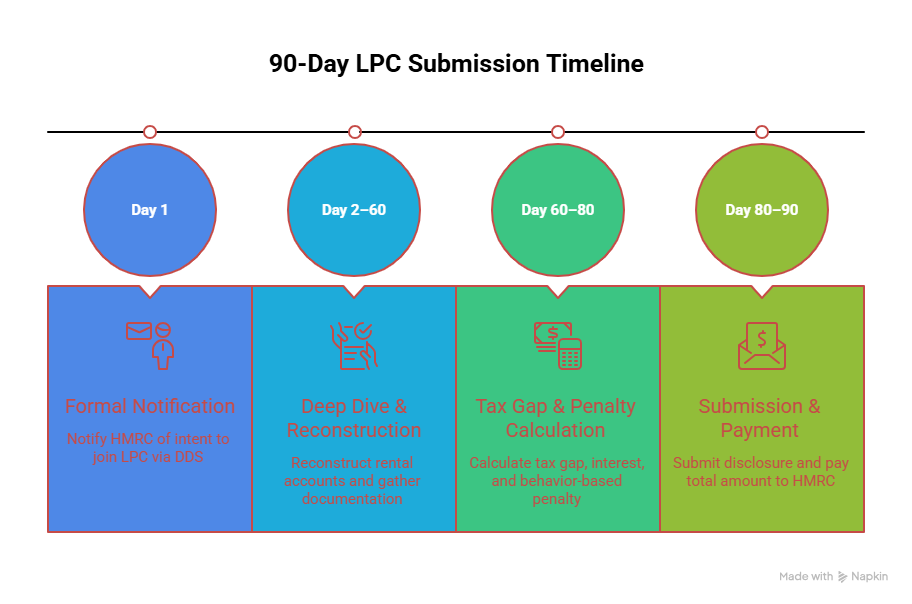
  • Day 1: Formal Notification via the Digital Disclosure Service (DDS).

  • Day 2–60: The “Deep Dive.” This is when we reconstruct your rental accounts.

  • Day 60–80: We calculate the “Tax Gap,” statutory interest, and the behavior-based penalty.

  • Day 80–90: Formal submission of the disclosure and payment of the total amount.

2. Essential Documentation Checklist

To make an accurate disclosure, we need to move beyond “estimates” wherever possible. You should begin gathering:

  • Income Records: Tenancy agreements, letting agent annual statements, or bank statements showing rent deposits.

  • Expense Evidence: Invoices for repairs, insurance certificates, management fee statements, and utility bills for void periods.

  • Mortgage Data: Annual mortgage interest certificates (usually provided by your lender every January).

  • Other Income Info: Your P60 or P11D (if employed) or self-employed accounts. Your rental tax is determined by your total income, so we need the full picture to apply the correct tax bands.

3. Dealing with Missing Records

What if you don’t have bank statements from six years ago?

  • Bank Requests: Most banks can provide historic statements for a small fee, though this can take 2–3 weeks (hence the urgency).

  • Reasonable Estimates: If records are truly lost, HMRC allows for “Best Estimates.” We can use local rental market data and average maintenance costs for your property type to build a defensible set of figures.

  • The Narrative: We must include a note in your disclosure explaining why records are missing and how we reached our estimates.

4. Calculating the “Add-Ons”: Interest and Penalties

Your disclosure isn’t just about the tax. HMRC expects you to “Self-Assess” two other figures:

Statutory Interest

This is not a penalty; it is compensation to the government for not having the money on time. Interest rates for late tax have risen significantly in 2025 and 2026. We use specialized software to calculate interest from the date the tax should have been paid to the current date.

The Penalty Offer

You must make a “Formal Offer” of a penalty. As discussed in previous articles, this is based on your behavior:

  • Reasonable Care: 0%

  • Careless (Unprompted): 0% – 30%

  • Deliberate (Unprompted): 20% – 70%

5. Making the “Formal Offer”

A unique feature of the LPC is that it is a Contractual Tax Disclosure
. When we submit the form, we are making a “Formal Offer” to pay a specific amount. If HMRC accepts this offer, it becomes a legally binding contract that prevents them from re-opening those specific years in the future (provided your disclosure was honest).

Tax Disclosure

6. What If You Can’t Pay Everything on Day 90?

If the final bill is larger than expected, do not wait until Day 90 to tell HMRC. * We can negotiate a “Time to Pay” (TTP) arrangement.

  • HMRC is generally more open to payment plans (spreading the cost over 6–12 months) if the request is made as part of a voluntary disclosure.

Frequently Asked Questions (FAQs)

Q1: Can I submit the disclosure before the 90 days are up?

Yes. You can submit as soon as your figures are ready. In fact, submitting early reduces the amount of statutory interest you have to pay.

Q2: What happens if I miss the 90-day deadline?

HMRC may remove you from the campaign. This means you lose the “favourable terms” and lower penalties. They may then open a formal enquiry into your affairs.

Q3: Does HMRC check every single disclosure?

HMRC “reviews” every submission. If your figures look sensible and match their “Connect” data, they usually issue an acceptance letter within 30–60 days. If the figures look suspiciously low, they will ask for evidence.

Q4: Do I need to send my receipts to HMRC with the disclosure?

No. You don’t send the receipts with the form, but you must keep them for 6 years after the disclosure. HMRC can ask to see your “working papers” at any time during that period.

Q5: Can Felix Accountants handle the payment for me?

You usually pay HMRC directly using your PRN (Payment Reference Number). However, we ensure you have the exact bank details and references to ensure your payment is allocated correctly to your disclosure.

Beat the Crock with Felix Accountants

The 90-day window is the final hurdle to tax peace of mind. Let Felix Accountants take the lead on the calculations and the paperwork, so you can focus on the future of your property investment.

Start My 90-Day Disclosure Process