Categories
Articles Blogs FAQs Guides News

How Do I Set Up My Personal Tax Account?

Table of Contents

How Do I Set Up My Personal Tax Account 

  1. What Can I Do with My Personal Tax Account? 
  2. What are the Benefits of setting up a Personal Tax Account? 
  3. Is it easy to Set up My Personal Tax Account in the UK? 
  4. How can I create my personal tax account?
  5. Can mPersonal Tax Account Help Review my National Insurance Record? 
  6. Can my Personal Tax Account Help Review my Employment Records? 
  7. Can Personal Tax Accounts Provide Information on PAYE codes? 
  8. Is your Personal Information Secure? 
  9. How Can I Ensure Nobody Accessed My Account? 
  10. Does HMRC Ask for Personal and Financial Detail? 
  11. Conclusion 
  12. Recent Posts

A personal tax account is an HMRC-initiated system to make the tax system in the UK more efficient and transparent. This system facilitates you to access all your tax-related personal information in one place. Through your tax account, you can solve your tax issues on time by yourself without writing or calling the HMRC. You are probably wondering, how do I set up my personal tax account? 

If you have access to your personal tax account, it means you can save a great deal of your time and energy. You can manage and handle your tax matters in a much better way. The personal tax account system was started in 2015 and it has been a splendid success since then as it saves countless hours by dealing with everything online. Surely, it is for the best that you set up your personal tax account.  

What Can I Do with My Personal Tax Account? 

The list of services for the personal tax account is constantly expanding and growing. Therefore, you can avail of many useful financial services from your personal tax account that include:  

  • Checking income tax code. 
  • Finding the national insurance number. 
  • Organising tax credits. 
  • Claiming a tax refund. 
  • Checking your income tax estimates. 
  • Paying overdue taxes. 
  • Updating or checking your marriage allowance. 
  • Checking the latest updates on the value of the state pension. 
  • Adding a family member or other trustworthy person to manage your account on your behalf. 
  • Viewing your self-assessment tax calculation, which might be helpful in applying for credit.  

If there is any error or miscalculation in anything like details or anything else, you can change it by yourself. This guide will help you comprehend how do I set up my personal tax account

What are the Benefits of setting up a Personal Tax Account? 

The personal tax account system is an attempt by the HMRC to make the taxation system more transparent and efficient. With the use of this taxation system, it becomes easier for you to update the HMRC about the changes to your circumstances, like getting married, having a baby, and changing your address. It enables you to change your child’s benefits circumstances, such as if the child joins or leaves education or training. If you are a parent, then you can keep track of child track credits. you can check or update the benefits you get from your work such as car insurance, or company car details.  

The major benefit of the personal tax account is that everything relating to your tax affairs will be online in one place. Hence, you will not have to spend time finding out different papers to get the details of your taxes.  

Also, creating your personal tax account enables you to monitor your tax-related affairs to make sure that your records are accurate and up to date.  

It is less time-consuming, more transparent, less difficult, more immediate, and entirely paperless. This process does not require lengthy letters but easy texting messages or emails- so you will be doing good for the environment too. Thus, it is an ideal situation.  

Is it easy to Set up My Personal Tax Account in the UK? 

Certainly, it is human nature to envisage every new thing as difficult until becoming familiar with it. But setting up your personal tax account with HMRC is like something easier done than said.  

Setting up a personal tax account is not time-taking or technicalities involving the job at all. According to HMRC, it should only take 5-10 minutes. 

Personal Tax Account

To start with, you must log in to your government gateway account.  

The form online available is itself much easier to follow as it simply involves inputting your information and setting up security protocol. At this stage, the time factor entirely depends on the organization of the paperwork you start with. The more your paperwork is organized, the less time will it takes. Let’s discuss the paperwork you require to understand how I set up my personal tax account.  

What do you need to Apply for the Paperwork?  

  • National insurance number. 
  • Recent pay slip. 
  • UK passport (must be on date) or most recent P60. 
  • Landline number or your mobile number, as part of the two-step security.  
  • Choose the email address you want to attach to the account.  

Now, you have acquired all the needed information to set up your personal account. Just go to the government gateway, and select either individual, (if you represent your own business) or agent (if you represent other people in financial matters to the government) to start the registration process.  

How can I create my personal tax account?

There are a few steps to set up your personal tax account. We share those steps one by one in a largely simplified way.  

1. Registration 

You will need to register online by using this link on the official website of the HMRC to access the personal tax account.  

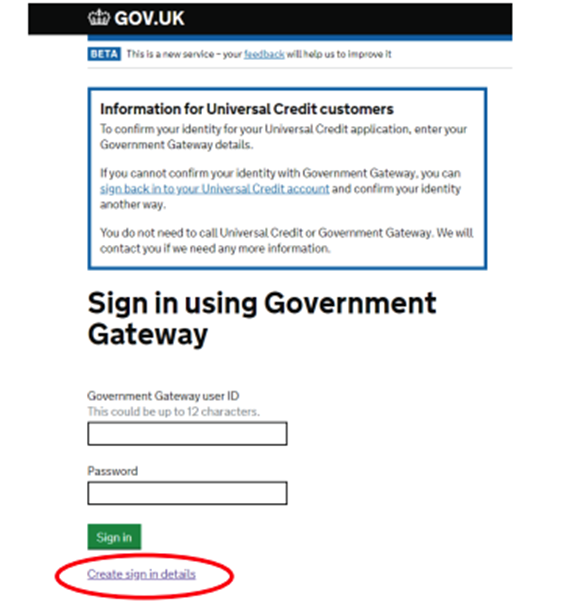
Click the ‘create sign-in details’ link given below the sign-in button to begin the registration process.  
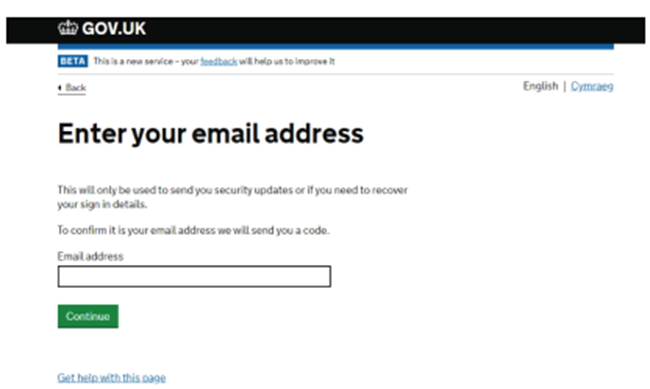
Then you will have to enter your email address. After doing so, select Continue. 
You will receive a code of 6 characters from HMRC at this email address. 
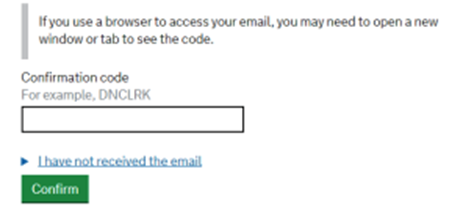
Once you have entered the details in the given box, HMRC will prompt you to enter your full name and create a password. Then you will see your Government Gateway ID number.  

2. Setting up your account 

Here the HMRC will ask you to select the type of account you need. Please select “individual” and then click the green button of “continue”.
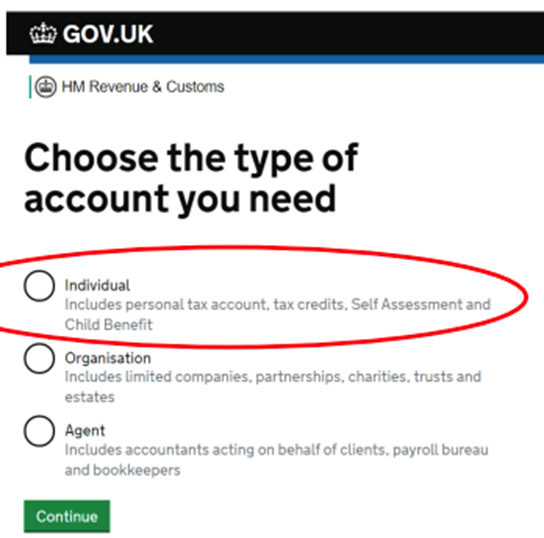
Now the HMRC will ask you to set up a method to receive an access code. It is important to know that select a method you are quite comfortable with because HMRC will use this method to send you an access code, every time you sign by using your Government Gateway user ID. 
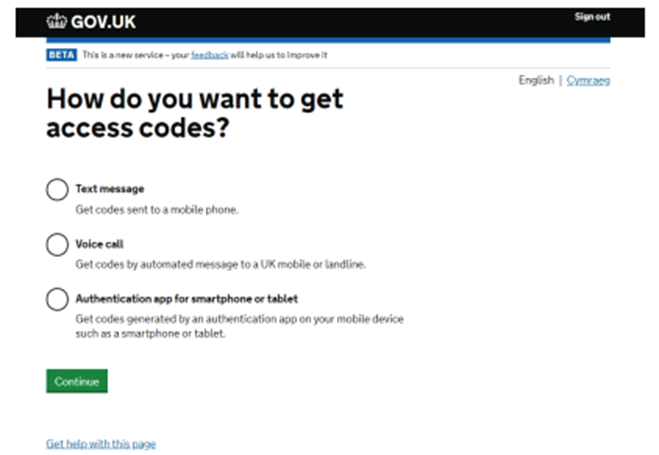
After selecting the method, you are most convenient with, click on the green button of “continue”.  

Then HMRC will ask you to enter the 6 digits access code it has provided you with.  

Kindly, enter the code and then click the green button “continue”.  

Now HMRC will ask you to confirm your identity, please provide the details where asked and then click the green button of “continue”. 

Now HMRC will ask you the way you want your identity o be confirmed by the HMRC. If you are a UK passport holder, you are recommended to use this option.  
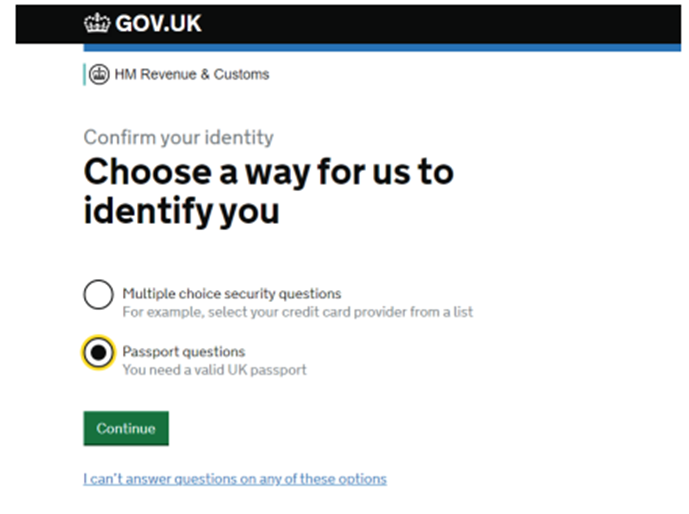
HMRC will ask you to share the same detail you have on your passport. Please enter the required details and then click the green button of “continue”.  

Now HMRC will confirm whether the details you entered are correct and whether the personal tax account has been successfully set up. After its confirmation, you will be asked whether you would like to receive your correspondence regarding your tax affairs electronically or post via your Personal Tax Account. please select the option which is most suitable to you and select the green “continue” button.  Now you will be taken to the Personal Tax Account home page.  

3. Recovering Login Details 

If you have previously used the online services of the government Gateway or HMRC to submit your tax returns electronically via the website of HMRC. You must log in by using those account details. But if you have forgotten the details of those accounts then please select one of the links given at the bottom of the sign-in page depending on the details you need to recover.  
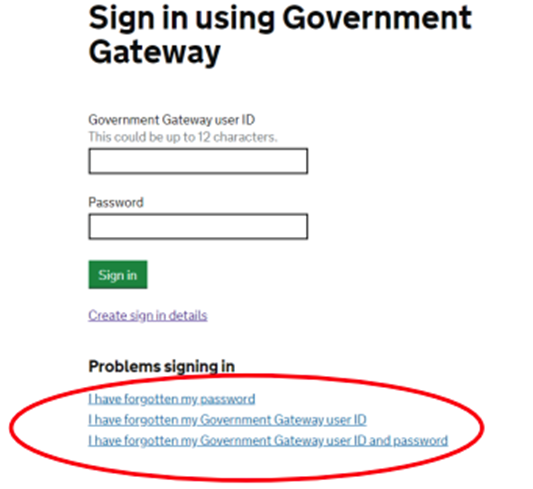
Now HMRC will take you, according to its process to recover your Government Gateway user ID or password. 

If you face any difficulty with the process, you can easily contact HMRC for help.  

Safety and security with your Personal Tax Account 

After completing the registration procedure, you are the only person to have access to your personal tax account with your user ID and password.  

Therefore, that answers your question, how do I set up my personal tax account? 

Can my Personal Tax Account Help Review my National Insurance Record? 

When it comes to reviewing your National Insurance record, your personal tax account can be particularly helpful. You can easily review your national insurance record that covers your entire working history by accessing your personal tax account. Reviewing your National Insurance record helps you ensure that your entire record is accurate and up to date. It also identifies any gaps in your contributions that might need to be addressed.  

After that, when you reach the pension age, you can ensure that you have the correct credits to receive a full pension. If you find any discrepancies and gaps, the best option is to contact HMRC for investigation.  

Can my Personal Tax Account Help Review my Employment Records? 

Yes, your personal tax account gives you the additional benefit of reviewing your employment records.  

It’s another benefit is that if you cannot obtain a copy of your P60 from your employer, you get it from your personal tax account. Once you understand how I set up my personal tax account, you can move forward with these steps.  

Can Personal Tax Accounts Provide Information on PAYE codes? 

Another useful feature of a personal tax account is that it enables you to view the PAYE codes use applied to your employment.  

Moreover, you also have the option to modify your PAYE code directly from your personal tax account.  

Is your Personal Information Secure? 

When it comes to security, HMRC takes it seriously and uses firewall protection for all its systems. This is like a bulwark to provide maximum protection for your information because its detective capacity is strong enough to detect any unauthorized entry. All the data that you share with HMRC is encrypted and nobody can see your data except yourself.  

Furthermore, you also must be conscious and vigilant of your online safety. Avoid sharing your user ID or password with anybody. If you cannot remember it and want to note it down, then ensure to keep it in a discrete place. Surely, you now have a clear idea of how I set up my personal tax account

How Can I Ensure Nobody Accessed My Account? 

One of the easiest ways, you must know whether someone accessed your account or not is the security measure of the system that shows you the time and date you logged into your personal tax account. Check this list frequently, if see any such thing that does not look right, immediately contact HMRC through their website.  

Another safety measure built into the system is automatic logging out of your account if it is not active after 15 minutes. If you are forgetful, don’t worry, the system will secure your account. 

Does HMRC Ask for Personal and Financial Detail? 

It is important to know, and HMRC often emphasizes to be mindful of the procedure of HMRC that it does not ask for any personal or financial details by email, phone, or text. Always be on watch to protect yourself from the scammer, if notice any such thing as suspicious, report it to the HMRC, even if you have not lost anything. Undoubtedly, it is in your best interest to do so.   

Shortly speaking, setting up a personal tax account offers a wide range of benefits by saving you a great deal of energy and time that you can utilize in something more productive and creative.  You can easily check state pensions, national insurance contributions, and many other tax affairs online without standing in long queues on helplines or doing related paperwork. It keeps you updated and informed about your tax status. And through it, you can also keep HMRC timely updated and informed about your circumstances. Most importantly, your financial information is safe and secure. 

FAQs

How do I activate my UTR number?

If your UTR (Unique Taxpayer Reference) is inactive, you can reactivate it by:

  1. Contacting HMRC – Call the Self Assessment helpline and request reactivation.
  2. Providing Personal Details – You may need to confirm your full name, address, National Insurance number, and date of birth.
  3. Waiting for Confirmation – HMRC will confirm reactivation, usually via letter or phone.

How to check income tax?

You can check your income tax by:

  1. Logging into your HMRC Personal Tax Account – View your tax payments, liabilities, and tax code.
  2. Using the HMRC App – Check your tax status on the go.
  3. Contacting HMRC – If you have queries about your tax records, call them for assistance.

How to file income tax?

To file your income tax return:

  1. Register for Self Assessment if you haven’t already.
  2. Gather Necessary Documents – Income records, expenses, and other tax-related details.
  3. Complete Your Tax Return – Log in to your HMRC account and fill out the SA100 form.
  4. Submit Before the Deadline – The deadline for online submissions is usually 31 January.

How do I create a UTR account?

To get a UTR number:

  1. Register for Self Assessment with HMRC.
  2. Provide Personal Information – Full name, address, date of birth, and National Insurance number.
  3. Wait for UTR to Arrive – It is usually sent by post within 10 working days in the UK.

How do I check if my UTR is active?

You can check if your UTR is active by:

  1. Logging into your HMRC account to view your Self Assessment status.
  2. Calling HMRC – Provide your UTR and ask if it is active.

How to set up self-employed?

  1. Register with HMRC for Self Assessment.
  2. Keep Records of your income and business expenses.
  3. Submit Your Tax Returns Annually to pay the correct amount of tax and National Insurance.

How do I check my UTR online?

You can find your UTR number by:

  1. Logging into your HMRC account – Your UTR is listed in your tax documents.
  2. Checking Previous HMRC Letters – It appears on tax returns and payment reminders.

How do I check my active tax status?

  1. Use Your HMRC Personal Tax Account – Check your tax payments and liabilities.
  2. Contact HMRC – If you’re unsure about your status, they can confirm it.

How long does it take to get a UTR?

HMRC usually issues a UTR within 10 working days if you’re in the UK or 21 days if you’re abroad.

How much money do you have to make as a self-employed person?

If you earn over £1,000 per tax year from self-employment, you must register with HMRC and file a tax return.

How do self-employed get money?

Self-employed individuals earn money by:

  • Charging clients/customers directly for services.
  • Selling products online or in-store.
  • Receiving payments through invoices, bank transfers, or platforms like PayPal.

How can I make money from home self-employed?

Options for making money from home include:

  • Freelancing – Writing, graphic design, programming, etc.
  • E-commerce – Selling on platforms like eBay, Etsy, or Amazon.
  • Affiliate Marketing – Promoting products for commissions.
  • Online Courses – Teaching skills through platforms like Udemy or Teachable.

How to earn $1,000 per day from home?

Earning $1,000 per day requires high-income skills or scalable businesses:

  • Dropshipping or E-commerce – Selling trending products online.
  • Stock Trading or Cryptocurrency – Requires experience and risk management.
  • Freelance Consulting – High-ticket services like business coaching.
  • Online Courses & Digital Products – Selling valuable knowledge at scale.

What is the fastest way to become self-employed?

  1. Identify a skill or service you can offer immediately.
  2. Register as self-employed with HMRC.
  3. Find clients through online platforms like Fiverr, Upwork, or LinkedIn.
  4. Start small and reinvest earnings to grow your business.

How to earn money from Google at home?

Google offers multiple ways to make money:

  • Google AdSense – Earn from ads on a blog or YouTube channel.
  • Google Play Store – Develop and sell apps.
  • Google Opinion Rewards – Get paid for surveys.
  • YouTube Partner Program – Monetize videos through ads and memberships.

click here for more

Categories
Articles Articles Blogs Guides News Today's article

How often can you pay dividends from your limited company?

For a new small business owner, how to access the funds you need to live on yourself is a crucial question!

One of the primary ways you can take money from a limited company is via dividends. This is basically a payment to you of the profit (or part of it), from your business, after tax and adjustments.

So, how often can I take a dividend?

The short answer:

As often as you want really!

 How often can you pay dividends from your limited company?

BUT

There are some things you’ve got to get right to do so.

The slightly longer answer:

There is a general myth about dividend payments. This dates back to when companies would often only declare ‘final’ dividends at a company’s Annual General Meeting. Indeed, some ‘Articles of Association’ (the document that governs certain legal procedures around the company) might have even required this to be the case.

However, times have changed. Most small limited company owners will instead take regular ‘Interim Dividends’.

Interim Dividends and the law

To make these dividends legal, you still need to take certain steps, including:

  • To ‘declare’ the dividends
  • To keep specific records

  in the meantime, here’s a quick check list. You need:

  • Proof that you had the profits to pay out (usually company accounts or a current Balance Sheet)
  • Meeting minutes declaring the dividend
  • An entry in your records / book-keeping software
  • Production of a Dividend voucher is recommended

At this point you would usually take the money, although you don’t have to. It could instead be marked in your ‘Director’s loan account’ for payment later, for example.

Dividends can be a really useful tool for tax-efficiently extracting money for a limited company.

However, they can also be technically challenging, and planning for the potential personal tax bill on them can cause a major headache.

Any Questions ?

You can book a 1-2-1 consultation with us so you can ask simple questions, and then go on to divvy out the dividends with more confidence yourself. It’s a great way for you to get the help you need, when you need it.

FAQs

1. What are dividends in a limited company?

Dividends are payments made by a limited company to its shareholders out of the company’s profits.

2. How often can you pay dividends from your limited company?

Dividend payments can be made at any time as long as the company has sufficient distributable profits available.

3. Is there a specific frequency for dividend payments in a limited company?

There is no set frequency for dividend payments in a limited company. They can be paid out regularly or on an ad-hoc basis, depending on the company’s financial situation and the decision of the directors.

4. Can dividends be paid if the company is not making a profit?

Dividends can only be paid out of profits, so if the company is not making a profit or does not have sufficient distributable reserves, dividends cannot be paid.

5. How do I determine if my company has enough profits to pay dividends?

It is essential to review the company’s financial statements and consult with an accountant to ensure that the company has enough distributable profits before declaring and paying dividends.

6. Are there any legal restrictions on dividend payments in limited companies?

Yes, there are legal restrictions and guidelines that must be followed when paying dividends, including ensuring that the company has enough distributable profits and complying with statutory requirements.

7. What are the tax implications of receiving dividends from a limited company?

Dividends are subject to dividend tax, which is paid by the shareholders. The tax rates and allowances for dividends can vary, so it is advisable to seek advice from a tax professional.

8. Can dividends be reinvested back into the company?

Yes, shareholders can choose to reinvest their dividends back into the company by purchasing additional shares or through other means as outlined in the company’s dividend reinvestment plan.

What should I do if I have more questions about paying dividends from my limited company?

Categories
Articles Articles Blogs Guides News Today's article

Something Every Small Business Should Know: Illegal Dividends

For limited company owners, dividends are often a great method to take out your hard-earned profit in a more tax efficient way.

However, the process of giving yourself money via dividends isn’t totally straightforward. It’s all too easy to make a mistake and give yourself a tax problem instead.

The most common mistake is when limited company owners view their dividends as their monthly ‘pay’. This viewpoint then results in the ltd company owners drawing out a sum of money each month as a ‘dividend’, with no regard to company performanceThat is one big no-no.

So, this blog is about one of the ways your ‘dividend’ could be illegal, and how to avoid it.

Why your dividend might be illegal

There can a few reasons why a dividend might be illegal, including:

  • Misunderstanding who can legally vote the dividend,
  • A lack of documentation
  • Not understanding the need for true profits to be available

As numbers people, we’d like to talk about the profit issue here. For a dividend to be legal there are several things that need to happen, which we cover in this blog on the subject. Just marking a bank payment as ‘dividend’ isn’t enough.

Is there sufficient profit to award a dividend?

There needs to be enough ‘profit’ to be able to pay any dividend. You need to be sure this profit exists. So, you need to review the most up to date set of accounts or reports you have before any dividend is considered.

If you are in the ‘cloud’ accounting world, you may have access to this via a product like Xero or QuickBooks. Log in and scroll down to the bottom of your accounts or Balance Sheet report, where you usually see something like this:

For many small businesses, the bottom figure ‘Total Capital and Reserves’ is often a good indicator of whether a dividend can be paid (and potentially how much). However, the figure can contain values that can’t have a dividend paid from them, such as share ‘capital’ (£2 in the above) or ‘share premium’ (not shown here).

In this example, the company looks in a reasonable position on paper to pay a dividend. However, there are some common pitfalls that mean in reality there could not actually be enough profits to pay money as a dividend.

Is your book-keeping accurate and up to date?

One major pitfall can be if your book-keeping isn’t accurate. Your book-keeping may not have taken into account a lot of adjustments such as:

  • The drop in value of the things (physical assets) your company owns (‘Depreciation’)
  • Timing adjustments
  • Provisions for expenses or income not yet made.

Other issues can include:

  • Dividends in the software are being shown in the ‘Profit and Loss’ report rather than in the Balance Sheet.
  • You are using last year’s accounts, so the data is likely to be out of date.

Get into the Balance Sheet habit

Get into the habit of reviewing the Total Capital and Reserves section of the Balance Sheet. It might not be completely accurate or current, but at least you’ll gain some awareness of whether a payment is likely to be ok as a dividend.

The most common scenario we see where dividend payments has gone wrong is where this ‘capital and reserves’ figure is very small, and the owner has not taken into account the adjustments for future tax, timing or depreciation.

My dividends might be illegal, what do I do?

There isn’t a generic answer we can give here as it varies wildly, based on your individual situation.

What we can say though that in many cases, the payment can often be reflected as a loan to the director instead. In reality, this is the key consequence of getting this wrong. Under the Companies Act, the shareholders could be asked to repay that dividend (essentially the same treatment as a loan).

I’m worried about making legal dividends

Review your figures and ask your accountant for help in understanding how this all works for you and your company. If you don’t have an accountant, or feel you aren’t making the most of dividends and other limited company tax opportunities with your current accountant, we can help. Just get in touch.

  • Call us
  • Send us a message


Categories
Articles Blogs News

Understanding VAT Implications for Property Developers and Investors

Navigating the world of property development and investment in the UK can feel like walking through a complex maze, especially when it comes to Value Added Tax (VAT). Understanding VAT implications for property developers and investors is crucial to ensure profitability and compliance. In this comprehensive guide, we’ll break down the complexities of VAT, highlight when it’s chargeable, how to reclaim it, and the compliance requirements to avoid penalties.

The Importance of VAT in Property Development and Investment

Imagine you’re a property developer about to embark on a new project—a luxury apartment complex in London. You’re excited about the potential returns but suddenly hit a wall when confronted with VAT charges you hadn’t anticipated. This unexpected cost eats into your profit margins, turning a promising venture into a financial strain.

This scenario is all too common. Without proper knowledge of VAT services UK, property developers and investors can face significant financial setbacks. Understanding VAT isn’t just about compliance; it’s about strategic financial planning that can make or break your investment.

What is VAT and How Does It Affect Property Transactions?

Value Added Tax (VAT) is a consumption tax added to goods and services in the UK. For property developers and investors, VAT can be both a cost and an opportunity, depending on the nature of your projects and how you manage your VAT obligations.

Types of Property Transactions and Their VAT Implications

  1. New Residential Buildings: Generally zero-rated for VAT purposes.
  2. Commercial Properties: Standard-rated at 20% VAT when sold or leased.
  3. Renovations and Conversions: Reduced or zero-rated VAT may apply under certain conditions.
  4. Land Sales: Typically exempt but can be opted to tax, making them standard-rated.

Expert Insight: John Smith, a VAT specialist, notes, “Understanding whether your property transaction is exempt, zero-rated, or standard-rated is crucial for effective VAT planning strategies.”

When is VAT Chargeable for Property Developers and Investors?

New Builds and Conversions

  • Zero-Rated Supplies: Selling or leasing new residential properties can be zero-rated, allowing you to reclaim VAT on associated costs.
  • Reduced Rate (5%): Applicable to conversions that change the number of dwellings (e.g., converting a house into flats).

Real-Life Example: Emma, a property investor, converted a commercial building into residential flats. By applying the reduced VAT rate, she saved thousands on her renovation costs.

Commercial Properties

  • Standard-Rated: Sale or lease of new commercial properties (less than three years old) is subject to 20% VAT.
  • Opt to Tax: Owners can choose to waive the VAT exemption on commercial properties, allowing them to charge VAT and reclaim input VAT on expenses.

Renovations and Repairs

  • Standard Rate Applies: General repairs and maintenance are usually standard-rated.
  • Reduced Rates: Certain renovations may qualify for reduced rates, such as bringing an empty home back into use.

How to Reclaim VAT: Input Tax Recovery

Reclaiming VAT on your expenses is a vital aspect of VAT compliance for property investors.

Eligibility for VAT Reclamation

  • VAT Registration: You must be VAT-registered to reclaim VAT on your purchases.
  • Intention to Make Taxable Supplies: You can reclaim VAT if you intend to sell or lease properties in a way that is taxable (standard-rated or zero-rated).

Common Reclaimable Expenses

  • Construction Costs: Materials and labour for building new properties.
  • Professional Fees: Architect, engineer, and legal fees.
  • Marketing and Sales Costs: Advertising and promotional expenses.

Important Note: Input VAT cannot be reclaimed on exempt supplies, such as residential lettings, unless you opt to tax.

Compliance Requirements to Avoid Penalties

Failing to comply with VAT regulations can result in severe penalties from HM Revenue & Customs (HMRC). Here’s how to stay on the right side of the law.

1. Accurate VAT Registration

  • Threshold Consideration: If your taxable turnover exceeds £85,000 in a 12-month period, you must register for VAT.
  • Voluntary Registration: Even below the threshold, registering can be beneficial if you have significant input VAT to reclaim.

2. Timely and Correct VAT Returns

  • Filing Deadlines: Usually quarterly, but can be monthly or annually.
  • Making Tax Digital (MTD): HMRC requires VAT records to be kept digitally and submitted using compatible software.

3. Proper Record-Keeping

  • Invoices and Receipts: Keep all VAT invoices for purchases and sales.
  • VAT Account: Maintain a summary of your VAT transactions.

Case Study: Mark, a property developer, faced a hefty fine due to incorrect VAT filings. By seeking tax compliance assistance, he rectified his records and implemented systems to prevent future errors.

4. Understanding Partial Exemption Rules

If you make both taxable and exempt supplies, you may only reclaim a portion of your input VAT.

  • Standard Method: Based on the proportion of taxable supplies.
  • Special Methods: Can be agreed upon with HMRC for a more accurate reflection.

VAT Planning Strategies for Property Developers and Investors

Effective VAT planning strategies can significantly impact your profitability.

1. Opting to Tax

  • Advantages: Allows you to reclaim VAT on purchases related to commercial properties.
  • Considerations: Once opted, it applies for at least 20 years and affects all future transactions.

2. Utilizing VAT Schemes

  • Flat Rate Scheme: Simplifies VAT accounting but may not be beneficial if you have high input VAT.
  • Cash Accounting Scheme: Pay VAT based on cash received rather than invoices issued, aiding cash flow.

3. Timing of Supplies

  • Invoice Timing: Strategically timing invoices can defer VAT payments.
  • Stage Payments: Align VAT liability with project cash flow.

Analogy: Think of VAT planning as navigating a ship through treacherous waters; with the right map and compass, you can avoid hidden dangers and reach your destination safely.

Addressing Potential Challenges

Counterargument: “VAT is too complex; it’s easier to ignore it.”

Response: Ignoring VAT obligations can lead to significant financial penalties and legal issues. Engaging with VAT services UK can simplify the process and protect your interests.

Counterargument: “I can handle VAT without professional help.”

Response: While possible, VAT regulations are intricate, and mistakes can be costly. Professional guidance ensures compliance and maximizes your financial benefits.

The Role of Professional VAT Services

Engaging experts in property developer VAT can provide invaluable assistance.

Benefits of Professional Assistance

  • Expert Knowledge: Stay updated with ever-changing VAT laws.
  • Customized Strategies: Tailored advice to suit your specific projects.
  • Peace of Mind: Assurance that you’re compliant and optimizing your VAT position.

Expert Quote: Lisa Brown, a VAT consultant, states, “Investing in professional VAT advice is not just a cost but a strategic move that can save property developers and investors substantial amounts in the long run.”

Conclusion: Navigating VAT Successfully

Understanding VAT implications is not just a legal requirement but a strategic necessity for property developers and investors in the UK. By being proactive, seeking professional tax compliance assistance, and implementing effective VAT planning strategies, you can enhance your profitability and avoid costly pitfalls.

Take the Next Step Towards VAT Compliance

Don’t let VAT complexities hinder your property ventures. Contact us today for personalized advice and discover how our expertise in VAT services UK can support your success.


Frequently Asked Questions

1. When must property developers and investors register for VAT?

Answer: You must register for VAT if your taxable turnover exceeds £85,000 in a 12-month period. However, voluntary registration may be beneficial if you have significant input VAT to reclaim.

2. Can I reclaim VAT on residential property developments?

Answer: Yes, if you’re building new residential properties for sale (zero-rated supplies), you can reclaim VAT on associated costs. However, if you’re renting out residential properties (exempt supplies), you generally cannot reclaim VAT unless you opt to tax.

3. What is the ‘opt to tax,’ and how does it affect me?

Answer: Opting to tax allows you to charge VAT on commercial property transactions, enabling you to reclaim input VAT on related expenses. It applies for at least 20 years and affects all future dealings with the property.

4. How does the reduced VAT rate apply to property conversions?

Answer: A reduced VAT rate of 5% may apply to the conversion of non-residential buildings into residential use or changing the number of dwellings (e.g., converting a house into flats).

5. What are the penalties for VAT non-compliance?

Answer: Penalties can include fines, interest charges, and in severe cases, criminal charges. The exact penalty depends on the nature and severity of the non-compliance.

6. How does partial exemption affect my VAT recovery?

Answer: If you make both taxable and exempt supplies, you can only reclaim input VAT related to taxable supplies. Partial exemption rules determine the proportion of VAT you can reclaim.

7. Is professional VAT assistance necessary for property developers and investors?

Answer: While not mandatory, professional assistance can help navigate complex VAT regulations, ensure compliance, and optimize your financial position, potentially saving you significant amounts.

8. What records do I need to keep for VAT purposes?

Answer: You must keep detailed records of all VAT invoices, receipts, and a VAT account summarizing your VAT transactions. Records should be kept for at least six years.

9. How does Making Tax Digital (MTD) impact my VAT reporting?

Answer: MTD requires you to keep digital records and submit VAT returns using compatible software. It aims to make the tax system more effective and easier for businesses.

10. Can timing my property transactions help with VAT planning?

Answer: Yes, strategically timing invoices and stage payments can align VAT liabilities with your cash flow, aiding in effective VAT planning.

Categories
Blogs

How to claim business mileage from your own company

As a limited company owner, you probably know you can claim the business miles you do in your own personal vehicle.

What you may not understand is how to physically ‘claim’ the money from your company.

So, in this blog we cover a few ways you can do this. As usual, we are presuming you are a director of your own UK limited company, as the rules and process would vary in other situations.

A quick reminder on business travel

Business travel may seem simple, but what journeys are actually claimable can be a complex topic. So before following some of the steps below, remember to work out if the journey is claimable in the first place!

For example:

· You cannot claim for regular commuting to your office every day

BUT

· You can usually claim for travel to a ‘temporary workplace’

· 

Business travel – the basics

We covered some of the basics in our previous blogs on the subject:

Claiming limited company fuel expenses

Travel costs for the self-employed (Technically it’s slightly different for limited companies, but the broad concepts are similar.)


Steps to claiming your mileage

There are a few crucial steps to making a mileage claim from your limited company.

1. Log your miles

This may sound completely obvious, but you will need to record the qualifying business miles. Various apps can do this for you (including Xero and QuickBooks). Otherwise, a simple spreadsheet, or even a pad and pen will do!

Record as much detail on the reason for the trip as you can, along with the mileage.

2. Calculate your claim

Be careful on tracking your mileage amounts as they are per tax year (6th April – 5th of the following April), not per company year.

The mileage rates used to be pretty nice as they were intended to cover some wear and tear, running costs of the vehicle etc. However, with current fuel prices as they are and the fact the values haven’t moved for some years, the current rates do not feel that generous!

At the time of writing, you can claim 45p per mile for the first 10,000 miles in a tax year, and 25p thereafter.

3. Enter into your records

You now need to enter your claim into your accounting system. This will either be:

An auto entry created by a mileage accounting app

A tab on your spreadsheet

An entry on your accounting records book

An ‘expense claim’ or ‘bill’ in your accounting software

Entering a ‘journal’ with the claim into your accounting software (see below)

Many accounting apps now include a mileage tracking feature using GPS and other technology. Some will charge for the feature, some don’t, but you don’t have to use that feature.

You could just enter the claim directly into your software another way. Even with some of the automatic calculations in the software apps, you still have a manual process later to approve and/or categorise the claim.

If you’d like to enter a single entry either annually or whenever you remember throughout the year, one option is to create a ‘journal’.

You can usually find a button somewhere to ‘add a journal’. You then need to enter details into the journal, which may look something like this:

 4. Decide if (or how!) you will repay yourself

In the journal entry example above, we categorised it as ‘Directors Loan Account’. This means that the company owes you the money at a later date, or will offset some of any money that you’ve potentially already drawn.

If the company has funds and you’d like to repay yourself the exact amount, you can simply do so on your online banking app straight to your personal account.

5. A key point to remember about repaying yourself

Unless you are getting physically paid mileage by your client / customer, there is no ‘extra’ free money to pay yourself this mileage amount.

So, you are paying yourself out of the available company money.

Many business owners struggle with this concept. It is not an extra invisible pot of cash. You are ‘creating’ some money by reducing the tax you might have to pay over, but it’s not 100% of the claim.

A few words on VAT

If you are VAT registered, it’s likely you could claim some VAT back on that mileage figure. We’ve not covered that here as its detailed and somewhat complex, but you we’d like you to know it’s a possibility.


Muddled about mileage?

First ask your accountant about any mileage allowances that might apply to you, and where to enter them in your software. If you don’t have an accountant, or feel you aren’t making the most of your mileage allowances with your current accountant, we’d love a chat about how we can help.

· Call us

· Send us a message


How to plan for your ‘dividend tax’ bill

Are you paying yourself from your limited company with dividends? It’s often a tax-efficient method, but it’s not generally tax-free. So, make sure you plan ahead and budget for the ‘tax bill’. Here’s how.

Dividends and personal tax

As a small business owner running a ltd company, you can often take some funds from the business as dividend. Many owners do this because it is usually efficient, and the paperwork is often easier actual ‘salary’.

When you do this, it’s very likely that you will have some personal tax to pay on those dividends. This is the #1 area we see limited company business owners trip up on – failing to plan and manage this tax bill.

If you get this wrong, it can seem like you are going round in circles. You could be constantly playing catch up and paying tax out, and feel like you are in a hole that you can’t get out of.

So, here are some thoughts on how you could plan for paying this tax and avoid that hole!


A quick reminder on how dividends work

Dividends are paid out of ‘retained profit’. So, what is ‘retained profit’?

This is the profit remaining after you’ve paid all of your expenses, accounted for the depreciation on any equipment, vehicles etc. the company may own. More importantly, you must have taken into account any tax the company owes now and in the future.

Keeping this super high level, what is then left is in theory a pot of money that is available for dividends to be paid from. This may include past profits not yet paid out.

The most important point of all

Needless to say, technically there is more to it than this, but it does show the key point about what profits are usually available. This is the crucial issue of the tax point. Many owners come unstuck because they fail to realise that the ‘pot’ of retained profit that is available needs to take into consideration CURRENT company tax bills.

Personal tax and payment via dividends

When you are paid using dividends, you are taxed personally on these.  

So how can you plan for your personal ‘dividend’ tax bill? There are 3 common strategies here.

1) Additional dividend

When the bill arrives, draw the money as an additional dividend to pay your personal tax from your company, when the time comes. BUT (and it’s a big but), this is by far the most dangerous option, as you could be in a situation where there are not enough profits to pay out a dividend to you to allow this.

You could be in a situation where you have the cash to do this, but technically on paper there are not the profits to do so. This can cause further tax issues. For example, you may currently have the cash because the company has a future tax bill due at a later date. So, whilst the cash is there, it’s not technically available to be a dividend.

This is the option where you find you can get into that loop of, draw money > get tax bill > draw extra money (that creates another tax bill) to pay tax > next year get larger tax bill > draw extra money (that creates another tax bill) to pay tax > etc.…

2a) Set aside some money

Set some of the money you draw aside for your personal tax bill. Some owners will do a ‘provision’ to give them some funds that should roughly cover the bill.

At the time of writing, a solid rough provision would be:

10% of the money you draw, up to the first £50,000,

then

30% on the next £50,000

If you are drawing more than £100,000, you would need to carry out more accurate planning.

The keen eyed will realise that 10% is more than the actual tax rate on those dividends, and 30% is slightly less than the tax on the higher rate dividends. Our experience is that if you put aside these percentages, you generally will have the funds to pay the bill. It’s never an exact science when using a provision approach.

2b) Work out what you will owe

This involves setting some of the money you draw aside for your personal tax bill, but working out in advance what that bill will be. You then have a goal to work towards. This will make it easier if your personal cashflow needs fluctuate month to month. It would give the ability to save more some months, and less on others!

I’m still confused about paying myself with dividend/s

Ask your accountant about payment by dividends, or book a consultation with us. We offer a paid 1 hour, 1-2-1 consultation so you can ask simple questions of an accountant. You don’t have to become a client, so it’s a great way for you to get the help, when you need it.

· Call us

· Send us a message

If you don’t have an accountant, we’d love a chat about how we can help.

More Blogs

Rental Income Taxes as a Property Investor in the UK

As a property investor in the UK, rental income taxes are a significant factor to consider when...

How Do I Set Up My Personal Tax Account?

Table of Contents How Do I Set Up My Personal Tax Account  A personal tax account is an...

How to Master HMRC Compliance: 3 Proven Strategies for Landlords and Property Investors

In the dynamic world of UK property investment, understanding and adhering to HM Revenue &...

Top Tax Planning Strategies for Property Investors in the UK

https://felixaccountants.com/tag/property-investors/Investing in property can be a lucrative...

The Essentials of DVLA Vehicle Tax: Updates, Exemptions, and How to Stay Compliant

Key Take aways • Understanding Vehicle Excise Duty (VED): Essential for all UK motorists to fund...

Inheritance Tax (IHT) and Trust Planning: Safeguarding Your Estate

Inheritance Tax (IHT) is a significant aspect of wealth transfer that often goes overlooked in...

7Powerful Cash Flow Tips for Successful Property Developers

In the fast-paced world of property development, managing cash flow is like keeping the engine...

Do you own a Limited Company? Beware of Illegal Dividends

For limited company owners, dividends are often a great method to take out your...

Understanding UK Tax Brackets for 2024-25

Dealing with the UK’s tax system can feel challenging, with various rates and rules to...
Categories
Blogs

Filing Limited Company Accounts: What You Need To Know

One of the main things we do is help business owners deal with their limited company accounts. Knowing what – and when the deadlines are for filing limited company accounts is the trick to helping the ‘legal bits’ of your business tick along seamlessly. Here is a brief roundup of what you need to file each year, and what might happen if you don’t.

Annual Accounts (to Companies House & HMRC)

These are the ‘full’ accounts that show you how the company has done in the year.

These work out the corporation tax you have to pay. Before these accounts can be filed, they must be produced to very specific accounting standards.

This ‘full’ set gets attached to the company’s tax return (see below) each year and is sent to HMRC.

There is an opportunity to get caught out when you’re filing limited company accounts, in that this is due to be submitted to Companies House 9 months after the company year-end. Directors often get caught out in the first year as its 21 months from registration, so is usually a slightly shorter deadline in year one.

Helpfully, your company’s registration on company’s house will also show you the due date for your accounts. 

You usually prepare a separate ‘filleted’ (previously known as ‘abbreviated’ ) set of accounts for Companies House, as these are publicly visible to anyone. This set doesn’t show you turnover, profits etc., just the overall ‘position’ of the business (useful for banks, lenders etc). 

Nearly all limited companies have accountants, as there are very limited free software (at time of writing) to help produce the accounts. They have to be ‘electronically tagged’ to be transmitted in a specific way to HM Revenue & Customs. This software (and the know-how) sits with accountants. 

Like all returns, there are penalties for not submitting your accounts to Companies House. You can expect them to range from £100 – £1500, but if you’ve been late before, they double. 

Ultimately, if you do not submit the accounts, you can also end up in court, so be sure to check the dates.

Corporation Tax Return (to HMRC)

With the full accounts in hand, you need to complete a corporation tax return that tells you and HM Revenue & Customs what tax to pay on the profits. This return is sent along with the full accounts. It is also ‘electronically tagged’ and sent via a specific electronic software system to HMRC. The deadline for the tax return is actually 12 months after the year-end. This may feel odd as the Companies House accounts are due at 9 months. Any tax payable is due at 9 months & One Day after the year-end – before the return is actually due!

It is worth being extra careful on the first-year tax return. It is very common for dates to not line up correctly, and possible that two returns need to be done. As you would expect, there are penalties for late filing, starting at £100. If you need support with filing limited company accounts, then contact us as, we’d be glad to help.

How often can you pay dividends from your limited company?

For a new small business owner, how to access the funds you need to live on yourself is a crucial question!

One of the primary ways you can take money from a limited company is via dividends. This basically a payment to you of the profit (or part of it), from your business, after tax and adjustments.

So, how often can I take a dividend?

The short answer:

As often as you want really!

BUT

There are some things you’ve got to get right to do so.

The slightly longer answer:

There is a general myth about dividend payments. This dates back to when companies would often only declare ‘final’ dividends at a company’s Annual General Meeting. Indeed, some ‘Articles of Association’ (the document that governs certain legal procedures around the company) might have even required this to be the case.

However, times have changed. Most small limited company owners will instead take regular ‘Interim Dividends’.

 Interim Dividends and the law

To make these dividends legal, you still need to take certain steps including:

· To ‘declare’ the dividends

· To keep specific records

in the meantime, here’s a quick check list. You need:

· Proof that you had the profits to pay out (usually company accounts or a current Balance Sheet)

· Meeting minutes declaring the dividend

· An entry in your records / book-keeping software

· Production of a Dividend voucher is recommended

At this point you would usually take the money, although you don’t have to. It could instead be marked in your ‘Director’s loan account’ for payment later, for example.

A few final words on dividend payments

Dividends can be a really useful tool for tax-efficiently extracting money for a limited company.

However, they can also be technically challenging, and planning for the potential personal tax bill on them can cause a major headache.

To help put yourself in the best position with this, check out the following:

· Do I need to pay tax on dividends?

· How to plan for your ‘dividend tax’ bill

You can also ask your accountant. Or you can book a paid 1 hour, 1-2-1 consultation with us so you can ask simple questions, and then go on to divvy out the dividends with more confidence yourself. It’s a great way for you to get the help you need, when you need it.

More Blogs


See More

Small Business Payroll Explained!

Small Business Payroll Explained!

Read More
How to claim business mileage from your own company

How to claim business mileage from your own company

Read More
Filing Limited Company Accounts: What You Need To Know

Filing Limited Company Accounts: What You Need To Know

Read More
Key 7 Numbers that are vital in your business

Key 7 Numbers that are vital in your business

Read More
How Do I Set Up My Personal Tax Account?

How Do I Set Up My Personal Tax Account?

Read More

Filing Accounts with HMRC

In addition to submitting accounts to Companies House, limited companies must file a Company Tax Return (CT600) accompanied by full statutory accounts to HMRC. This submission calculates the Corporation Tax owed based on the company’s profits. The deadline for filing the Company Tax Return is 12 months after the end of the accounting period it covers. However, any Corporation Tax due must be paid within 9 months and one day after the end of that period.

Joint Filing Options

To streamline the process, companies that do not require an auditor can file their accounts and Company Tax Return simultaneously using HMRC’s online service. This integrated approach ensures that both HMRC and Companies House receive the necessary documents, reducing administrative effort.

Consequences of Non-Compliance

Failure to file accounts or pay Corporation Tax on time can lead to significant penalties. Companies House imposes fines starting from £150 for late accounts, increasing with the length of the delay. HMRC may also levy penalties and interest for late tax returns or payments. Persistent non-compliance can result in the company being struck off the register or directors facing personal liability

Frequently Asked Questions (FAQs) about Filing Limited Company Accounts

1. Can I prepare and file my own limited company accounts?

Yes, company directors can prepare and file their own accounts. However, many opt to hire professional accountants to ensure accuracy and compliance with the latest regulations. Even with professional assistance, directors remain legally responsible for the company’s filings.

2. What records must a limited company maintain?

A limited company is required to keep accurate financial records, including details of all income and expenditure, assets and liabilities, and records of all goods bought and sold. These records support the information submitted in the annual accounts and tax returns.

3. What happens if I miss the filing deadline?

Missing the filing deadline for accounts or tax returns results in automatic penalties. The longer the delay, the higher the penalty. For example, late filing of accounts with Companies House can incur penalties starting from £150, escalating if the delay continues. Similarly, HMRC imposes fines and may charge interest on any unpaid tax.

4. Do dormant companies need to file accounts?

Yes, even if a company is dormant (not trading), it must file dormant accounts with Companies House annually and inform HMRC of its dormant status to avoid unnecessary tax filings.

5. Can I change my company’s accounting reference date?

Yes, a company can change its accounting reference date, which alters its financial year-end. This can be done by notifying Companies House and is often used to align the company’s financial year with the calendar year or the financial periods of parent companies.

For detailed guidance and access to online filing services, visit the official GOV.UK website

Categories
Blogs

Key 7 Numbers that are vital in your business

Key 7 Numbers that are vital in your business

Do you feel in the dark about your business’s numbers?
Many small business owners feel there is a real lack of data available to them. This is usually due to a combination of:
a) not knowing what numbers are important (and why)
and
b) not having a system to produce them regularly
So, here’s your business owner’s guide to 7 of the most impactful numbers you could know about your business. Once you know them, they can give you some real insight into what’s happening in the business, and help you understand how to push the business forward.
Some of these numbers you will easily be able to pull from your records, and some might need a more detailed calculation. We don’t cover the detail of the calculation here. Right now, we just want you to be aware what key numbers you should be looking at are, and why they are important.
Know your numbers
First, we’ll talk you through you the ‘Big 3’ key numbers that most owners need a handle on. Then we’ll explore “4 More” that really help you get under the bonnet of the business.

THE BIG 3
1. Revenue
The obvious first number to understand is how much you are selling. Call it ‘sales’, ‘revenue’ or ‘turnover’ – it’s all the same thing.
Knowing this number, and whether it is growing or decreasing will give you a key indication of whether the business is going in the right direction.
It’s not the only number that matters, but it’s a pretty important one!
2. Gross Profit Margin
This one is MASSIVE. The power in knowing this number and actively trying to improve it can change your business, and ultimately your life as an owner.
Your gross profit margin tells you what profit would be left after you pay for your ‘direct’ costs for every £ of revenue you generate. This number is normally a % figure.
For example, if you make a product, it’s usually the profit after you’ve paid for the materials to make it, package it, delivery, etc.
Your gross profit margin shows you how profitable your main business activities are, before considering your fixed costs (overheads)..

3. Net Profit and ‘EBITDA’
Some would argue that Net Profit is actually all that matters. It’s the profit (if any!) that’s left at the end when all other costs have been taken into consideration.
One key version of this number is something known as ‘EBITDA’. This is the profit, but with some of the more ‘unusual’ costs that are normally found in accounts stripped out.
EBITDA means:
Earnings (profit) Before Interest, Tax, Depreciation and Amortization (another form of depreciation).
The best way to use your EBITDA figure is as a percentage of your revenue. This will then in theory tell you, for any given £ revenue figure, what profit is left at the end. So, if you have an EBITDA of, say 35%, then for every £100 you make, £35 as Profit.
It’s very important to keep tracking this figure, so you are also keeping an eye on the direction the business is heading in.

4 MORE
4. Revenue per employee
This number is how much revenue (sales) you produce per employee in the business. This number is impacted by many elements of your business including:

⦁ Efficiency
⦁ Employee costs (holidays, pension plans, etc)
⦁ Training
⦁ Tech and Equipment
⦁ HR and Recruitment
As a result, this number is more of a holistic look at the business and how efficient the team is. If you concentrate on improving this number, you often find many others are positively impacted.
5. Cash Days
Your Cash Days number can also be called ‘working capital days’. It is a measure that gives you a snapshot of how long it takes for money to go through your business.
Your Cash Days calculation combines:

⦁ How long it takes for your customers to pay you
⦁ How long it takes for you to pay your suppliers
⦁ How long it takes for your stock to be turned into cash
⦁ How long it takes any ‘work in progress’ to be turned into cash
Improving this figure (making it lower) can really help improve the cash in your business at any given time. This is particularly important in times of financial stress or market worries.
6. Core Cash Target
This number looks at the ideal amount of cash your business should keep on hand before starting investments or paying profits out.
Depending how you calculate this, it’s usually a number that includes:

⦁ Your total taxes due
⦁ An amount for your fixed overheads
It gives you an idea of what you really need to hold back in reserve before committing funds to other projects or put in your pocket as the owner!
7. Business Return
This number is another indicator of how your business is progressing overall. It is normally calculated by looking at:
⦁ Your net profit over a year
vs
⦁ The overall ‘value’ of your business
You could look at this number as ‘Is the business producing a good enough return?’. For example, would you get more if you just closed the business now, cashed in and stuck the money in a bank?

Summary
And there we have it, 7 key numbers you should know about your business.
If you don’t know them, or are not sure how to find them, we have a range of business advisory services that build in these key numbers at their core.
Our business advisory service includes monthly meetings to:
⦁ Review these numbers
⦁ Understand what’s happening
⦁ Help you set an action plan to move the numbers and push your business forward
Want to know your numbers? Call this number 07877284111– and ask about our business advisory services. We’re here to help.

Categories
Blogs Guides Taxation Services

Taxation Services for Efficient Tax Planning and Compliance in the UK

In the complex world of UK taxation, navigating the intricate maze of laws and regulations can feel like attempting to solve a puzzle without all the pieces. For landlords, property investors, and SMEs, effective tax planning isn’t just a luxury—it’s a necessity for growth and sustainability. Our expert taxation services are designed to simplify this journey, helping you minimize liabilities while staying fully compliant with UK tax laws.

Understanding the Importance of Strategic Tax Planning

Imagine Emma, a budding property investor who recently acquired several rental properties across the UK. Excited about her new venture, she soon found herself overwhelmed by the complexities of property taxes, VAT obligations, and self-assessment returns. Without proper guidance, Emma risked overpaying taxes and facing penalties for non-compliance.

Emma’s story isn’t unique. Many businesses and investors miss out on opportunities to save money simply because they aren’t aware of the tax reliefs and strategies available to them. This is where our tax planning for property investors UK comes into play, turning confusion into clarity.

Our Comprehensive Taxation Services

Tailored Tax Planning for Property Investors

Property investment can be a rewarding yet challenging field. Our services help you:

  • Maximize Deductions: Identifying allowable expenses to reduce taxable income.
  • Understand Capital Gains Tax: Offering capital gains tax advice UK to minimize liabilities when selling properties.
  • Leverage Tax Reliefs: Utilizing schemes and incentives specific to property investors.5 Must-Know Tax Tips for Every Small Business Owner

Business Tax Compliance UK

For SMEs, staying compliant with ever-changing tax laws is crucial. We provide:

  • Corporation Tax Services UK: Ensuring accurate calculations and timely submissions.
  • VAT Services UK: Managing VAT registrations, returns, and planning.
  • Self-Assessment Tax Returns UK: Assisting business owners and sole traders with precise filings.

Specialized Tax Relief Strategies UK

Every pound saved in taxes is a pound that can be reinvested into your business. Our experts:

  • Identify Opportunities: Exploring R&D credits, allowances, and other reliefs.
  • Plan Ahead: Implementing strategies that align with your long-term goals.
  • Stay Updated: Keeping abreast of legislative changes that impact your tax position.

Navigating the Complexities of UK Tax Laws

The UK’s tax system is one of the most intricate globally. According to HM Revenue & Customs (HMRC), errors in tax filings cost UK businesses millions of pounds annually in penalties and lost opportunities. Our role as your HMRC liaison is to bridge the gap between you and the tax authorities, ensuring transparency and compliance.

Capital Gains and Inheritance Tax Planning UK

Protecting your wealth for future generations is essential. We offer:

  • Inheritance Tax Planning UK: Structuring your assets to minimize inheritance tax liabilities.
  • Capital Gains Tax Advice UK: Advising on the disposal of assets to reduce capital gains tax.

Real-Life Impact: A Success Story

Consider John, an SME owner who felt the weight of increasing tax bills year after year. Unaware of the available reliefs, he was overpaying by thousands of pounds. After engaging our services, we conducted a thorough review and implemented tailored strategies. The result?

  • Significant Tax Savings: We reduced John’s tax liability by 25% in the first year.
  • Peace of Mind: With our ongoing support, John now focuses on growing his business without worrying about compliance issues.

“I never realized how much I was leaving on the table until they stepped in. Their expertise in business tax compliance UK transformed my finances.” — John, SME Owner

The Value We Bring to Your Business

Expert Guidance and Support

Tax laws don’t stand still, and neither do we. Our team stays ahead of legislative changes to provide you with:

  • Up-to-Date Advice: Ensuring your strategies are compliant and effective.
  • Proactive Planning: Anticipating changes that could impact your tax position.

Comprehensive HMRC Liaison

Dealing with HMRC can be daunting. We act as your representative, handling:

  • Communications: Responding to inquiries and submitting required documentation.
  • Tax Audit Support UK: Assisting during HMRC audits to protect your interests.

Addressing Common Challenges

Overcoming the Fear of Audits

The word “audit” often strikes fear into business owners. With our tax audit support UK, we:

  • Prepare Thoroughly: Ensuring all records are accurate and compliant.
  • Advocate for You: Representing your case professionally to HMRC.

Balancing Compliance with Tax Efficiency

Some worry that aggressive tax planning might lead to compliance issues. We prioritize:

  • Ethical Practices: Employing legitimate strategies within the law.
  • Transparent Communication: Keeping you informed every step of the way.

Insights from Industry Experts

Tax expert and author Jane Smith notes:

“Effective tax planning is not about dodging taxes but about understanding the law to make informed decisions that benefit both the taxpayer and the economy.”

Our philosophy aligns with this perspective, focusing on sustainable strategies that stand up to scrutiny.

Taking the Next Step Towards Financial Empowerment

Imagine redirecting significant tax savings back into your business or investments. With our taxation services, this vision becomes a reality.

Personalized Consultations

We begin with understanding your unique situation:

  • In-Depth Analysis: Reviewing your financial landscape.
  • Customized Strategies: Crafting plans that align with your goals.

Ongoing Support

Our relationship doesn’t end after implementation:

  • Regular Reviews: Adjusting strategies as your circumstances change.
  • Accessible Expertise: We’re just a call or email away whenever you need us.

Conclusion

Navigating the UK’s tax landscape doesn’t have to be an uphill battle. With the right partner, you can turn tax compliance from a source of stress into an opportunity for growth. Let us guide you towards greater financial efficiency and peace of mind.

Contact Us Today

Ready to unlock the full potential of your finances? Get in touch to discover how our taxation services can make a difference.

Frequently Asked Questions

What is involved in tax planning for property investors UK?

Answer: Tax planning for property investors in the UK involves strategies to minimize tax liabilities related to rental income, property sales, and inheritance. This includes leveraging allowable expenses, understanding capital gains tax implications, and planning for inheritance tax.

How can business tax compliance UK benefit my SME?

Answer: Ensuring business tax compliance helps avoid penalties, reduces the risk of audits, and can uncover opportunities for tax savings. It involves adhering to all relevant tax laws, timely filings, and accurate reporting.

Why are self-assessment tax returns UK important?

Answer: Self-assessment tax returns are required for individuals with income not taxed at source. Accurate completion ensures you pay the correct amount of tax and avoid penalties for late or incorrect submissions.

What services are included in corporation tax services UK?

Answer: Corporation tax services include calculating your company’s tax liability, preparing and filing tax returns, advising on payment deadlines, and implementing strategies to minimize tax through allowances and reliefs.

How do VAT services UK support my business?

Answer: VAT services assist with registration, preparing and submitting VAT returns, advising on VAT schemes, and ensuring compliance with VAT regulations to avoid penalties.

What is capital gains tax advice UK?

Answer: Capital gains tax advice involves strategies to reduce the tax payable when disposing of assets like property or shares. This includes timing disposals, using allowances, and considering reliefs.

How can tax relief strategies UK help my business?

Answer: Tax relief strategies involve identifying and utilizing reliefs and allowances to reduce taxable income. This can include R&D credits, investment allowances, and reliefs specific to certain industries or activities.

Why is inheritance tax planning UK important?

Answer: Inheritance tax planning helps you structure your estate to minimize the tax burden on your heirs. This can involve gifts, trusts, and other mechanisms to efficiently transfer wealth.

What role does HMRC liaison play in taxation services?

Answer: Acting as your HMRC liaison, we handle all communications with the tax authority, respond to inquiries, submit required documents, and represent you during audits, ensuring compliance and reducing stress.

How does tax audit support UK assist during an HMRC audit?

Answer: Tax audit support provides guidance and representation during an HMRC audit. We help prepare necessary documentation, address queries, and work to resolve issues efficiently, protecting your interests.

Let us be your trusted partner in navigating the complexities of UK taxation, turning challenges into opportunities for growth and success.