
Categories
Blogs Let Property Campaign

What Happens After You Submit a Let Property Campaign Disclosure to HMRC?

Sending an HMRC rental income disclosure is a significant step, but it is not necessarily the end of the process. Landlords often ask what happens after a Let Property Campaign disclosure, whether HMRC will check their figures and how they can be confident the matter is closed.

The answer depends on the quality of your submission and the facts of your case. Here is the post-submission process, based on HMRC guidance available in November 2026.

The first step: HMRC acknowledges receipt

Once HMRC receives your disclosure, it says it will send an acknowledgement as soon as possible. That acknowledgement confirms receipt; it does not necessarily mean HMRC has accepted the figures, penalty calculation or full offer.

HMRC asks taxpayers who have not received an acknowledgement within 30 days to contact the Let Property Campaign helpline. Keep copies of the submitted calculation, declaration, letter of offer, supporting schedules and payment evidence.

Check that any payment used the specific HMRC payment reference issued for the disclosure. A correct payment sent against the wrong reference can be difficult to trace.

Does HMRC review every disclosure?

HMRC says it reviews disclosures and expects many to be self-explanatory. It may nevertheless ask for clarification or evidence. A well-presented file should make the methodology understandable without forcing an officer to reconstruct the entire tax position.

Questions might concern missing rental years, a large repair expense, finance costs, joint ownership, the use of estimates or how a penalty percentage was chosen. The precise questions vary. No adviser can guarantee that a particular disclosure will go unquestioned.

For the preparation stage, see our Let Property Campaign disclosure process guide.

What an acceptance letter means

If HMRC is satisfied after its checks, it issues a letter accepting the offer. The taxpayer’s offer and HMRC’s acceptance form part of the campaign’s formal settlement process.

Keep the letter safely with the calculations and payment records. Do not treat the initial acknowledgement as equivalent to a final acceptance letter. Also remember that acceptance is based on the disclosure being full and accurate; it is not a licence to conceal other income.

What if HMRC asks for further information?

Respond by the stated deadline and address the question directly. If an officer asks how you arrived at a 2019/20 maintenance figure, provide the invoice, bank evidence or reasonable estimate explanation that supports that figure. Sending hundreds of unsorted documents is rarely as useful as a concise schedule linked to the evidence.

Some practical tips:

  • Identify the exact tax year and property for each query.
  • State whether amounts are supported by invoices, bank statements or estimates.
  • Explain why an expense is revenue expenditure rather than a capital improvement.
  • Reconcile letting-agent statements to bank receipts and gross rent.
  • Review whether any correction changes the tax, interest or penalty figures.

If you discover a material omission, seek professional advice promptly about how to correct it. Silence is much riskier than addressing the problem.

Can HMRC reject a Let Property Campaign disclosure?

Yes. HMRC warns that materially incorrect or incomplete disclosures may not be accepted. Its guidance also identifies cases where an enquiry or compliance check had been notified before the taxpayer notified an intention to disclose as unlikely to be accepted under the campaign.

This does not mean every minor arithmetic query results in rejection. The concern is whether the disclosure fairly represents the full liability and whether the campaign’s conditions have been met. Where HMRC cannot accept the disclosure, it contacts the taxpayer.

If HMRC has already opened an enquiry, speak to the officer handling that enquiry rather than trying to assume the LPC route is still available. Our article LPC versus tax investigation explains why the distinction matters.

What if the interest or penalty calculation was wrong?

HMRC may query the basis of statutory interest or the behavioural penalty assessment. Interest generally runs from the original tax due date to payment and uses historic rates, which can change within the period.

Penalty calculations are more than a simple percentage selected for convenience. The underlying reason for the omission, whether it was prompted or unprompted, and the quality of disclosure are relevant. A short explanation of the methodology should accompany the calculation.

Review our existing landlord penalty guide before responding to an HMRC challenge.

After acceptance: get future rental reporting right

An accepted historic disclosure does not replace ordinary reporting for the current tax year. Check that your Self Assessment registration is correct, all current rental income is recorded and the appropriate returns are filed by their deadlines.

Maintain a separate property ledger, retain invoices and agent statements, and record rental income gross before deducting agent commission where required. Where Making Tax Digital for Income Tax applies, use compatible software and follow the digital-record and update requirements.

You should also consider whether historic changes affect another item such as the High Income Child Benefit Charge. That question is best addressed through a full tax-year review, not an assumption.

A simple post-submission checklist

  • Save the exact disclosure, schedules and signed declaration.
  • Keep the notification, disclosure and payment references.
  • Check that HMRC has received or allocated the payment.
  • Watch for the acknowledgement; chase after 30 days if absent.
  • Reply promptly to queries and keep copies of correspondence.
  • Retain the acceptance letter when issued.
  • Make sure current and future rental income is fully declared.

Frequently asked questions

How long does HMRC take to accept a disclosure?

HMRC does not promise a fixed acceptance period. It says it will acknowledge receipt promptly and review the submission. A complex disclosure may generate questions.

Can HMRC ask for invoices years after my disclosure?

HMRC may ask for evidence supporting material figures. Keep the underlying records and a written explanation of estimates used where original evidence is missing.

Does an acknowledgement mean my case is closed?

No. HMRC’s final acceptance letter is the more important confirmation of an accepted offer.

Can I change a disclosure after sending it?

If you identify an error, act quickly and ask HMRC or your authorised adviser how to correct the submission. The proper approach depends on its status and the nature of the error.

Need help with an HMRC follow-up letter?

Felix & Co. Accountants can review your submitted disclosure, explain HMRC questions and prepare a structured response supported by evidence. Arrange a confidential consultation, or explore our Let Property Campaign service.


Categories
Blogs Let Property Campaign

Can’t Afford Your Let Property Campaign Tax Bill? HMRC Payment Options Explained

If you have undeclared rental income, the prospect of a large backdated tax bill can be more frightening than the disclosure itself. You may know that your rental profits should have been reported, yet worry that HMRC expects every pound immediately. A Let Property Campaign payment plan may be possible, but you must approach HMRC correctly and on time.

Can you make an HMRC disclosure if you cannot afford to pay?

Yes, a lack of funds does not mean you should ignore undeclared rental income. HMRC expects payment with the disclosure, but its official guidance provides for discussions about payment arrangements where you cannot pay in full. Crucially, you should contact the Let Property Campaign helpline before sending the disclosure and agree how to proceed.

This is not an automatic right to instalments. HMRC considers your finances, other assets and your ability to pay. An arrangement may be refused or may require a different amount or timescale from the one you suggest.

Understand the 90-day disclosure deadline

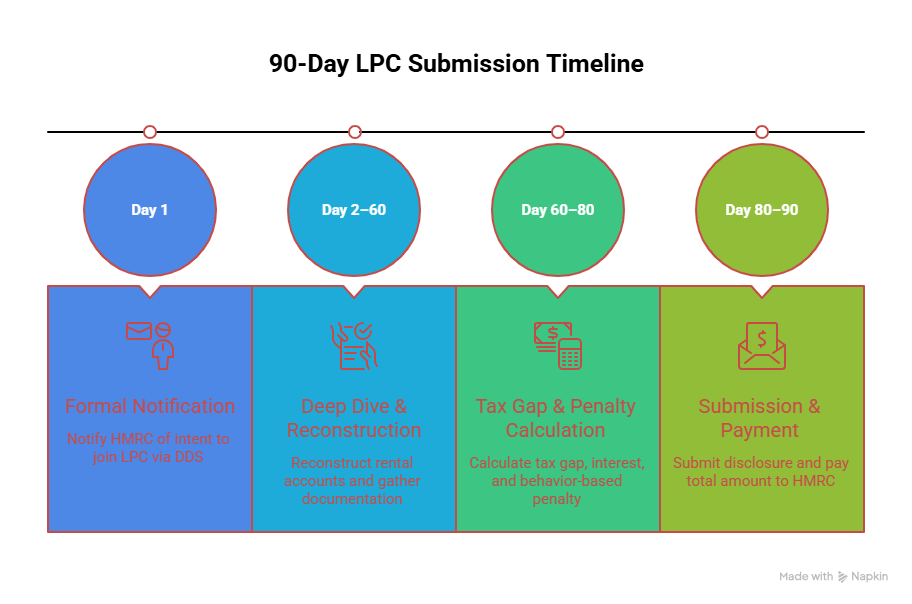
There are two distinct stages. First, you notify HMRC that you intend to disclose. HMRC then issues a disclosure reference and payment reference. You generally have 90 days from the date of HMRC’s notification acknowledgement to calculate and submit the disclosure.

By the deadline, HMRC should receive the disclosure and payment, or payment arrangements should have been made. The clock does not stop simply because you are still collecting records, applying for finance or discussing matters with your accountant.

A useful first action is to record the exact deadline on HMRC’s letter. Do not confuse it with the annual Self Assessment filing deadline or assume HMRC will grant extra time without agreement. Read our practical disclosure process guide for the full sequence.

Work out the real liability before suggesting payments

Do not estimate a payment plan based on gross rents alone. The amount owed may include unpaid Income Tax, interest and relevant penalties, taking account of the correct treatment of allowable expenses and, where applicable, residential finance-cost tax reductions.

Prepare a year-by-year schedule showing the rent received, deductible expenses, taxable rental profit, other income and estimated additional tax. Then calculate statutory interest using the applicable rates and dates. An accurate calculation matters because overstating the bill may make repayment appear impossible, while understating it may produce an incomplete disclosure.

For example, suppose a landlord calculates £14,500 of additional Income Tax, £2,400 interest and £1,100 penalties, a total of £18,000. They have £5,000 available and expect £500 a month of genuinely spare cash. That information may provide a starting point for discussing an arrangement, but HMRC has not pre-approved an £18,000 debt to be paid over 26 months. It will assess the facts, including savings and other assets.

What financial information does HMRC ask for?

HMRC says it may ask for the disclosure reference, a proposed payment schedule and your financial position. Gather these details before calling:

  • Monthly income, including salary, rental income and other regular receipts.
  • Ordinary living costs, mortgage payments and essential business expenditure.
  • Cash and bank balances, investments, vehicles and property assets.
  • Existing debts, loan payments and other liabilities.
  • How much you can pay immediately and a realistic timetable for the balance.

Be accurate and candid. HMRC may ask about assets even if they are not readily convertible to cash. A budget showing genuine affordability is more helpful than a promise you cannot keep.

How to approach HMRC about a payment arrangement

Start by completing enough of the rental tax calculations to know the likely total. Call the Let Property Campaign helpline using the contact details in HMRC’s official guidance. Explain that you want to correct the under-declaration but cannot pay the full amount at once.

Ask how HMRC wants you to proceed, what evidence it needs and whether any proposed arrangement can be confirmed in writing. Keep a note of the date, person spoken to and reference number. Do not submit a disclosure on the assumption that payment instalments have already been agreed when they have not.

An accountant can prepare a year-by-year tax computation, review the penalty position and help you put a properly supported proposal to HMRC. This does not guarantee acceptance but improves the accuracy of the information presented.

Will interest or penalties disappear under a payment plan?

Usually not. Late-payment interest and disclosure penalties are separate matters. Statutory interest is generally calculated from the original due dates up to payment, and further interest may arise while tax remains unpaid. A payment agreement is not the same as a waiver of interest.

Penalties depend on the facts, including whether an error was careless or deliberate, what HMRC knew and how the disclosure was made. Never promise a zero penalty simply because the landlord came forward voluntarily. Our guide to LPC penalties explains the principles.

Common mistakes to avoid

  • Waiting until day 89 before investigating the figures or contacting HMRC.
  • Treating an estimate as the final liability without checking mortgage interest restrictions.
  • Assuming an instalment proposal is automatically approved.
  • Omitting other historic undeclared income that must be addressed.
  • Offering monthly payments without budgeting for current tax obligations.
  • Ignoring HMRC correspondence once a payment discussion has started.

If you have already missed a deadline or received an enquiry notice, the correct route may differ from an ordinary voluntary LPC disclosure.

Frequently asked questions

Can I submit the disclosure first and request a payment plan afterwards?

HMRC’s LPC guidance says to contact it before submitting if you cannot pay in full. Discuss payment arrangements before the disclosure is sent.

Can HMRC force me to sell a rental property?

HMRC may consider your assets when assessing affordability and can pursue recovery if liabilities remain unpaid. The consequences depend on the individual case. Seek specialist advice rather than assuming that ownership of property prevents any arrangement.

Can an accountant negotiate directly with HMRC?

An authorised tax adviser can communicate with HMRC, prepare calculations and assist with a proposal. HMRC makes the final decision on any payment arrangement.

Does a payment arrangement guarantee that HMRC accepts my disclosure?

No. The disclosure must still be complete and accurate, and HMRC can ask questions or reject a materially incorrect submission.

The practical next step

If the bill looks unaffordable, start the tax calculation early and approach HMRC before the LPC deadline. Felix & Co. Accountants can assess the historic rental profit, interest, penalties and a realistic payment proposal together. Book a confidential 15-minute consultation.

For professional guidance on eligibility, calculations and dealing with HMRC, see our Let Property Campaign accounting service.

Categories
Blogs Let Property Campaign

Undeclared Rental Income and Making Tax Digital: What Landlords Must Do Next

Correcting several years of undeclared rental income is an important step, but it is only part of getting your tax affairs up to date. For some landlords, undeclared rental income and Making Tax Digital now raise two different tasks: fixing historic returns and complying with current digital reporting obligations.

The Let Property Campaign deals with earlier omissions where it is the appropriate HMRC route. Making Tax Digital for Income Tax (MTD) sets ongoing digital record-keeping and quarterly update obligations for individuals who are within scope.

Are the Let Property Campaign and MTD the same thing?

No. The Let Property Campaign (LPC) is HMRC’s route for eligible individual residential landlords correcting previously undeclared tax. It normally involves determining the tax due for relevant older years, interest and penalties, with a disclosure within 90 days after notification acknowledgement.

MTD for Income Tax concerns how qualifying sole traders and landlords keep digital records, submit quarterly updates and complete their annual tax return. Submitting an LPC disclosure does not automatically fulfil MTD updates; sending MTD quarterly information does not settle old, undeclared years.

The correct approach is to deal with both where necessary, not to put historic arrears into a current quarterly update.

MTD for Income Tax thresholds and start dates

HMRC is introducing MTD for Income Tax in stages. The key thresholds and reference years are:

  • From 6 April 2026: qualifying income over £50,000, based generally on the 2024/25 return.
  • From 6 April 2027: qualifying income over £30,000, based generally on the 2025/26 return.
  • From 6 April 2028: qualifying income over £20,000, based generally on the 2026/27 return.

These figures concern relevant gross qualifying income from self-employment and property, before expenses, not merely rental profit or total employment salary. Jointly owned property and special situations require further checking.

For example, a landlord with gross property income of £38,000 and no self-employment income would not meet the £50,000 first-stage threshold on that figure alone, but might fall within the later £30,000 stage if the relevant qualifying income tests are satisfied.

What if an old tax return understated your qualifying income?

This is worth reviewing carefully. A landlord may have reported £22,000 of gross property income in a relevant return but later discover another rental property that should have been included.

Correcting the return could change the qualifying-income position used to decide whether and when MTD applies. Do not assume an old incorrect figure protects you from future obligations.

Check the applicable HMRC rules, relevant reference years, amendments and any HMRC notices. The MTD start date depends on the actual circumstances, not simply the year you first became a landlord.

What information must a landlord record digitally?

Landlords within MTD must use compatible software to create and retain digital records of the required property income and expenses and send quarterly summaries to HMRC.

Useful records typically include:

  • Rent received, linked to each property and transaction date.
  • Agent statements reconciling gross rent, fees and net payments.
  • Expenses such as insurance, repairs and professional fees.
  • Finance costs and supporting mortgage statements.
  • Property ownership and relevant allocation details.
  • Supporting invoices, bank evidence and adjustments.

Keep the accounts sufficiently organised to distinguish capital expenditure, rental losses and special reliefs. A digital spreadsheet may assist, but confirm your software arrangements and any applicable digital-link rules comply with HMRC requirements.

Do quarterly updates replace the annual tax return?

No. HMRC confirms that people within MTD must still complete their annual tax return, using compatible software and the relevant procedures. Quarterly updates are summaries of business or property income and expenses, not final tax assessments for each quarter.

Similarly, there is no general rule that the quarterly update causes Income Tax to become payable four times a year. Normal annual tax payment obligations continue, subject to the applicable rules.

This distinction is particularly important to landlords who have just settled a large historic LPC bill and are concerned about extra immediate quarterly payments.

Example: from disclosure to regular compliance

Consider a landlord who omitted rent for 2019/20 to 2023/24 and also has substantial current rental turnover. The sensible sequence may be:

  1. Reconstruct historic rent and allowable costs year by year.
  2. Establish which earlier years belong in an LPC disclosure and which recent returns require amendments or filing.
  3. Calculate Income Tax, interest and any penalties without double-counting.
  4. Check whether the landlord meets the MTD income threshold in the relevant reference year.
  5. Choose suitable digital bookkeeping and MTD-compatible submission software.
  6. File current returns and updates on time.

Working with an adviser can make the historic and ongoing record sets consistent without treating them as interchangeable.

For help getting ready to file accurately, see our guide to registering for and filing Self Assessment.

n

Common MTD mistakes for landlords correcting old income

A frequent mistake is using net bank deposits after letting-agent fees as the only rent figure without identifying gross receipts and expenses properly. Another is combining personal and jointly owned rental income incorrectly.

Landlords also sometimes include employment salary when deciding whether the MTD qualifying-income threshold is reached. HMRC’s threshold is based on the relevant property and self-employment income, not all taxable income in the same way as a Personal Allowance calculation.

Finally, an MTD software subscription cannot itself guarantee accuracy: finance-cost relief, property losses, joint ownership and historic adjustments still require sound tax treatment.

Frequently asked questions

If I make an LPC disclosure, do I automatically have to join MTD?

No. MTD depends on whether you fall within its scope and relevant thresholds. An LPC disclosure does not by itself make everyone subject to MTD.

Can MTD quarterly updates correct rent missing from six years ago?

No. Historic omissions must be corrected through the appropriate earlier-year tax return or disclosure process.

Do I need a separate MTD update for each rental property?

MTD reporting follows HMRC’s rules for your property business and individual circumstances; do not assume every property requires its own separate tax return.

Can a landlord use spreadsheets?

Some compatible arrangements use spreadsheets with bridging or other software. Verify the current HMRC rules and that the full system supports digital records and submissions.

Set up compliant property accounts after disclosure

Felix & Co. Accountants helps landlords reconstruct earlier tax years and organise current bookkeeping, Self Assessment and MTD obligations. Book a landlord tax and MTD review, or read our main LPC service page.