
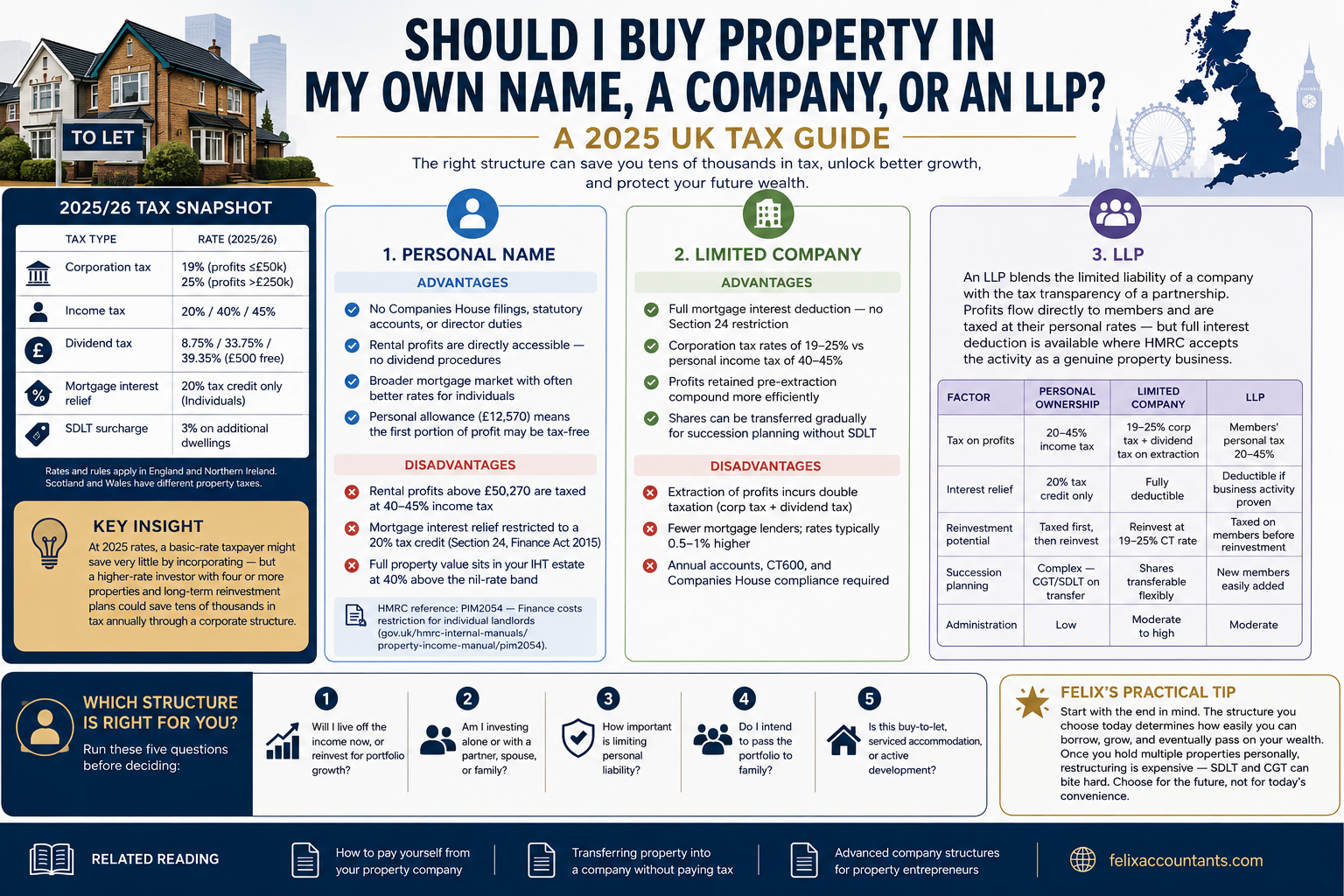
One of the most consequential decisions any UK property investor faces is deceptively simple to state: should you buy property in your personal name, through a limited company, or via a Limited Liability Partnership (LLP)? The answer will shape your tax bill, your mortgage options, your estate planning, and your long-term wealth for decades. This guide sets out the 2025/26 framework clearly so you can make the right call for your circumstances.
| Key Insight |
| At 2025 rates, a basic-rate taxpayer might save very little by incorporating — but a higher-rate investor with four or more properties and long-term reinvestment plans could save tens of thousands in tax annually through a corporate structure. |
The 2025/26 UK Property Tax Landscape
Before choosing a structure, understand the current rates that frame the decision.
| Tax Type | Rate (2025/26) | Applies To |
| Corporation tax | 19% (profits ≤£50k) — 25% (profits >£250k) | Limited companies |
| Income tax | 20% / 40% / 45% | Individual landlords |
| Dividend tax | 8.75% / 33.75% / 39.35% (£500 free) | Company profit extraction |
| Mortgage interest relief | 20% tax credit only | Individual landlords |
| SDLT surcharge | 3% on additional dwellings | All investors |
Option 1: Should I Buy Property in Your Personal Name?
Advantages
- No Companies House filings, statutory accounts, or director duties
- Rental profits are directly accessible — no dividend procedures
- Broader mortgage market with often better rates for individuals
- Personal allowance (£12,570) means the first portion of profit may be tax-free
Disadvantages
- Rental profits above £50,270 are taxed at 40–45% income tax
- Mortgage interest relief restricted to a 20% tax credit (Section 24, Finance Act 2015)
- Full property value sits in your IHT estate at 40% above the nil-rate band
HMRC reference: PIM2054 — Finance costs restriction for individual landlords (gov.uk/hmrc-internal-manuals/property-income-manual/pim2054).
Option 2: Should I Buy Property Through a Limited Company?
Advantages
- Full mortgage interest deduction — no Section 24 restriction
- Corporation tax rates of 19–25% vs personal income tax of 40–45%
- Profits retained pre-extraction compound more efficiently
- Shares can be transferred gradually for succession planning without SDLT
Disadvantages
- Extraction of profits incurs double taxation (corp tax + dividend tax)
- Fewer mortgage lenders; rates typically 0.5–1% higher
- Annual accounts, CT600, and Companies House compliance required
Option 3: Should I Buy Property Through an LLP?
An LLP blends the limited liability of a company with the tax transparency of a partnership. Profits flow directly to members and are taxed at their personal rates — but full interest deduction is available where HMRC accepts the activity as a genuine property business.
| Factor | Personal Ownership | Limited Company | LLP |
| Tax on profits | 20–45% income tax | 19–25% corp tax + dividend tax on extraction | Members’ personal tax 20–45% |
| Interest relief | 20% tax credit only | Fully deductible | Deductible if business activity proven |
| Reinvestment potential | Taxed first, then reinvest | Reinvest at 19–25% CT rate | Taxed on members before reinvestment |
| Succession planning | Complex — CGT/SDLT on transfer | Shares transferable flexibly | New members easily added |
| Administration | Low | Moderate to high | Moderate |
Which Structure Is Right for You?
Run these five questions before deciding:
- Will I live off the income now, or reinvest for portfolio growth?
- Am I investing alone or with a partner, spouse, or family?
- How important is limiting personal liability?
- Do I intend to pass the portfolio to family?
- Is this buy-to-let, serviced accommodation, or active development?
| Felix’s Practical Tip |
| Start with the end in mind. The structure you choose today determines how easily you can borrow, grow, and eventually pass on your wealth. Once you hold multiple properties personally, restructuring is expensive — SDLT and CGT can bite hard. Choose for the future, not for today’s convenience. |
Related Reading
How to pay yourself from your property company | Transferring property into a company without paying tax | Advanced company structures for property entrepreneurs
Frequently Asked Questions on How to Buy Property in the UK
Is it better to buy property in my own name or through a company in 2025?
For higher-rate taxpayers planning long-term portfolio growth, a limited company typically provides superior tax efficiency through lower corporation tax rates and full mortgage interest deduction. Personal ownership is simpler and may suffice for one or two properties with low gearing.
Can I move properties from my personal name into a company?
Yes, but this is treated as a disposal at market value, potentially triggering CGT and SDLT. Incorporation Relief (s.162 TCGA 1992) can defer CGT if the activity qualifies as a business. See our dedicated guide at felixaccountants.com/transfer-property-into-company-without-paying-tax/
What is Section 24 and does it affect my decision on how to buy property?
Section 24 (Finance Act 2015) restricts individual landlords to a 20% tax credit on mortgage interest rather than a full deduction. Limited companies are unaffected. This restriction is often the primary driver for incorporation decisions.
Does an LLP pay corporation tax when they buy property?
No. An LLP is tax-transparent — profits are allocated directly to members and taxed at their personal income tax rates. This means no corporation tax at entity level, but also no benefit from the lower 19–25% corporate rates.
What SDLT surcharge applies when you buy property through a company?
Companies purchasing residential property for £500,000 or more face a flat 15% SDLT rate unless the property is held for genuine letting or development purposes. The standard 3% additional-dwelling surcharge also applies to corporate purchases below that threshold.
| Ready to choose the right structure? Let Felix Accountants map out your optimal ownership model. |