
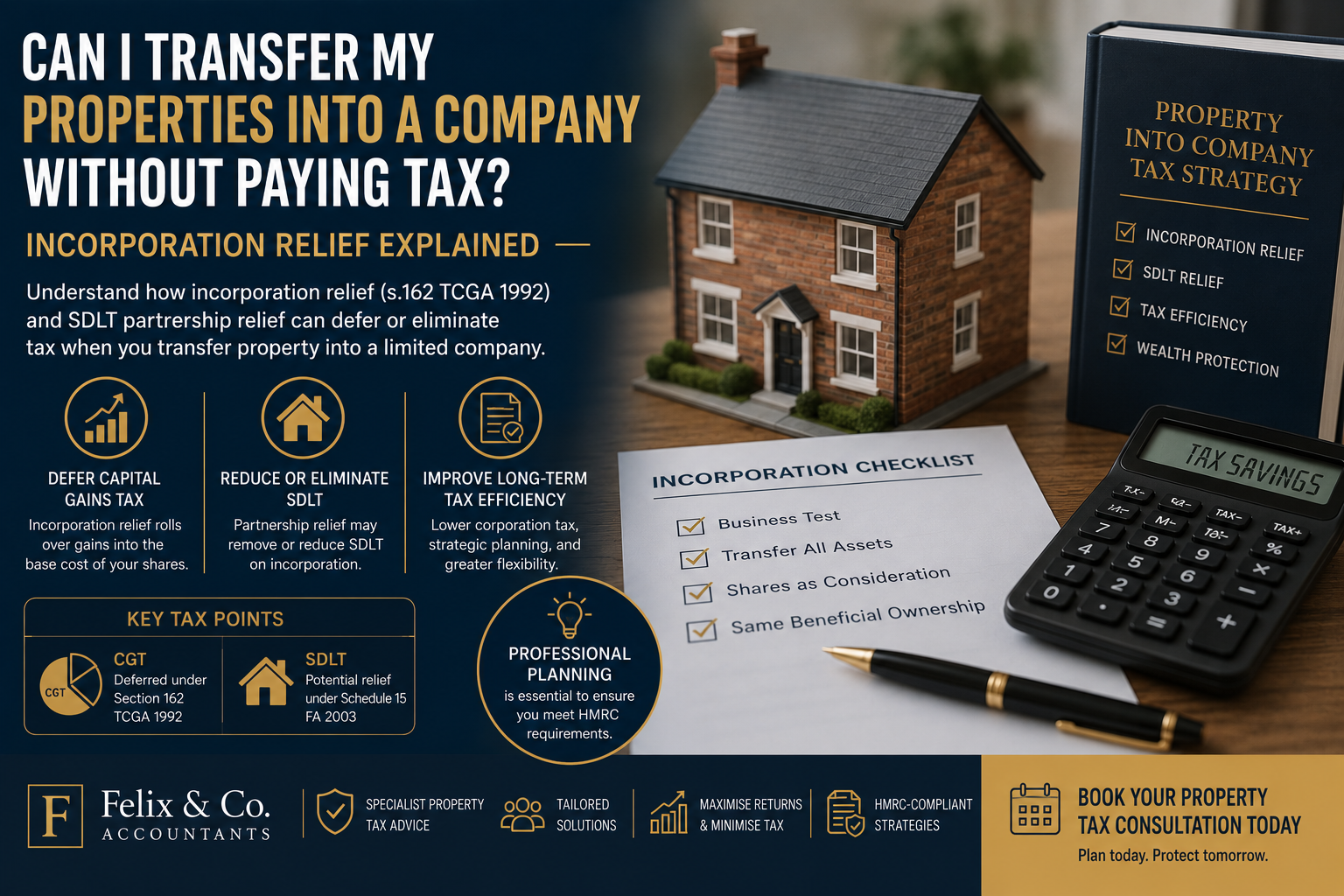
Many landlords ask whether they can transfer property into a limited company without paying tax in the UK. While incorporation can improve long-term tax efficiency, the transfer itself is treated as a disposal for tax purposes and may trigger Capital Gains Tax (CGT) and Stamp Duty Land Tax (SDLT). However, incorporation relief and SDLT partnership relief can significantly reduce or defer these charges when the correct conditions are met.
What Happens When You Transfer Property Into a Limited Company?
HMRC treats an incorporation as if you sold the properties to the company at market value, and the company simultaneously bought them at that same value. Two tax charges therefore arise simultaneously:
| Tax Charge | Who Pays | Basis of Calculation |
| Capital Gains Tax (CGT) | You (the individual) | Market value minus original acquisition cost and improvements |
| Stamp Duty Land Tax (SDLT) | The company | Market value of the property, potentially with 3% surcharge |
Incorporation Relief (Section 162 TCGA 1992)
This relief defers the capital gain that would otherwise crystallise on transfer. Instead of paying CGT immediately, the gain is ‘rolled over’ into the base cost of the shares you receive in the new company. No tax is paid now — it is deferred until you eventually sell the shares.
Four Conditions to Transfer Property Into a Limited Company Without Paying Tax
| Condition | Requirement | Practical Implication for Landlords |
| 1. A business must exist | Transferring a business, not merely an investment | Passive rent collection rarely qualifies — active management is required |
| 2. Whole business transferred | All assets (except cash) must transfer together | All properties, leases, and contracts move to the company |
| 3. Shares received as consideration | Transfer is wholly or partly in exchange for shares | You receive shares equal in value to net assets transferred |
| 4. Same beneficial ownership | Proportional share allocation | Co-owners receive shares in the same ratio as their property interests |
| The Business Test — Ramsay v HMRC [2013] |
| The Upper Tribunal confirmed in Ramsay v HMRC [2013] UKUT 0226 (TCC) that ‘mere ownership and rent collection is not sufficient’ to constitute a business. HMRC expects: 4+ properties, 20+ hours per week of active management, organised systems, third-party services, and documented activity records. |
How the CGT Deferral Works: A Worked Example
| Step | Amount |
| Original portfolio purchase price | £600,000 |
| Current market value | £1,000,000 |
| Potential capital gain | £400,000 |
| CGT payable without relief (at 24%) | £96,000 |
| CGT with incorporation relief | £0 — deferred into share base cost |
| Base cost of shares issued | £600,000 (market value £1m minus deferred gain £400k) |
SDLT Partnership Relief (Schedule 15 FA 2003)
Even where CGT is deferred, the company acquiring the property may owe SDLT. However, where the properties were held in a genuine business partnership, Schedule 15 of the Finance Act 2003 can eliminate or significantly reduce this SDLT charge.
| Pre-Incorporation Ownership | SDLT on Incorporation |
| Sole ownership | Full SDLT on market value (including 3% surcharge) |
| Genuine partnership (e.g. husband and wife) | Potential SDLT relief if partnership existed as a business before incorporation |
| LLP converting to Ltd Co | Relief may apply depending on continuity of ownership |
| Critical Requirement for Partnership Relief | |
| HMRC expects formal evidence of the partnership before incorporation: a partnership tax return (SA800), a separate bank account in the partnership name, and documented partnership accounts. Without this evidence, HMRC will deny relief and charge full SDLT on the market value. | |
Director’s Loan Account Benefit
Where the company assumes your outstanding mortgage, this creates a Director’s Loan Account (DLA) in your favour — equivalent to the equity you transferred. This balance can be drawn back from the company completely tax-free, providing an additional extraction route post-incorporation.
Related Reading
Personal vs company property ownership — 2025 guide | How to reduce SDLT legally on property purchases | Property portfolio demergers — splitting your holdings
Transfer Property Into a Limited Company FAQs
Do I pay CGT when I transfer my properties into a limited company?
Not immediately, if incorporation relief (s.162 TCGA 1992) applies. The gain is deferred into the base cost of your shares. However, the business test must be met — passive ownership does not qualify.
What CGT rate applies on eventual disposal of the shares?
Disposal of shares in a close company holding investment property will typically be subject to CGT at 20% (higher-rate taxpayers) under current rules. Business Asset Disposal Relief at 10% is unlikely to apply to purely investment portfolios.
What is the minimum number of properties needed for incorporation relief?
There is no statutory minimum, but HMRC and tribunal decisions suggest that four or more properties, combined with significant management activity (20+ hours/week), typically constitute a business for relief purposes.
Can I refinance the mortgages when I incorporate?
Existing lenders must consent to transfer their mortgages from personal to company name. Most residential buy-to-let lenders will require a full application and will charge arrangement fees. Bridging finance is sometimes used to facilitate the transition.
Is there a deadline for incorporating my portfolio?
There is no statutory deadline, but the sooner you incorporate (where it is beneficial), the sooner you benefit from lower corporation tax on profits. Additionally, the longer you wait, the larger the deferred gain that will crystallise on eventual share disposal.
| Before you transfer property into a limited company, it is important to review both the CGT and SDLT implications.. Book a consultation with Felix Accountants to stress-test your position before you commit. |
JSON-LD Schema Markup