
For UK business owners and high-earning investors, pension property investment offers an opportunity to combine retirement planning with commercial property ownership. When structured correctly, a pension can own commercial premises directly, with rental income and capital gains generally growing free from income tax and Capital Gains Tax (CGT). This article explains how SSAS and SIPP structures work, what types of property can be purchased, and the key compliance requirements to consider.
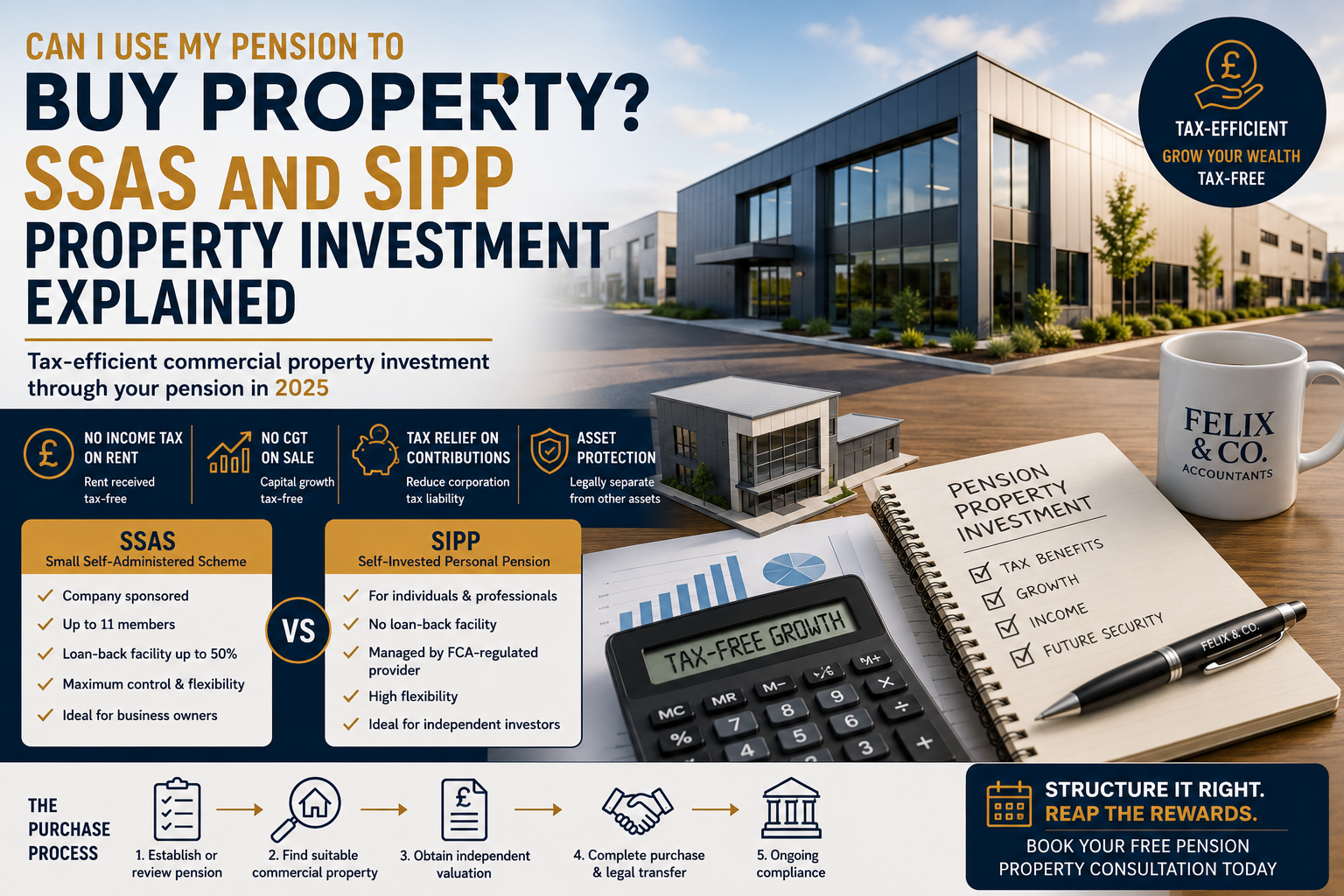
Pension Property Investment Benefits
| Benefit | Detail |
| No income tax on rent | Rental income received gross — accumulates tax-free within the pension |
| No CGT on sale | Any capital gain realised by the pension is entirely exempt from CGT |
| Tax relief on contributions | Employer contributions into SSAS/SIPP are deductible against corporation tax |
| Tax-free compounding | All returns reinvested without tax erosion |
| Asset protection | Pension assets are legally separate from personal/company assets — creditor protection |
| IHT Warning — Pensions from April 2027 | |
| Currently, pension death benefits pass outside the IHT estate. From April 2027, HMRC proposes to bring some pension death benefits within the IHT charge. The rules are not yet finalised. Review your pension and estate plan annually and take updated advice before making long-term IHT planning assumptions based on pensions. | |
Pension Property Investment: SSAS vs SIPP
| Feature | SSAS (Small Self-Administered Scheme) | SIPP (Self-Invested Personal Pension) |
| Who is it for? | Company-sponsored — directors and family members | Individuals and professionals without a trading company |
| Membership | Up to 11 members | Individual (though joint purchases possible) |
| Investment control | Trustees (usually directors) make all decisions | Managed through FCA-authorised provider |
| Loan-back facility | Yes — up to 50% of net assets lent back to sponsoring company | No — SIPPs cannot lend to connected persons |
| Flexibility | Highest — can pool assets between members | High — but within provider’s permitted investments |
| Best suited for | Business owners buying trading premises for their company | Independent investors seeking direct commercial property exposure |
Pension Property Investment Rules for Commercial Property
Both SSAS and SIPP can purchase commercial property: offices, retail units, industrial premises, warehouses, and land intended for commercial development. Residential property is almost never permitted — HMRC’s ‘taxable property’ rules impose punitive charges of up to 55% of the property value on prohibited residential investments.
| The Residential Property Prohibition |
| A house or flat cannot be held in a SSAS or SIPP. Even a flat above a shop may be problematic unless the residential element is clearly incidental to the commercial use and let to a completely unconnected third party at full market rent. Always obtain written confirmation from the pension provider and HMRC specialist before proceeding. |
Pension Property Investment Purchase Process
- Establish or review the SSAS/SIPP — confirm registration with HMRC, available funds, and borrowing headroom
- Identify a suitable commercial property and confirm eligibility with the pension provider
- Obtain an independent market valuation from a RICS-qualified surveyor
- Agree purchase terms — the pension scheme buys directly, sometimes jointly with the sponsoring company
- Appoint solicitors and coordinate legal transfer — all rent thereafter must flow to the pension’s bank account
- Maintain ongoing compliance: market-rate rent, buildings insurance, annual scheme accounts
Strategic Uses: Business Owners
- Buy your company’s trading premises: the business pays rent into the pension instead of to a third-party landlord
- Succession planning: SSAS members can include next-generation family members
- Business funding: SSAS loan-back allows the pension to finance company growth at interest rates retained within the scheme
- Channel property company profits into the pension to reduce corporation tax and reinvest within a tax-free wrapper
Related Reading
How to pay yourself from your property company | Pass on property wealth without paying too much tax | Advanced company structures for property entrepreneurs
Frequently Asked Questions
Can a SIPP or SSAS buy residential property?
No. Residential property is ‘taxable property’ under HMRC rules. If held in a pension, HMRC imposes an unauthorised payment charge of up to 55% of the property’s value. Only commercial property qualifies for direct pension ownership.
How much can a pension borrow to purchase property?
Both SSAS and SIPP schemes can borrow up to 50% of their net assets at the time of borrowing. The loan must be at a commercial interest rate and repaid within a reasonable term.
What happens to the property when I retire?
The pension can continue to hold the property and generate rental income to fund drawdown payments. Alternatively, the property can be sold at any time, with proceeds available for drawdown. CGT does not apply to disposals within the pension wrapper.
Can I rent my company’s premises from my SSAS pension?
Yes. This is one of the most powerful uses of a SSAS. Your company pays rent at full market value to the pension, generating a corporation tax deduction for the company and tax-free rental income growth for the pension. The lease must be formally documented and market rent confirmed by an independent surveyor.
What is the annual allowance and does it limit pension property investment?
The annual allowance (£60,000 for 2025/26) caps total pension contributions — employer plus employee — that receive tax relief. It limits how quickly you can build pension funds. However, existing pension assets can be used to buy property immediately, and prior-year carry-forward provisions can boost contribution levels.
| A pension-owned property is one of the most tax-efficient assets available to UK business owners. Let Felix Accountants show you how to structure yours. |
JSON-LD Schema Markup