
Making Tax Digital for Income Tax Self Assessment (MTD ITSA) becomes mandatory for many UK landlords from 6 April 2026. Landlords with annual property income above £50,000 will need to maintain digital records, use HMRC-compliant software and submit quarterly updates to HMRC. This is far more than a paperwork change — it requires a complete shift to digital record-keeping and ongoing reporting. Landlords who prepare early will find the transition straightforward, while those who delay risk penalties, errors and last-minute compliance pressures.
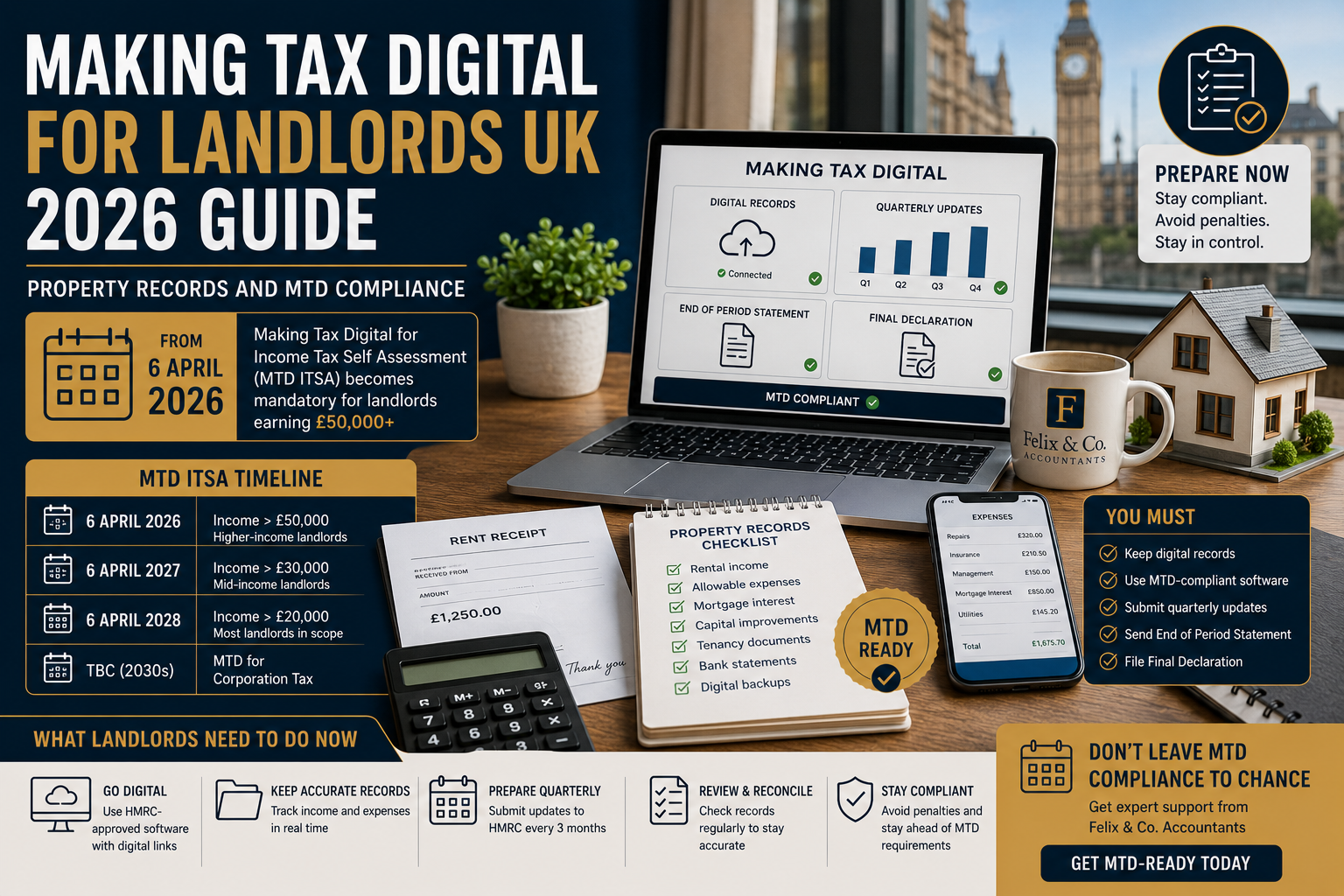
Making Tax Digital Timeline for Landlords
| Date | Threshold | Who Is Affected |
| 6 April 2026 | Gross property/self-employment income >£50,000 | Higher-income landlords and self-employed individuals |
| 6 April 2027 | Income threshold reduces to £30,000 | Mid-income landlords added to scope |
| 6 April 2028 | Income threshold reduces to £20,000 | Majority of active landlords now within scope |
| TBC (2030s) | MTD for Corporation Tax | Companies including property SPVs — date under consultation |
What Making Tax Digital Requires in Practice
- Keep digital records of all income and expenses using HMRC-approved software
- Submit quarterly updates to HMRC (summarising income and expenditure for each property)
- Submit an End-of-Period Statement (EOPS) at year end to finalise figures
- File a Final Declaration (replacing the traditional annual self-assessment return)
| What HMRC Means by ‘Digital Link’ |
| HMRC requires that data flows electronically from its point of origin to the HMRC submission — without manual re-entry. This means you cannot use a spreadsheet to calculate figures and then re-key them into submission software. The connection must be digital throughout the chain. |
Records You Must Keep for Each Property
| Record Category | Examples | Retention Period |
| Rental income | Bank statements, rent receipts, tenant invoices, deposit records | 5 years after filing deadline |
| Allowable expenses | Repair invoices, insurance certificates, management fee statements | 5 years after filing deadline |
| Finance costs | Mortgage statements (interest element), loan agreements | 5 years after filing deadline |
| Capital items | Receipts for improvements (for CGT records) | Indefinitely while property is held + 5 years |
| Legal & tenancy documents | Tenancy agreements, safety certificates, notices | Life of tenancy + 5 years |
Recommended Digital Accounting Platforms
- QuickBooks Online — strong bank-feed integration; suitable for multi-property portfolios
- Xero — excellent reporting and multi-entity management for company portfolios
- FreeAgent — designed for smaller property portfolios and sole traders
- Landlord Vision / Arthur Online — property-specific platforms with direct HMRC integration
Making Tax Digital Compliance Mistakes to Avoid
- Using spreadsheets alone without an HMRC-approved digital link to the submission system
- Mixing personal and property business transactions in the same bank account
- Recording expenses retrospectively from memory rather than at the time of payment
- Ignoring small receipts — mileage logs, postage, cleaning supplies all add up significantly
- Failure to reconcile bank feeds monthly, leading to duplicates and errors in submissions
Related Reading
Allowable expenses for property investors | Serviced accommodation and HMO tax guide | Furnished Holiday Let tax benefits and compliance
Frequently Asked Questions
Do I have to use MTD if I earn less than £50,000 from property?
Not from April 2026, but the threshold reduces to £30,000 from April 2027 and £20,000 from April 2028. Starting to use compliant digital software now means the transition will be seamless when your threshold is reached.
Can I continue using a spreadsheet for my property records?
Only if it uses a HMRC-compliant bridging solution that maintains a digital link to the submission platform. A spreadsheet used in isolation and then re-keyed into another system will not meet the MTD requirements.
What does a quarterly MTD submission contain?
Each quarterly submission summarises total income and total expenses for the period. It is not a tax return — you are not paying tax quarterly. It simply updates HMRC’s view of your position throughout the year, with the Final Declaration at year-end confirming the total.
Are limited companies included in MTD ITSA?
No. MTD ITSA covers individual landlords and self-employed people. Companies (including property SPVs) will be subject to a separate Making Tax Digital for Corporation Tax regime, which is still under consultation and expected later in the decade.
What are the penalties for non-compliance with MTD?
HMRC operates a points-based penalty system for late MTD submissions. Each missed quarterly update accrues a penalty point, and a financial penalty is triggered once a threshold is reached. The penalties escalate for persistent non-compliance.
| Don’t leave your MTD compliance to chance. Felix Accountants provides end-to-end digital bookkeeping support for UK landlords. |
JSON-LD Schema Markup