Living abroad doesn’t mean you’re out of reach for HM Revenue & Customs (HMRC). In fact, in 2026, the digital trail left by overseas landlords is easier than ever for the UK tax office to follow. Whether you’re a UK expat working in Dubai, a retiree in Spain, or a foreign investor, if you receive income from a UK property, you generally owe UK tax. Expat Tax Rules
Many overseas landlords mistakenly believe that because they pay tax in their country of residence, or because their UK letting agent deducts tax at source, they have no further obligations. At Felix Accountants, we specialize in the Non-Resident Landlord Scheme (NRLS) and helping overseas owners regularize their past through the Let Property Campaign (LPC).
1. What is the Non-Resident Landlord Scheme (NRLS)?
The NRLS is a tax regulation designed to ensure HMRC gets its cut of rental income from landlords whose “usual place of abode” is outside the UK (typically staying abroad for 6 months or more).
Under the scheme, there are two ways tax is collected:
Withholding at Source: Your letting agent (or your tenant, if they pay over £100/week) must deduct 20% basic rate tax from your rent and pay it directly to HMRC.
Gross Payment: You can apply to HMRC using Form NRL1 to receive your rent in full. If approved, you are responsible for paying the tax yourself via a Self Assessment tax return.
The Common Trap: Receiving rent “gross” does not mean the rent is tax-free. It simply means you’ve promised HMRC you will handle the paperwork yourself. If you receive rent gross but fail to file a return, you are in breach of the scheme.
2. Why Overseas Landlords are “High Risk” for HMRC
In 2026, HMRC’s Connect system is linked to global exchange agreements. HMRC now receives data from banks in over 100 countries. If you are transferring funds from a UK letting agent to an overseas account, or if you have a UK mortgage but a foreign address, the system flags you.
Common reasons overseas landlords fall behind:
Assuming the Letting Agent handles it: They only deduct 20%; they don’t file your personal tax return or claim your personal allowance.
Double Taxation Confusion: Thinking you only pay tax where you live. (Most treaties state property income is taxed first in the country where the property is located).
The “Mortgage Wash” Myth: Thinking that if the rent just covers the mortgage, there is no profit to declare.
3. How the Let Property Campaign Works for Expats
If you’ve realized you have years of undeclared UK income, the Let Property Campaign (LPC) is your best route to safety. It is open to non-resident individuals (but not companies or trusts).
The Advantage for Expats:
If you come forward voluntarily, we can often argue that being “out of the country” or “confused by international rules” constitutes Reasonable Care or a Non-Deliberate error.
By using the LPC, you can:
Secure lower penalties (often 0% to 20%).
Avoid a formal, intrusive tax enquiry that might look into your other global assets.
Clean up your UK record before you decide to sell the property or move back.
4. Capital Gains Tax: The “Exit” Trap
If you are an overseas landlord looking to sell your UK property in 2026, you face a strict Non-Resident Capital Gains Tax (NRCGT) regime.
You must report the sale to HMRC within 60 days of completion.
You must pay the tax within that same 60-day window.
The Problem: If your rental income history isn’t clean, HMRC may hold up the sale or use the sale notification to trigger an audit of the last 20 years of rent.
Using the Let Property Campaign before you list the property for sale is a vital strategic move.
5. Claiming Your Personal Allowance
Even as a non-resident, many people (including UK citizens and EEA nationals) are still entitled to the UK Personal Allowance (£12,571 in 2026).
If your UK rental profit is £10,000, and you have no other UK income, you owe £0 in tax.
However, you must still file a return to claim this allowance. If your agent has been deducting 20% tax, you can actually use your tax return to claim a refund of every penny they took.
6. How Felix Accountants Supports Global Landlords
Distance shouldn’t be a barrier to compliance. We offer a digital-first service for overseas clients:
Remote Consultation: Video calls in your time zone.
Digital Disclosure: We handle the entire LPC submission through HMRC’s Digital Disclosure Service.
NRL1 Applications: We help you apply to receive rent gross for the future.
Refund Management: If you’ve overpaid via withholding tax, we get your money back.
Frequently Asked Questions (FAQs)
Q1: I pay tax in the USA/Dubai/Australia. Do I still pay in the UK?
Yes. The UK has the “primary taxing right” on UK land. You pay the UK first. You can then usually claim a “Foreign Tax Credit” in your home country so you don’t pay twice on the same money.
Q2: My tenant pays me directly into my UK bank account. Does HMRC know?
Highly likely. In 2026, banks share “suspicious activity” reports and data on large regular transfers with HMRC. Furthermore, the Land Registry records show you own the house but aren’t living there.
Q3: Can I use the LPC if I own the property through a BVI or Jersey company?
No. The Let Property Campaign is for individuals only. Non-resident companies must use a different disclosure route and are subject to UK Corporation Tax.
Q4: I haven’t lived in the UK for 10 years. How far back will they look?
If the failure to disclose was “Careless,” they look back 6 years. If they deem it “Deliberate” (because you knew the rules but ignored them), they can go back 20 years.
Q5: Will using the LPC affect my immigration status or visa?
Usually, no. HMRC is a separate department from the Home Office. In fact, having “clean” tax affairs is often a requirement for many visa renewals and citizenship applications.
Protect Your UK Investment from Abroad
Don’t let an administrative oversight in the UK turn into a global legal headache. Whether you owe tax or are due a refund, Felix Accountants will bridge the gap between you and HMRC.
Joint Ownership Tax_ Why Both Owners Must Disclose Separately to HMRC - visual selection
One of the most common reasons landlords fail a tax audit is a misunderstanding of how Joint Tax Ownership. Many couples assume that if the rent goes into a joint bank account, or if one partner manages the property, only one tax return is needed.
In 2026, HMRC’s “Connect” system is specifically designed to flag properties with multiple owners where only one (or neither) is declaring income. At Felix Accountants, we frequently handle cases where a husband and wife are both pursued for back-tax because they didn’t realize that joint ownership requires dual disclosures.
1. The “50/50 Rule” for Married Couples
If you are married or in a civil partnership and living together, HMRC applies a strict “default” rule: Rental income is split 50/50 for tax purposes.
It does not matter if:
One of you earned all the money to buy the house.
The rent is paid into only one person’s bank account.
One of you does all the “work” of being a landlord.
Unless you have a specific legal agreement (see Form 17 below), HMRC will expect each of you to declare exactly 50% of the profit on your own individual tax returns.
2. The “Separate Disclosure” Requirement
This is the part that catches most people out during the Let Property Campaign (LPC). If a husband and wife have undeclared income from a jointly owned property:
You cannot make one joint disclosure.
Each person must notify HMRC separately.
Each person will receive their own unique Disclosure Reference Number (DRN).
Each person must submit their own 90-day calculation showing their share of the income.
The Risk: If only the husband discloses and the wife doesn’t, HMRC will accept the husband’s money but then open a separate investigation into the wife for her 50% share—often with higher “prompted” penalties.
3. Changing the Split: Form 17 and Deeds of Trust
Sometimes, it is more tax-efficient for the lower-earning partner to receive more of the income. For example, if the wife is a basic-rate taxpayer and the husband is a higher-rate taxpayer, you might want a 90/10 split in her favor.
To do this legally in 2026, you must:
Have a Deed of Trust: A solicitor must draft a document showing you own the property in unequal shares (as “Tenants in Common”).
Submit Form 17: You must notify HMRC of this unequal split within 60 days of signing the deed.
Important Note for LPC: You cannot backdate a Form 17. If you are disclosing for the last 6 years and you only just signed a Deed of Trust, you must still disclose the previous years on a 50/50 basis. You can only use the new split for the future.
Joint Ownership Tax_ Why Both Owners Must Disclose Separately to HMRC – visual selection
If you own a property with someone you are not married to, the rules are different:
You are generally taxed according to your actual ownership share (e.g., if you own 70% of the house, you pay tax on 70% of the rent).
You can agree to a different split of profits and losses, but it must reflect the reality of your agreement and be supported by evidence.
Just like married couples, both of you must file separate tax returns or LPC disclosures.
5. The “Personal Allowance” Strategy
Joint ownership is often a powerful tool for reducing your total tax bill.
Example: A property makes £20,000 profit. If only one person owns it and they are a higher-rate taxpayer, they pay £8,000 in tax.
If a married couple owns it 50/50, they each have £10,000 profit. If neither has other income, that £10,000 falls within their Personal Allowance (£12,571), and the total tax bill is £0.
This is why HMRC is so aggressive in checking that both parties are declaring; the “missing” 50% often represents a significant amount of lost tax revenue for the government.
6. How Felix Accountants Manages Joint Disclosures
When a couple comes to us with a joint property issue, we provide a coordinated service:
Mirror-Image Disclosures: We prepare both disclosures simultaneously to ensure the figures match perfectly (HMRC will flag any discrepancies).
Penalty Mitigation: We argue that since you are disclosing as a household, you are showing maximum cooperation, which helps keep penalties for both partners at the minimum.
Future-Proofing: We help you decide if a Form 17 election is right for you moving forward to keep your future tax bills as low as possible.
Joint Tax Disclosure
Frequently Asked Questions (FAQs)
Q1: My husband is the only one on the mortgage, but we both own the house. Who pays the tax?
Tax follows beneficial ownership, not necessarily the mortgage. If you have a legal document showing you both own the property, you both must declare the income. If only one person is on the title deeds, that person is usually 100% responsible unless a “Trust” exists.
Q2: We have a joint bank account where the rent goes. Is that enough for HMRC?
No. A joint bank account is not proof of a joint tax liability. HMRC looks at the legal and beneficial ownership of the property itself.
Q3: Can one of us pay the full tax bill for both of us?
No. HMRC treats you as two separate taxpayers. You must each pay your own share of tax, interest, and penalties from your own (or joint) funds under your own reference numbers.
Q4: What if my partner refuses to disclose?
This is a difficult situation. You should still make your 50% disclosure to protect yourself. This prevents you from being charged with “Deliberate” concealment, even if your partner remains non-compliant.
Q5: If we sell the house, do we both pay Capital Gains Tax (CGT)?
Yes. Each owner has their own CGT Annual Exempt Amount. By owning the property jointly, you can effectively double your tax-free allowance when you sell.
Double the Owners, Double the Care
Joint ownership is a great way to share the rewards of property investment, but it comes with dual responsibilities. If you and your co-owner haven’t been filing separate returns, Felix Accountants can help you both get back on track together.
When a family member passes away or moves into full-time residential care, the practicalities of managing their home can be overwhelming. One of the most common solutions we see at Felix Accountants is for families to rent out the property to cover the significant costs of care home fees. Care home rent tax.
There is a widespread misconception that because the money is going directly to a “good cause”—like a nursing home—the income is not taxable. Unfortunately, in the eyes of HMRC, rental income is taxable regardless of how the profit is spent. This article clarifies the tax position for executors and beneficiaries to ensure you don’t inadvertently create a new tax debt while trying to care for a loved one.
Many families assume that if the care home fees are £3,000 a month and the rent is £1,500 a month, there is “no profit” and therefore no tax.
The Tax Reality: Care home fees are considered a personal living expense, not a business expense. Just as you cannot deduct your own grocery bill or rent from your salary before paying tax, you cannot deduct care home fees from rental income.
Example: If you receive £18,000 in rent over a year and have £2,000 in allowable property expenses (insurance, repairs), your taxable profit is £16,000. It does not matter if all £16,000 was paid to a nursing home; you still owe tax on that profit.
2. Who is Responsible for the Tax?
The person or entity responsible for paying the tax depends on the current legal status of the property.
Scenario A: The owner is still alive but in care
If your parent or relative is still the legal owner, the rental income belongs to them.
The Process: They (or you, via Power of Attorney) must file a Self Assessment tax return in their name.
The Benefit: They still get their Personal Allowance (£12,571). If their only other income is a small state pension, much of the rental income might fall within their tax-free threshold.
Scenario B: The owner has passed away (The Probate Period)
If the owner has died but the property hasn’t been legally transferred to the beneficiaries yet, the property belongs to the “Deceased’s Estate.”
The Process: The Executor is responsible for reporting the income.
The Tax Rate: Estates do not get a Personal Allowance. Rental income is usually taxed at a flat 20% basic rate from the first pound of profit.
Scenario C: You have inherited the property
Once the property is transferred into your name, the income is yours.
The Process: You must report the income on your own Self Assessment return. The tax rate will depend on your other earnings (20%, 40%, or 45%).
3. The Danger of “Power of Attorney” Errors
We often help clients like “Adam,” who had Power of Attorney for his father. Adam rented out his father’s house to pay for a nursing home and assumed that because he wasn’t personally keeping the money, he didn’t need to tell HMRC.
The Risk: HMRC’s “Connect” system sees the property is being rented. If no tax return is filed, they will eventually issue a “nudge letter.” If the owner is elderly or incapacitated, this can create a stressful legal situation for the family. Using the Let Property Campaign is the safest way to correct these historical oversights.
4. Allowable Expenses: What You Can Deduct
While you cannot deduct the care fees, you can deduct legitimate property costs to lower the tax bill:
Letting Agent Fees: Management and finders’ fees.
Maintenance & Repairs: Fixing a leaky roof or broken boiler (but not “improvements” like an extension).
Property Insurance: Landlord-specific policies.
Utility Bills: If paid by the landlord during void periods.
Accountancy Fees: The cost of preparing the rental accounts.
5. Inheritance Tax (IHT) and the “Care Fee Debt”
If the local authority is paying for care via a Deferred Payment Agreement (DPA), they are essentially placing a loan against the house.
When the person passes away, this “debt” is deducted from the value of the estate before Inheritance Tax is calculated.
However, the rental income earned while the person was alive remains subject to Income Tax. You cannot offset the IHT debt against the Income Tax bill.
6. How Felix Accountants Can Help
Managing the affairs of a relative in care is emotionally draining. The last thing you need is a dispute with HMRC. We provide:
Estate Tax Management: We handle the filings for executors during probate.
LPC Disclosures: If you’ve been renting a relative’s home for years without realizing it was taxable, we can use the Let Property Campaign to settle the history with minimum penalties.
Power of Attorney Support: we work with Attorneys to ensure the donor’s tax affairs are kept in perfect order.
Frequently Asked Questions (FAQs)
Q1: Is there any “Care Home Relief” for property tax?
No. There is no specific relief in the UK tax code that allows rental income to be tax-free simply because it pays for care.
Q2: What if the property is held in a Life Interest Trust?
In this case, the “Life Tenant” (the person in care) is usually entitled to the income. The trustees are responsible for ensuring the tax is paid, but it is typically taxed at the Life Tenant’s rates.
Q3: Can I split the income with my siblings to use our Personal Allowances?
Only if you all legally own a share of the property. If the property is still in your parent’s name, the income must be reported as theirs. If you have inherited it jointly, the income is split according to your ownership shares.
Q4: We are selling the house to pay the care fees. Do we pay tax on the rent in the meantime?
Yes. Even if you only rent the property for six months while waiting for a sale, that income must be declared if it exceeds the £1,000 allowance.
Q5: Does HMRC find out about inherited properties?
Yes. HMRC receives data from the Probate Office and the Land Registry. If a property changes hands and then appears on a rental site or has a tenant deposit registered, the “Connect” system will flag it.
Compassionate, Expert Tax Support
Dealing with care fees is difficult enough without a surprise tax bill. If you are managing a relative’s property, let Felix Accountants take the tax burden off your shoulders.
If you have received an HMRC “nudge letter” regarding undeclared rental income, you likely found a document titled “Certificate of Tax Position”enclosed, Tax Position Cert.
The letter usually asks you to tick a box, sign the declaration, and return it within 30 days.
At Felix Accountants, our advice to landlords is simple: Do not sign this certificate without professional representation. While the document looks like a standard administrative form, it is a legally binding declaration with significant risks. This article explains why the certificate is a “trap” for the unwary and how you should respond instead to protect your interests.
1. What is the Certificate of Tax Position?
The Certificate of Tax Position is a voluntary declaration form issued by HMRC. It is designed to “nudge” taxpayers into confirming their tax status. Usually, it offers you three or four checkboxes, such as:
I have declared all my rental income.
I have not been a landlord during the specified period.
I have additional tax to disclose (and will use the Let Property Campaign).
HMRC uses these certificates to filter their data. If you sign saying you are up to date, they may cross-reference your signature against their “Connect” database. If there is a discrepancy, your signature becomes evidence of a deliberate false statement.
2. The Legal “Catch”: It’s Not a Statutory Requirement
One of the most important things to understand is that there is no legal obligation to sign the Certificate of Tax Position. Unlike your annual Self Assessment tax return, which you are legally required to file, this certificate is an informal request. HMRC phrases the letter to make it seem mandatory, but they cannot legally penalize you simply for refusing to sign this specific form.
Why HMRC prefers the certificate over a letter:
By getting you to sign the certificate, HMRC forces you into a “Yes/No” corner. It removes the nuance of your specific situation. A professional letter from an accountant, however, allows for context, “Reasonable Excuse,” and technical explanations that the form simply doesn’t accommodate.
3. Four Major Risks of Signing Prematurely
Risk A: The “Perjury” Trap
The certificate often includes a declaration that the information is “correct and complete to the best of my knowledge and belief.” If you sign this and it is later proven that you missed even a small amount of income, HMRC can escalate the case from a “civil error” to a criminal investigation for “Dishonest Disclosure.”
Risk B: No “Look-Back” Limit
A standard tax return covers one year. The Certificate of Tax Position often covers all previous years. By signing it, you are making a blanket statement about your entire history as a landlord. If you haven’t performed a thorough “health check” on your records for the last 20 years, you are effectively signing a blank check for HMRC to investigate you if they find a single historical error.
Risk C: Admission of Guilt
If you tick the box saying “I need to disclose,” you have formally admitted to a tax irregularity before you even know the full figures. This can sometimes limit your ability to argue for lower penalties later, as you have already conceded that your affairs were not in order.
Risk D: Triggering a Formal Enquiry
Ironically, signing the “I am up to date” box can sometimes trigger the very investigation you were trying to avoid. If HMRC’s “Connect” system has strong data suggesting you owe tax, and you sign a document saying you don’t, they will view it as a “red flag” and open a full, intrusive enquiry.
4. Why Professional “Letter of Representation” is Better
Instead of signing the certificate, Felix Accountants typically recommends responding with a formal Letter of Representation.
A letter allows us to:
Acknowledge the Nudge: We show HMRC you are being cooperative (which helps keep penalties low).
Provide Context: We can explain why income wasn’t declared (e.g., you thought the “Rent-a-Room” scheme covered it, or you were living abroad).
Request More Time: We can formally ask for an extension to the 30-day deadline to conduct a proper audit.
Specify the Route: We can state that you are using the Let Property Campaign, which is a separate and more favorable disclosure route than the certificate.
5. What If My Tax Affairs Really Are Correct?
Even if you are 100% certain you owe no tax, we still advise against signing the certificate.
If you owe nothing (perhaps because your expenses exceed your income, or you qualify for specific reliefs), a detailed letter from an accountant explaining the math is far more likely to “close” the case than a ticked box. Ticking a box provides no proof; a professional letter provides evidence.
6. How Felix Accountants Protects You
When you bring your nudge letter to us, we follow a rigorous “Protection Protocol”:
Data Verification: We check what HMRC actually knows versus what your bank statements say.
Strategic Refusal: We notify HMRC that our client will not be signing the certificate but will provide a full response via our firm.
The “Reasonable Care” Argument: We build a case that any errors were not “deliberate,” potentially saving you thousands in penalties.
Peace of Mind: We act as the “buffer” between you and HMRC, handling all correspondence so you don’t have to deal with them directly.
Frequently Asked Questions (FAQs)
Q1: The letter says I must respond within 30 days. What happens if I don’t?
Ignoring the letter is the worst option. If you don’t respond, HMRC will assume the worst and likely open a formal tax enquiry. This is much more expensive and stressful than a voluntary disclosure.
Q2: Can HMRC fine me for not signing the certificate?
No. They cannot fine you for refusing to sign the certificate itself. However, they can fine you for the underlying unpaid tax. Our goal is to fix the tax issue without using their “trap” document.
Q3: My letting agent already deducts tax. Do I still need to worry about the certificate?
Yes. Letting agents often only deduct tax for “Non-Resident Landlords,” and even then, they might not deduct the correct amount. You are still responsible for filing a personal tax return and ensuring the total tax paid is accurate.
Q4: I already signed and sent the certificate. Am I in trouble?
Not necessarily, but you should contact us immediately. If you made a mistake on the certificate, we can “pre-empt” HMRC by submitting a correction through the Let Property Campaign before they start an investigation.
Q5: Will HMRC be annoyed if I don’t use their form?
HMRC investigators are used to dealing with accountants. They actually prefer a well-structured professional disclosure over a poorly completed form, as it makes their job of closing the case easier.
Don’t Sign Your Rights Away
The HMRC nudge letter is the start of a negotiation. Don’t give away your leverage by signing a document you don’t fully understand.
Contact Felix Accountants today for a confidential review of your nudge letter and a professional alternative to the Certificate of Tax Position.
For decades, the rhythm of the UK self-employed has been consistent: scramble in January, gather a shoebox of receipts, and file a tax return just before the deadline. As of April 6, 2026, that era ends for high-earning sole traders and landlords. Making Tax Digital for Income Tax Self Assessment (MTD for ITSA) is the most significant change to the UK tax system since the introduction of Self Assessment in the 1990s. It fundamentally shifts taxation from a retrospective annual “event” to a continuous, near-real-time “process.”
This guide is not just about compliance; it is about operational survival. The businesses that treat this transition as a software upgrade will thrive. Those that treat it as an administrative annoyance will face compounding penalties and cash-flow chaos.
This document serves as your manual for the 2026 transition. We will dissect the legislation, evaluate the software landscape, and provide a step-by-step roadmap to ensuring your business is digital-ready.
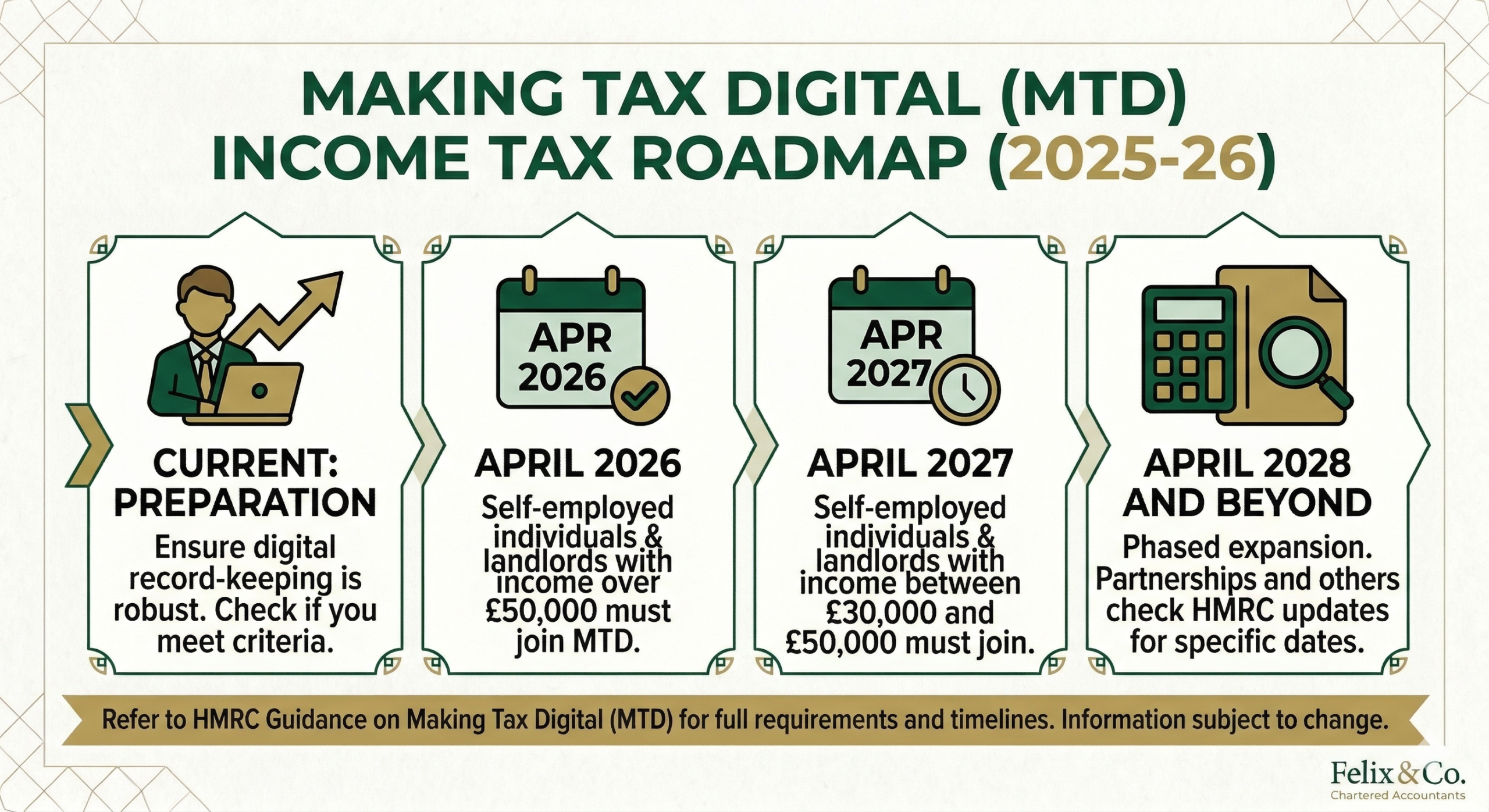
The government has delayed MTD several times, but the April 2026 deadline is now set in legislation. Understanding if you fall into “Phase 1” is critical.
The New Thresholds: The £50,000 Rule
The rollout is phased based on Qualifying Income.
Phase 1 (Starts April 6, 2026): You are mandated if your qualifying income is over £50,000.
Phase 2 (Starts April 6, 2027): You are mandated if your qualifying income is over £30,000.
Phase 3 (Under Review): Those earning under £30,000 are currently not mandated, but this is likely to change post-2027.
Qualifying Income: What Counts and What Doesn’t
A common error is confusing “Profit” with “Income.” The threshold is based on Gross Income (Turnover) before expenses are deducted.
If you have £60,000 in sales but £55,000 in expenses (leaving only £5,000 profit), you are still mandated to join MTD in 2026 because your gross income exceeds £50,000.
The Calculation Formula: You must aggregate (add together) all income from:
Self-Employment Turnover: Sales from your sole trader business.
Property Income: Gross rental income from UK property.
Example:
You run a consultancy earning £35,000 turnover.
You rent out a flat earning £16,000 gross rent.
Total Qualifying Income: £51,000.
Verdict: You are MANDATED for April 2026.
What is EXCLUDED from Qualifying Income:
Dividends from limited companies.
Employment income (PAYE salary).
Interest on savings.
Pension income.
The “Basis Period” Alignment
Before MTD begins, all businesses must align their accounting years with the tax year (April 6 to April 5). This process, known as Basis Period Reform, was largely completed in the 2023/24 and 2024/25 tax years.
By April 2026, you will no longer have a “basis period” that differs from the tax year. If your old accounting date was December 31st, it has legally been shifted to March 31st or April 5th for tax purposes. Your MTD software will assume this tax-year alignment automatically.
The New Rhythm of Reporting
Under the old system, you sent one data submission per year. Under MTD 2026, you will send at least five.
1. Digital Record Keeping: The Legal Requirement
This is the bedrock of MTD. You are no longer permitted to keep manual records. You cannot maintain a paper cashbook and then type the totals into a website once a year.
The Rules:
Transaction Level Data: You must record the date, value, and category of every single transaction digitally.
Near Real-Time: Records should be updated as transactions happen, or at least frequently enough to meet quarterly deadlines.
Digital Links: If you use more than one piece of software (e.g., a spreadsheet + bridging software), the data must move between them digitally (import/export), not by you manually copy-pasting figures.
2. The Quarterly Updates (Q1-Q4)
Every three months, your software must send a summary of your income and expenses to HMRC.
The Standard Quarters:
Quarter 1: April 6 – July 5 (Deadline: August 7)
Quarter 2: July 6 – October 5 (Deadline: November 7)
Quarter 3: October 6 – January 5 (Deadline: February 7)
Quarter 4: January 6 – April 5 (Deadline: May 7)
Note: These submissions are “cumulative” in many software designs, meaning if you spot a mistake in Q1 during Q2, you can often correct it in the next update rather than refiling the previous one (software dependent).
Crucially: These updates do not lock in your tax bill. They are estimates to give HMRC (and you) a view of your growing tax liability.
3. The Final Declaration (EOPS replacement)
Replaces the current SA100 tax return. Due by January 31st of the following year.
This is where you:
Make final accounting adjustments (accruals, prepayments).
Claim reliefs and allowances.
Confirm other non-business income (interest, dividends).
Finalize your tax calculation and pay.
Making Tax Digital
Software Adoption Strategy
HMRC does not provide software. You must purchase it. Your choice depends entirely on your business complexity and budget.
Option A: Comprehensive Cloud Suites (The “Gold Standard”)
These replace your current system entirely. You do your invoicing, expense tracking, and banking inside the software.
Xero: Excellent for collaboration with accountants. Strong ecosystem of add-on apps.
Best for: Businesses that want to automate.
QuickBooks Online: Very user-friendly, aggressive pricing, strong mobile app.
Best for: Solopreneurs who want simplicity.
FreeAgent: Often free if you bank with NatWest/Mettle. Designed specifically for freelancers.
Best for: Banking integration users.
Option B: Bridging Software (The “Spreadsheet Loyalists”)
If you have a complex Excel spreadsheet you refuse to abandon, you can use Bridging Software.
How it works: You keep using Excel. You add a specific “API Worksheet” to your file. You upload the file to the Bridging Software, which “reads” the totals and sends them to HMRC.
Pros: Cheap, minimal process change.
Cons: High risk of “breaking” digital links. Does not offer the time-saving automation of bank feeds.
Examples: 123 Sheets, VitalTax, Absolute Excel.
Option C: Property-Specific Apps (The Landlord’s Choice)
Landlords have unique needs (mortgage interest restrictions, property-level tracking).
Hammock: Connects to bank feeds and automatically tracks rent.
Landlord Studio: Great for managing tenant details alongside tax compliance.
How to Migrate from Spreadsheets
If you choose to move to a Cloud Suite (Option A) for 2026:
Pick a “Cut-Off” Date: Ideally, start using the new software on April 6, 2025 (one year early) to practice.
Connect Bank Feeds: This is the #1 time saver. It pulls transactions automatically.
Clean Your Data: Ensure your customer and supplier lists are up to date before importing them.
The Penalty Regime & Compliance
HMRC has introduced a new, arguably fairer, penalty system for MTD. It is designed to punish persistent offenders rather than those who make a one-off mistake.
The Points-Based System
You no longer get an immediate fine for being one day late. Instead, you accrue points.
Accrual: Every time you miss a submission deadline (Quarterly or Final), you get 1 Point.
Threshold: For quarterly reporters (most people), the penalty threshold is 4 Points.
The Fine: Once you hit 4 points, you receive a £200 fixed penalty.
Escalation:Every subsequent late submission while you are at the threshold triggers another £200 fine.
Resetting Your Points
To wipe your slate clean back to zero, you must meet a “Period of Compliance”:
You must file everything on time for 12 months.
You must have submitted all previously missed returns.
Soft Landing
HMRC has indicated a “soft landing” approach for the first year of mandate. While interest will always accrue on late payments, penalties for late submissions may be lenient during the 2026/27 transition year, provided you are showing a genuine attempt to comply.
Specific Scenarios
Landlords with Joint Property
This is complex. If you own a property 50/50 with a spouse:
You are treated as two separate entities.
If your share of the gross rent + your other self-employment income > £50,000, you are mandated.
Currently, software handling joint property splits is variable; ensure your chosen software supports “Joint Letting” calculations.
Construction Industry Scheme (CIS)
If you are a subcontractor having 20% tax deducted at source:
Your MTD software must record these deductions.
You still report Gross Income for the threshold test, even if you receive Net pay.
Agents and Accountants
You can authorize an accountant to file your MTD updates. However, you are legally responsible for the digital records. You cannot simply hand them a bag of receipts in January anymore; the relationship must become collaborative and year-round.
Your 12-Month Roadmap
Do not wait until April 2026. The panic will drive software prices up and availability of accountants down.
Q3 2025: Calculate your Qualifying Income based on the 2024/25 tax year. Confirm if you are over £50k.
Jan 2026: Open a dedicated business bank account if you haven’t already. Link it to your software.
March 2026: Run a “dummy” quarter. Enter your March data just to test the workflow.
April 6, 2026: Go Live.
Making Tax Digital
Frequently Asked Questions (FAQs)
Can I still use Excel spreadsheets for MTD in 2026?
Yes, but only if you use “Bridging Software.” You cannot send the spreadsheet to HMRC directly. You must link your spreadsheet to HMRC-compatible bridging software that pulls the data cells and submits them via the API. The spreadsheet must maintain digital links—you cannot copy and paste totals.
What happens if I earn £52,000 in 2025 but my income drops to £40,000 in 2026?
Once you are mandated (because you crossed the threshold in the base year), you generally stay in the system. You cannot usually exit MTD until your income has fallen below the threshold for three consecutive years (though specific exit criteria are subject to final HMRC guidance updates).
Does this apply to Limited Companies?
No. This 2026 mandate is strictly for Income Tax Self Assessment (Sole Traders and Landlords). MTD for Corporation Tax is planned for the future but does not have a set date yet (likely not before 2028/29).
Can I file my quarterly updates early?
Yes, as soon as the quarter ends (e.g., July 6th), you can file. You have until the deadline (August 7th), but filing early is good practice to get an estimated tax calculation.
Do I have to pay my tax quarterly?
No. MTD changes reporting, not payment. Under current legislation, your payment deadlines remain January 31st (balance + first payment on account) and July 31st (second payment on account). However, MTD gives you a clearer picture of what you will owe, helping you save.
Is the software free?
Generally, no. While some banks (like NatWest via Mettle) offer free software (FreeAgent) to account holders, most solutions (Xero, QuickBooks) are monthly subscriptions costing between £15 and £35 per month. This cost is a tax-deductible business expense.
For most new entrepreneurs, taxes are an afterthought. They are a nagging anxiety at the back of the mind, a confusing bureaucratic hurdle to be dealt with “later” once there is actual revenue to manage. This is the first, and most expensive, mistake a small business owner makes. Taxes are likely to be the single largest expense your business will ever face over its lifetime. They are not merely an annual obligation; they are a continuous financial current that erodes your profit margins with every transaction.
If you treat taxes solely as a compliance issue—something to be handed off to an accountant once a year just to stay out of jail—you are leaving massive amounts of capital on the table. Capital that could be used to reinvest in marketing, hire better talent, upgrade equipment, or simply build your personal wealth.
Small business tax savingsare not found in secret loopholes or shady offshore accounts. They are found in the boring, disciplined application of the tax code to your specific business situation throughout the entire year.
The goal of this comprehensive guide is to shift your mindset. You need to move from viewing taxes as a bill to be paid to viewing taxes as a variable cost to be managed. Just as you negotiate with suppliers for better prices on raw materials, you must utilize legal strategies to negotiate your obligation with the tax authorities.
This requires proactive planning. You cannot wait until December 31st to decide you want to save money for that tax year. By then, 90% of your strategic options have evaporated. Real tax savings happen in July, August, and September, when you make the decisions that dictate your year-end figures.
In the following sections, we will dismantle the complexities of small business taxation. We will move from foundational record-keeping to complex entity structuring and retirement sheltering. This is not light reading; it is a manual for financial optimization.
The Foundation of Strategic Tax Planning
Before discussing advanced strategies like S-Corp elections or defined benefit plans, we must lay the groundwork. You cannot build a skyscraper on quicksand. If your basic financial house is not in order, no amount of clever accounting will save you. In fact, disorganized finances are the primary reason legitimate deductions are disallowed during an audit.
The Crucial Distinction: Tax Avoidance vs. Tax Evasion
It is vital to begin with clarity on the legality of what we are discussing.
Tax Evasion: This is illegal. It involves deliberately misrepresenting the true state of your affairs to the tax authorities to reduce your tax liability. Examples include underreporting income, inflating deductions with fake receipts, or hiding money in undisclosed accounts. Evasion carries heavy penalties, fines, and potential jail time.
Tax Avoidance: This is perfectly legal and highly encouraged. It is the use of legal methods to modify an individual’s or a business’s financial situation to lower the amount of income tax owed. This involves claiming legitimate deductions, choosing the most tax-efficient business structure, and utilizing tax credits offered by the government to encourage certain behaviors.
The Power of Organized Records: The “Shoebox” is Not a Strategy
The single greatest barrier to small business tax savings is poor record-keeping.
Many small business owners operate out of a “shoebox”—literally or metaphorically stuffing receipts into a box or a disorganized digital folder all year long, and then dumping them on an accountant’s desk days before the filing deadline.
This approach guarantees two things:
Your accountant’s bill will be astronomically high because they are doing bookkeeping, not tax strategy.
You will miss out on thousands of dollars in valid deductions because you lost receipts, forgot what certain expenses were for, or cannot prove the business purpose of a transaction.
In the eyes of a tax auditor, if it isn’t documented, it didn’t happen.
Modern Bookkeeping Essentials: You must move to cloud-based accounting software (e.g., QuickBooks Online, Xero, Wave, or regional equivalents depending on your country). These tools link directly to your business bank accounts and credit cards, importing transactions automatically.
Your daily or weekly task is merely to categorize these transactions. Did you spend $50 at an office supply store? Categorize it as “Office Supplies.” Did you take a client to lunch? Categorize it as “Meals” and add a digital note about who you met and the business topic discussed.
This real-time categorization means that at year-end, your Profit & Loss statement is ready instantly. More importantly, it allows you to see mid-year how much profit you are showing, giving you time to implement spending strategies before the year closes.
Small Business Tax Savings
Separating Church and State: Commingling Funds
The cardinal sin of small business finance is “commingling.”
Commingling occurs when you mix personal and business finances. This looks like:
Using your personal credit card to buy business inventory.
Using your business checking account to pay for your personal groceries or home mortgage.
Depositing business client checks into your personal savings account.
Why is this so destructive to tax savings?
Piercing the Corporate Veil: If you have formed an LLC or Corporation to protect your personal assets from business lawsuits, commingling funds can destroy that protection. A court may decide your business is just an “alter ego” of yourself, making you personally liable for business debts.
Audit Nightmare: If an auditor sees personal expenses mixed with business expenses, they will immediately distrust your entire set of books. They are likely to disallow all your deductions until you can painstakingly prove each one is legitimate—a process that is expensive and stressful.
Missed Deductions: It becomes incredibly difficult to track what is truly deductible when everything is mixed together.
The Golden Rule: From Day One, open a dedicated business checking account and get a dedicated business credit or debit card. Only business income goes into that account; only business expenses come out. If you need money for personal use, transfer a lump sum from the business account to your personal account and label it an “Owner’s Draw” or “Salary.”
Structural Savings—Choosing the Right Business Entity
How your business is legal organized dictates how it is taxed. Choosing the wrong structure can result in you paying significantly more tax than necessary, or exposing yourself to unnecessary liability.
Sole Proprietorships: Simplicity vs. Liability
A Sole Proprietorship is the default setting. If you start freelancing or selling goods today without registering a formal entity, you are a sole proprietor.
The Tax Reality: The business and the owner are the same person for tax purposes. All business income flows directly to your personal tax return. You pay personal income tax on the profits at your individual tax bracket rate.
The Self-Employment Tax Trap: In many jurisdictions (like the US), sole proprietors must pay both the employer AND employee portions of social security and Medicare taxes on their net earnings. This is often called “Self-Employment Tax” and can add a significant percentage (around 15% in the US) on top of regular income tax.
The Upside: It is incredibly simple to maintain. There are rarely separate corporate tax filings required.
The Downside: Unlimited personal liability. If your business is sued, your personal house, car, and savings are at risk. From a tax perspective, once your income passes a certain threshold, the self-employment tax burden becomes very heavy compared to other structures.
Partnerships: Sharing the Burden and the Bounty
A partnership is essentially a sole proprietorship involving two or more people.
The Tax Reality: Partnerships are usually “pass-through” entities. The business itself doesn’t pay income tax. Instead, it files an informational return showing total profits or losses, and then issues forms to each partner showing their share. Each partner then reports that share on their personal tax returns and pays tax at their individual rates.
The Upside: Like sole proprietorships, they avoid “double taxation” (explained below). They allow for flexibility in how profits and losses are allocated among partners (subject to complex rules).
The Downside: General partners usually have unlimited personal liability for the debts of the business and the actions of other partners. Like sole proprietors, partners are often subject to self-employment taxes on their share of the profits.
Corporations (C-Corps): The Double Taxation Dilemma vs. Fringe Benefits
A regular Corporation (often called a C-Corp in the US) is a completely separate legal and tax entity from its owners (shareholders).
The Tax Reality: The corporation earns revenue, incurs expenses, and pays tax on its profits at the corporate tax rate. Then, if it distributes the remaining after-tax profits to the shareholders as dividends, the shareholders must pay personal income tax on those dividends. This is the infamous “Double Taxation.”
The Downside: For most small businesses, double taxation is a major deterrent. The administrative burden of maintaining corporate formalities (board meetings, minutes) is high.
The Upside: C-Corps have the widest range of allowable fringe benefits that are deductible to the corporation and tax-free to the employee-owner (such as certain medical reimbursement plans or educational assistance). They are also usually required if you plan to seek significant venture capital funding.
Pass-Through Entities (S-Corps and LLCs): The Sweet Spot for Many
For many small businesses looking for significant tax savings, the goal is to combine the liability protection of a corporation with the tax benefits of a partnership. This is where entities like the Limited Liability Company (LLC) and the S-Corporation election come into play.
The LLC (Limited Liability Company): An LLC is a legal chameleon. By default, a single-member LLC is taxed just like a sole proprietorship, and a multi-member LLC is taxed like a partnership. However, an LLC can elect to be taxed as a Corporation (either C-Corp or S-Corp). The LLC provides the liability shield for personal assets, while allowing flexibility in tax treatment.
The S-Corporation Election (A Major Savings Strategy): In the US tax system (and similar concepts exist elsewhere), an S-Corp is not a separate type of business entity; it is a tax election made by an LLC or a C-Corp.
The S-Corp election is perhaps the most powerful tool for small business owners earning substantial profits.
How the S-Corp Saves Money: Unlike a sole proprietorship where all net profit is subject to self-employment tax, an S-Corp owner-employee splits their income into two buckets:
A Reasonable Salary (W-2): The owner must take a “reasonable salary” for the work they do. This salary is subject to standard payroll taxes (Social Security and Medicare).
Distributions (Profit Share): Any remaining profit after expenses and the owner’s salary can be taken as a “distribution.” Distributions are NOT subject to self-employment/payroll taxes. They are only subject to regular income tax.
Example of the Savings: Imagine a business nets $100,000.
As a Sole Proprietor, you pay self-employment tax on the full $100,000.
As an S-Corp, you might determine a “reasonable salary” for your role is $60,000. You pay payroll tax only on the $60,000. The remaining $40,000 is taken as a distribution, completely avoiding the payroll/self-employment tax. This can save thousands of dollars annually.
Caveat: Determining “reasonable salary” is a major audit trigger area. It must be based on real market data for your industry and role, not just arbitrarily set low to avoid taxes.
Mastering the Art of Deductions
Once your structure is set, the daily battle for tax savings is fought in the realm of deductions. A deduction is simply an expense that lowers your taxable income.
If you earn $100,000 and have $30,000 in legitimate deductions, you are only taxed on $70,000. Maximizing deductions is crucial.
The Golden Rule: “Ordinary and Necessary”
Most tax codes around the world use a variation of the phrase “ordinary and necessary” to define a deductible business expense.
Ordinary: An expense that is common and accepted in your specific industry. A high-end camera is an ordinary expense for a professional photographer, but not for a freelance writer.
Necessary: An expense that is helpful and appropriate for your business. It doesn’t have to be absolutely indispensable, but it must aid in the pursuit of profit.
Tax savings occur when you aggressively identify every single expenditure that meets these criteria and ensure it is documented.
Small Business Tax Savings
The Home Office Deduction: Myths vs. Reality
For freelancers and remote business owners, the home office deduction is substantial, but often feared due to myths about it triggering audits.
To qualify, the space must generally meet two tests:
Regular and Exclusive Use: You must use a specific area of your home regularly for business. Crucially, it must be exclusive. You cannot use the dining room table that you also eat dinner on. It must be a separate room or a clearly defined space used only for work.
Principal Place of Business: Your home must be the main location where you conduct business, or where you regularly meet clients, or where you perform administrative tasks if you have no other fixed location.
How it saves you money: You can deduct a percentage of your overall home expenses based on the square footage of your office relative to the whole house. This includes a portion of rent or mortgage interest, property taxes, utilities, homeowners insurance, and repairs.
There are two methods (in the US system, for example):
Simplified Method: A standard deduction of $5 per square foot of home office space, up to 300 square feet (max $1,500 deduction). Easy paperwork, but often yields a smaller deduction.
Actual Expense Method: Calculating the actual percentage of all home costs. More paperwork, usually a much higher deduction.
Vehicle Expenses: Mileage Rate vs. Actual Expenses
If you use your personal car for business purposes (driving to client meetings, picking up supplies, etc.), those costs are deductible. Note: commuting from your home to your regular workplace is almost never deductible.
You generally have two options for calculating this deduction:
Standard Mileage Rate: The government sets a standard rate per mile/kilometer driven for business (e.g., around 65-67 cents per mile in the US recently). You simply track your business miles and multiply by the rate. This covers gas, insurance, repairs, and depreciation.
Best for: Cars that are economical on gas, or owners who don’t want the hassle of tracking every receipt.
Requirement: A contemporaneous mileage log. You must record the date, miles, destination, and business purpose for every trip at the time it happens (there are apps for this).
Actual Expense Method: You track all costs associated with the car for the year (gas, oil, repairs, tires, insurance, registration, lease payments or depreciation). You then determine the percentage of business use vs. personal use based on mileage logs. If you used the car 70% for business, you deduct 70% of those total costs.
Best for: Expensive cars with high depreciation, older cars requiring lots of repairs, or vehicles with very poor gas mileage.
Strategy: The first year you use a car for business is crucial. In many jurisdictions, if you choose the Actual Expense method in year one, you are stuck with it for the life of the car. If you choose Standard Mileage in year one, you can sometimes switch back and forth in later years. Often, starting with Standard Mileage is the safer bet unless you buy a very expensive heavy SUV (which has its own special depreciation rules).
Travel, Meals, and Entertainment: Navigating the Gray Areas
This is an area rife with confusion and frequent tax law changes.
Business Travel: To be deductible, travel must be away from your “tax home” (your main area of business activity) for a period substantially longer than an ordinary day’s work, usually requiring sleep or rest. You must have a specific business purpose planned before you leave.
Deductible travel expenses include:
Airfare, train, or bus tickets.
Lodging (hotel, Airbnb).
Local transportation at your destination (taxis, Ubers, car rentals).
Shipping of baggage or sample materials.
Meals: Business meals are generally deductible, but rarely at 100%. Typically, they are 50% deductible.
To qualify:
The expense must not be lavish or extravagant.
The business owner or an employee must be present.
There must be a legitimate business discussion immediately before, during, or after the meal.
Documentation is vital here. On the receipt, you need to note who you ate with and what business topic was discussed.
Entertainment: In many recent tax code updates (including the US Tax Cuts and Jobs Act of 2017), deductions for most business entertainment activities generally passed away. Taking a client to a ball game, a golf outing, or a concert is usually no longer deductible, even if business is discussed.
However, there are exceptions. Office holiday parties for employees are usually 100% deductible. Meals provided at such entertainment events (if purchased separately on the invoice) may still qualify for the 50% meal deduction.
Advanced Capital and Asset Strategies
When your business buys large items—computers, machinery, office furniture, vehicles—these are not treated the same as buying printer paper. These are “capital assets.”
Generally, you cannot deduct the full cost of a capital asset in the year you buy it. Instead, you must “capitalize” and “depreciate” it.
Depreciation Basics: Writing Off Assets Over Time
Depreciation is the process of deducting the cost of an asset over its useful lifespan as defined by the tax code.
For example, if you buy a $50,000 machine that the tax code says has a 5-year life, you might normally deduct roughly $10,000 a year for five years (the actual math is often more complex due to depreciation schedules like MACRS).
This is fair, but it doesn’t help with immediate cash flow or immediate tax reduction in the year of purchase.
Accelerated Depreciation (Section 179 and Bonus Depreciation)
Governments often want to encourage businesses to invest in equipment to stimulate the economy. To do this, they offer accelerated depreciation methods. These are massive tools for small business tax savings.
Section 179 Expensing: This provision allows businesses to deduct the full purchase price of qualifying equipment and software purchased or financed during the tax year, up to certain substantial limits (often over $1 million).
Instead of waiting five years to get your full deduction on that $50,000 machine, you take the entire $50,000 deduction this year. This can drastically lower your current year’s taxable income.
Key constraints on Section 179:
It cannot create a net loss for the business. It can only reduce your profit to zero.
There are limits on how much total equipment you can purchase in a year before the benefit phases out.
Bonus Depreciation: This is similar to Section 179 but acts differently. It allows you to deduct a substantial percentage (sometimes 100%, though this percentage phases down in different tax years based on current legislation) of the cost of eligible property in the first year.
Differences from Section 179:
Bonus depreciation can create a net operating loss.
It often applies automatically unless you elect out of it.
Strategy: If you have a high-profit year and need to buy equipment anyway, timing that purchase before year-end and utilizing Section 179 or Bonus Depreciation is a classic strategy to wipe out a large chunk of tax liability. However, remember that if you take the full deduction now, you will have zero deductions for that piece of equipment in future years.
Hiring, Payroll, and Human Capital Taxes
As your business grows, you need help. How you classify the people who work for you has massive tax and legal implications.
Employees (W-2) vs. Independent Contractors (1099)
This is one of the biggest compliance battlegrounds in small business taxation.
Businesses often prefer hiring independent contractors (freelancers). Why? Because it’s cheaper and easier. You pay the contractor their fee, and that’s it. You don’t pay Social Security, Medicare, unemployment taxes, workers’ compensation insurance, or deal with withholding.
However, the government prefers employees because payroll taxes are a reliable revenue stream, and employees have more protections.
Misclassifying an employee as a contractor to save on payroll taxes is a dangerous game. If caught, you can be liable for years of back taxes, penalties, and interest for all misclassified workers.
How do tax authorities decide? It usually comes down to control.
Behavioral Control: Do you direct how, when, and where the worker does their job? Do you provide the tools and training? (Indicates Employee).
Financial Control: Is the worker paid a regular salary regardless of output? Are they reimbursed for expenses? Are they prohibited from seeking other work? (Indicates Employee). A true contractor usually has a chance for profit or loss based on their efficiency.
Relationship type: Is there a contract stating they are an independent contractor? (This helps, but isn’t definitive). Is the work they do a key aspect of your regular business activity?
Tax Strategy Point: While hiring contractors saves on payroll tax, hiring employees can unlock certain tax credits (like the Work Opportunity Tax Credit in the US for hiring from certain target groups) that are unavailable for contractors.
Hiring Family Members: A Legitimate Strategy
Hiring your spouse or children can be an excellent, fully legal way to keep money in the family while lowering your overall tax burden.
Hiring Your Children: If you run a sole proprietorship or a partnership owned by you and your spouse, and you hire your child under age 18 to do legitimate work (filing, cleaning the office, social media management), their wages are often exempt from Social Security and Medicare taxes. Further, if their earnings are below the standard deduction threshold, they may pay zero federal income tax on that money.
The benefit: You get a business deduction for their wages (lowering your high-bracket income), and the income is shifted to the child who pays little or no tax on it.
Hiring Your Spouse: Hiring a spouse doesn’t usually save on payroll taxes (they are subject to them like any employee), but it can double the amount your household can contribute to tax-advantaged retirement accounts, which we will discuss next.
Warning: The work must be real. The pay must be reasonable for the duties performed. You must treat them like any other employee—tracking hours and paying via official payroll.
The Tax Shelters of Retirement Planning
Many small business owners reinvest everything back into the business and neglect personal retirement savings. This is a mistake, not just for future security, but for present-day tax planning.
Retirement plans are among the few remaining legal tax shelters. The government wants you to save for retirement, so they offer significant tax breaks to do so.
Why Retirement Accounts Are Tax Magic
Most small business retirement plans offer two primary types of tax advantages:
Tax-Deferred Growth (Traditional plans): You contribute “pre-tax” money. This lowers your taxable income in the year you make the contribution. The money grows tax-free until you withdraw it in retirement, at which point you pay regular income tax on it (ideally when you are in a lower tax bracket).
Tax-Free Growth (Roth plans): You contribute “post-tax” money (no immediate deduction). However, the money grows tax-free, and withdrawals in retirement are 100% tax-free.
For high-earning small business owners looking for immediate tax relief, Traditional pre-tax plans are usually the primary focus.
SEP IRAs, Solo 401(k)s, and SIMPLE IRAs
Small business owners have access to powerful retirement vehicles that allow for much higher contribution limits than standard personal IRAs.
SEP IRA (Simplified Employee Pension):
Pros: Very easy to set up and maintain. High contribution limits (e.g., up to 25% of compensation or a high dollar cap like $66,000+ annually). Contributions are deductible to the business.
Cons: If you have eligible employees, you must contribute the same percentage to their accounts as you do to your own. This gets expensive quickly if you have a staff.
Best for: Solopreneurs or businesses with few or no employees.
Solo 401(k) (or Individual 401k):
The Ultimate Tool for Solopreneurs: This is arguably the best retirement savings vehicle for a business owner with no employees other than a spouse.
How it works: You act as both employee and employer. As an employee, you can make a salary deferral contribution (e.g., up to $22,500+). As the employer, you can make an additional profit-sharing contribution (up to ~20-25% of net earnings). The combined total can reach very high limits (similar to the SEP IRA caps).
Bonus: Many Solo 401(k) plans allow for a “Roth” option for the employee deferral part, and some allow for loans against the balance.
Constraint: You absolutely cannot have full-time outside employees.
SIMPLE IRA (Savings Incentive Match Plan for Employees):
Best for: Small businesses with employees that want to offer a retirement benefit without the high administrative costs of a full 401(k).
How it works: Employees can contribute via salary deferral. The employer must make a mandatory matching contribution (usually matching up to 3% of employee pay) or a fixed non-elective contribution (2% for everyone regardless of whether they save).
Tax Benefit: The employer contributions are tax-deductible business expenses.
Niche Credits, International Issues, and Future Trends
Beyond standard deductions, there are specific “tax credits.” A deduction lowers your taxable income; a tax credit lowers your actual tax bill dollar-for-dollar. A $1,000 deduction might save you $250 in tax if you are in the 25% bracket. A $1,000 credit saves you $1,000. Credits are vastly more valuable.
Research & Development (R&D) Credits
Many small businesses assume R&D credits are only for giant pharmaceutical or tech companies. This is false.
If your business is developing new products, designing new software, creating new manufacturing processes, or even significantly improving existing ones, you might qualify. The activity generally needs to involve overcoming some technical uncertainty through a process of experimentation.
Examples of small businesses that often miss R&D credits:
A micro-brewery experimenting with new fermentation processes.
A software shop building a custom CRM for a client.
A construction firm engineering a novel way to stabilize a foundation on difficult terrain.
If you qualify, the R&D credit can save vast amounts of tax, and in some cases, can even be applied against payroll taxes if the business is a startup with no income tax liability yet.
The International Landscape (VAT and Cross-Border)
In our digital world, even small businesses often sell internationally. This introduces a new layer of tax complexity, primarily involving Value Added Tax (VAT) or Goods and Services Tax (GST).
If you sell digital products (software, e-books, courses) into the European Union, for example, you may be required to collect and remit EU VAT based on the location of your customer, not your location, once you cross certain sales thresholds.
Ignoring international tax obligations can lead to massive liabilities later. If you are selling globally, you need a tax advisor who understands cross-border taxation and digital nexus laws.
Audit-Proofing Your Business
The fear of an audit keeps many business owners from claiming legitimate deductions. This is the wrong approach. You should claim every deduction you are legally entitled to, but do so with the expectation that you will have to prove it.
Understanding Audit Triggers
While audit selection formulas are secret, certain behaviors are known to raise red flags with tax authorities:
Consistent Losses: It’s normal for a new business to lose money. But a business that reports losses for 3-5 years straight may look less like a business and more like a “hobby” to the IRS (or local equivalent). Hobby losses are generally not deductible against other income.
Outsized Deductions: If your income is $100,000 and you claim $40,000 in travel expenses, that ratio looks suspicious for most industries.
Perfect Numbers: Tax returns filled with round numbers (e.g., $5,000 for advertising, $2,000 for supplies) look estimated, not actual. Real accounting results in messy numbers like $4,982.14.
High W-2 Income and a Side Business Loss: High earners often start side “businesses” just to generate losses to offset their salary income. Tax authorities look closely at these scenarios to ensure the business intent is real.
The Documentation Defense
The only defense against an audit is flawless documentation.
If you are audited, the burden of proof is usually on you, not the tax agency. You must prove your deductions are valid.
Your mantra must be: Who, What, Where, When, Why, and How Much.
For every significant transaction, you need:
The invoice/receipt showing the amount and date.
Proof of payment (cancelled check, credit card statement transaction).
A notation of the business purpose.
If you have this level of organization, an audit is merely an inconvenience, not a disaster. If your records are a mess, an audit is a financial catastrophe.
Building Your Tax Dream Team
If you have read this far, you realize that small business taxation is incredibly complex. It is a dynamic environment with rules changing annually based on political winds and economic policy.
Trying to handle all of this yourself is a poor use of your time as a business owner. Your highest value activity is growing your business, not reading tax code updates.
The final, and perhaps most important, strategy for small business tax savings is hiring the right professionals.
You need more than just a “tax preparer.” A preparer takes your numbers in February and puts them into the right boxes on the forms. That is historical recording.
You need a Tax Strategist or a proactive CPA/Enrolled Agent.
You want a professional who will meet with you in June and October, not just during tax season. You want someone who says: “I see your profits are up this year. Before year-end, we should consider purchasing that new equipment you need to utilize Section 179, and let’s look at maximizing your Solo 401(k) contribution. If we do these two things before December 31st, we will save you $15,000 in taxes.”
That advisor pays for themselves ten times over.
Tax savings are not an accident. They are the result of education, organization, proactive planning, and professional guidance. Start treating tax planning as a core business function today, and watch your bottom line grow.
Frequently Asked Questions (FAQs)
What is the single easiest way for a new small business to save on taxes?
The easiest win is flawlessly tracking every single expense from day one. Most new businesses overpay taxes simply because they forget to claim small, recurring expenses like software subscriptions, partial home internet use, business mileage, or small supplies. Use a dedicated business bank account and connect it to accounting software like QuickBooks or Xero immediately. You can’t deduct what you don’t track.
I’m a freelancer making about $80,000 a year. Should I become an S-Corp?
It is highly likely that an S-Corp election would save you money at that income level. As a sole proprietor, you pay self-employment tax (roughly 15.3% in the US) on the entire $80k profit. As an S-Corp, you might pay yourself a reasonable salary of $50k (paying payroll tax only on that) and take the remaining $30k as a distribution (free of payroll tax). The savings on that $30k portion usually outweigh the added payroll setup costs of the S-Corp. However, you must consult a professional to run the exact numbers for your situation.
Can I really deduct my clothing as a business expense?
Usually, no. The rule is that clothing is only deductible if it is (A) required for your job and (B) not suitable for everyday “street wear.” A uniform with a company logo, steel-toed boots for a construction worker, or theatrical costumes are deductible. A nice suit to wear to client meetings is generally not deductible because you could wear it to a wedding or out to dinner.
What happens if I can’t pay my business taxes on time?
The worst thing you can do is ignore it. Always file your return on time, even if you can’t pay the full amount immediately. The penalty for failing to file is much higher than the penalty for failing to pay. Once filed, immediately contact the tax authorities to set up an installment agreement (payment plan). They are generally willing to work with businesses that are proactive about their debts.
Is it true that entertainment expenses are no longer deductible?
For the most part, yes, especially in the US following the 2017 tax reform. Taking clients to sporting events, golf, or concerts is generally no longer deductible. However, business meals with clients are still usually 50% deductible, provided business is actually discussed. Company-wide parties for employees (like a holiday party) generally remain 100% deductible. learn More
As Christmas arrives, most business owners in the UK shift their focus to winding down. The out-of-office replies go on, the mince pies come out, and thoughts turn to the festive break.
However, experienced Directors know that this quiet period is actually the most critical window for financial housekeeping.
“Year-End” means two things in the UK tax calendar. Firstly, the looming 31st January deadline for filing your Self Assessment. Secondly, the rapidly approaching end of the financial tax year on 5th April. The actions you take during the Christmas period can significantly impact your final tax bill for the 2025/26 year.
Whether you want to extract profits tax-efficiently, reward your staff without a tax penalty, or simply ensure you don’t face a fine in the New Year, this guide covers the essential steps every Director needs to take right now.
Before looking at long-term strategy, you must address the immediate administrative burden. The deadline for filing your 2024/25 online Self Assessment tax return is midnight on 31st January 2026.
Why You Should File Before Christmas
Leaving this until January is a dangerous game.
HMRC Support: Phone lines at HMRC are notoriously jammed in January. If you have a problem with your UTR code or need to reset a password, doing it in December ensures you can actually get help.
Cash Flow: Filing early doesn’t mean paying early. You can file in December to know exactly what your bill is, then keep the cash in your high-interest business savings account until payment is due on the 31st.
Coding out Debts: If you owe less than £3,000 in tax and wanted it collected via your tax code (through your PAYE salary), the deadline for this was 30th December. If you file after this date, you cannot spread the cost; you must pay the lump sum by 31st January.
2. The “Festive” Tax Breaks
Christmas is the one time of year HMRC allows you to be generous tax-free—provided you follow the rules of the exemption strictly.
The £150 Party Exemption
As detailed in our previous guides, you can spend up to £150 per head (including VAT) on an annual Christmas party.
Action: Ensure you have calculated the cost-per-head accurately. If you spend £151, the entire amount becomes taxable.
Tip: If you haven’t held a party, you can still use this allowance for a virtual event or a dinner for just you and your spouse (if you are both employees/directors).
Trivial Benefits (Gifting)
You can gift staff (and yourself) items worth up to £50.
Action: Buy staff a Christmas hamper, a bottle of wine, or a non-cash voucher.
Director Limit: Remember, as a Director, you have an annual cap of £300 for these gifts. If you haven’t used your allowance yet, December is the time to buy yourself six separate £50 gifts to extract £300 from the company tax-free.
3. Corporation Tax Planning: Reduce the Profit
If your company year-end aligns with the calendar year (31st December) or the tax year (31st March), you have a limited window to reduce your taxable profit.
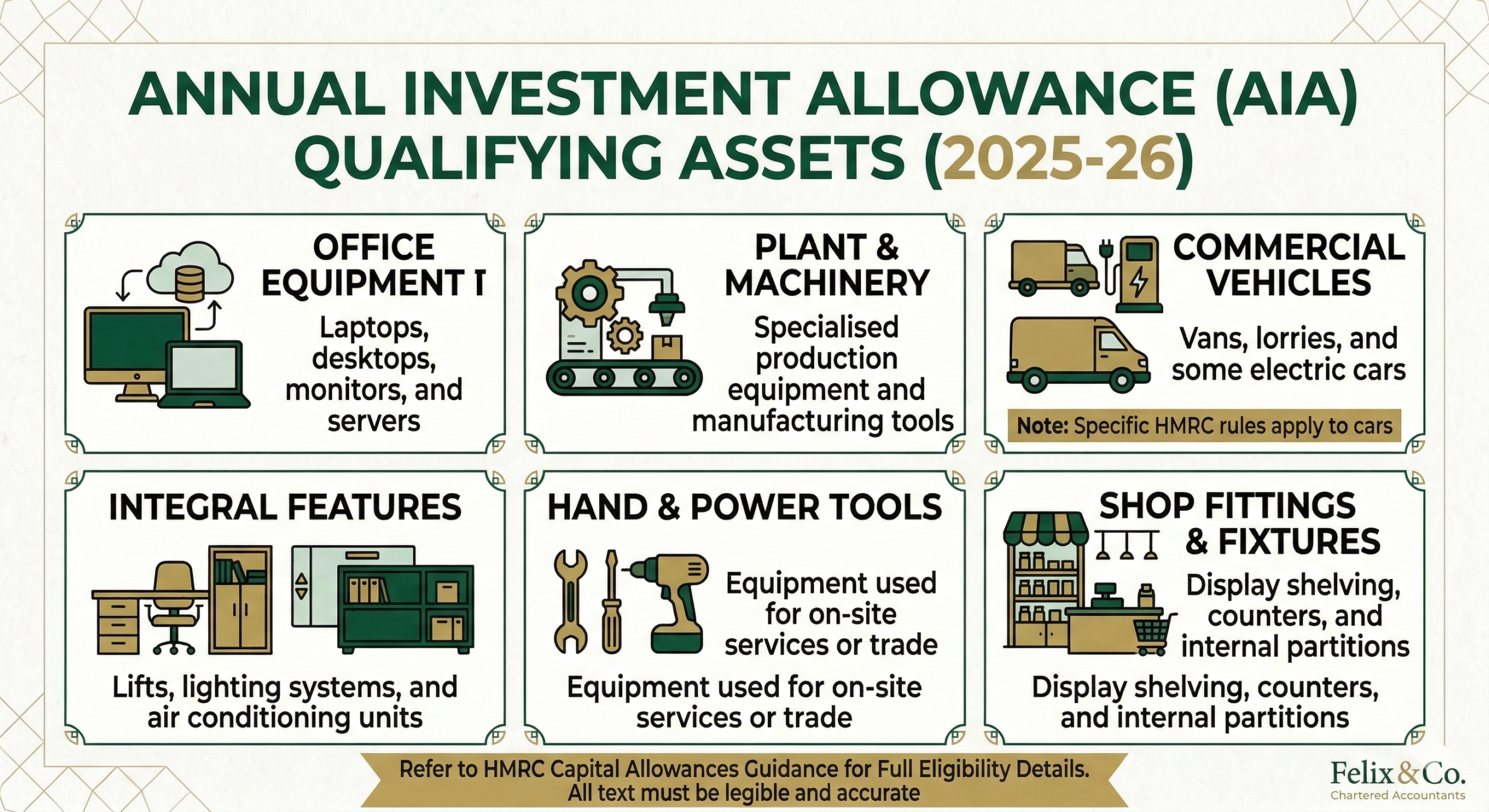
Capital Allowances & “Full Expensing”
The current “Full Expensing” rules allow companies to claim 100% first-year relief on qualifying new plant and machinery.
The Strategy: If you are planning to buy new laptops, office furniture, or machinery next year, buy them before your company year-end.
The Result: The entire cost is deducted from your profits immediately, reducing your Corporation Tax bill for this year. If you wait until day one of the new financial year, you delay that tax relief by a full 12 months.
Pension Contributions
Employer pension contributions are one of the most tax-efficient ways to extract money from a company.
Tax Relief: Contributions are an allowable business expense (saving you 19-25% in Corporation Tax).
No NI: There is no National Insurance to pay on pension contributions.
Timing is Key: To claim the relief in this financial year, the money must actually leave your business bank account and clear into the pension provider’s account before your year-end date. A “commitment to pay” is not enough.
4. Personal Tax Planning: The “Use It or Lose It” Allowances
The 2025/26 tax year ends on 5th April 2026. Many allowances cannot be carried forward.
The Dividend Allowance
For the 2025/26 tax year, the tax-free dividend allowance is just £500.
Action: Ensure you have declared and paid at least £500 in dividends to all shareholders (including family members with alphabet shares) to utilize this tax-free band.
Christmas
The Capital Gains Tax (CGT) Exemption
The Annual Exempt Amount for CGT is now £3,000.
Action: If you hold assets (like shares or crypto) personally that have increased in value, consider “crystallising” gains up to £3,000 before April. You can sell the asset to use the allowance. Note that you cannot buy the same asset back immediately (the “Bed and Breakfasting” rule), but you can buy a similar asset or have your spouse buy it.
Marriage Allowance
If you are a basic rate taxpayer and your spouse earns less than the personal allowance (£12,570), they can transfer £1,260 of their allowance to you.
The Benefit: This saves you up to £252 in tax.
Action: You can backdate this claim for up to 4 years, potentially unlocking a refund of over £1,000 if you haven’t claimed before.
5. Director’s Loan Accounts (DLA)
If you have taken money out of the company during the year that wasn’t salary or dividends, your Director’s Loan Account is likely overdrawn.
The Section 455 Trap
If your DLA is overdrawn at your company year-end, you have 9 months to repay it. If you don’t, the company must pay a temporary tax charge of 33.75% (Section 455 tax).
Action: Review your DLA now. If it is overdrawn, consider declaring a dividend now (if you have sufficient retained profits) to clear the balance before the year-end. This tidies up the balance sheet and avoids the S455 complication.
Summary Checklist for Directors
File Self Assessment (Deadline: 31 Jan).
Host Christmas Party (£150/head limit).
Buy Trivial Benefits (£50 gifts for staff/Directors).
Maximize Pension Contributions (Pay before company year-end).
Purchase Equipment (Utilize Capital Allowances).
Clear Director Loans (Declare dividends to settle debts).
Check Dividend Allowance (Use the £500 tax-free band).
Frequently Asked Questions (FAQs)
When is the absolute deadline for paying my Self Assessment tax bill?
You must pay any tax you owe for the 2024/25 tax year by midnight on 31st January 2026. If you miss this, you will be charged interest and potentially a 5% surcharge if you are 30 days late.
Can I carry forward my Christmas party allowance if I didn’t use it?
No. The £150 annual event exemption is a “use it or lose it” allowance for that specific tax year. You cannot roll it over to next year to have a £300 party.
I missed the 30th December deadline to code out my tax. What can I do?
You must pay the full amount directly to HMRC by 31st January. However, if you cannot afford the full bill, you can set up a “Time to Pay” arrangement online, provided you owe less than £30,000 and file your return on time.
Does buying equipment really reduce my tax bill immediately?
Yes, under the “Annual Investment Allowance” (AIA) or “Full Expensing” rules, most equipment purchases (computers, machinery, vans) can be deducted 100% from your profits in the year of purchase. If you make £50,000 profit and buy a £2,000 laptop before year-end, you only pay Corporation Tax on £48,000.
Why should I declare dividends before April 5th?
Tax allowances (like the £500 dividend allowance and the basic rate tax band) reset on April 6th. They cannot be carried forward. If you have unused allowance in the 2025/26 year, you should declare a dividend to use it up, otherwise, that tax-free opportunity is lost forever. Lean More
In the modern economic landscape, the traditional career path is evolving. It is becoming increasingly common to start a “side hustle”—keeping your main paid job while running a freelance, consulting, or sole trade business on the side.
Whether you are selling crafts on Etsy, consulting in your spare time, or offering digital services, a side hustle is a fantastic way to test the water. It allows you to see if your business idea is profitable and enjoyable without the massive pressure of needing it to support you full-time immediately.
However, the excitement of that first sale often comes with a wave of anxiety about administration. Questions inevitably arise: Where do I register? Is this legal? Will I pay emergency tax? Will my boss find out?
If you are thinking of starting a business alongside your main job, fear not. The system is more logical than it often appears. Here is a comprehensive guide to the side hustle tax UK essentials, based on expert advice for the 2025/26 tax year.
1. The Big Question: When Do You Need to Register?
One of the most common misconceptions is that you need to register with the government the moment you have a business idea or make your first pound.
Unlike setting up a Limited Company, which requires immediate registration with Companies House and strict filing duties from day one, a sole trade or freelance side hustle has a much lower barrier to entry.
The £1,000 Trading Allowance
You do not actually need to tell the tax authorities (HMRC) anything until you start earning over £1,000 in your side hustle revenue.
The Rule: This threshold exists because of the Trading Allowance.
The Benefit: It generally makes the first £1,000 of side income tax-free. If you earn £800 in a year from your side gig, you do not need to register, and you do not need to pay tax on it.
Once you exceed that £1,000 gross income threshold, you must register.
The Registration Timeline
Even if you do cross the threshold, there is no need to panic. The system gives you plenty of time to get your affairs in order.
The Deadline: You need to notify HMRC by the 5th of Octoberafter the tax year ends.
Example Scenario:
You start your business in September 2025.
Your first tax year ends on 5th April 2026.
You have until 5th October 2026 to register.
To register, you simply create an HMRC account online and complete a short form to receive a Unique Tax Reference (UTR). This is a 10-digit number that acts as the ID card for you and your business within the tax system.
2. How Is Your Tax Calculated? The “Bucket” Analogy
Perhaps the biggest source of confusion for new entrepreneurs is understanding how side hustle tax interacts with the tax they already pay on their main job salary. Many fear that earning extra money will mess up their tax code or push them into a punitive tax bracket.
To understand it easily, think of your tax return as a Giant Bucket.
The Input: All your income goes into this bucket. Your salary from your main job stacks up at the bottom, and your side hustle income is poured on top.
The Total Calculation: HMRC calculates the total tax bill for the entire amount in the bucket.
The Deduction: They then look at the tax you have already paid through your employer (via PAYE) and deduct it from the total bill.
The Balancing Payment: The remaining amount is your “balancing payment.” This is the specific amount you must pay directly to HMRC for your side hustle.
This system ensures you are not taxed twice on the same income, but it also means your side hustle is taxed at your “marginal rate”—the highest rate of tax you pay.
3. Tax Rates and Allowances
It is crucial to be realistic about how much tax you will pay.
The Personal Allowance Trap
Most people in the UK have a Personal Allowance of roughly £12,570 that is tax-free. However, if you have a full-time job, this allowance is usually used up entirely by your main salary.
The Consequence: This means your side hustle income will likely be taxed from the very first penny of profit (assuming you are above the trading allowance). You do not get a “second” tax-free allowance for your second job.
Side Hustle
Income Tax Bands
Basic Rate (20%): If your total income (job + side hustle) remains under the higher rate threshold (approx £50,270), you pay 20% tax on your side hustle profits.
Higher Rate (40%): If your total income crosses that threshold, only the specific portion that crosses the line is taxed at 40%. You do not pay 40% on your entire income.
National Insurance (NI)
National Insurance works differently from Income Tax. While Income Tax looks at the “bucket” of total income, NI looks at income sources individually.
Class 1 NI: You pay this on your main job salary.
Class 4 NI: You generally only pay this on your side hustle if the side hustle profits alone exceed roughly £12,570 (the Lower Profits Limit for 2025/26).
The Rate: If you are liable, this is usually charged at 6% on profits between £12,570 and £50,270.
This is a hidden benefit of side hustles: you can often earn a decent amount of profit (up to ~£12,500) without triggering any extra National Insurance, even if you pay Income Tax on it.
4. Reducing the Bill: Expenses
You do not pay tax on your revenue; you pay tax on your profit.
Profit = Income – Expenses
To reduce your tax bill legally, you should claim tax-deductible expenses.
The Golden Rule: Expenses must be incurred “wholly and exclusively” for your business.
Valid Expenses: Website hosting, advertising costs, raw materials, professional subscriptions, business insurance.
When you enter these costs on your tax return, they reduce your profit figure. A lower profit figure means a lower tax bill.
5. When Do You Pay?
The timeline for paying your tax is surprisingly generous, but this can be a double-edged sword.
The Deadline: Your tax return and payment are both due by the 31st of Januaryafter the tax year ends.
Example:
Start Date: September 2025.
Tax Year Ends: April 2026.
Payment Due: 31st January 2027.
While this long delay (almost 16 months from when you started!) helps with cash flow, it is risky if you haven’t saved the money. It is highly advisable to register and file your return as early as possible (e.g., in April or May). This lets you know exactly what the bill is months before the January deadline, giving you time to save without stress.
6. Does My Employer Need to Know?
A major anxiety for many employees is privacy. “Will my boss know I have a side business?”
Generally, No.
Privacy: Your employer does not know you are self-employed unless you tell them or you market yourself publicly in a way they can see.
Tax Codes: It is very rare for a side hustle to affect your main job’s tax code. HMRC typically collects side hustle tax via your direct payment in January, not by adjusting your monthly payslip.
7. Top Tips for Success
Based on expert advice, here are three tips to ensure your side hustle administration runs smoothly.
Open a Separate Bank Account Do not mix personal and business spending. Open a separate account (even just a standard current account) for your side hustle.
Why? It keeps your records clean. When tax time comes, you just download one statement, and every transaction on it is relevant.
Keep Great Records “I’ll remember what that receipt was for later” is the most dangerous phrase in business.
Why? You won’t remember. Ensure you capture all data—invoices, receipts, mileage logs—as you go. Use an app or a simple spreadsheet to track income and expenses monthly.
Register Early (Optional) Even if you are under the £1,000 threshold, you might choose to register voluntarily.
Why? You may need to prove self-employment for a mortgage application, or you may want to claim a loss (if your expenses were higher than your income) to offset against your main job tax.
Side Hustle
Starting a side hustle is a journey of discovery and potential financial freedom. While the tax side can seem intimidating, it follows a logical set of rules.
By keeping good records, understanding the “bucket” system, and remembering that you have plenty of time to register, you can ensure you pay the right amount of tax—and not a penny more.
Frequently Asked Questions (FAQs)
What is the Trading Allowance?
The Trading Allowance is a tax exemption that allows you to earn up to £1,000 in gross income (total sales) from a side hustle or self-employment tax-free. If you earn less than this, you generally do not need to report it to HMRC.
Do I have to pay tax if I have a full-time job? Yes. Your tax-free Personal Allowance is usually used up by your main job. This means most profit from your side hustle (above the Trading Allowance) will be taxed, typically at 20% or 40%, depending on your total income.
When is the deadline for registering a side hustle?
You must register for Self Assessment by 5th October in your business’s second tax year. For example, if you start trading in the 2025/2026 tax year, you must register by 5th October 2026.
Will my employer find out about my side hustle through HMRC? It is very unlikely. HMRC keeps your tax affairs private. They usually collect tax on your side hustle via a direct payment from you, rather than changing the tax code used by your employer. Unless you tell them, your employer usually won’t know.
What happens if I miss the tax payment deadline?
If you miss the 31st January deadline for filing your return or paying your tax, HMRC will issue an immediate £100 fine. Interest will also start to accrue on any unpaid tax. It is always better to file on time, even if you can’t pay the full amount immediately, as you can set up a “Time to Pay” arrangement.
Do I need a specific “Business Bank Account”?
Legally, as a sole trader, no. You can use a personal account. However, it is highly recommended to have a separate account solely for business transactions to make your accounting and tax return much easier. Read More
The property landscape across England and Wales is currently defined by a sense of collective holding of breath. October data revealed a modest but noteworthy trend: a slight cooling of the housing market, with average prices edging down by approximately 0.3%. This minor dip has brought the typical property value to roughly £353,000, a figure that reflects a market catching its breath rather than bracing for impact.
This is not a story of a market in freefall, nor is it a sign of panic. Instead, it’s a classic example of pre-fiscal event jitters. Both prospective buyers and tentative sellers are showing a marked hesitation, electing to wait on the sidelines. Their collective gaze is fixed firmly on the upcoming Autumn Budget, anticipating whether the Chancellor’s decisions will introduce new variables—be they adjustments to affordability, changes to stamp duty land tax (SDLT), or tweaks to mortgage market regulations—that could fundamentally alter their financial calculations.
The UK housing market cooling observed in October is a fascinating blend of caution and underlying resilience. To understand its true significance, one must look past the monthly headline and examine the deeper currents of economic policy, buyer sentiment, and transactional activity that define this peculiar moment. This cooling period is less about a market correction and more about a calculated pause as the sector seeks fiscal clarity.
Decoding the 0.3% Dip: Why Modesty is the Message
A 0.3% monthly fall is statistically minor, yet its timing provides rich context. In a market accustomed to fluctuating wildly based on external stimuli—from the ‘race for space’ during lockdowns to the frenzy following various stamp duty holidays—this small, controlled reduction supports a broader narrative of market stability.
It is crucial to differentiate this current trend from the sharp, often volatile, movements seen in previous years. The pandemic era saw unnatural surges driven by temporary tax cuts and shifting lifestyle priorities. The market today is normalizing, settling into a pattern that experts suggest is far healthier and more sustainable in the long run.
The Stamp Duty Aftershock and Transaction Normalization
The turbulence created by the various stamp duty adjustments is finally subsiding. These measures, while effective in stimulating short-term activity, often resulted in ‘cliff-edge’ transaction spikes followed by sharp, temporary troughs. Now, however, transaction volumes have settled into a far more predictable and manageable pattern.
Steady State: Activity is neither surging uncontrollably nor collapsing dramatically. It is holding steady.
Reduced Speculation: The absence of imminent, expiring tax incentives means speculative buying aimed at ‘beating the deadline’ has largely disappeared.
Focus on Fundamentals: Buyers are now concentrating on long-term affordability, interest rates, and employment stability, rather than short-term savings on closing costs.
This normalization of transaction volumes is a key indicator of the market’s current health. It suggests that while the UK housing market cooling is real, it is driven by rational caution rather than economic fear. The sector is collectively waiting for fiscal clarity, demonstrating a mature, predictable reaction to government deliberation.
The Budget Bind: How Uncertainty Freezes the Market
The central mechanism driving the current market hesitation is the simple yet powerful force of uncertainty surrounding the Autumn Budget. For both buyers and sellers, the upcoming announcement represents a potential terra nova for property finance.
The Buyer’s Dilemma: Affordability and Mortgage Rates
For buyers, especially first-time buyers and those relying heavily on high loan-to-value (LTV) mortgages, the Chancellor’s briefcase holds critical variables:
Interest Rates and Lending Policy: While the Bank of England sets the base rate, government policy can influence lending conditions, schemes like ‘Help to Buy’ replacements, or guarantees. Any hint of further support for high LTV lending could suddenly bring more people into the market.
Affordability Tests: Changes to how affordability is assessed could alter the maximum loan amount prospective buyers can secure. A more stringent or more lenient approach, perhaps in response to inflation or wage growth data, directly impacts purchasing power.
SDLT Thresholds: Although a massive overhaul is unlikely, even a minor adjustment to SDLT thresholds, particularly for properties under a certain price, could significantly impact the total cash outlay required to complete a purchase. Buyers are waiting to see if they can save even a few thousand pounds on taxes by delaying their offer.
The Seller’s Strategy: Pricing and Competition
Sellers, equally cautious, face a different set of calculations. They are worried that any new measure designed to stimulate buying (e.g., a further SDLT cut) might be better capitalised on by waiting until the New Year. Conversely, they fear that policies designed to dampen inflation or cool the economy might reduce buyer demand even further.
Price Stickiness: Many sellers are reluctant to adjust their asking price down significantly, preferring instead to take their property off the market temporarily or simply wait. This “price stickiness” contributes to lower transaction volumes and a marginal price dip, rather than a steep crash.
Competition: Sellers who must move are finding competition is less fierce than a year ago, leading to longer selling times and, inevitably, the slight price reduction seen in October. The average time on the market is creeping up, reinforcing the narrative of a slower, more considered buying process.
housing market
Regional Resilience vs. Localised Lag
While the national average shows a 0.3% dip, it is essential to remember that the UK housing market is a patchwork of micro-markets. The UK housing market cooling is not uniform.
In highly desirable, usually resilient areas—such as parts of the South East or specific urban centers—the dip may be negligible or even non-existent. Demand, fuelled by high wage growth and limited housing stock, remains robust. Conversely, areas that saw the most dramatic price increases during the post-lockdown boom are often the first to see a slight correction as the market adjusts to pre-pandemic growth rates.
Wales: The Welsh market, which also experienced significant growth, appears to be tracking the English market closely, suggesting shared macroeconomic drivers are at play.
London: The capital, which often operates on its own cycle, continues to show highly localised trends, with high-end properties maintaining value while the middle market adjusts to interest rate realities.
The overall trend, however, is clear: the market’s responsiveness to interest rate stability and general economic forecasting has returned. It is no longer purely driven by an artificial boost.
Looking Ahead: The Post-Budget Picture
What happens next will depend entirely on the substance and tone of the Chancellor’s announcement. There are three potential scenarios for the market post-Budget:
The Stimulus Scenario: The Chancellor announces substantial measures to boost housing supply or demand (e.g., new infrastructure funding, enhanced buyer schemes, or a renewed look at SDLT). Result: The October dip is reversed quickly in a New Year mini-boom as pent-up buyers rush back in.
The Austerity Scenario: The focus is on tackling national debt and inflation, with no new, market-specific measures. Result: The current cooling trend accelerates slightly as affordability constraints continue to bite, but no crash is initiated. The market settles into a period of slow, steady price movement.
The Status Quo Scenario: The Budget addresses wider economic issues but leaves existing housing policies largely untouched. Result: The market releases its held breath, transactions resume at the current steady rate, and the trend of stability (with minor monthly fluctuations) continues through the first quarter of the year. This is arguably the most likely and healthiest outcome.
Advice for Buyers and Sellers in a Waiting Market
The waiting game is stressful, but it also presents opportunities for those who move strategically.
For Prospective Buyers
Now is a time to be prepared, patient, and persistent. The slight cooling has marginally reduced competition and allowed the average time on the market to increase.
Get Mortgage-Ready: Secure a Decision In Principle (DIP) and lock in the best available rate. This will put you in a strong position to move quickly post-Budget.
Negotiate Harder: The slight dip and increased average selling time indicate that sellers may be more open to negotiation than they were six months ago. Don’t be afraid to make a reasonable, but firm, offer.
Focus on Value: The current dip allows you to focus on the long-term value of a property, rather than simply rushing to secure any house.
For Sellers
Your goal is to be realistic and appealing. Overpricing in a cooling market is the single biggest mistake.
Review Your Price: Be objective. If your house has been on the market for over two months, a small price adjustment (perhaps 0.5% to 1.0%) can often reignite interest and save you more money in the long run than a lengthy wait.
Maximise Appeal: Invest in staging, excellent photography, and minor repairs. In a slower market, only the best-presented homes move quickly and at their asking price.
Instruct an Agent: Work with an agent who understands the current ‘wait-and-see’ mentality and can articulate the value of your property beyond a temporary Budget-related dip.
The Path to a Healthier Market
The 0.3% price dip in October is not a harbinger of doom; it is a vital sign of a market resetting its expectations. This UK housing market cooling is driven by prudent caution and the desire for fiscal clarity before committing to major financial decisions.
housing market
As the industry collectively awaits the Chancellor’s address, the prevailing mood is one of anticipation, not anxiety. The market is normalizing, prioritizing sustainability and genuine affordability over speculative frenzy. For buyers and sellers alike, the key to success in this environment lies in strategic patience and readiness to act decisively once the fiscal fog has lifted.
FAQs on the UK Housing Market Cooling
Question
Answer
What does a 0.3% dip mean for the market?
A 0.3% dip is very small. It signals stability and a slight cooling rather than a sharp crash. It is primarily a reflection of both buyers and sellers pausing their activity to wait for clarity from the Autumn Budget.
Is the price dip the same across all regions?
No. The 0.3% is a national average for England and Wales. Highly sought-after areas may see little to no change, while regions that experienced the steepest price growth during the post-pandemic period are more likely to see a marginal correction.
How does the Autumn Budget affect house prices?
The Budget can affect prices by introducing or changing policies on Stamp Duty Land Tax (SDLT), first-time buyer schemes, and lending regulations. Uncertainty about these potential changes causes buyers and sellers to delay their moves, leading to the current ‘hesitation’ and cooling.
Should I buy now or wait until after the Budget?
Buyers who are in a strong financial position (with a mortgage pre-approved) can benefit from the current reduced competition and increased negotiation room. Waiting may provide fiscal clarity, but it also risks a quick surge in demand if the Budget introduces positive incentives.
Will house prices crash?
Most experts agree that a crash is unlikely. The current trend suggests a continued stabilization or a slow, steady decline in prices in line with rising interest rates and affordability constraints, rather than a dramatic, sudden collapse. Underlying demand for housing remains strong.
Angela Rayner’s high-profile property tax dispute has thrust Stamp Duty Land Tax (SDLT) into the national spotlight. While the headlines focused on a potential underpayment, her case inadvertently highlights a far more common issue affecting thousands of UK property buyers: significant, unnoticed overpayments.
Industry data reveals a startling trend. A review of over 7,000 transactions found that a staggering 11% of buyers paid too much SDLT. The average refund for these homeowners and landlords was nearly £13,000, with some claims reaching tens of thousands of pounds. This isn’t an issue confined to complex commercial deals; it frequently affects everyday property purchases.
The complexity of SDLT regulations means that many people are leaving substantial sums of money with HMRC, completely unaware they are entitled to a refund. This article explores why these overpayments happen, the most common reliefs you might have missed, and how you can check if you’re one of the thousands owed money back.
The Angela Rayner Case: A Wake-Up Call for Homeowners
The political scrutiny surrounding Angela Rayner’s property dealings serves as a powerful reminder of how intricate and confusing Stamp Duty rules are. The debate over her main residence and potential Capital Gains Tax liability is linked directly to the same set of facts that determine SDLT—specifically, which property is considered your primary home when calculating tax.
If politicians and their advisors can struggle with the nuances of property tax, it’s no surprise that the average homebuyer can easily make costly errors. The case underscores a critical point: determining your tax liability isn’t always straightforward. It has shed light on the grey areas within the system, prompting many to question whether they themselves paid the correct amount of Stamp Duty when they bought their home.
Why Are So Many People Overpaying Stamp Duty?
The overpayment problem stems from a combination of complex legislation, oversimplified tools, and a lack of specialist knowledge during the conveyancing process.
The Sheer Complexity of SDLT Rules
Stamp Duty is not a simple, one-size-fits-all tax. It operates on a tiered system with multiple rates, bands, and surcharges. The introduction of the 3% higher rate for additional dwellings (HRAD) in 2016 added another significant layer of complexity. This surcharge is a common source of confusion and overpayment, especially in situations involving separation, inheritance, or buying a new home before an old one is sold. On top of these core rules, there are dozens of legitimate reliefs and exemptions that can dramatically reduce the amount of tax due, but they are often overlooked.
Over-Reliance on Standard Calculators
Many homebuyers and even some professionals rely heavily on HMRC’s online SDLT calculator. While useful for straightforward purchases, this tool has a major limitation: it is not designed to handle complex scenarios. It does not actively prompt users to consider if their purchase qualifies for specific reliefs, such as those for mixed-use properties or multiple dwellings.
Consequently, users often input basic information and accept the standard calculation, assuming it to be correct. This can lead to them paying thousands more than necessary because the calculator is unaware of the specific circumstances of their purchase.
The Role of Conveyancers and Solicitors
Your conveyancer or solicitor plays a crucial role in the legal transfer of your property, and part of this includes filing your SDLT return. However, it’s important to understand that most conveyancers are legal experts, not specialist tax advisors. Their primary objective is to ensure the transaction is legally sound and that you meet your tax obligations to avoid penalties.
Faced with ambiguous rules, many will understandably err on the side of caution, resulting in a higher SDLT payment. They may not have the niche expertise to identify and advise on less common but perfectly legitimate reliefs, leading to an overpayment that goes unchallenged.
Stamp Duty
Unclaimed Stamp Duty Reliefs: Are You Missing Out on a Refund?
The key to understanding most overpayments lies in unclaimed tax reliefs. These are not obscure loopholes; they are official, government-approved allowances designed to ensure fairness in the tax system. If your purchase involved any of the following scenarios, you may have overpaid.
Mixed-Use Property Relief
This is one of the most frequently missed reliefs. A property is considered ‘mixed-use’ if it has both residential and non-residential elements. When you buy a mixed-use property, the entire transaction can be taxed at the lower non-residential SDLT rates, often resulting in a substantial saving.
Common examples include:
A house with a doctor’s surgery, shop, or office attached.
A farm with agricultural land that is more than just a garden.
Property with commercial garages or workshops.
A home that has rights to commercial activity, such as fishing or shooting.
Even a small piece of land included in the purchase that is used for a commercial purpose can qualify the entire transaction.
Replacing a Main Residence Surcharge Refund
Did you buy your new home before you sold your old one? If so, you would have been required to pay the 3% higher rate surcharge. However, many people don’t realise that this is often refundable. If you sell your previous main residence within three years of buying your new one, you can apply to HMRC to reclaim the full amount of the surcharge paid. The deadline to claim is 12 months from the sale of the old property.
The ‘Granny Annexe’ Exemption
If you bought a property with a self-contained annexe or a separate dwelling in the grounds (often called a ‘granny annexe’), you may have been incorrectly charged the 3% surcharge. A specific exemption applies to these subsidiary dwellings, provided the annexe is worth less than one-third of the total property value and is within the grounds of the main house. This can save you a significant amount on your tax bill.
Probate and Inherited Property Nuances
Purchasing a property from a deceased person’s estate (a probate sale) can have unique SDLT implications. The rules can become particularly complex if there are multiple beneficiaries or if the buyer is also a beneficiary. Assumptions made about the nature of the transaction can easily lead to miscalculations and overpayment.
How to Check if You’ve Overpaid and Claim Your SDLT Refund
If you suspect you may have paid too much Stamp Duty, it’s crucial to act. There are clear time limits for claiming a refund.
Review Your Property Transaction
Look back at the details of your purchase. Ask yourself the following questions:
Did my property have any land or buildings used for non-residential purposes?
Did I buy a property with a separate, self-contained annexe?
Did I pay the 3% surcharge and then sell my previous home within three years?
Was the purchase from a deceased estate or did it involve complex family arrangements?
If the answer to any of these is ‘yes’, your transaction may not have been straightforward and is worth investigating.
The Refund Application Process
Generally, you have up to four years from the effective date of the transaction to claim an overpayment of SDLT from HMRC. This is done by making a claim for ‘overpayment relief’.
For a 3% surcharge refund after selling a previous home, the window is tighter: you must make the claim within 12 months of selling your former main residence.
The process involves writing to HMRC with the full details of the transaction, the reason for the claim, evidence to support it, and the amount of tax you believe has been overpaid.
Why Seeking Professional Advice is a Smart Move
While it’s possible to approach HMRC yourself, the complexity that led to the overpayment in the first place can make claiming a refund difficult. A specialist SDLT advisory firm can be invaluable. Unlike a general conveyancer, these firms focus exclusively on Stamp Duty tax law.
They can:
Accurately assess your eligibility for a refund.
Identify the correct relief and build a robust case.
Handle all correspondence and technical queries with HMRC on your behalf.
Operate on a ‘no-win, no-fee’ basis, meaning you only pay if your claim is successful.
Frequently Asked Questions (FAQs)
How long do I have to claim an SDLT refund?
You generally have four years from the date of your property purchase to make an overpayment claim to HMRC. For reclaiming the 3% higher rate surcharge after selling your previous home, the deadline is 12 months from the date of that sale.
Can I trust the HMRC Stamp Duty calculator?
The HMRC calculator is a useful guide for simple transactions but should not be treated as a definitive tax assessment. It does not account for many complex scenarios or prompt you to consider reliefs you may be entitled to, which can lead to overpayment.
My conveyancer handled my SDLT. Could they have made a mistake?
Yes. While conveyancers are legal experts, they are not always specialist tax advisors. They may follow standard procedures that don’t account for the unique aspects of your purchase, leading them to err on the side of caution and overpay your tax.
What is a ‘mixed-use’ property for SDLT purposes?
A mixed-use property contains both residential and non-residential elements. This could be a building with a flat above a shop, a house with a doctor’s office, or a farmhouse with agricultural land. If a property is deemed mixed-use, the entire transaction can be taxed at the lower non-residential rates.
Don’t Leave Your Money with the Taxman
The Angela Rayner case has inadvertently performed a public service by highlighting the labyrinthine nature of property tax. The key takeaway for every homeowner and property investor is simple: do not assume the Stamp Duty you paid was correct.
Thousands of people are owed significant refunds due to missed reliefs and misunderstood rules. Take a few moments to review your property purchase. If your situation was anything other than a straightforward single-dwelling purchase, you could be next in line for a five-figure refund from HMRC.