The Annual Tax on Enveloped Dwellings (ATED) is a tax that applies to high-value residential properties owned by companies, partnerships with corporate members, or collective investment schemes in the UK. It was introduced in 2013 and mainly targets properties valued above £500,000 that are owned through a corporate structure, rather than by individuals.
A crucial part of ATED is the Valuation Rule, which determines how to assess the value of a property for tax purposes. This rule is significant because the amount of ATED tax owed depends directly on the value of the property. The following section explains the ATED valuation rules, including how property values are determined, when valuations are required, and the effect of valuations on the tax liability.
ATED: Key Considerations: Valuations
The Annual Tax on Enveloped Dwellings (ATED) tax year runs from 1 April to 31 March, and the tax return must be filed within a set period after the end of the tax year. The valuation of the property is a key factor in determining the amount of ATED annual charge payable.
The valuation rule refers to the method of determining the market value of a residential property for the purposes of ATED. The valuation is a fundamental aspect because the amount of ATED owed is based on the value of the property, and properties above a certain threshold are subject to the tax.
ATED Valuation Rules
Key Valuation Dates for ATED
The Valuation Rule is tied to specific dates that establish when and how a property should be valued for ATED purposes:
1 April 2012: This is the initial valuation date for properties that were owned on or before this date. When ATED was first introduced, the market value of these properties on 1 April 2012 determined whether the property was subject to the tax.
Acquisition Date: If the property is purchased after 1 April 2012, the valuation date becomes the date of acquisition, meaning the market value on the day the property is bought determines the ATED liability.
Five-Year Revaluation Cycle: After the initial valuation, properties must be revalued at least every five years. The most recent revaluation date was 1 April 2022, and the next revaluation date is 1 April 2027. If a property is purchased before the end of a five-year period, it must still be revalued according to the standard five-year cycle, not the remaining years. For instance, if the property is valued in 2024, the next revaluation will still occur in 2027, not 2029.
The value of the property for any chargeable period is therefore the later of:
its initial valuation date
the revaluation date
The five-year cycle ensures that the valuation reflects current market conditions and is crucial for maintaining the accuracy of tax liabilities over time.
When Revaluation Is Required
Revaluation is necessary under certain circumstances, such as:
Initial Valuation: For properties owned on 1 April 2012, or after this date, the value must be established as of the acquisition date or 1 April 2012, as applicable.
Five-Year Cycle: Properties must be revalued every five years, ensuring the tax reflects any changes in the market.
Significant Renovations or Disposals: If a property undergoes major renovations or improvements that significantly increase its value, or if a substantial portion of the property is sold or disposed of, a revaluation may be required before the five-year mark.
Major Renovations and Disposals
A substantial acquisition or disposal triggers a revaluation for ATED purposes. For example, if a property was valued at £5 million on 1 April 2012, and the owner sold part of it (like a small piece of land) for £200,000 on 30 August 2014, the revaluation would not simply be £4.8 million (the original value minus £200,000). Instead, the property would need to be revalued based on the market value of the remaining interest as of the disposal date, which could even change its value significantly.
An acquisition is considered “substantial” if the buyer pays £40,000 or more for the property or any part of it, including any linked transactions.
A disposal of part of the property (but not the whole property) is considered “substantial” if the value of the part sold is £40,000 or more.
ATED Valuation Rules
Transactions Between Connected Parties
If the transaction involves connected parties (such as family members, friends, or businesses with shared interests), special rules apply. In such cases, the market value of the property is used for ATED purposes, not just the price agreed upon between the parties. This is to prevent under-reporting of the property’s value, ensuring that the tax is based on a fair and accurate valuation.
Valuing the Property: How to Proceed
You have two options for valuing your property:
Self-Valuation: You can personally assess the value of the property, but it must reflect the market price that a willing buyer and seller would agree upon.
Professional Valuation: Hiring a professional property value is another option, which may offer more assurance regarding the accuracy of the valuation.
The key point here is that the valuation should be reasonable and justifiable. HMRC will usually accept self-valuations but may challenge them if they believe the valuation is incorrect.
FQSs
What are valuation rules?
Valuation rules are guidelines or methods used to determine the monetary value of an asset, business, or property. These rules vary depending on the purpose of the valuation, such as taxation, financial reporting, or investment analysis.
What is the purpose of ATED?
The Annual Tax on Enveloped Dwellings (ATED) is a UK tax designed to discourage companies from holding high-value residential properties. It ensures such properties are taxed appropriately when owned by corporate entities, partnerships with corporate members, or collective investment schemes.
How to avoid ATED?
To avoid ATED, property owners can:
De-envelope the property – Transfer ownership from a corporate entity to an individual.
Claim applicable reliefs – Available for rental businesses, property developers, or properties open to the public.
Ensure the property value is below £500,000 – ATED applies to properties above this threshold.
Since de-enveloping can have other tax implications, consulting a tax professional is recommended.
What is the meaning of ATED?
ATED stands for Annual Tax on Enveloped Dwellings, a tax on certain high-value UK residential properties owned by non-natural persons (e.g., companies or investment funds).
What is the formula for valuation?
Valuation formulas depend on the asset being valued. Common methods include:
Discounted Cash Flow (DCF) Analysis – Calculates the present value of expected future cash flows.
Comparable Company Analysis – Values a business based on similar companies.
Precedent Transactions – Uses past sales of similar assets to determine value.
In the context of UK taxation, Rule 2 of the valuation rules refers to specific guidelines for determining the market value of assets for tax purposes. The exact rule may vary based on the legislation being applied.
What is de-enveloping?
De-enveloping is the process of transferring ownership of a property from a corporate entity (the “envelope”) to an individual. This is often done to avoid taxes like ATED but may have other tax consequences, such as Stamp Duty or Capital Gains Tax.
What is NRCGT?
NRCGT stands for Non-Resident Capital Gains Tax. It applied to non-residents disposing of UK residential property between 6 April 2015 and 5 April 2019. From 6 April 2019, it was expanded to cover all UK land and property owned by non-residents.
Is “ated” a suffix?
Yes, “-ated” is a suffix used in English to form adjectives indicating a condition or state, such as “complicated” or “animated.”
What is the meaning of “coppy”?
“Coppy” is an old English term referring to a small coppice or thicket of trees. It is not commonly used today.
What is the meaning of “ture”?
“Ture” is not a standalone word in English but is a suffix found in nouns like “nature” and “structure.”
How much is NRCGT?
The Non-Resident Capital Gains Tax (NRCGT) rates are:
Individuals – 18% or 28%, depending on income level.
Companies – 20%.
These rates apply to gains from UK property disposals by non-residents.
What is the remittance basis?
The remittance basis is a UK tax treatment that allows non-domiciled residents to be taxed only on foreign income and gains brought (“remitted”) into the UK, instead of being taxed on worldwide income.
Am I still a UK resident if I live abroad?
UK tax residency depends on factors such as:
The number of days spent in the UK.
Ties to the UK (family, property, work).
The Statutory Residence Test (SRT) determines residency status. In some cases, you can still be considered a UK resident while living abroad.
What ends with “ated”?
Many English words end with “-ated,” such as:
Complicated
Animated
Dedicated
Isolated
Frustrated
This suffix often indicates a condition or state resulting from an action.
What is the full meaning of “ate”?
“Ate” is the past tense of the verb “eat,” meaning to have consumed food. It can also be a suffix in words like “dominate” or “activate.”
What does the stem “ate” mean?
The stem “ate” comes from Latin and often means “to cause” or “to make” in verbs like “educate” (to cause learning) or “animate” (to bring to life).
A personal tax account is an HMRC-initiated system to make the tax system in the UK more efficient and transparent. This system facilitates you to access all your tax-related personal information in one place. Through your tax account, you can solve your tax issues on time by yourself without writing or calling the HMRC. You are probably wondering, how do I set up my personal tax account?
If you have access to your personal tax account, it means you can save a great deal of your time and energy. You can manage and handle your tax matters in a much better way. The personal tax account system was started in 2015 and it has been a splendid success since then as it saves countless hours by dealing with everything online. Surely, it is for the best that you set up your personal tax account.
What Can I Do with My Personal Tax Account?
The list of services for the personal tax account is constantly expanding and growing. Therefore, you can avail of many useful financial services from your personal tax account that include:
Checking income tax code.
Finding the national insurance number.
Organising tax credits.
Claiming a tax refund.
Checking your income tax estimates.
Paying overdue taxes.
Updating or checking your marriage allowance.
Checking the latest updates on the value of the state pension.
Adding a family member or other trustworthy person to manage your account on your behalf.
Viewing your self-assessment tax calculation, which might be helpful in applying for credit.
If there is any error or miscalculation in anything like details or anything else, you can change it by yourself. This guide will help you comprehend how do I set up my personal tax account.
What are the Benefits of setting up a Personal Tax Account?
The personal tax account system is an attempt by the HMRC to make the taxation system more transparent and efficient. With the use of this taxation system, it becomes easier for you to update the HMRC about the changes to your circumstances, like getting married, having a baby, and changing your address. It enables you to change your child’s benefits circumstances, such as if the child joins or leaves education or training. If you are a parent, then you can keep track of child track credits. you can check or update the benefits you get from your work such as car insurance, or company car details.
The major benefit of the personal tax account is that everything relating to your tax affairs will be online in one place. Hence, you will not have to spend time finding out different papers to get the details of your taxes.
Also, creating your personal tax account enables you to monitor your tax-related affairs to make sure that your records are accurate and up to date.
It is less time-consuming, more transparent, less difficult, more immediate, and entirely paperless. This process does not require lengthy letters but easy texting messages or emails- so you will be doing good for the environment too. Thus, it is an ideal situation.
Certainly, it is human nature to envisage every new thing as difficult until becoming familiar with it. But setting up your personal tax account with HMRC is like something easier done than said.
Setting up a personal tax account is not time-taking or technicalities involving the job at all. According to HMRC, it should only take 5-10 minutes.
Personal Tax Account
To start with, you must log in to your government gateway account.
The form online available is itself much easier to follow as it simply involves inputting your information and setting up security protocol. At this stage, the time factor entirely depends on the organization of the paperwork you start with. The more your paperwork is organized, the less time will it takes. Let’s discuss the paperwork you require to understand how I set up my personal tax account.
What do you need to Apply for the Paperwork?
National insurance number.
Recent pay slip.
UK passport (must be on date) or most recent P60.
Landline number or your mobile number, as part of the two-step security.
Choose the email address you want to attach to the account.
Now, you have acquired all the needed information to set up your personal account. Just go to the government gateway, and select either individual, (if you represent your own business) or agent (if you represent other people in financial matters to the government) to start the registration process.
How can I create my personal tax account?
There are a few steps to set up your personal tax account. We share those steps one by one in a largely simplified way.
1. Registration
You will need to register online by using this link on the official websiteof the HMRC to access the personal tax account.
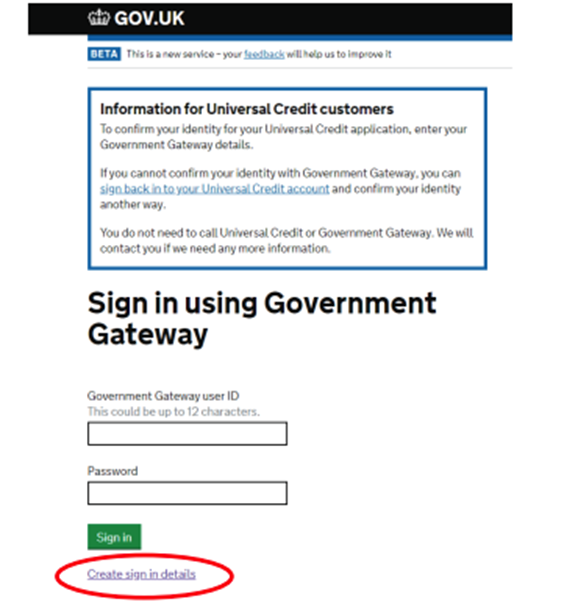
Click the ‘create sign-in details’ link given below the sign-in button to begin the registration process.
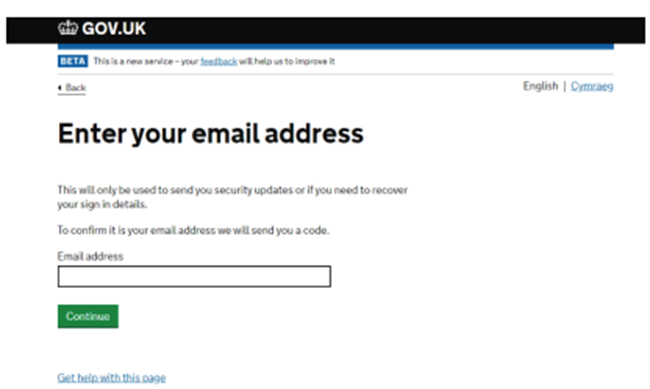
Then you will have to enter your email address. After doing so, select Continue.
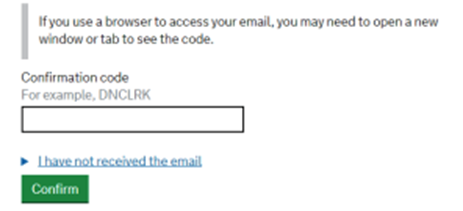
You will receive a code of 6 characters from HMRC at this email address.
Once you have entered the details in the given box, HMRC will prompt you to enter your full name and create a password. Then you will see your Government Gateway ID number.
2. Setting up your account
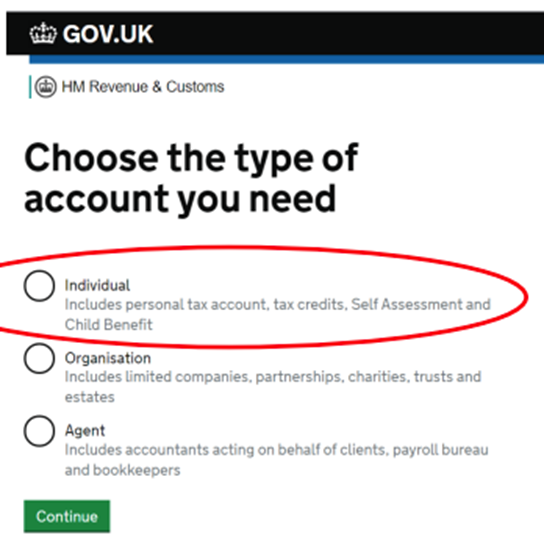
Here the HMRC will ask you to select the type of account you need. Please select “individual” and then click the green button of “continue”.
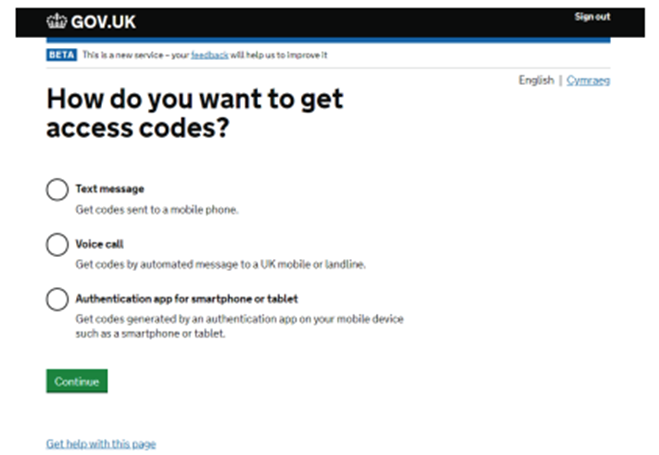
Now the HMRC will ask you to set up a method to receive an access code. It is important to know that select a method you are quite comfortable with because HMRC will use this method to send you an access code, every time you sign by using your Government Gateway user ID.
After selecting the method, you are most convenient with, click on the green button of “continue”.
Then HMRC will ask you to enter the 6 digits access code it has provided you with.
Kindly, enter the code and then click the green button “continue”.
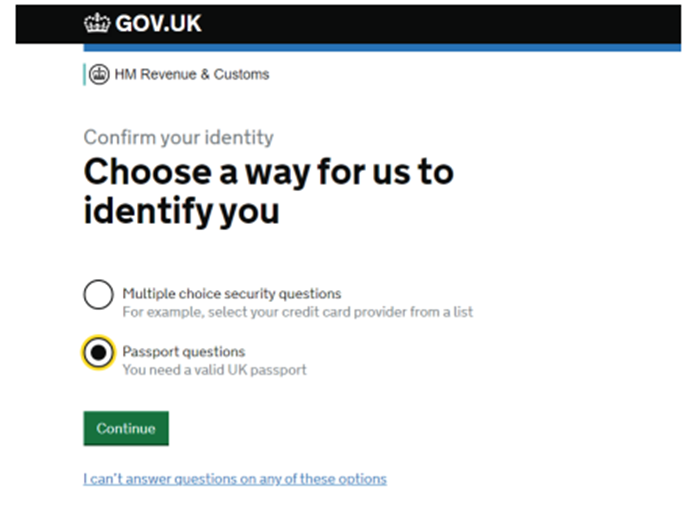
Now HMRC will ask you to confirm your identity, please provide the details where asked and then click the green button of “continue”.
Now HMRC will ask you the way you want your identity o be confirmed by the HMRC. If you are a UK passport holder, you are recommended to use this option.
HMRC will ask you to share the same detail you have on your passport. Please enter the required details and then click the green button of “continue”.
Now HMRC will confirm whether the details you entered are correct and whether the personal tax account has been successfully set up. After its confirmation, you will be asked whether you would like to receive your correspondence regarding your tax affairs electronically or post via your Personal Tax Account. please select the option which is most suitable to you and select the green “continue” button. Now you will be taken to the Personal Tax Account home page.
3. Recovering Login Details
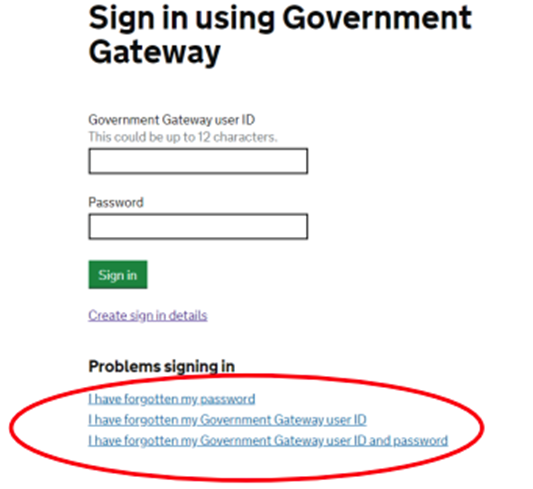
If you have previously used the online services of the government Gateway or HMRC to submit your tax returns electronically via the website of HMRC. You must log in by using those account details. But if you have forgotten the details of those accounts then please select one of the links given at the bottom of the sign-in page depending on the details you need to recover.
Now HMRC will take you, according to its process to recover your Government Gateway user ID or password.
If you face any difficulty with the process, you can easily contact HMRC for help.
Safety and security with your Personal Tax Account
After completing the registration procedure, you are the only person to have access to your personal tax account with your user ID and password.
Therefore, that answers your question, how do I set up my personal tax account?
Can my Personal Tax Account Help Review my National Insurance Record?
When it comes to reviewing your National Insurance record, your personal tax account can be particularly helpful. You can easily review your national insurance record that covers your entire working history by accessing your personal tax account. Reviewing your National Insurance record helps you ensure that your entire record is accurate and up to date. It also identifies any gaps in your contributions that might need to be addressed.
After that, when you reach the pension age, you can ensure that you have the correct credits to receive a full pension. If you find any discrepancies and gaps, the best option is to contact HMRC for investigation.
Can my Personal Tax Account Help Review my Employment Records?
Yes, your personal tax account gives you the additional benefit of reviewing your employment records.
It’s another benefit is that if you cannot obtain a copy of your P60 from your employer, you get it from your personal tax account. Once you understand how I set up my personal tax account, you can move forward with these steps.
Can Personal Tax Accounts Provide Information on PAYE codes?
Another useful feature of a personal tax account is that it enables you to view the PAYE codes use applied to your employment.
Moreover, you also have the option to modify your PAYE code directly from your personal tax account.
Is your Personal Information Secure?
When it comes to security, HMRC takes it seriously and uses firewall protection for all its systems. This is like a bulwark to provide maximum protection for your information because its detective capacity is strong enough to detect any unauthorized entry. All the data that you share with HMRC is encrypted and nobody can see your data except yourself.
Furthermore, you also must be conscious and vigilant of your online safety. Avoid sharing your user ID or password with anybody. If you cannot remember it and want to note it down, then ensure to keep it in a discrete place. Surely, you now have a clear idea of how I set up my personal tax account.
How Can I Ensure Nobody Accessed My Account?
One of the easiest ways, you must know whether someone accessed your account or not is the security measure of the system that shows you the time and date you logged into your personal tax account. Check this list frequently, if see any such thing that does not look right, immediately contact HMRC through their website.
Another safety measure built into the system is automatic logging out of your account if it is not active after 15 minutes. If you are forgetful, don’t worry, the system will secure your account.
Does HMRC Ask for Personal and Financial Detail?
It is important to know, and HMRC often emphasizes to be mindful of the procedure of HMRC that it does not ask for any personal or financial details by email, phone, or text. Always be on watch to protect yourself from the scammer, if notice any such thing as suspicious, report it to the HMRC, even if you have not lost anything. Undoubtedly, it is in your best interest to do so.
Shortly speaking, setting up a personal tax account offers a wide range of benefits by saving you a great deal of energy and time that you can utilize in something more productive and creative. You can easily check state pensions, national insurance contributions, and many other tax affairs online without standing in long queues on helplines or doing related paperwork. It keeps you updated and informed about your tax status. And through it, you can also keep HMRC timely updated and informed about your circumstances. Most importantly, your financial information is safe and secure.
FAQs
How do I activate my UTR number?
If your UTR (Unique Taxpayer Reference) is inactive, you can reactivate it by:
Contacting HMRC – Call the Self Assessment helpline and request reactivation.
Providing Personal Details – You may need to confirm your full name, address, National Insurance number, and date of birth.
Waiting for Confirmation – HMRC will confirm reactivation, usually via letter or phone.
How to check income tax?
You can check your income tax by:
Logging into your HMRC Personal Tax Account – View your tax payments, liabilities, and tax code.
Using the HMRC App – Check your tax status on the go.
Contacting HMRC – If you have queries about your tax records, call them for assistance.
How to file income tax?
To file your income tax return:
Register for Self Assessment if you haven’t already.
Gather Necessary Documents – Income records, expenses, and other tax-related details.
Complete Your Tax Return – Log in to your HMRC account and fill out the SA100 form.
Submit Before the Deadline – The deadline for online submissions is usually 31 January.
How do I create a UTR account?
To get a UTR number:
Register for Self Assessment with HMRC.
Provide Personal Information – Full name, address, date of birth, and National Insurance number.
Wait for UTR to Arrive – It is usually sent by post within 10 working days in the UK.
How do I check if my UTR is active?
You can check if your UTR is active by:
Logging into your HMRC account to view your Self Assessment status.
Calling HMRC – Provide your UTR and ask if it is active.
How to set up self-employed?
Register with HMRC for Self Assessment.
Keep Records of your income and business expenses.
Submit Your Tax Returns Annually to pay the correct amount of tax and National Insurance.
How do I check my UTR online?
You can find your UTR number by:
Logging into your HMRC account – Your UTR is listed in your tax documents.
Checking Previous HMRC Letters – It appears on tax returns and payment reminders.
How do I check my active tax status?
Use Your HMRC Personal Tax Account – Check your tax payments and liabilities.
Contact HMRC – If you’re unsure about your status, they can confirm it.
How long does it take to get a UTR?
HMRC usually issues a UTR within 10 working days if you’re in the UK or 21 days if you’re abroad.
How much money do you have to make as a self-employed person?
If you earn over £1,000 per tax year from self-employment, you must register with HMRC and file a tax return.
How do self-employed get money?
Self-employed individuals earn money by:
Charging clients/customers directly for services.
Selling products online or in-store.
Receiving payments through invoices, bank transfers, or platforms like PayPal.
How can I make money from home self-employed?
Options for making money from home include:
Freelancing – Writing, graphic design, programming, etc.
E-commerce – Selling on platforms like eBay, Etsy, or Amazon.
Affiliate Marketing – Promoting products for commissions.
Online Courses – Teaching skills through platforms like Udemy or Teachable.
How to earn $1,000 per day from home?
Earning $1,000 per day requires high-income skills or scalable businesses:
Dropshipping or E-commerce – Selling trending products online.
Stock Trading or Cryptocurrency – Requires experience and risk management.
Freelance Consulting – High-ticket services like business coaching.
Online Courses & Digital Products – Selling valuable knowledge at scale.
What is the fastest way to become self-employed?
Identify a skill or service you can offer immediately.
Register as self-employed with HMRC.
Find clients through online platforms like Fiverr, Upwork, or LinkedIn.
Start small and reinvest earnings to grow your business.
How to earn money from Google at home?
Google offers multiple ways to make money:
Google AdSense – Earn from ads on a blog or YouTube channel.
Google Play Store – Develop and sell apps.
Google Opinion Rewards – Get paid for surveys.
YouTube Partner Program – Monetize videos through ads and memberships.
In the dynamic world of UK property investment, understanding and adhering to HM Revenue & Customs (HMRC) regulations is crucial. HMRC compliance assistance isn’t just about ticking boxes—it’s about safeguarding your investments, avoiding hefty fines, and maintaining a reputable standing in the industry. This comprehensive guide will help landlords and property investors navigate the complex terrain of tax compliance for landlords, ensuring smooth sailing in your property ventures.
Imagine driving a car without understanding the rules of the road. Sooner or later, you’re bound to run into trouble. Similarly, without proper knowledge of property tax compliance UK, landlords and investors risk facing penalties, legal issues, and financial losses.
Why Compliance Matters
Financial Security: Avoid unexpected fines and penalties.
Legal Protection: Stay within the bounds of the law to protect your assets.
Reputation Management: Maintain trust with tenants, investors, and financial institutions.
As Emily Thompson, a seasoned property investor, puts it: “Compliance isn’t just about following rules; it’s about building a sustainable and trustworthy business.”
Understanding Your Tax Obligations
1. Registering for Self-Assessment
If you earn income from property rentals, you must register for self-assessment with HMRC.
Deadline: Register by 5th October following the tax year you started renting out property.
Process: Complete the online registration on the HMRC website.
2. Filing Self-Assessment Tax Returns
Accurate self-assessment guidance is essential to report your income and expenses correctly.
Deadlines:
Paper Returns: 31st October following the end of the tax year.
Online Returns: 31st January following the end of the tax year.
Payments: Any tax owed must also be paid by 31st January.
3. Declaring Rental Income
All rental income must be declared, including:
Residential Lettings: Houses, flats, rooms.
Commercial Properties: Offices, shops.
Holiday Lettings: UK and overseas properties.
Real-Life Example: John, a landlord in Manchester, failed to declare income from his Airbnb property. HMRC’s compliance auditing caught the discrepancy, resulting in fines and backdated taxes.
Allowable Expenses and Deductions
Understanding what expenses you can deduct is key to reducing your tax bill.
Common Allowable Expenses
Maintenance and Repairs: Fixing existing issues (not improvements).
Property Management Fees: Costs of hiring letting agents.
Insurance: Landlord policies covering buildings, contents, and liability.
Utilities and Council Tax: If you pay these for your tenants.
Expert Insight: Sarah Mitchell, a tax advisor, notes, “Many landlords overlook allowable expenses, missing out on significant tax savings.”
Important Deadlines and Penalties
Key Deadlines
5th October: Register for self-assessment.
31st October: Paper tax return submission.
31st January: Online tax return submission and payment of tax owed.
31st July: Second payment on account (if applicable).
Penalties for Non-Compliance
Late Filing: £100 immediate penalty, increasing over time.
Inaccurate Returns: Penalties range from 0% to 100% of the tax due, depending on the severity.
Interest Charges: Applied to late payments.
Comparison: Think of HMRC deadlines as train departure times—miss them, and you face delays and additional costs to reach your destination.
Strategies for Staying Compliant
1. Keep Detailed Records
Maintain thorough records of all transactions.
Income Records: Rent received, dates, and sources.
Expense Receipts: Keep invoices and receipts for all allowable expenses.
Digital Tools: Use accounting software to organize and store records.
2. Stay Informed on Tax Changes
Tax laws evolve, and staying updated is vital.
HMRC Updates: Subscribe to newsletters.
Professional Advice: Regular consultations with a tax professional.
3. Utilize HMRC Compliance Assistance
Online Resources: HMRC provides guides and tools.
Helplines: Direct support for specific queries.
Analogy: Navigating tax compliance without assistance is like exploring a new city without a map—possible but unnecessarily challenging.
Dealing with Self-Assessment
Understanding Self-Assessment
It’s a system HMRC uses to collect Income Tax. Taxpayers must complete a tax return to declare income and capital gains.
Filling Out Your Tax Return
Sections to Complete:
Property Income: Declare rental income and expenses.
Other Income: Include any additional earnings.
Calculations: HMRC will calculate the tax owed based on your return.
Tip: Double-check figures to ensure accuracy and avoid triggering an audit.
The Role of Compliance Auditing UK
What is Compliance Auditing?
An independent review to ensure you’re adhering to tax laws and regulations.
Benefits
Identify Issues Early: Catch mistakes before HMRC does.
Peace of Mind: Confidence that your affairs are in order.
Professional Guidance: Recommendations to improve compliance.
Real-Life Example: After a compliance audit, Linda discovered she had been underclaiming expenses. Correcting this saved her £2,000 in taxes.
Consequences of Non-Compliance
Financial Penalties
Fixed Penalties: For late submissions.
Percentage Penalties: Based on the amount of tax owed.
Legal Action
Prosecution: In severe cases, leading to criminal records.
Asset Seizure: HMRC may recover debts through your assets.
Expert Quote: Mark Turner, a legal expert, warns, “Non-compliance can escalate quickly, turning financial missteps into legal battles.”
Addressing Common Misconceptions
“I’m a Small Landlord; HMRC Won’t Notice Me.”
HMRC employs sophisticated data analytics to identify discrepancies, regardless of the size of your portfolio.
“Cash Payments Don’t Need to Be Declared.”
All income, including cash payments, must be declared. Undeclared income is illegal and constitutes tax evasion.
Taking Proactive Steps
Seek Professional Advice
Accountants: Specializing in property tax.
Tax Advisors: Offering tailored strategies.
Educate Yourself
Workshops and Seminars: Learn from experts.
Online Courses: Enhance your understanding.
Analogy: Proactively managing compliance is like maintaining your car—regular check-ups prevent breakdowns.
Conclusion: Secure Your Investment’s Future
Navigating HMRC compliance may seem daunting, but it’s an essential part of being a responsible landlord or property investor. By staying informed, organized, and proactive, you can focus on growing your investments without worrying about unexpected hurdles.
Ready to Simplify Your Tax Compliance?
Our experts specialize in HMRC compliance assistance for landlords and property investors. Contact us today to ensure you’re on the right track and make the most of your property ventures.
Frequently Asked Questions
1. What is HMRC compliance assistance, and why do I need it?
Answer: HMRC compliance assistance involves guidance and support to ensure you meet all tax obligations. It’s essential to avoid penalties, legal issues, and to maximize your financial benefits.
2. How do I register for self-assessment as a landlord?
Answer: You can register online via the HMRC website by completing the relevant forms before the 5th October deadline following the tax year you started receiving rental income.
3. What are allowable expenses for landlords?
Answer: Allowable expenses include maintenance and repairs, property management fees, insurance, and utility bills paid on behalf of tenants. Capital improvements are not allowable expenses.
4. What happens if I miss the self-assessment filing deadline?
Answer: Missing the deadline results in an automatic £100 penalty, which increases over time. Additional penalties and interest may apply based on the tax owed.
5. How can compliance auditing UK help me?
Answer: Compliance auditing helps identify any areas of non-compliance, offers recommendations for improvement, and provides peace of mind that your tax affairs are in order.
6. Do I need to declare income from overseas properties?
Answer: Yes, UK residents must declare worldwide income, including rental income from overseas properties, on their self-assessment tax return.
7. Can I handle HMRC compliance on my own?
Answer: While possible, the complexities of tax laws make professional assistance beneficial. Experts can ensure accuracy and help you take advantage of all available tax reliefs.
8. What is the penalty for undeclared rental income?
Answer: Penalties can range from 0% to 100% of the tax due, depending on the nature of the error (careless or deliberate). In severe cases, legal action may be taken.
9. How often should I review my tax compliance status?
Answer: Regularly—ideally annually or when significant changes occur in your property portfolio or tax laws.
10. Where can I find reliable self-assessment guidance?
Answer: HMRC’s official website provides comprehensive guidance. Additionally, professional tax advisors can offer personalized assistance.
• Understanding Vehicle Excise Duty (VED): Essential for all UK motorists to fund road infrastructure. DIVLA Vehicle Tax • Recent DVLA Updates: Introduction of digital tax reminders and online account services. DVLA Vehicle Tax. • Electric Vehicle Tax Changes: Upcoming VED charges for electric vehicles starting April 2025. • Tax Exemptions: Eligibility criteria for disabled drivers, historic vehicles, and more. • Avoiding Penalties: Steps to ensure timely tax payments and prevent fines. • FAQs: Common queries addressed for clarity.
Navigating the intricacies of vehicle taxation is crucial for every UK motorist. The Driver and Vehicle Licensing Agency (DVLA) continually updates its processes to enhance efficiency and compliance. This comprehensive guide delves into the latest DVLA tax updates, reminder systems, exemptions, and key considerations to keep you informed and compliant.
Understanding Vehicle Excise Duty (VED) Vehicle Excise Duty (VED), commonly known as road tax, is a mandatory levy for vehicles used or parked on public roads in the UK. This tax funds the maintenance and development of the country’s road infrastructure. Failure to pay VED can result in substantial fines and legal consequences.
Recent DVLA Tax Updates Digital Tax Reminders In August 2023, the DVLA introduced a digital service allowing motorists to receive vehicle tax reminders via email or SMS, replacing traditional postal notifications. This initiative aims to reduce instances of unpaid road tax by providing timely digital reminders.
Online Account Services
The DVLA launched an online account service enabling drivers to access their driving licence and vehicle information in one place. Through this platform, users can view their driving record, check penalty points, and set up digital tax reminders.
Changes for Electric Vehicles
Starting April 1, 2025, electric vehicles will no longer be exempt from Vehicle Excise Duty (VED). Newly registered electric vehicles will be subject to the lowest first-year rate, with subsequent years taxed at the standard rate. Additionally, electric vehicles with a list price over £40,000 will incur the Expensive Car Supplement.
Setting Up Digital Tax Reminders To avoid missing tax payments, motorists can set up digital reminders through the DVLA’s online account service. This process is straightforward and can be completed in a few minutes. By opting for digital reminders, you ensure timely notifications and reduce the risk of incurring fines.
Consequences of Non-Compliance
Driving an untaxed vehicle is illegal and can lead to severe penalties, including fines up to £1,000. The DVLA has the authority to clamp or impound untaxed vehicles, resulting in additional fees for release and storage. It’s essential to keep your vehicle tax up to date to avoid these repercussions.
DVLA Tax Exemptions
Certain vehicles are exempt from VED, including those used by disabled drivers, historic vehicles made before 1983, and specific agricultural vehicles. However, even exempt vehicles must be registered with the DVLA. It’s crucial to verify your vehicle’s status to ensure compliance.
How to Avoid Tax Penalties
Regularly Check Your Tax Status: Utilize the DVLA’s online services to monitor your vehicle’s tax status and receive reminders.
Update Personal Details Promptly: Ensure that your contact information with the DVLA is current to receive all communications.
Understand Your Vehicle’s Tax Class: Different vehicles have varying tax rates based on factors like emissions and age. Familiarize yourself with your vehicle’s tax obligations.
Frequently Asked Questions (FAQs)
Q1: How do I check if my vehicle is taxed? A1: You can check your vehicle’s tax status using the DVLA’s online service.
Q2: What should I do if I haven’t received a tax reminder? A2: If you haven’t received a reminder, you can still tax your vehicle using the reference number from your vehicle log book (V5C) or the green ‘new keeper’ slip if you’ve just purchased the vehicle.
Q3: Are electric vehicles exempt from VED? A3: Currently, electric vehicles are exempt from VED. However, starting April 1, 2025, newly registered electric vehicles will be subject to VED charges.
Q4: How can I set up digital tax reminders? A4: You can set up digital tax reminders through the DVLA’s online account service.
Q5: What are the penalties for driving an untaxed vehicle? A5: Driving an untaxed vehicle can result in fines up to £1,000. The DVLA also has the authority to clamp or impound untaxed vehicles.
Staying informed about DVLA tax updates and utilizing available reminder services are vital steps in maintaining compliance and avoiding penalties. By embracing digital tools and understanding your obligations, you contribute to the upkeep of the UK’s road infrastructure and ensure a smooth driving experience.
Electric Vehicles (EVs): Starting April 1, 2025, EVs registered on or after this date will no longer be exempt from VED. In the first year, these vehicles will incur a nominal tax of £10, followed by the standard annual rate of £190 from the second year onward. rac.co.uk
CO₂ Emission-Based Rates: Vehicles emitting 1-50g/km of CO₂, including many hybrids, will face a first-year tax of £110. Rates for vehicles with higher emissions will increase substantially, with the most polluting vehicles (over 255g/km CO₂) seeing their first-year tax double from £2,745 to £5,490. rac.co.uk
Enhanced Digital Services:
The DVLA is expanding its online offerings to streamline processes for drivers:
Driver and Vehicles Account: Launched in August 2023, this platform allows motorists to:
View driving licence and vehicle details in one place.
Set up vehicle tax reminders via email or text, reducing reliance on postal notifications.
Access information about MOT expiry dates and vehicle tax rates.
For professional drivers, view Certificate of Professional Competence (CPC) and tachograph card details.
Renew photocard driving licences and apply for a first provisional licence.
Upload personal photos for licence renewals, eliminating the need to use passport photos.
Share driving licence information securely when needed.
These digital enhancements aim to provide a more efficient and user-friendly experience for UK motorists, aligning with the DVLA’s commitment to modernizing its services.
Inheritance Tax (IHT) is a significant aspect of wealth transfer that often goes overlooked in estate planning. Its impact on your estate can be substantial if proactive measures are not taken to mitigate it. In the UK, the nil-rate band for IHT is £325,000 per individual for the 2024/2025 tax year. This means that any portion of your estate exceeding this value is taxed at 40%. For married couples, the combined allowance is £650,000, which can be applied against the total value of their estate, including the family home.
Given the relatively low nil-rate band threshold, many estates—particularly those that include property—easily exceed it, resulting in significant tax liabilities. For instance, an estate valued at £2,000,000 would incur a tax bill of £540,000 after applying the £650,000 allowance. This potential loss highlights the importance of careful planning to reduce your IHT liability.
Residence Nil-Rate Band (RNRB) Inheritance Tax
To alleviate the IHT burden, the Residence Nil-Rate Band (RNRB) allows an additional £175,000 tax-free threshold per individual if the estate includes a family home being passed to direct descendants. When combined with the regular nil-rate band, this can increase the tax-free allowance to £500,000 per person, or £1 million for a couple.
However, there are limitations. RNRB only applies if:
The estate includes a family home.
The home is passed to direct descendants (children or grandchildren).
The total value of the estate is less than £2 million.
For estates exceeding £2 million, RNRB reduces by £1 for every £2 above the threshold, making proactive planning even more critical for high-value estates.
One straightforward strategy is to gift assets during your lifetime. While this removes assets from your estate, it comes with the drawback of losing control over the gifted items. For those who wish to maintain some level of authority over their assets, this may not be an ideal solution.
2. Encumbering Assets
Another option is to encumber assets with debt, which lowers the net estate value subject to IHT. However, this may not appeal to individuals who have worked hard to pay off debts and prefer to own their assets outright.
3. Using Discretionary Trusts
A more sophisticated and flexible approach involves discretionary trusts. Trusts allow you to gift assets while retaining control as a trustee. Here’s how they work:
Initial Transfer: You can transfer up to £325,000 into a trust without incurring IHT.
Seven-Year Rule: After seven years, this amount falls outside your estate for IHT purposes.
Renewable Allowance: This process can be repeated every seven years, enabling you to transfer additional assets incrementally.
For example, setting up a trust and transferring £325,000 initially reduces the taxable value of your estate. After seven years, another transfer of £325,000 can further reduce the estate’s value. Over time, this strategy can save hundreds of thousands of pounds in IHT.
Case Study: Reducing IHT Liability with Trusts
Imagine a business owner with an estate valued at £2,000,000:
By transferring £325,000 into a discretionary trust, the taxable estate decreases to £1,675,000.
Repeating the transfer after seven years reduces the estate further.
Over time, removing £650,000 from the estate lowers the IHT liability by £260,000.
This strategy not only reduces the tax burden but also ensures that the individual retains control over the assets, which can generate income for beneficiaries while being managed within the trust.
Balancing Estate Planning with Retirement Needs
While reducing your estate’s value for IHT purposes is beneficial, it’s essential to retain sufficient assets to support your lifestyle during retirement. Trusts are powerful tools, but they should be part of a comprehensive financial plan that addresses both current and future needs.
Summary
Inheritance Tax planning is vital for anyone with an estate exceeding the IHT threshold. Strategies such as using discretionary trusts allow you to transfer up to £325,000 out of your estate every seven years, significantly reducing IHT liability while maintaining control over your assets. Early and strategic planning can save your beneficiaries from substantial tax bills, preserving more of your wealth for future generations.
FAQs
How much can you inherit from your parents without paying taxes in the UK?
In the UK, you can inherit up to the nil-rate band of £325,000 per individual without paying Inheritance Tax (IHT).
If the estate includes a family home passed to direct descendants, an additional Residence Nil-Rate Band (RNRB) of £175,000 may apply, increasing the tax-free allowance to £500,000 per parent or £1 million for a couple.
Can I put my house in trust to avoid Inheritance Tax UK?
Yes, transferring your house into a discretionary trust can reduce IHT liability. However, this strategy must be planned carefully to comply with tax rules. The property will generally fall outside your estate if the transfer is made more than seven years before death.
Remember, there are potential capital gains tax (CGT) implications when transferring property into a trust.
What is the biggest mistake parents make when setting up a trust fund UK?
The biggest mistake is not seeking professional advice. Poorly drafted trust deeds or failing to understand tax implications can lead to unintended IHT or CGT liabilities. Another common error is setting up trusts that don’t align with their overall estate and retirement planning needs.
What is the loophole for Inheritance Tax in the UK?
The seven-year rule is a key IHT loophole. Gifts made more than seven years before death are exempt from IHT. Using this rule, you can make potentially exempt transfers (PETs) to reduce the value of your taxable estate.
Do foreigners have to pay UK Inheritance Tax?
Foreigners with UK assets (such as property or investments) are subject to UK IHT on those assets. However, their worldwide estate may not be subject to UK IHT unless they are considered domiciled in the UK.
Can I gift £100,000 to my son in the UK?
Yes, you can gift £100,000, but it will count as a potentially exempt transfer (PET). If you pass away within seven years of making the gift, it may be subject to IHT depending on the value of your estate and other exemptions.
What are the disadvantages of putting your house in a trust UK?
Capital Gains Tax (CGT): Transferring property into a trust can trigger CGT if the property is not your primary residence.
Loss of Flexibility: You lose direct ownership of the house, which can complicate decisions regarding its use or sale.
Costs: Setting up and managing a trust incurs legal and administrative fees.
Can I give my son $50,000 in the UK?
Yes, you can gift $50,000 (approximately £40,000). Like larger gifts, it will qualify as a potentially exempt transfer (PET) for IHT purposes, and if you live for more than seven years after the gift, it becomes exempt.
Which trust is best to avoid Inheritance Tax?
Discretionary Trusts are highly effective for IHT planning. They allow assets to be passed outside your estate after seven years while retaining control and offering flexibility in distributing income or capital to beneficiaries.
How much money do you need to set up a trust UK?
The cost of setting up a trust varies but typically starts at £1,000 to £2,500 for basic trusts. Complex trusts, such as discretionary trusts, may cost more depending on the legal and tax advice required.
What are the dangers of trust funds?
Costs: Trusts can be expensive to set up and maintain due to ongoing administrative and legal requirements.
Complexity: Mismanagement or lack of understanding of the trust’s terms can lead to disputes or unintended tax liabilities.
Rigidity: Once assets are placed in a trust, they may not be easily accessible.
Can you sue a trust UK?
Yes, beneficiaries or other interested parties can sue a trust if there are grounds to believe that trustees have mismanaged the trust or breached their fiduciary duties.
What is the 60k loophole?
The £60,000 IHT exemption applies to non-UK domiciled individuals who only pay IHT on their UK assets. This exemption is not available for individuals considered UK-domiciled for tax purposes.
What items are free from Inheritance Tax?
Gifts between spouses or civil partners are exempt.
Charitable donations are also free from IHT.
Assets left to certain qualifying organizations, such as museums or the National Trust, may qualify for exemption.
How do I beat Inheritance Tax UK?
Use gifting allowances, such as the annual £3,000 exemption.
Set up discretionary trusts to transfer assets out of your estate.
Utilize the Residence Nil-Rate Band (RNRB).
Make potentially exempt transfers (PETs) by gifting assets and surviving seven years.
Consider life insurance policies to cover IHT liabilities.
For expert guidance on IHT planning, contact Felix Accountants. our experienced team can help you develop tailored solutions to safeguard your estate.
SSAS for Tax Efficiency: Holding Commercial Property in a Pension
If you own or plan to buy trading premises or other commercial property, you may want to think about a Small Self-Administered Scheme (SSAS) for Tax Efficiency. Many business owners keep commercial property in their company or in their personal name. Both approaches can cause unwanted costs and risks. Holding property in a trading company links it to corporate liabilities and often triggers multiple taxes on sale or profit extraction. Holding property personally may avoid those specific risks, but it can lead to higher income tax on rent.
Below, you’ll learn why holding property in a trading company can be less favorable, why a SSAS can help you, and how real examples prove the tax benefits. You’ll also find a final FAQ at the end. Use this information to shape your own decision and explore professional advice when needed.
Downsides of Holding Property in a Trading Company
Tax Issues
• When the company sells the property, it faces corporation tax on any capital gain.
• If dividends are paid out of the profit, you as a shareholder may owe income tax again.
• This “double taxation” cuts into the overall benefit of holding property in the business.
Risks to the Asset
• The property is tied to the company’s liabilities.
• If the company faces financial trouble, creditors may target the property to recover debts.
A SSAS (Small Self-Administered Scheme) can be an efficient way to hold trading premises. It is often used by private company owners. It’s different from a Self-Invested Personal Pension (SIPP), which needs an external trustee. A SSAS is usually controlled by the company’s directors. They decide how and where to invest the scheme’s assets.
Here are some key features:
• Direct Control: Directors act as trustees.
• Flexibility: You can transfer funds or property into the scheme.
• Tax Advantages: Contributions, rent, and gains can benefit from special pension rules.
Key SSAS Benefits
1. Tax-Free Contributions
o Your company can pay cash or transfer property in specie (direct transfer of assets).
o Contributions can offset corporation tax.
o The annual pension allowance is £60,000 per working director for the 2024/2025 tax year.
o Unused allowances from the previous three years can roll forward. This can allow up to £180,000 of contributions per director.
2. Tax-Free Rental Income
o If the property is rented back to your own company, the rent goes into the SSAS without income tax.
o That rental income can be reinvested in other pension assets.
3. Tax-Free Lump Sum and Flexible Drawdown
o You can withdraw up to 25% of your total pension fund tax-free when you retire.
o The rest of the fund can be drawn down as taxable income, but modern pension rules offer flexibility in how much you take.
4. Capital Gains Relief
o Any profit from selling the property inside the SSAS is free of capital gains tax.
5. Risk Control
o Property inside the SSAS is not exposed to business creditors if the trading company has financial problems.
o This can add a layer of protection for your property.
1. Property Valued at £300,000
o You transfer the property from the company to the SSAS.
o The company might claim tax relief on that £300,000 contribution. At a 19% corporation tax rate, that could mean a saving of £57,000.
o Future rent paid to the SSAS is tax-free, and any rise in property value is not subject to capital gains tax.
2. Manufacturing Business with £400,000 Premises
o If the property is held in the company and sold later, it faces corporation tax on the gain, then you owe income tax on dividends.
o Moving it into a SSAS can cut out those taxes, plus the rent stream is not taxed, and the SSAS retains the long-term gains.
These examples show how a SSAS can simplify your tax position and give your property a degree of protection.
Using a Small Self-Administered Scheme (SSAS) for commercial property may offer tax savings for a range of businesses. You could claim relief on contributions, receive tax-free rent, and enjoy capital gains relief. The asset also sits outside your company’s trading risks. Over the long term, this can grow your retirement fund and help preserve value for you and your family. Still, always confirm the steps with a qualified professional if you have specific property or pension questions.
Frequently Asked Questions
1. What is a SSAS?
A SSAS is a pension scheme often set up by directors of private companies. They manage it themselves, which provides more investment control than some other pensions.
2. Who can be a SSAS trustee?
In most cases, directors of the business act as trustees. You can also involve other trustees if needed.
3. Are there limits on contributions?
Yes. The annual allowance is £60,000 per working director for the 2024/2025 tax year, with unused allowances from up to three previous years available.
4. Does a SSAS invest in residential property?
Typically no. SSAS rules mostly allow commercial property, stocks, funds, and certain other assets. Residential property is generally not permitted.
5. How long does it take to set up a SSAS?
It can take a few weeks. You’ll need a trust deed, scheme rules, and formal registration with HMRC.
6. Do I need a professional valuation when transferring property?
Yes. HMRC often requires an independent valuation to confirm the property’s market value.
7. What if the property is mortgaged?
The SSAS can sometimes take over or refinance the loan, but you must follow HMRC guidelines and possibly adjust the loan structure.
8. Can I lose tax benefits if the rent is below market value?
Rent should reflect an arm’s-length transaction. Below-market arrangements may lead to tax complications with HMRC
9. Is there a penalty for exceeding the annual pension allowance?
Yes. Any contributions above the allowance can trigger an annual allowance tax charge.
10. Can SSAS rules change over time?
They can. Pension regulations do shift. It’s wise to stay informed about any updates from HMRC or the government.
When running an owner-managed business, one of the most common questions is how to pay yourself while minimizing your tax liabilities and tax efficient dividends. Typically, accountants will recommend taking a modest salary (often set around the National Insurance threshold) and then extracting the remaining profits in the form of dividends. This blog post focuses on the latter aspect—how to draw dividends from your business in the most tax-efficient way, what the current tax rates are, and why proper documentation is essential.
For the 2024/2025 tax year, each shareholder can draw dividends up to the basic rate threshold of £50,270. These dividends are taxed at a dividend tax rate of 8.75%, after the company has already paid 19% corporation tax on the underlying profits. If you and your spouse are both shareholders, you could potentially extract up to £100,540 in dividends (i.e., £50,270 each) without incurring additional income tax beyond the 8.75%.
Higher Rate and Additional Rate Thresholds
Higher Rate (33.75%): If you need to take dividends above the basic rate threshold of £50,270, any additional dividends up to £125,140 will be taxed at 33.75%.
Additional Rate (39.35%): Any dividend income above £125,140 will be taxed at 39.35%.
Here’s a quick reference table for dividend tax rates in the 2024/2025 tax year:
Dividend Income
Effective Tax Rate on Dividends
£0 – £50,270
8.75%
£50,270 – £125,140
33.75%
Over £125,140
39.35%
2. Maximizing Family Allowances
One of the most effective strategies involves splitting company ownership among family members—commonly spouses—to take advantage of multiple basic rate bands and personal allowances. This approach can dramatically reduce the overall tax bill. For instance, if both you and your spouse are shareholders, you can each withdraw dividends up to your individual thresholds before hitting higher tax rates.
The £100,000+ Income Consideration
It’s crucial to monitor your total income if you are nearing £100,000. Once your income exceeds £100,000, your personal allowance (which is £12,570 for 2024/2025) begins to taper. Specifically, for every £2 of income over £100,000, your personal allowance is reduced by £1. This can create an effective tax rate of 60% on income in the £100,000–£125,140 range. Therefore, it makes sense to optimize each family member’s allowances up to £100,000 before taking further dividends, to avoid this punitive effective rate.
The combination of a lower salary and higher dividends is a legitimate, well-established tax planning method for many small business owners. However, HMRC keeps a close eye on arrangements that reduce tax liabilities, especially when they involve dividing income among family members.
The Arctic Systems Case (2007)
A landmark case, Arctic Systems, involved a husband-and-wife team who were both shareholders of a small company. The husband was the primary income generator, and the couple decided to split dividends evenly. HMRC argued the dividends should be treated as remuneration (subject to income tax and National Insurance), but the House of Lords ruled in the taxpayers’ favor. The court affirmed that properly declared dividends to shareholders must be treated as dividends and not reclassified as salary.
While the ruling supported business owners’ right to structure income through dividends, it also emphasized the need to follow correct procedures and maintain proper documentation.
4. Ensuring Proper Documentation and Compliance
When paying dividends, it’s vital to follow the relevant company law requirements to avoid any accusations of misclassification (e.g., disguising salary as dividends). Here’s what you need to do:
Board Minutes
Hold a formal board meeting (or directors’ meeting) before declaring dividends.
Prepare up-to-date management accounts to confirm there are sufficient distributable profits or reserves to cover the dividend payment.
Record the decision to declare dividends in official minutes.
Dividend Vouchers
Once dividends are declared, issue a dividend voucher to each shareholder.
The voucher should clearly state the amount of the dividend and the payment date.
Maintaining these records shows that you’ve made a lawful distribution of company profits and not taken money out as a salary or a loan. It’s crucial to avoid drawing more dividends than your company’s distributable reserves because this could be deemed illegal (ultra vires) under company law.
If you withdraw dividends monthly, avoid waiting until the end of the financial year to prepare all the documentation. Each monthly distribution should be accompanied by a dividend voucher at the time it’s paid. This creates a clear paper trail, proving that the funds were always intended and treated as dividends.
5. Key Takeaways
Dividends Can Save You Tax
Extracting profits through dividends (rather than solely via salary) can significantly reduce your overall tax burden.
Know Your Thresholds
For the 2024/2025 tax year, the basic rate threshold is £50,270 (8.75% dividend tax), and the higher rate threshold extends to £125,140 (33.75%). Above £125,140, dividends are taxed at 39.35%.
Carefully manage your total income if you are approaching £100,000 to retain your personal allowance.
Maximize Family Allowances
If you and your spouse are shareholders, you can each draw dividends up to your individual thresholds. This can potentially allow you to extract up to £100,540 combined before incurring higher rates.
Proper Documentation Is Non-Negotiable
Board minutes, dividend vouchers, and clear record-keeping are essential.
Failing to document dividends properly can lead to HMRC challenges and potential reclassification of dividends as salary or loans.
Stay Compliant with Company Law
Pay dividends only if there are sufficient distributable reserves. Dividends in excess of these reserves can be illegal.
Ensure your documentation is timely and accurate to prevent scrutiny.
Drawing profits from your company in a tax-efficient manner often involves a careful balance of salary and dividends. By leveraging the basic rate threshold, monitoring income around the £100,000 mark, and properly documenting dividend payments, you can significantly reduce your overall tax liability. The Arctic Systems case highlights that while HMRC may scrutinize such arrangements, properly declared and documented dividends remain a legitimate and effective strategy.
As always, the best approach depends on your specific financial situation. For personalized guidance, consult an accountant or tax advisor who can help tailor a plan that fits both the tax regulations and the long-term health of your business.
FAQs
How to take profits out of a company? Profits can be taken out of a company in several ways, including through dividends, salaries, bonuses, or loans to directors. Each method has different tax implications, so it’s important to consult with a tax advisor before proceeding.
What is the tax strategy for dividends? The tax strategy for dividends typically involves taking advantage of lower dividend tax rates compared to ordinary income. It can also be beneficial to plan dividend distributions in a way that minimizes personal income tax and makes use of any available tax-free allowances or credits.
What are the strategies for profit extraction? Common strategies for profit extraction include:
Paying yourself a salary, which is a deductible expense for the company but subject to income tax.
Paying dividends, which are usually taxed at a lower rate than salary.
Taking a director’s loan, although this must be repaid within a certain period to avoid tax complications.
What is the most tax-efficient way to pay yourself as a director? The most tax-efficient method often combines a lower salary (to cover living expenses and minimize National Insurance contributions) and taking the remainder as dividends. This allows for a lower overall tax rate as dividends are typically taxed at a lower rate than salary.
How do you divide company profits? Company profits can be divided in different ways depending on the ownership structure. In limited companies, profits are typically divided as dividends among shareholders. If there are directors or other stakeholders, agreements such as profit-sharing plans or bonuses can be used.
Can I take dividends monthly? Yes, dividends can be paid monthly if the company’s profits and financial situation allow for it. However, they must be declared at the annual general meeting (AGM) and appropriately accounted for. Regular monthly payments might require careful planning to ensure the company’s cash flow is maintained.
What is the best profit-taking strategy? The best strategy often combines a reasonable salary with dividends. By keeping your salary within a lower tax bracket and taking dividends up to the threshold of the available tax-free dividend allowance, you can minimize taxes.
What are the methods of dividing profits? Profits can be divided in multiple ways, including:
Dividends to shareholders based on shareholding percentage.
Bonuses for employees or directors.
Reinvestment into the business or reserve funds.
What are the 3 methods of resource extraction? The three methods of resource extraction in business include:
Extraction of physical resources (e.g., mining, agriculture).
Extraction of financial resources (e.g., dividends, loan repayment).
Extraction of intellectual property or technology (e.g., licensing, selling patents).
How are profits divided in a corporation? In a corporation, profits are typically divided through dividends to shareholders, depending on the number of shares each person holds. If there are multiple classes of shares, profits might be allocated according to the class of shares.
How does a 70/30 partnership work? A 70/30 partnership is where one partner takes 70% of the profits and the other 30%, based on their contribution to the business, capital investment, or agreed terms. These profit-sharing percentages can vary depending on the partnership agreement.
How is company profit calculated? Company profit is calculated by subtracting total expenses (including operating costs, interest, depreciation, and taxes) from total revenue. This gives the net profit, which is the amount available to be divided among shareholders or reinvested in the business.
Need More Help?
Visit felixaccountants.com to learn more about tax-efficient strategies for owner-managed businesses. Our team is here to help you navigate salary structures, dividend payments, and compliance with ease.
Climbing the housing ladder and upgrading to a better home is no easy feat: it takes time and money. The process becomes even more nerve-wracking when the market is down, or at the other extreme, red-hot with bidding wars.Current Housing Market Conditions.
Whether you are a first-time buyer or looking to upgrade, we explore whether now is the right time to buy a house. We base our analysis on a range of factors and present to you the things to assess when making the decision to buy a home.
What’s Happening to House Prices?
House prices in the UK are still near their all-time highs from summer 2022, with the average home costing £286,144 in November 2024. Though annual price growth has quickened to 3.7% — the fastest in two years — regional differences persist.
In the previous two years, the housing market has faced hurdles. High interest rates and tight budgets have capped how much buyers can borrow. Yet prices have held steady, supported by a lack of supply, low unemployment, rising wages and family help or built-up equity. Experts expect house prices to rise gradually as the economy strengthens and affordability improves.
Is Now a Good Time to Buy a House?
People often randomly blurt out when it is a good or a bad time to buy a home. But they do not base that assumption on the following two key points:
The housing market is not a single entity. It is made up of countless micro-markets, each with its own trends. Even in the same town or neighbourhood, some streets might be in high demand while others see homes sitting unsold for months. One development might struggle to attract buyers, while another nearby has bidding wars.
Buying a home, whether it is your first, a move to a new place, or an investment, is a major decision, and it is not just about money. Timing often depends on your personal circumstances like family, work or long-term goals.
There is always chatter about short-term shifts in property prices, but those small changes don’t matter much if you are planning to live in the home for years. Ideally, you would buy below market value, which is more likely when the market is slow. When homes take a while to sell, sellers might accept a lower offer just to close the deal.
Even in hot markets, where properties seem to sell instantly, you might still negotiate a good price. Estate agents often hype up demand, but the final price depends on many factors including the seller’s situation.
Although it is ideal to buy when house prices and mortgage rates are low, perfectly timing the market is nearly impossible. Instead, find a balance that feels financially comfortable for you.
Britain’s property market follows a seasonal rhythm. Spring is a busy time when many people list their homes for sale. For buyers, it is a great opportunity to explore a wide range of properties and get a sense of the market in their desired area.
However, spring also attracts more buyers, meaning more competition and potentially higher prices. Sellers listing in spring seek to complete their move by summer, so the market tends to slow down in August as people head off on holiday.
Things pick up again in September, though the number of properties on the market might not match spring levels. Buyers and sellers in autumn are often more serious, aiming to wrap up transactions before the year ends.
The quietest times for the property market are usually August, December and January, making those months less hectic but offering fewer options for those on the hunt.
FAQs
What is the current housing market situation in the UK?
The current housing market in the UK is characterized by high demand, limited supply, and rising prices in many regions. Factors like low interest rates and government incentives have influenced the market.
Are house prices in the UK dropping?
House prices in the UK have been volatile in recent years, but the general trend has been one of increase. While there might be regional variations, a widespread drop in house prices is not currently evident.
Is the UK going through a housing crisis?
The UK has been facing a housing crisis marked by issues such as affordability, lack of supply, and increasing homelessness. The crisis is multifaceted and affects both renters and potential homeowners.
Should I wait until 2024 to buy a house in the UK?
The decision to buy a house in the UK should be based on personal circumstances, market conditions, and financial readiness. It’s advisable to consider factors like interest rates, property prices, and your own financial stability.
Will UK house prices fall in the next 5 years?
Predicting future house price movements is challenging. While fluctuations may occur, long-term trends often depend on various economic factors. Consult housing market forecasts for more insight.
What time of year is the cheapest to buy a house in the UK?
Traditionally, the property market tends to be quieter in winter, potentially offering buyers more negotiating power. However, other factors can influence prices, so it’s essential to research the specific market you’re interested in.
Is a housing crash coming in the UK?
Predicting a housing crash is difficult. While factors like economic instability, interest rate changes, or a sudden oversupply of properties could trigger a crash, it’s not certain. Monitoring market trends is crucial.
Why are landlords selling up in the UK in 2024?
Landlords in the UK might be selling properties due to various reasons such as changes in tax regulations, increased regulations in the rental market, or individual financial considerations.
Is the UK in a living crisis?
The term “living crisis” encompasses issues like housing affordability, wage stagnation, rising living costs, and inadequate social support. These challenges collectively impact the standard of living for many people in the UK.
Will houses ever be affordable again in the UK?
Achieving housing affordability in the UK requires addressing complex factors like supply constraints, wage growth, and government policies. Efforts to improve affordability may involve interventions in the housing market.
What is the outlook for the UK real estate market in 2024?
The outlook for the UK real estate market in 2024 depends on factors like economic conditions, interest rates, government policies, and global events. Monitoring market trends and forecasts can provide insights into the market’s direction.
Why are houses so expensive in the UK?
Several factors contribute to high house prices in the UK, including limited housing supply, high demand, low interest rates, speculative investments, and regional disparities in affordability.
Is it a good time to sell a house in the UK?
The decision to sell a house in the UK should be based on personal circumstances, market conditions, and financial goals. Factors like property demand, pricing trends, and your own housing needs should be considered.
Why is the UK housing market so broken?
The UK housing market faces challenges due to issues like insufficient supply of affordable homes, high demand, speculation, planning regulations, and disparities in regional housing markets. Reform efforts are ongoing to address these issues.
As the property market braces for changes, are hurrying to buy homes before April 2025 stamp duty changes. First-Time Buyer.
Announced in this year’s recent Autumn Budget, the upcoming changes have created a sense of urgency as buyers try to avoid new rules that could make owning a home more expensive.
Stamp Duty Changes Add to Buyers’ Pressures
The new rules will lower the stamp duty exemption for first-time buyers from £425,000 to £300,000. For standard residential properties, the threshold will slide from £250,000 to £125,000.
Those changes have worried many first-time buyers, who are rushing to complete purchases before the deadline.
With the average first-time buyer property costing £227,191—close to the £250,000 mark—and much higher in London at £443,550, affordability is becoming an even bigger issue.
Mortgage appointments jumped 14% in the four weeks after the announcement. First-time buyers are racing against the clock and facing other challenges like rising living costs and stagnant wages.
A Challenging Year for Aspiring Homeowners
The past year hasn’t been easy for first-time homebuyers. Analysts say more than half fell short of their deposit savings goals in 2024. And nearly a third had to dip into their savings for unexpected costs, pushing their dream of owning a home even further away.
Still, analysts are calling 2024 a year of “resilience and determination” for these buyers. Their grit sheds light on a bigger issue: housing affordability.
In popular areas, soaring property prices far outpace new limits, meaning the challenges for first-time buyers go well beyond stamp duty.
Despite their determination, 76% of first-time buyers feel the government isn’t doing enough to support them. Many critics believe Chancellor Rachel Reeves missed a crucial chance in the Autumn Budget to provide real help.
That lack of meaningful action comes as homeownership drifts further out of reach for many young people. Programs like the Help to Buy ISA and Lifetime ISA offer some relief but fall short of closing the widening affordability gap.
First-time buyers aren’t just aspiring homeowners. They’re the future drivers of our economy. Supporting them goes beyond helping them buy homes; it’s also about ensuring prosperity for future generations.
Looking Ahead to 2025
The rush to buy before April 2025 shows the determination, and perhaps desperation, of first-time buyers. Data shows that 71% of aspiring buyers plan to purchase in the next two years, with 34% aiming for 2025.
But things could get tougher for those who can’t meet the deadline. Lower thresholds mean higher upfront costs, possibly pushing many buyers out of the market for good.
The situation is even worse in London, where property prices for first-time buyers already far exceed the new limits. Without targeted government action to address affordability, many may be locked out of the market for the long term.
First-time buyers are hurrying to buy homes before April 2025 to avoid higher stamp duty costs. New rules will lower the stamp duty exemption, making homeownership more expensive, especially with rising property prices.
FAQs
What is the first-time buyer stamp duty relief in the UK?
First-time buyers are exempt from stamp duty on properties up to £300,000. For properties between £300,000 and £500,000, a reduced rate applies.
How to reduce stamp duty legally in the UK?
You can reduce stamp duty by purchasing a property below the thresholds, utilizing exemptions (e.g., first-time buyer relief), or buying property through a company.
How much is stamp duty for first-time buyers in the UK?
First-time buyers pay no stamp duty on properties up to £300,000. For properties priced between £300,001 and £500,000, a 5% stamp duty applies on the portion above £300,000.
Who is exempt from stamp duty in the UK?
Exemptions include properties inherited, some types of charitable transfers, and certain government schemes like Help to Buy for first-time buyers.
Can you become a first-time buyer again in the UK?
No, you can only claim first-time buyer relief once. If you have previously owned property, you are no longer considered a first-time buyer.
Who qualifies as a first-time buyer in the UK?
A first-time buyer is someone who has never owned a property in the UK or abroad.
Do couples lose first-time buyer status if one partner bought in the past in the UK?
Yes, if either partner has previously owned a property, both are considered second-time buyers and are ineligible for first-time buyer relief.
How is stamp duty calculated in the UK?
Stamp duty is calculated as a percentage of the property’s purchase price, with different rates depending on price brackets.
Do first-time buyers pay stamp duty in Wales?
In Wales, first-time buyers can benefit from the Land Transaction Tax (LTT) relief, which works similarly to stamp duty but has different thresholds.
When one partner owns the house in the UK?
If only one partner owns the house, that person is the sole owner for tax purposes, and the other may be considered a tenant or co-tenant.
What is a second-time buyer?
A second-time buyer is someone who has previously owned property and is buying a new home.
What are the stages of the buyer-seller relationship?
The key stages are: Initial contact, property viewing, offer and acceptance, negotiations, legal checks, exchange of contracts, and completion.
Do first-time buyers pay stamp duty in London?
Yes, first-time buyers in London are subject to the same stamp duty relief as those in the rest of England, provided the property price is within the qualifying range.
Who pays stamp duty in the UK, buyer or seller?
The buyer is responsible for paying stamp duty in the UK.
What is the threshold for stamp duty in the UK?
The current threshold is £250,000 for standard residential properties; properties over this threshold are subject to stamp duty.
Can I be a first-time buyer again in the UK?
No, once you have owned property, you are no longer eligible for first-time buyer relief.
Can you have two residential mortgages in the UK?
Yes, it’s possible to have multiple residential mortgages, but the affordability criteria will be stricter.
What is the difference between buyer 1 and buyer 2?
Buyer 1 refers to a first-time buyer, and Buyer 2 refers to someone who has purchased property before (second-time buyer or beyond).
What is the first-time buyer relief in the UK?
First-time buyer relief means you pay no stamp duty on properties up to £300,000, and a reduced rate applies for properties between £300,001 and £500,000.
Is stamp duty on top of house price?
Yes, stamp duty is an additional cost on top of the house price.
What will stamp duty be in 2025 in the UK?
The rates for 2025 will depend on the government’s budgetary decisions, but no specific changes are confirmed yet.
House prices in the UK are climbing to record highs, with many potential buyers rushing to secure properties before upcoming changes to the tax system in April. Stamp Duty, however, is already seeing signs of suffering. This surge in demand is partly driven by the desire to lock in properties before new tax measures are introduced, which could make buying a home even more expensive.
However, despite the rising house prices, revenue from Stamp Duty Land Tax (SDLT) has already begun to suffer. This suggests that while prices are increasing, fewer transactions are taking place, likely due to affordability challenges and the impact of higher interest rates. But there is more to this that needs to be explored.
What is Behind the Revenue Drop?
The latest figures released by HMRC show residential stamp duty tax generated £9.4 billion in the 2023/24 tax year. This is a great fall from the £12.8 billion raised in 2022/23.
Contributory factors to this decline include:
Rising Interest Rates – Successive increases in interest rates dampened buyer confidence and resulted in fewer transactions in the property market.
More Expensive Mortgages – The cost of borrowing has jumped, further discouraging potential buyers from entering the market.
Affordability Constraints – In a time of inflationary pressures and stagnant wages, the level of affordability is a concern and has been especially so for first-time buyers.
A Shifting Landscape for Residential Transactions
The decline in stamp duty receipts also represents a wider slowdown context in the residential property market. Figures released separately showed transaction volumes significantly fell in the same period as fewer buyers were able or willing to meet higher mortgage repayments.
Besides, relief measures for stamp duty during the pandemic that helped revenues to record levels two years ago have expired as rates go back to their standard thresholds.
The 27% revenue fall comes at a tricky time for public finances. This could have implications for government budgets and spending plans. Being the main source of funds for local infrastructure and services, this decline may need a rethink in housing policies by policy framers, along with tax laws.
While the market is still soft, experts say the revenue from stamp duty might rebound when the interest rates stabilise and housing affordability improves. Calls for reform of the system have increased, with targeted measures called for to help first-time buyers and to lighten the tax burden on low-to-middle-income families.
This data reflects the turmoil in the economy, which is hitting the UK housing market. Evidence to that effect is the 27% tumble in residential stamp duty tax receipts.
With affordability issues and higher interest rates still holding buyers back, it is now more important than ever that the government does something new to stimulate the housing market if it wants to ensure a long-term source of tax revenue.
FAQs
How much does the UK make from stamp duty?
The UK government generates billions annually from stamp duty. In the 2022-2023 fiscal year, it was estimated at around £15 billion.
How is stamp duty calculated in the UK?
Stamp duty is calculated based on the purchase price of the property, with different rates applying depending on the price range.
What will stamp duty be in 2025 in the UK?
The rates for 2025 will depend on any changes in the budget and policies, which are not yet set.
When did stamp duty change in the UK?
Stamp duty rates have changed several times, with significant changes in 2014, 2016, and most recently in 2020, during the COVID-19 pandemic.
What is the tax on a second home in the UK?
There is an additional 3% stamp duty surcharge for second homes and buy-to-let properties.
Do foreigners pay stamp duty in the UK?
Yes, foreigners are required to pay stamp duty when purchasing property in the UK, just like UK residents.
Who pays the most tax in the UK?
High-income earners, particularly those in the top 1% of income, pay the most tax in the UK.
What are the current stamp duty rates in the UK?
Stamp duty is tiered: 0% for properties up to £250,000, 5% between £250,001 and £925,000, 10% between £925,001 and £1.5 million, and 12% above £1.5 million.
Who pays stamp duty in the UK, buyer or seller?
The buyer is responsible for paying stamp duty.
Do you pay stamp duty in the UK?
If you buy a property above a certain value, you will need to pay stamp duty.
What is the stamp duty for first-time buyers in the UK?
First-time buyers pay no stamp duty on properties up to £300,000. For properties between £300,000 and £500,000, a reduced rate applies.
Can a non-UK resident buy a property in the UK?
Yes, non-UK residents can buy property in the UK.
How can I avoid stamp duty in England?
Legal methods to reduce or avoid stamp duty include purchasing below the threshold, buying through a company, or utilizing exemptions for certain types of transactions.
Does owning a property abroad affect stamp duty in the UK?
No, owning property abroad does not affect your stamp duty liability in the UK.
What is the tax on foreigners buying property in the UK?
Foreign buyers face the same stamp duty rates as UK residents but may also have to pay an additional 2% surcharge on the purchase price.
Can I get citizenship in the UK if I buy a house?
Buying property in the UK does not grant automatic citizenship. A visa or residency application is required.
Can I buy a house in the UK with money from abroad?
Yes, you can buy property in the UK with money from abroad, but you will need to comply with UK regulations and taxes.