
Small businesses can write off the entire purchase price of qualifying equipment, software, and vehicles in the exact tax year they put those assets to work. This Section 179 tax code provision represents a significant opportunity to save cash and lower business overhead. Instead of writing off a fraction of a computer or truck purchase over a five-year recovery schedule, you can deduct the full amount immediately.
The rules shifted favorably recently. Thanks to the One Big Beautiful Bill Act (OBBBA), the deduction ceiling grew substantially. For the 2026 tax year, you can claim up to $2,560,000 in immediate write-offs.
Section 179 tax Deduction Basics
Most business assets lose value over time. Usually, you must spread your deduction for that loss over several years. Section 179 changes this standard system. It lets you accelerate the write-off process by claiming the entire depreciation expense in year one.
To use this tax break, you must meet key timing requirements. You must buy or lease the asset and place it into service by midnight on December 31 of the tax year. “Placed in service” means the equipment is fully functional and ready for its intended business use. Merely purchasing the item or leaving it in its box does not count.
The deduction is subject to a dollar-for-dollar phase-out. For 2026, the spending threshold begins at $4,090,000.If your company spends more than that on qualifying business property, your maximum allowed deduction decreases by the excess amount. Once your capital equipment spending hits $6,650,000, your deduction drops to zero.
How to Calculate Your Section 179 tax Write-Off
Calculating your savings requires three numbers. You need your total equipment purchase cost, your business use percentage, and your tax rate.
If you use an asset for both personal and business purposes, you must prorate the deduction. The asset must serve your business more than 50% of the time to qualify at all. For example, suppose you purchase a $10,000 heavy-duty printer. You use it 80% for client work and 20% for personal printing. Your qualifying cost basis becomes $8,000.
Here is a straightforward calculation for a business using 100% business-use equipment:
| Calculation Step | Example Values |
| Total Equipment Cost | $150,000 |
| Section 179 Deduction | $150,000 |
| Estimated Tax Rate | 35% |
| Direct Tax Cash Savings | $52,500 |
| Net Cost of Equipment | $97,500 |
If your total purchases exceed the $4,090,000 threshold, apply this formula:
Deduction Limit=$2,560,000−(Total Purchases−$4,090,000)
For example, if you buy $4,500,000 in equipment, your excess spending is $410,000. Your modified deduction ceiling drops to $2,150,000.

Qualifying Property Under Section 179 tax Rules
The IRS limits this deduction to specific asset types. Most tangible personal property used in your business qualifies.
The primary categories include:
- Office furniture like desks, chairs, and conference tables.
- Computers, servers, laptops, and networking hardware.
- Off-the-shelf software available to the general public with a non-exclusive license.
- Manufacturing machinery, printing presses, and specialized tools.
- Qualified Improvement Property (QIP) including interior renovations to commercial buildings.
- Building security systems, fire alarms, HVAC units, and commercial roofing.
Both new and used equipment qualify for the write-off. The used equipment must be new to your business. You cannot purchase used gear from a related family member or business entity to claim the write-off.
Vehicle Rules and Weight Limits
Vehicles face stricter standards due to historical abuse of the tax code. The IRS categorizes vehicles by Gross Vehicle Weight Rating (GVWR). You can find this rating on the manufacturer label inside the driver side door jamb.
Passenger cars and light trucks under 6,000 lbs GVWR have a low caps limit. For 2026, these light vehicles are subject to a maximum first-year depreciation limit of $20,300.
Heavy SUVs, pickup trucks, and cargo vans with a GVWR between 6,001 and 14,000 lbs qualify for a higher threshold. In 2026, the maximum Section 179 deduction for these heavy SUVs is capped at $32,000.Large commercial vehicles exceeding 14,000 lbs GVWR escape passenger limits entirely. Delivery trucks, box trucks, buses, and heavy construction equipment qualify for the full Section 179 write-off up to the $2,560,000 cap.
Section 179 tax vs Bonus Depreciation
Bonus depreciation is another accelerated tax incentive, but it operates under different rules. Under the current 2026 rules, 100% bonus depreciation is available for qualified property.
Unlike Section 179, bonus depreciation does not cap your total deduction amount. It does not decrease based on your total capital purchases during the year.
Another major difference involves business income. You cannot use Section 179 to create a net business loss. Your Section 179 deduction is limited to your net taxable business income. Bonus depreciation has no such limit. You can use it to create or increase a Net Operating Loss (NOL), which you can carry forward to offset future profits.
The standard approach is to apply Section 179 first to maximize deductions on specific assets. You then apply 100% bonus depreciation to any remaining asset basis.
How to Claim the Deduction on Your Taxes
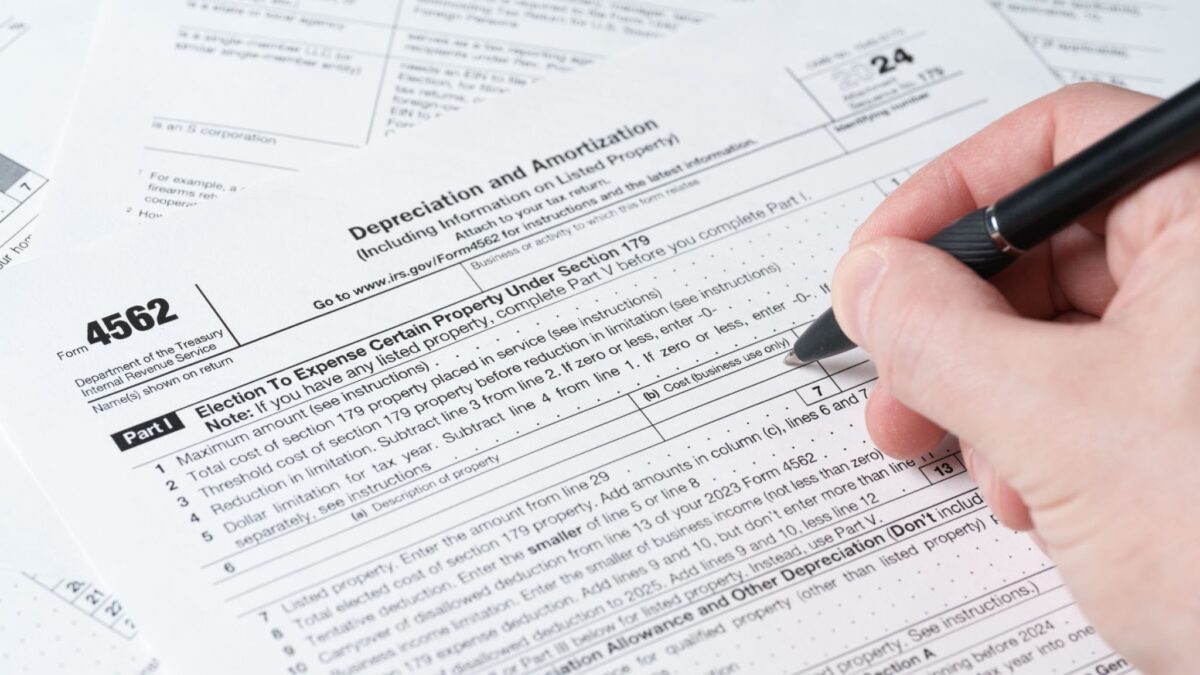
To claim this tax break, you must file IRS Form 4562 with your annual tax return. You will list the qualifying assets, their total cost, and the specific deduction amount you elect to expense.
Keep meticulous records for each purchase. Save the original invoices, receipts, and purchase contracts. Document the exact date you placed the equipment in service. If the asset has split business and personal use, maintain a log to prove your business use percentage exceeds the 50% threshold.

Frequently Asked Questions
Who qualifies for Section 179 tax?
All active businesses that purchase, finance, or lease qualifying new or used equipment during the tax year qualify for this write-off. You must use the acquired property for business operations more than 50% of the time to lock in your eligibility. Meeting these criteria lets you claim the Section 179 tax deduction to lower your tax liability.
What are the Section 179 limits for 2026?
For the 2026 tax year, the maximum Section 179 tax deduction limit is $2,560,000. This limit begins to phase out dollar-for-dollar when your total qualifying equipment purchases exceed $4,090,000. Once your annual equipment spending reaches $6,650,000, the deduction is completely unavailable.
Can used equipment qualify for Section 179?
Yes, used equipment qualifies for the write-off as long as it is new to your business. You cannot buy the used assets from a related business or family member. The Section 179 tax provisions treat qualifying used machinery, furniture, and tools exactly like brand-new hardware.
What is the difference between Section 179 and bonus depreciation?
The Section 179 tax deduction cannot exceed your active business taxable income, meaning it cannot create a net loss. It is capped at $2,560,000. Conversely, 100% bonus depreciation is uncapped and can create a net operating loss to offset taxes in other years.
Does a vehicle qualify for Section 179?
Yes, vehicles qualify for this write-off, but the IRS applies strict weight limits. Light passenger cars under 6,000 lbs have low caps. Heavy work trucks, cargo vans, and specialized passenger vehicles over 6,000 lbs GVWR are eligible to receive the full Section 179 tax write-off.
How do you calculate a Section 179 deduction?
Multiply the total cost of your qualified equipment by your business-use percentage to find your depreciable basis. If your total annual spending is under $4,090,000, you can write off the entire basis up to $2,560,000 using the Section 179 tax code.
What is the maximum Section 179 deduction for an SUV?
For heavy passenger SUVs with a GVWR between 6,001 and 14,000 lbs, the maximum first-year Section 179 tax write-off is limited to $32,000 in 2026. You can depreciate any remaining value using bonus or standard MACRS schedules.
Can Section Section 179 tax create a net operating loss?
No, the Section 179 tax deduction cannot exceed your net business taxable income. If your business operates at a loss before the deduction, you cannot claim it to create a net operating loss. Any disallowed portion carries forward to the next tax year.
| How Small Businesses Can Use Section 179 to Save Thousands on Taxes |