
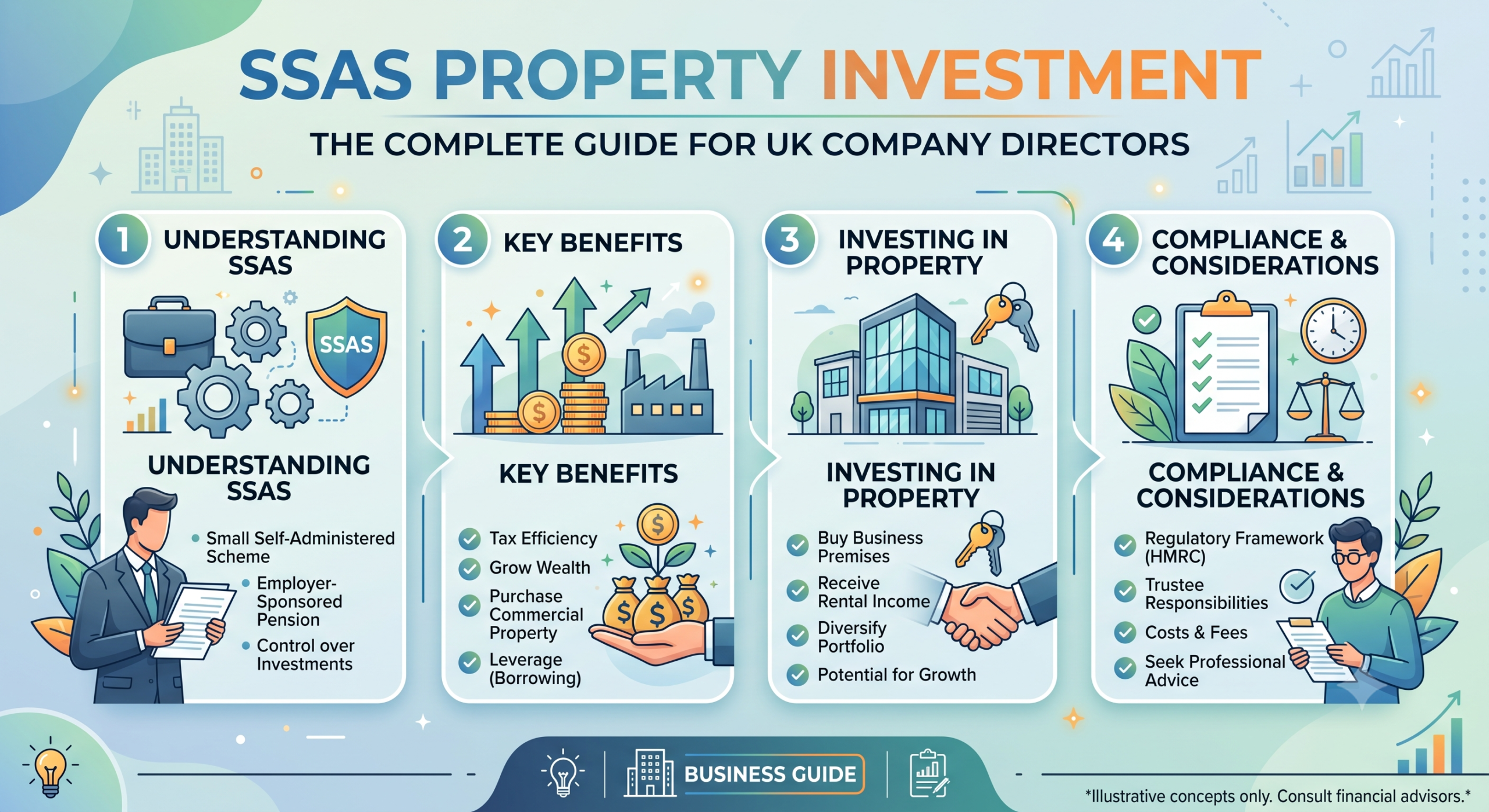
If you run a limited company, SSAS property investment lets you buy commercial premises through your own pension scheme. Rent flows into your pension, not a landlord’s pocket. Growth builds up tax-free. You keep control over every decision.
This guide breaks down how it works, what HMRC allows, and where directors get it wrong.
What Is a SSAS Pension?
A Small Self-Administered Scheme (SSAS) is an occupational pension trust. A limited company sets it up for its directors, senior staff, and sometimes family members.
Unlike a workplace pension, a SSAS gives members direct control. Members usually act as trustees too. That means you decide where the money goes.
This control is the whole point of SSAS property investment. A standard pension hands you a fund menu. A SSAS lets you buy an actual building.
How SSAS Property Investment Works
Trustees can use scheme funds, plus borrowing, to purchase premises. The company can then lease that property back from the pension.
Three features make this strategy work:
- Rental income lands in the pension tax-free
- Growth on the property is free of Capital Gains Tax
- Contributions attract Corporation Tax relief for the company
The result is a building your business uses, sitting inside a tax-efficient wrapper.
The Commercial-Only Rule
HMRC only allows commercial property inside a SSAS. This includes offices, warehouses, retail units, factories, and land with planning permission for commercial use.
Residential property is banned. Direct ownership of a house, flat, or buy-to-let triggers an unauthorised payment charge. That penalty runs as high as 55%.
There is one narrow exception. A residential unit tied to a commercial use, like a flat above a shop occupied by staff, may qualify. The rules here are strict, and the flat’s occupant cannot be connected to any SSAS member.
How Much Can a SSAS Borrow?
Trustees can borrow up to 50% of the scheme’s net asset value. Lenders typically secure this as a commercial mortgage against the property itself.
| SSAS Net Assets | Maximum Borrowing (50%) | Total Buying Power |
| £400,000 | £200,000 | £600,000 |
| £600,000 | £300,000 | £900,000 |
| £1,000,000 | £500,000 | £1,500,000 |
This borrowing limit gets tested once, at the point the loan is taken out. It does not get retested if property values later fall.
SSAS vs SIPP for Property Investment
Both a SSAS and a SIPP (Self-Invested Personal Pension) can hold commercial property. The two structures differ in important ways.
| Feature | SSAS | SIPP |
| Who can join | Company directors and family | Any individual |
| Trustee control | Members are usually trustees | Provider acts as trustee |
| Pooling funds | Multiple members can pool pensions | Cannot pool with others |
| Loan to sponsoring company | Yes, up to 50% of net assets | Not permitted |
The loan back facility is the biggest difference. It lets a SSAS lend money directly to the business that set it up, something a SIPP cannot do.
Tax Benefits of SSAS Property Investment
Directors choose SSAS property investment because the tax treatment beats owning property personally or through the trading company.
- No Income Tax on rent. Rental payments from the tenant company go straight into the pension.
- No Capital Gains Tax. Selling the property inside the scheme creates no CGT liability.
- Corporation Tax relief. Employer contributions into the SSAS reduce the company’s taxable profit.
- Asset protection. The property sits outside the trading company, away from business creditors.
These benefits only apply while the scheme follows HMRC’s rules exactly.
Risks and Compliance Traps
A SSAS rewards careful trustees. It punishes careless ones.
Unauthorized payments. Buying residential property, letting a member use scheme assets personally, or breaching connected-party rules all trigger tax charges.
Trading vs investment. Holding one commercial unit for rental income counts as investment. Buying, developing, and flipping properties on rotation can look like trading. HMRC treats trading activity differently, and it can lose its tax-free status.
Concentration risk. Tying most of your pension into one building leaves your retirement fund exposed if the tenant company struggles.
Valuation and lease terms. Rent must be set at an independent, arm’s-length market rate. An artificially low rent can also count as an unauthorized payment.
How to Set Up a SSAS for Property Investment
- Appoint a professional trustee. Most schemes need a qualified SSAS practitioner alongside the member trustees.
- Register the scheme with HMRC. The SSAS becomes a registered pension scheme once approved.
- Transfer or contribute funds. Members can transfer old pensions in, and the company can make contributions.
- Instruct a solicitor and surveyor. Property purchases need an independent valuation and full legal searches.
- Agree a formal lease. The company signs a commercial lease with the SSAS at market rent.
A Simple Example
Sarah transfers £400,000 from old pensions into a SSAS. Her company adds £100,000 as an employer contribution, gaining Corporation Tax relief.
The scheme now holds £500,000 in cash. Trustees buy a freehold office building outright, with no borrowing needed.
The company signs a lease at £36,000 a year in rent. That rent flows into Sarah’s pension tax-free, growing her retirement fund while her business gets a permanent home.
Is SSAS Property Investment Right for You?
This route suits company directors who:
- Own or lease commercial premises already
- Want long-term control over pension investments
- Have enough pension value to make property purchase practical
- Are comfortable taking professional trustee advice
It suits fewer people who need short-term access to their pension fund, since property is an illiquid asset.
Frequently Asked Questions
Can a SSAS buy residential property?
No, not directly. HMRC bans SSAS schemes from holding residential property, and doing so triggers an unauthorised payment charge. There are narrow exceptions, such as staff accommodation tied to a commercial building. SSAS property investment stays restricted to commercial premises, land, and specific mixed-use arrangements approved under HMRC rules.
How much can a SSAS pension borrow?
A SSAS can borrow up to 50% of its net asset value at the date the loan is made. A scheme worth £600,000 can therefore borrow £300,000, giving £900,000 of buying power. This limit gets tested once, not retested if property values fall later.
Is a SSAS a good idea for property investment?
For company directors with sufficient pension value, SSAS property investment can be tax-efficient and flexible. Rent and growth build up tax-free, and trustees control every decision. It suits long-term investors comfortable with an illiquid asset, but it needs proper professional advice before setup.
How does a SSAS pension work?
A limited company establishes the SSAS as a trust for its directors and senior staff. Members typically act as trustees, giving them direct control over investment decisions, including SSAS property purchases, employer loanbacks, and other permitted assets, all within strict HMRC pension rules.
What is the difference between a SSAS and a SIPP?
A SSAS is set up by a company for multiple members, who usually act as trustees and can pool funds together. A SIPP is an individual pension. Only a SSAS can lend money back to its sponsoring company, making it the preferred structure for SSAS property strategies among business owners.
Can a SSAS lend money to a company?
Yes. A SSAS can lend up to 50% of its net asset value back to the sponsoring employer. The loan needs a first legal charge over an asset of equal value, a maximum five-year term, and interest at at least 1% above average bank base rates.
What type of commercial property can a SSAS hold?
A SSAS can hold offices, factories, warehouses, retail units, hotels, pubs, and commercial land, including development sites with the right planning permission. Direct residential property remains prohibited under HMRC’s investment-regulated pension scheme rules, keeping SSAS property investment firmly commercial in scope.
What happens if a SSAS breaks the residential property rules?
Breaching the rules creates an unauthorized payment. HMRC can charge tax of up to 55% on the value involved, alongside a possible scheme sanction charge. This makes professional trustee oversight essential for any SSAS property purchase, especially where a property has mixed commercial and residential use.
| SSAS Property Investment: The Complete Guide for UK Company DirectorsBook Your Comprehensive Property Tax Review |