
One of the most common questions from new company directors is deceptively simple: what can I actually claim back from my own company? The underlying rule is straightforward in principle — expenses must be incurred “wholly and exclusively” for business purposes — but applying it in practice, especially where personal and business use overlap, is where most of the genuine complexity lives.
Not sure which of your costs your company can reimburse? Book a free 15-minute consultation with Felix Accountants. Book your free call here.
The “Wholly and Exclusively” Rule
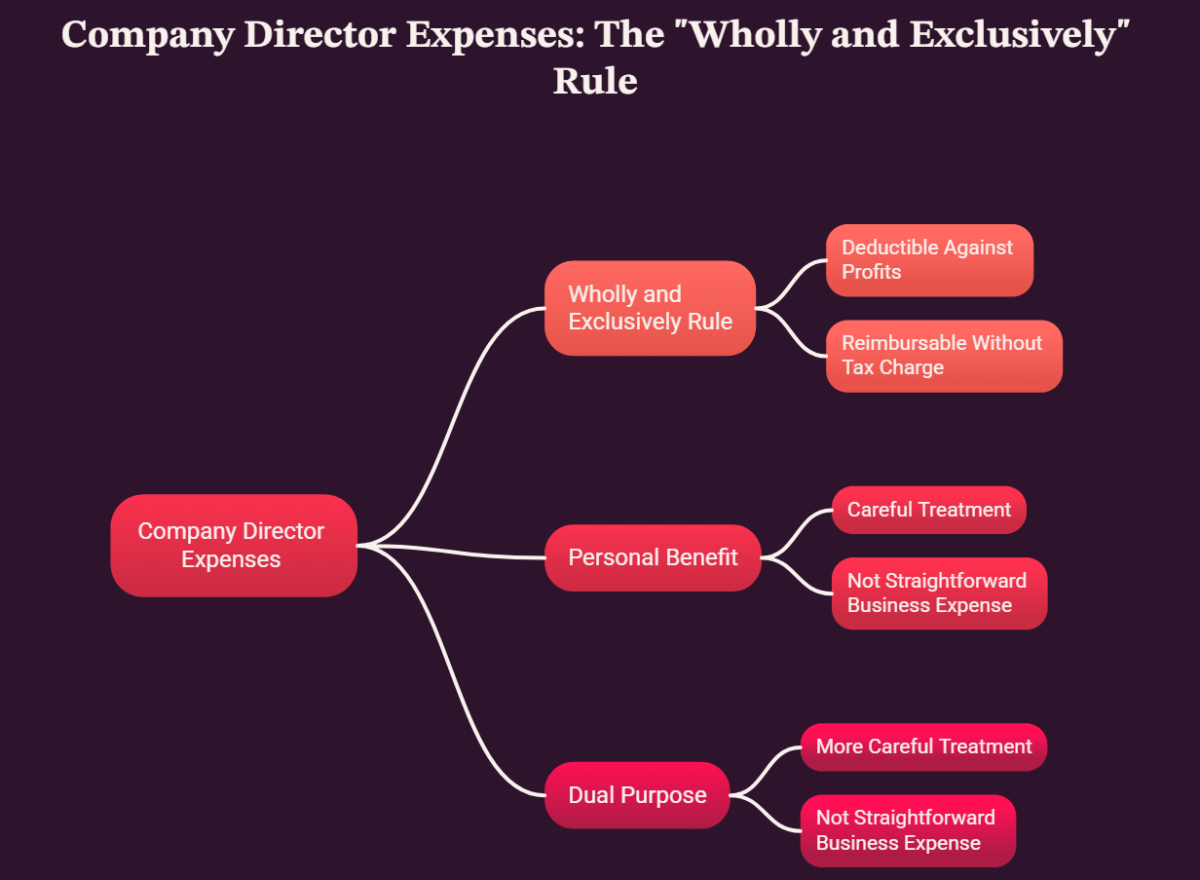
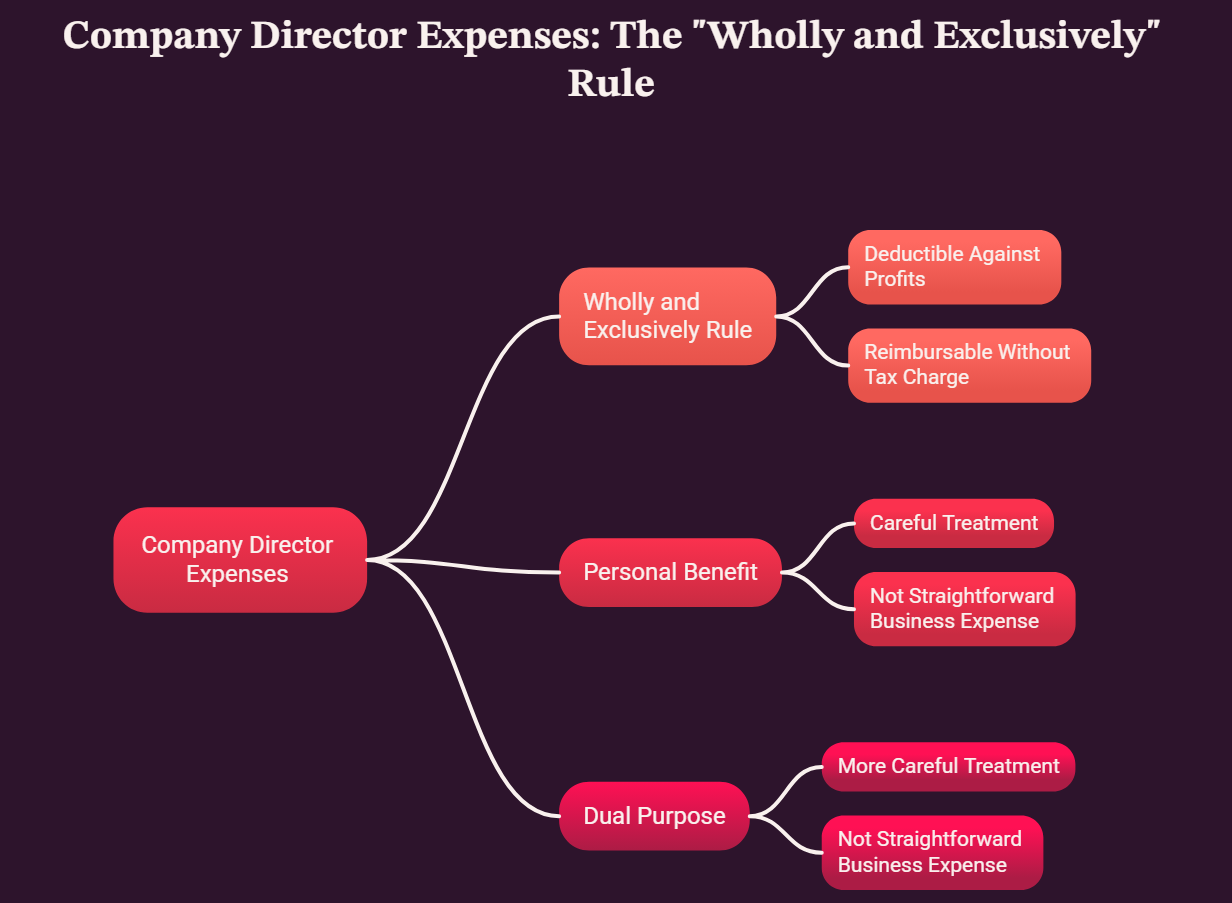
For a cost to be deductible against company profits (reducing Corporation Tax) and reimbursable to a director without creating a personal tax charge, it generally needs to have been incurred wholly and exclusively for the purposes of the company’s trade. Costs with any significant personal benefit or dual purpose need much more careful treatment, and some can’t be claimed as a straightforward business expense at all, even if there’s a genuine business element involved. Our full guide on allowable limited company expenses covers the general framework this sits within.
Straightforward Reimbursable Expenses
These generally cause few complications, as long as they’re genuinely business-related:
- Travel costs for business journeys (excluding ordinary commuting to a permanent workplace)
- Business mileage, using HMRC’s approved mileage rates when using a personal vehicle for company business
- Accommodation and subsistence costs while travelling for business
- Professional subscriptions and memberships relevant to the trade
- Office supplies, software subscriptions, and equipment used for the business
- Business insurance premiums
- Training costs directly relevant to the role, in most circumstances
Our guide on claiming business mileage from your own company covers the specific approved mileage rates and record-keeping needed to support this particular claim.
Working From Home
Directors working from home can generally claim a modest, flat-rate contribution toward household costs, or a more detailed calculation based on actual additional costs (such as extra heating and electricity) attributable to business use of part of the home, provided it’s calculated on a reasonable, defensible basis rather than an arbitrary figure.
Company Cars: A More Complicated Area
Company cars are one of the most commonly misunderstood areas of director expenses. If a company provides a car that’s available for the director’s personal use (not just business use), this generally creates a taxable “benefit in kind,” reported on a P11D, with the director paying Income Tax on the benefit and the company paying Class 1A National Insurance. The tax cost of this varies significantly depending on the car’s list price and CO2 emissions, which is why fully electric or low-emission vehicles are often considerably more tax-efficient as a company car than a typical petrol or diesel model. Our guide on running your car in a tax-effective way covers this comparison in more detail, including when using your own car and claiming mileage is more efficient than a company-provided vehicle.
Business Entertainment: Generally Not Deductible
This catches a lot of directors out. Client entertainment costs — taking a client to dinner, for example — are generally not deductible against Corporation Tax at all, even though they’re a genuine, arguably necessary business cost. This is a specific, long-standing exclusion in the tax rules, distinct from the general “wholly and exclusively” test that governs most other expenses. Staff entertainment, by contrast, can qualify for a specific annual exemption (subject to a per-head limit) for events such as a Christmas party, provided the conditions are met.
Home-to-Work Travel
Ordinary commuting between home and a permanent workplace generally isn’t a deductible business expense, regardless of the distance involved. This is one of the more counter-intuitive rules for new directors, particularly where a director works primarily from a home office but occasionally travels to a separate business premises — the specific facts of where the “permanent workplace” is considered to be can significantly affect what’s claimable.
Reimbursing Genuine Personal Expenditure With a Business Element
Where a cost has both a business and personal element — a broadband contract used for both work and personal browsing, for example — only the business proportion can generally be claimed, and it needs to be calculated on a reasonable, justifiable basis. Claiming the full cost of something with genuine dual use, rather than an apportioned business element, is a common area where directors inadvertently create a benefit in kind or an incorrect Corporation Tax deduction.
What Happens When Something Isn’t a Clean Business Expense?
Where a cost doesn’t meet the wholly-and-exclusively test, or has a personal benefit element, it typically falls into one of a few categories:
- Taxable benefit in kind: reported on a P11D, with Income Tax paid by the director and Class 1A National Insurance paid by the company
- Not deductible for Corporation Tax at all: some costs, like client entertainment, simply aren’t allowable regardless of how they’re reimbursed
- Treated as a dividend or salary: if a payment doesn’t fit any genuine expense category, it may need to be treated as personal income instead, with the corresponding tax treatment
Keeping the Right Records
Whatever the expense, clear supporting records matter — receipts, a note of the business purpose, and (for mixed-use costs) a documented basis for the apportionment. This protects both the Corporation Tax deduction and the director’s personal tax position if HMRC ever asks questions about a specific claim.
Pension Contributions: A Particularly Tax-Efficient Option
Separately from routine expense reimbursement, company pension contributions made directly on a director’s behalf are generally a deductible business expense for the company and don’t create a personal Income Tax or National Insurance charge for the director, making this one of the more tax-efficient ways to extract value from company profits. Our guide on using pension contributions for tax relief covers this in more detail.
How Felix Accountants Can Help
We help directors work out exactly what can be reimbursed cleanly, what needs to go through P11D reporting, and how to structure genuinely mixed-use costs correctly. See our wider business tax services for how this fits into your company’s broader Corporation Tax position.
Frequently Asked Questions
Can my company pay for my commute to the office?
Generally no. Ordinary commuting between home and a permanent workplace isn’t a deductible business expense, regardless of distance.
Can I claim client entertainment as a business expense?
No, client entertainment costs are generally not deductible for Corporation Tax purposes, even though they’re a genuine business activity.
What happens if my company provides me with a car I can use personally?
This generally creates a taxable benefit in kind, reported on a P11D, with Income Tax paid by you and Class 1A National Insurance paid by the company, based on the car’s list price and emissions.
Can I claim the full cost of my home broadband if I use it for work?
Only the business-use proportion is generally claimable, calculated on a reasonable, justifiable basis, rather than the full personal and business cost combined.
Is it better to have a company car or claim mileage using my own car?
It depends on the specific vehicle, its emissions, and how much personal use is involved — for many directors, using a personal car and claiming approved mileage rates is more tax-efficient than a company-provided car, particularly for higher-emission vehicles.
Let’s clarify exactly what your company can reimburse. Book your free 15-minute consultation with Felix Accountants.