
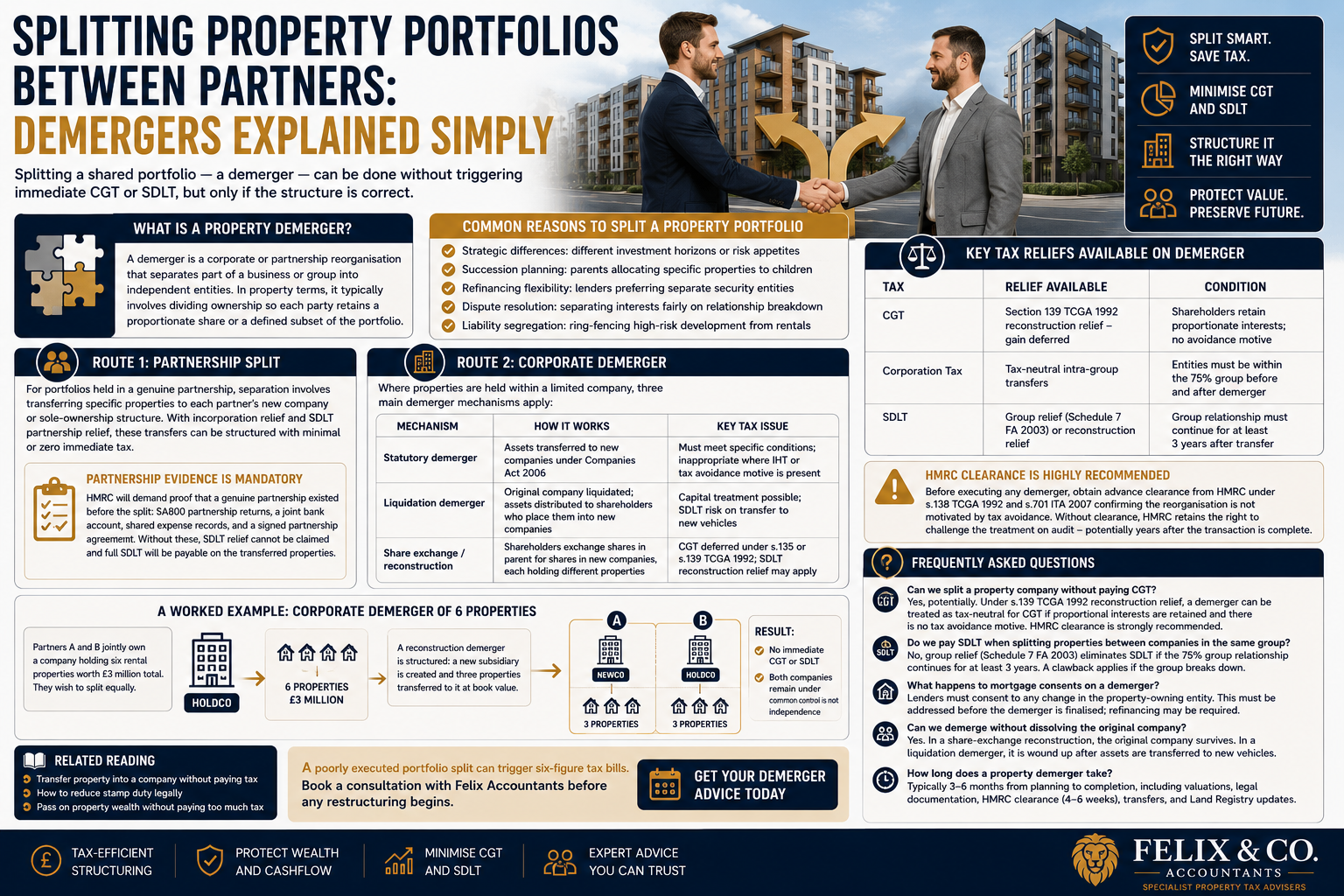
A property portfolio demerger allows property investors, business partners and family members to split shared property holdings in a tax-efficient way. As property partnerships evolve, partners often reach a point where their strategic objectives diverge. One wants to continue growing a rental portfolio; another wants to focus on development. Others simply wish to go their separate ways. Splitting a shared portfolio — a demerger — can be done without triggering immediate CGT or SDLT, but only if the structure is correct.
What Is a Property Portfolio Demerger?
A demerger is a corporate or partnership reorganisation that separates part of a business or group into independent entities. In property terms, it typically involves dividing ownership so each party retains a proportionate share or a defined subset of the portfolio.
Why Investors Use a Property Portfolio Demerger
- Strategic differences: different investment horizons or risk appetites between partners
- Succession planning: parents allocating specific properties to individual children
- Refinancing flexibility: lenders preferring separate security entities per investor
- Dispute resolution: separating interests fairly on relationship breakdown
- Liability segregation: ring-fencing high-risk development projects from stable rental assets
Property Portfolio Demerger Through a Partnership Split
For portfolios held in a genuine partnership, separation involves transferring specific properties to each partner’s new company or sole-ownership structure. Where incorporation relief and SDLT partnership relief apply (as discussed in Chapter 4), these transfers can be structured with minimal or zero immediate tax.
| Partnership Evidence Is Mandatory |
| HMRC will demand proof that a genuine partnership existed before the split: SA800 partnership returns, a joint bank account, shared expense records, and a signed partnership agreement. Without these, SDLT relief cannot be claimed and full SDLT will be payable on the transferred properties. |
Property Portfolio Demerger Through a Corporate Restructure
Where properties are held within a limited company, three main demerger mechanisms apply:
| Mechanism | How It Works | Key Tax Issue |
| Statutory demerger | Assets transferred to new companies under Companies Act 2006 | Must meet specific conditions; inappropriate where IHT or tax avoidance motive is present |
| Liquidation demerger | Original company liquidated; assets distributed to shareholders who place them into new companies | Capital treatment possible; SDLT risk on transfer to new vehicles |
| Share exchange / reconstruction | Shareholders exchange shares in parent for shares in new companies, each holding different properties | CGT deferred under s.135 or s.139 TCGA 1992; SDLT reconstruction relief may apply |
Key Tax Reliefs for a Property Portfolio Demerger
| Tax | Relief Available | Condition |
| CGT | Section 139 TCGA 1992 reconstruction relief — gain deferred | Shareholders retain proportionate interests; no avoidance motive |
| Corporation Tax | Tax-neutral intra-group transfers | Entities must be within the 75% group before and after demerger |
| SDLT | Group relief (Schedule 7 FA 2003) or reconstruction relief | Group relationship must continue for at least 3 years after transfer |
| HMRC Clearance Is Highly Recommended | ||
| Before executing any demerger, obtain advance clearance from HMRC under s.138 TCGA 1992 and s.701 ITA 2007 confirming the reorganisation is not motivated by tax avoidance. Without clearance, HMRC retains the right to challenge the treatment on audit — potentially years after the transaction is complete. | ||
A Worked Example: Corporate Demerger of 6 Properties
Partners A and B jointly own a company holding six rental properties worth £3 million total. They wish to split equally. A reconstruction demerger is structured: a new subsidiary is created and three properties transferred to it at book value. A receives shares in the new subsidiary; B retains shares in the original company. Result: no immediate CGT or SDLT, both companies remain under common control until independence.
Related Reading
Transfer property into a company without paying tax | How to reduce stamp duty legally | Pass on property wealth without paying too much tax
Frequently Asked Questions
Can we split a property company without paying CGT?
Potentially, yes. Under s.139 TCGA 1992 reconstruction relief, a demerger structured so that shareholders retain proportionate interests in the separated entities can be treated as tax-neutral for CGT. The structure must not be motivated by tax avoidance, and advance HMRC clearance is strongly recommended.
Do we pay SDLT when splitting properties between companies in the same group?
Group relief (Schedule 7 FA 2003) eliminates SDLT on transfers between companies within the same 75% corporate group, provided the group relationship is maintained for at least three years after the transfer. A clawback applies if the group relationship breaks down within that period.
What happens to mortgage consents on a demerger?
Existing lenders must consent to any change in the property-owning entity. This is a practical constraint that must be addressed before the demerger structure is finalised. In some cases, refinancing is required, which can create additional cost and delay.
Can we demerge without dissolving the original company?
Yes. In a share-exchange reconstruction, the original company survives — shareholders simply swap some shares for shares in a newly created company. In a liquidation demerger, the original company is wound up, but properties transfer to the shareholders’ new vehicles before dissolution.
How long does a property demerger take?
A well-prepared demerger typically takes 3–6 months from initial planning to completion. This includes obtaining valuations, drafting legal documents, applying for HMRC clearance (which can take 4–6 weeks), executing the transfers, and registering new ownership at HM Land Registry.
| A poorly executed portfolio split can trigger six-figure tax bills. Book a consultation with Felix Accountants before any restructuring begins. |
JSON-LD Schema Markup