
Serviced accommodation and HMOs have transformed from niche strategies into mainstream property businesses — but their tax treatment is substantially different from standard buy-to-let, and HMRC is paying increasing attention to operators who blur the boundaries. This guide explains exactly how each model is taxed and what you must do to remain compliant.
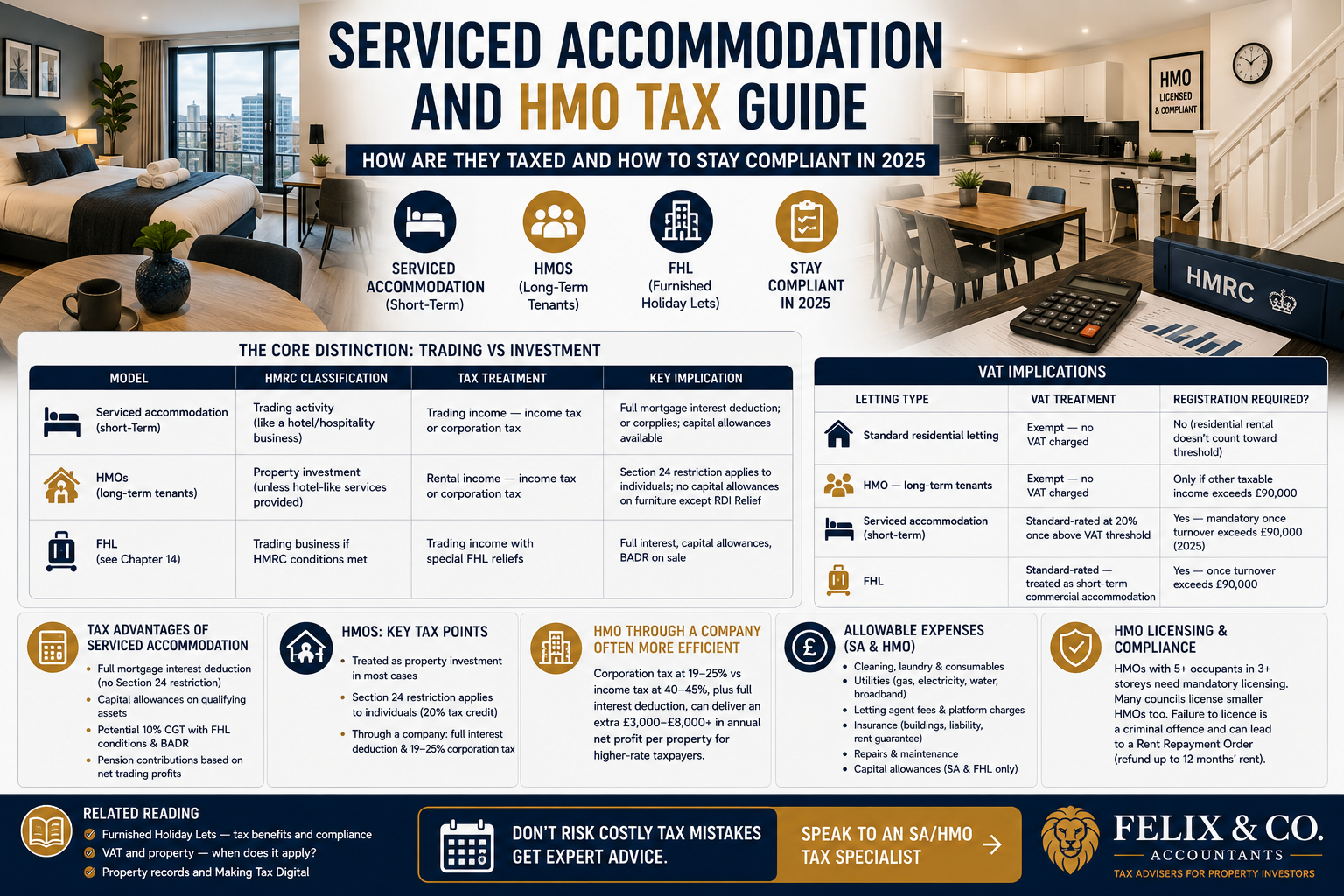
Serviced Accommodation vs HMO Tax Treatment
| Model | HMRC Classification | Tax Treatment | Key Implication |
| Serviced accommodation (short-term) | Trading activity (like a hotel/hospitality business) | Trading income — income tax or corporation tax | Full mortgage interest deduction; NIC applies; capital allowances available |
| HMOs (long-term tenants) | Property investment (unless hotel-like services provided) | Rental income — income tax or corporation tax | Section 24 restriction applies to individuals; no capital allowances on furniture except RDI Relief |
| FHL (see Chapter 14) | Trading business if HMRC conditions met | Trading income with special FHL reliefs | Full interest, capital allowances, BADR on sale |
Serviced Accommodation Tax Rules
Serviced accommodation income is generally classed as trading income. This delivers several significant advantages over standard residential letting:
- Full mortgage interest deduction — Section 24 restriction does not apply to trading activity
- Capital allowances on furniture, fixtures, equipment, and technology installations
- Potential Business Asset Disposal Relief at 10% CGT rate on sale where FHL conditions are also met
- Pension contributions can be made based on net trading profits
However, trading classification also means: Class 2 and Class 4 National Insurance contributions may apply to individual operators; and local authority business rates replace council tax for most SA properties.
Tax Treatment: HMOs
HMOs are typically treated as standard residential property investment. Individual HMO landlords face the Section 24 mortgage interest restriction (20% tax credit only). Through a limited company, interest remains fully deductible and corporation tax rates of 19–25% apply.
| HMO Through a Company — Often More Efficient |
| For HMO landlords with significant mortgage borrowing, the limited company route can substantially improve net returns. Corporation tax at 19–25% versus income tax at 40–45%, combined with full interest deduction, frequently delivers an extra £3,000–£8,000+ in annual net profit per property for higher-rate taxpayers. |
VAT on Serviced Accommodation and HMOs
| Letting Type | VAT Treatment | Registration Required? |
| Standard residential letting | Exempt — no VAT charged | No (residential rental doesn’t count toward threshold) |
| HMO — long-term tenants | Exempt — no VAT charged | Only if other taxable income exceeds £90,000 |
| Serviced accommodation (short-term) | Standard-rated at 20% once above VAT threshold | Yes — mandatory once turnover exceeds £90,000 (2025) |
| FHL | Standard-rated — treated as short-term commercial accommodation | Yes — once turnover exceeds £90,000 |
Allowable Expenses for SA and HMO
- Cleaning, laundry, and consumable supplies (toiletries, linen, kitchen essentials)
- Utilities (gas, electricity, water, broadband) — where paid by the landlord
- Letting agent and management fees; booking platform charges (Airbnb, Booking.com)
- Buildings and liability insurance; rent guarantee insurance
- Repairs and maintenance (not capital improvements)
- Capital allowances on furniture, TVs, appliances, CCTV (SA and FHL operators only)
HMO Licensing and Regulatory Compliance
HMOs with 5 or more occupants in 3 or more storeys require mandatory licensing from the local authority. Many councils have introduced additional licensing requirements for smaller HMOs. Failure to licence is a criminal offence and can result in a Rent Repayment Order requiring the landlord to refund up to 12 months of rent.
Related Reading
Furnished Holiday Lets — tax benefits and compliance | VAT and property — when does it apply? | Property records and Making Tax Digital
Frequently Asked Questions
Is Airbnb income taxed as a trade or rental income?
If you let a property short-term on Airbnb with cleaning, linen changes, and guest services, HMRC typically treats this as trading income. If you simply let the property without services and guests manage themselves, the distinction is less clear. The FHL tests (if applicable) provide the clearest framework — if those are not met, the income may be taxed as property investment income.
Do I need to register for VAT for my serviced accommodation?
Yes, once your gross turnover from short-term letting (including all SA and FHL income) exceeds £90,000 per year (2025/26 threshold), you must register for VAT and charge 20% on income. You can then reclaim VAT on all business expenses including cleaning, utilities, and refurbishments.
Can I claim capital allowances on my HMO furniture?
Not on standard buy-to-let HMO furniture. The Replacement of Domestic Items Relief allows a deduction only when you replace an existing item like-for-like — there are no capital allowances on initial furnishing costs. Serviced accommodation and FHL operators can claim capital allowances on all eligible fixtures and equipment.
What is a Rent Repayment Order and when can tenants apply for one?
A Rent Repayment Order (RRO) allows tenants to reclaim up to 12 months of rent from a landlord who has committed a housing offence — including operating an unlicensed HMO or failing to comply with an improvement notice. The First-Tier Tribunal can order repayment even where the landlord is later prosecuted.
Should I hold my HMO portfolio in a company or personally?
For higher-rate taxpayers with significant mortgage borrowing, a limited company typically provides substantially better returns: full interest deduction, 19–25% corporation tax versus 40–45% income tax, and greater extraction flexibility. The decision depends on current leverage, income needs, and long-term portfolio plans.
| Don’t manage your serviced accommodation or HMO tax position without professional support. Book a consultation with Felix Accountants today. |
JSON-LD Schema Markup