
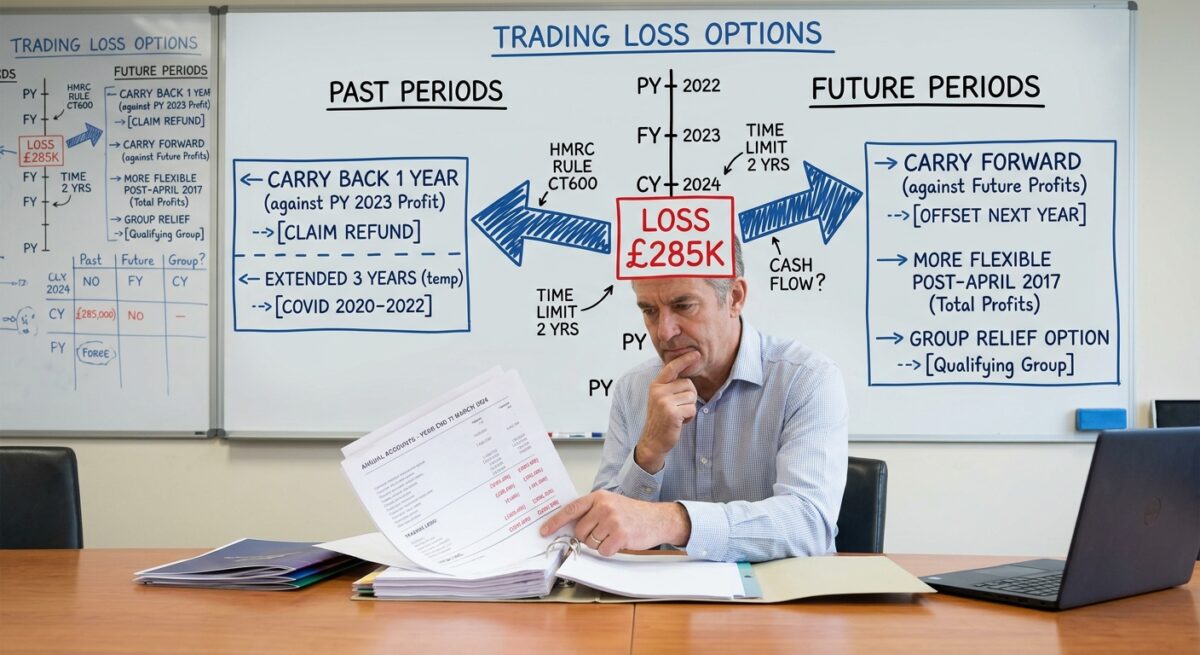
A trading loss is never welcome news, but it isn’t purely bad news for your Corporation Tax position either. UK companies have several options for using a trading loss to reduce tax, whether that’s offsetting it against profits from the same period, carrying it back to a profitable prior year for a refund, or carrying it forward to reduce tax in future years. Understanding which options apply — and which is most valuable for your specific situation — can make a real difference to your company’s cash position.
Made a loss and not sure how to use it? Book a free 15-minute consultation with Felix Accountants and we’ll work through your options. Book your free call here.
What Counts as a Trading Loss?
A trading loss arises when your company’s allowable expenses exceed its taxable income from its main trading activity within an accounting period. It’s calculated in broadly the same way as profit, just with the result coming out negative. It’s worth noting that different types of loss — trading losses, capital losses, and non-trade loan relationship losses — are treated differently, so the options below relate specifically to trading losses from your company’s core business activity.
Option 1: Offset Against Profits in the Same Accounting Period
If your company has other income in the same accounting period — for example, rental income, investment income, or a capital gain — a trading loss can generally be set against that other income first, reducing your overall Corporation Tax bill for the period in which the loss arose.
Option 2: Carry the Loss Back
Under general rules, a trading loss can be carried back and set against profits from the previous accounting period. If your company made a substantial profit last year and a loss this year, carrying the loss back can generate a genuine cash refund of tax already paid — this is often the most immediately valuable option where cash flow is a priority, since it converts the loss into money back in the business relatively quickly, rather than a benefit that only helps once future profits materialise.
Option 3: Carry the Loss Forward
Where a loss can’t be fully used against current or prior-year profits, the remainder can be carried forward indefinitely and set against future profits, as long as the company continues to trade. This is the most commonly used relief for ongoing businesses that expect to return to profitability, and it doesn’t have an expiry date — a carried-forward loss remains available to use against future profits for as long as the company continues trading.
For accounting periods starting on or after 1 April 2017, losses carried forward can generally be set against total profits of the company (not just profits from the same trade), giving more flexibility than losses carried forward from earlier periods, which were typically restricted to profits from the same trade only.
Option 4: Terminal Loss Relief for Companies That Have Stopped Trading
If a company permanently ceases trading and makes a loss in its final 12 months, special “terminal loss” rules allow that loss to be carried back up to three years, rather than the standard one year, against profits from the same trade, applied against the most recent year first and working backwards. This can be particularly valuable for directors winding up a business, since it may unlock refunds from several years of prior Corporation Tax payments.
A Restriction Worth Knowing About: The £5 Million Threshold
For most small and medium-sized companies, this won’t apply, but it’s worth being aware of: where a company or group’s profits exceed £5 million in an accounting period, only 50% of profits above that threshold can be sheltered by carried-forward losses in that period. Below the £5 million threshold, companies can generally use all their available carried-forward losses without this restriction.
Group Relief: Losses Across Related Companies
Where a company is part of a group structure with at least 75% common ownership, trading losses can potentially be surrendered between group companies within the same accounting period, allowing a loss in one company to reduce the tax bill of a profitable related company. This is a more complex area, particularly for property investors using multiple special purpose vehicles, and it’s worth reviewing alongside your wider SPV structure if your group includes several companies.
How to Make a Claim
Loss relief claims are generally made as part of your Company Tax Return (CT600), using the specific loss-relief boxes for the accounting period in question. Where a loss is being carried back to an earlier period, you may need to amend that earlier return or write to HMRC separately, depending on how the return was originally filed and whether it’s still within the amendment window.
Choosing Between Carrying Back and Carrying Forward
Where both options are genuinely available, the right choice depends on your priorities:
- Carry back if immediate cash flow matters more than long-term tax planning, since it generates a relatively quick refund
- Carry forward if you expect meaningfully higher profits in future years and would rather shelter tax at a point when the company can more easily absorb the cash flow impact of paying tax now
These aren’t mutually exclusive across different loss amounts — some companies use a combination, carrying back what they can and carrying forward the remainder.
How Felix Accountants Can Help
We help company directors model out the different loss relief options, calculate the actual cash benefit of each, and prepare the correct claims on the CT600 or via a formal letter to HMRC where needed. See our wider business tax services for how loss relief fits into broader Corporation Tax planning, and our guide on tax-efficient business sale exit planning if losses are part of a wider decision about the company’s future.
Frequently Asked Questions
How long can a company carry forward a trading loss?
Indefinitely, as long as the company continues to trade. There’s no expiry date on carried-forward trading losses.
Can I choose whether to carry a loss back or forward?
Generally yes, where both options are genuinely available, though the specific claim process and time limits differ, so it’s worth deciding based on which gives the better financial outcome for your company.
Do carried-forward losses restrict which profits they can be used against?
For losses arising in accounting periods starting on or after 1 April 2017, carried-forward losses can generally be set against the company’s total profits, not just profits from the same trade.
What happens to trading losses if my company stops trading?
If the company permanently ceases trading, a loss made in its final 12 months can be carried back up to three years under special terminal loss relief rules, rather than the standard one-year carry-back.
Is there a limit on how much loss a large company can use?
For companies or groups with profits exceeding £5 million in an accounting period, only 50% of profits above that threshold can be sheltered by carried-forward losses. Most small and medium-sized companies aren’t affected by this restriction.
Let’s work out the best way to use your company’s loss. Book your free 15-minute consultation with Felix Accountants.