
Property development offers the highest potential returns of any property strategy — but it also carries the most risk and tax complexity. A poorly structured development project can expose profits to unnecessary corporation tax, personal liability, and HMRC challenge. Using a Special Purpose Vehicle (SPV) resolves most of these risks at the cost of disciplined administration.
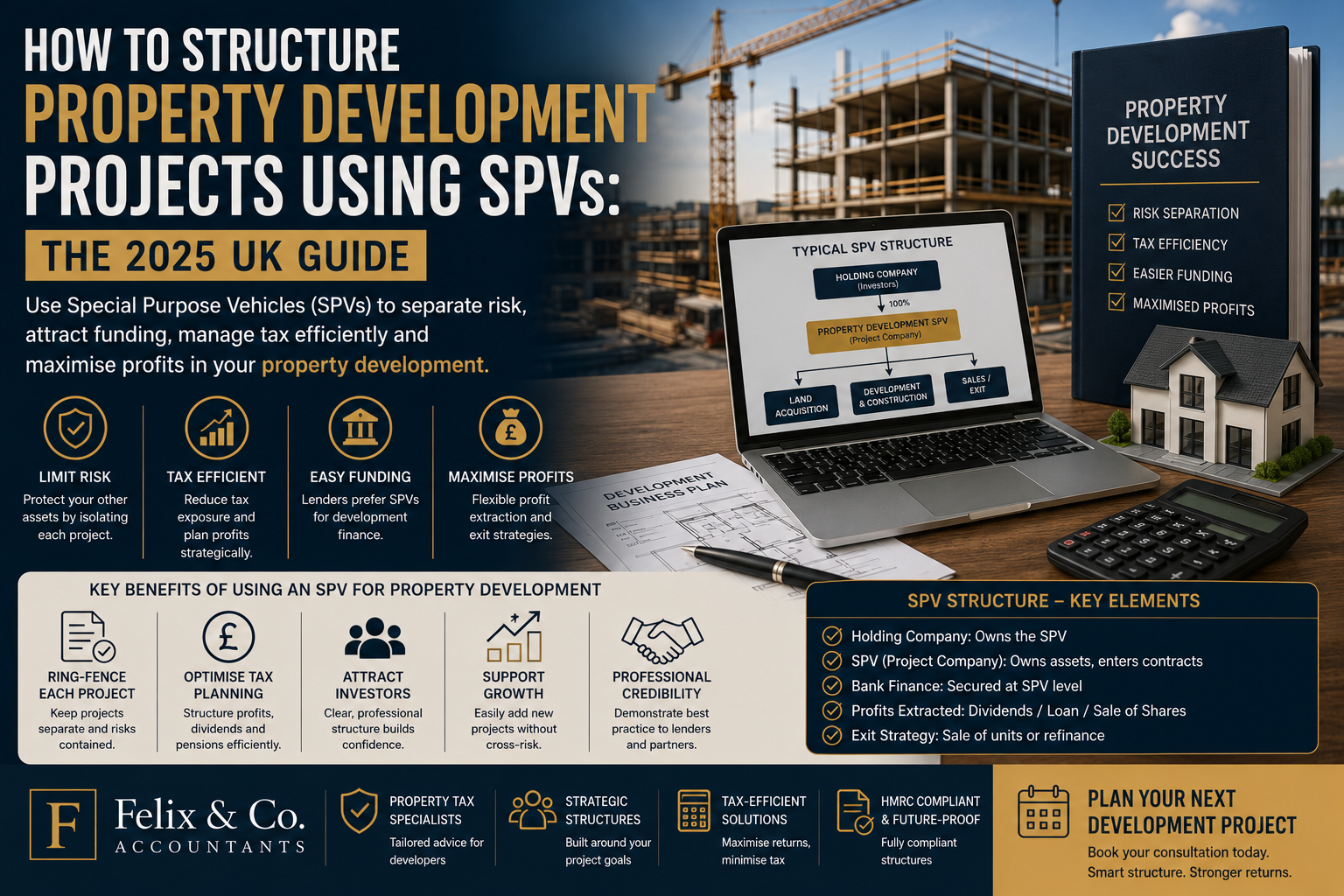
Property Development SPV Structures Explained
An SPV is a company created solely to undertake a specific development project. It holds the land, contracts with builders and professionals, receives the sales proceeds, and closes (or lies dormant) once the project is complete. Lenders almost always prefer SPVs because security can be taken against a clean, ring-fenced entity without exposure to your other activities.
Why Property Development Projects Use SPVs
- Legal and financial separation between each project
- Clean accounting: performance is measurable per project
- Lender confidence: security is limited to the SPV’s assets
- Insolvency isolation: failure of one project does not contaminate others
- Flexible profit extraction: dividends, management fees, or capital distribution on wind-up
Tax Treatment of an SPV
An SPV is taxed as a standalone company. Corporation tax at 19–25% applies to profits. The critical distinction in a development context is whether the company is developing properties for sale (trading) or for long-term retention (investment).
| Activity Type | Tax Treatment | Key Implication |
| Development for sale (trading stock) | Profits are trading income — corporation tax at 19–25% | No CGT relief; full cost deduction including land and build |
| Development then retained for letting (investment) | Property is a capital asset; rental income taxed; gain on disposal is CG | Capital allowances may apply; different accounting rules |
| Mixed: develop some, retain some | Requires careful apportionment between trading and investment | Transfer to investment subsidiary should be at market value |
Funding and Ownership Structures
Development projects are rarely fully equity-funded. Common structures include a sole-shareholder SPV (developer provides all capital and management); a joint-venture SPV (multiple shareholders in agreed proportions); and a development management structure (developer earns a fee from the SPV rather than a profit share). Where outside investors are involved, a shareholders’ agreement must document profit-sharing, decision rights, and exit mechanisms.
| VAT Registration for SPVs |
| Register the SPV for VAT promptly — ideally before the first professional invoice. New residential construction is zero-rated, allowing full input VAT recovery on all build costs. Registering late means losing VAT on early-stage costs permanently. |
SDLT on Land Acquisition
When the SPV acquires the development land, SDLT is payable on the purchase price. Non-residential SDLT rates apply to bare development land, which are considerably lower than residential rates and carry no additional-dwelling surcharge.
| SDLT Band (Non-Residential) | Rate |
| Up to £150,000 | 0% |
| £150,001 – £250,000 | 2% |
| Above £250,000 | 5% |
How to Extract Profits from a Property Development SPV
Once a development is complete and proceeds received, profits can be extracted via: (1) dividends to shareholders after corporation tax; (2) management fees to a parent service company; or (3) capital distribution on formal winding up of the SPV — potentially qualifying for lower capital gains rates if structured correctly as a distribution in specie.
Related Reading
VAT and property — when does it apply? | Advanced company structures for property entrepreneurs | How to reduce stamp duty legally
Property Development SPV FAQS
Do I need a new SPV for every development project?
It is best practice to use a separate SPV for each significant project. This ring-fences risk, simplifies accounting, and satisfies lender requirements. For small projects, one SPV can handle multiple phases if risk profiles are similar — but seek advice first.
Can I use an LLP instead of a limited company as an SPV?
Yes. An LLP SPV is used where flexible profit allocation between partners is important, or where the development involves joint venture parties who need income-taxed rather than dividend-taxed returns. LLPs are tax-transparent — profits flow to members and are taxed personally.
How is development profit taxed versus rental income?
Development profit (from sales of developed property) is taxed as trading income under corporation tax (19–25%). Rental income from retained properties is investment income — taxed differently, with different expense rules and no capital allowances on buildings.
What happens to SDLT when land is transferred into an SPV?
SDLT is payable on land acquisition by the SPV at non-residential rates (lower than residential). Where the land is transferred from a related partnership or group company, group relief or reconstruction relief may reduce or eliminate SDLT.
Can my SPV borrow against land it acquires before planning is granted?
Yes. Bridging finance on development land pre-planning is common, though rates are higher. The SPV’s ability to borrow is ring-fenced to its own assets and the developer’s guarantee — another reason why SPV structure is valued by lenders.
| Structure your next development correctly from day one. Book a consultation with Felix Accountants — specialist property development advisers. |
JSON-LD Schema Markup