
This VAT and property UK guide 2025 explains when VAT applies to residential and commercial property, how VAT recovery works, and when landlords should consider opting to tax.. Many investors assume it simply doesn’t apply to residential letting — and for standard long-term lettings they are correct — but this assumption becomes expensive the moment they venture into commercial property, development projects, or short-term letting.
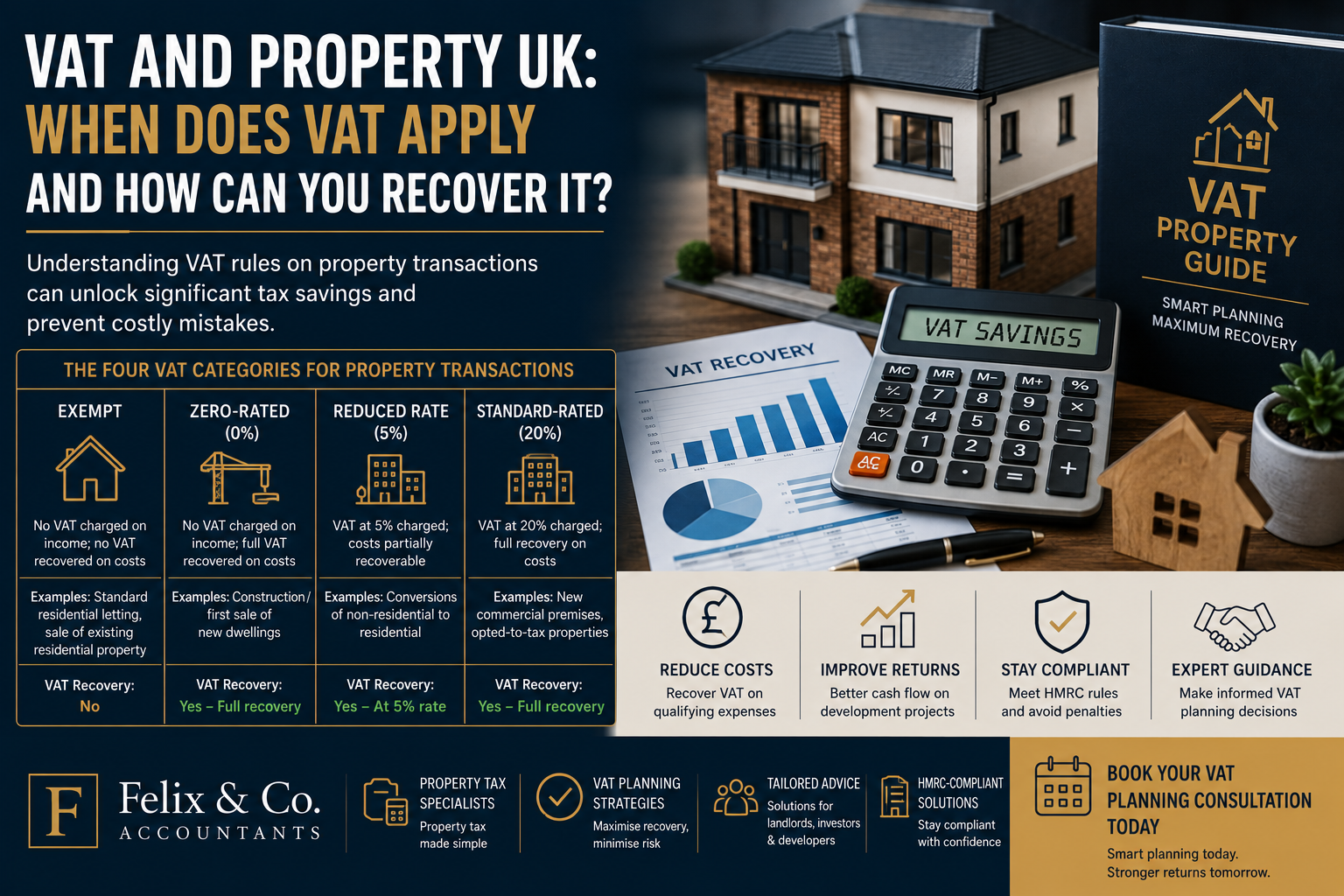
The Four VAT Categories for Property Transactions
| VAT Category | What It Means | Property Examples | VAT Recovery on Costs? |
| Exempt | No VAT charged on income; no VAT recovered on costs | Standard residential letting, sale of existing residential property | No |
| Zero-rated (0%) | No VAT charged on income; full VAT recovered on costs | Construction/first sale of new dwellings | Yes — full recovery |
| Reduced rate (5%) | VAT at 5% charged; costs partially recoverable | Certain conversions of non-residential to residential | Yes — at 5% rate |
| Standard-rated (20%) | VAT at 20% charged; full recovery on costs | New commercial premises, opted-to-tax properties | Yes — full recovery |
| The Critical Distinction: Exempt vs Zero-Rated | |||
| Both categories result in zero VAT being charged to the customer — but the difference in financial outcome is enormous. Exempt = you cannot recover VAT you paid on your costs. Zero-rated = you can recover all VAT you paid on costs. For a £500,000 development project, this difference can be £80,000–£100,000. | |||
VAT and Property UK: Residential Property Rules
The letting or sale of existing residential property is generally exempt from VAT. This means you charge no VAT on rent or sale proceeds, but you also cannot reclaim VAT incurred on repairs, maintenance, or professional fees.
However, newly built dwellings are zero-rated when first sold or let on a long lease. A developer building residential units from bare land can reclaim all VAT on construction costs and professional services — a powerful financial advantage that must be structured correctly from the outset.
VAT and Property UK: Commercial Property and the Option to Tax
Commercial property transactions are generally standard-rated at 20%. However, older commercial properties (3+ years old) are exempt by default unless the owner makes an Option to Tax election (HMRC form VAT1614A).
When to Consider Opting to Tax
- You have incurred substantial VAT on refurbishment or development of commercial property
- Your tenants are VAT-registered and can recover the VAT you charge them
- You intend to sell the property and the buyer is VAT-registered
- You want to prevent irrecoverable VAT from eroding your returns
| Option to Tax Warning |
| An Option to Tax, once made, normally lasts 20 years and cannot easily be revoked. If you option a property and then let it to an unregistered business (a GP surgery, charity, or small retailer, for example), your VAT charge will increase their costs with no recovery possible — making your property less competitive. |
VAT and Property UK: Transfer of a Going Concern (TOGC)
A TOGC applies when a property rental business is sold as a going concern, with tenants in place and the buyer continuing the same letting activity. When conditions are met, the sale is outside the scope of VAT entirely — no VAT is charged and the buyer avoids paying large amounts up front. Both parties must be VAT-registered and the seller must have opted to tax (where applicable).
Serviced Accommodation and Short-Term Lets
Short-term holiday accommodation and serviced apartments are treated as standard-rated supplies (20% VAT). Once turnover exceeds £90,000 (2025 threshold), VAT registration is mandatory. This allows recovery of VAT on cleaning, utilities, and maintenance — but requires charging 20% on income.
Related Reading
Property development SPV structures | Furnished Holiday Let tax benefits | Serviced accommodation and HMO tax guide
Frequently Asked Questions
Do I need to register for VAT if I only let residential property?
No. Residential lettings are exempt from VAT, so rental income does not count towards the £90,000 registration threshold. You would only need to register if you have additional taxable income streams (e.g. commercial lets, serviced accommodation) that collectively exceed the threshold.
What is the option to tax and should I use it?
The option to tax converts an otherwise exempt commercial property into a standard-rated supply, allowing you to recover VAT on costs. It is beneficial when your tenants are VAT-registered and can recover the VAT, or when you have substantial development costs you want to reclaim. It is less suitable for mixed commercial/residential use or where tenants are unregistered.
Can I recover VAT on costs for a new-build residential development?
Yes. The construction and first sale of new dwellings is zero-rated, meaning you charge no VAT on the sale but can reclaim all VAT incurred on construction, professional fees, and materials. This is a significant cash-flow and cost benefit for residential developers.
What is TOGC and how does it save VAT?
Transfer of a Going Concern (TOGC) applies when a property rental business is sold with tenants in occupation and the buyer continues the same business. The sale falls outside VAT scope, meaning no VAT is charged and the buyer doesn’t pay VAT on the purchase price. Both parties must be VAT-registered for it to apply.
Does VAT apply to mixed-use development projects?
Mixed-use buildings (e.g. ground-floor commercial with flats above) require a partial exemption calculation. You can only recover the proportion of input VAT that relates to your taxable (commercial or opted-to-tax) income stream. Professional VAT advice at the planning stage is essential.
| This VAT and property UK guide 2025 highlights why understanding exempt, zero-rated and standard-rated transactions is essential before making property investment or development decisions.VAT planning decisions made before the first invoice save far more than corrections made afterwards. Book your consultation with Felix Accountants. |
JSON-LD Schema Markup