
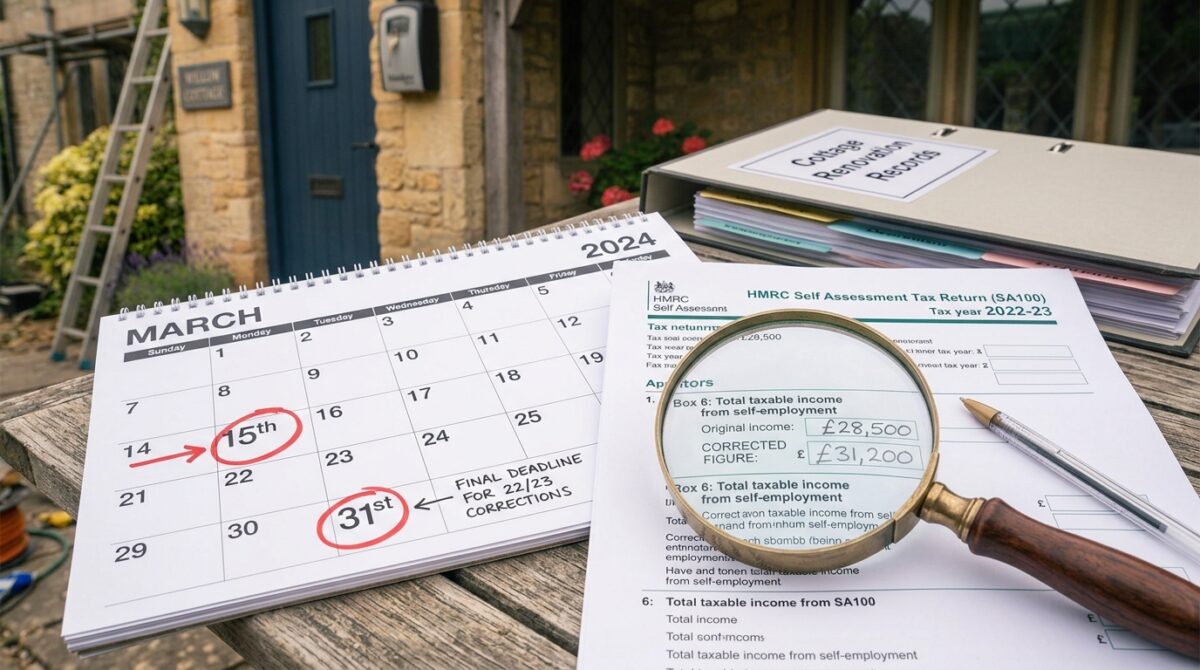
There isn’t just one deadline for correcting a Self Assessment error — there are several, and which one applies depends on how the correction affects your tax bill, how long ago the return was filed, and whether HMRC has already noticed the issue themselves. Understanding these different time limits helps you work out exactly where you stand, and how urgently you need to act.
Not sure which correction window applies to your situation? Book a free 15-minute consultation with Felix Accountants. Book your free call here.
The Standard Amendment Window: 12 Months
For most straightforward corrections, you have 12 months from the original filing deadline to amend your return, whether online or on paper. For example, a 2024/25 return with a filing deadline of 31 January 2026 can be amended up until 31 January 2027. Within this window, corrections are relatively simple — log in to your HMRC online account (after a required 72-hour wait following the original submission), update the figures, and resubmit.
After 12 Months, But Within Four Years: Over-payment Relief
If you’ve missed the standard 12-month amendment window and the correction would mean you’d overpaid tax, you can make a formal claim for “over-payment relief.” This must generally be submitted within four years from the end of the tax year the return relates to, and requires a written claim to HMRC rather than a simple online amendment — including the tax year involved, the reason for the correction, the amount overpaid, and a signed declaration.
Underpayments Outside the 12-Month Window
If the correction means you owe more tax, rather than less, there isn’t a similarly generous window — you should notify HMRC as soon as you become aware of the error, regardless of how long ago the original return was filed. Voluntarily correcting an underpayment, even years later, is still treated far more favourably than waiting for HMRC to discover it independently, since it keeps the disclosure classed as unprompted for penalty purposes.
How Long Does HMRC Have to Challenge Your Return?
It’s worth understanding the position from HMRC’s side too, since it affects how long a genuine error could remain “live.” HMRC’s general time limits for opening a “discovery assessment” — essentially, going back and adjusting a previous year’s tax — depend on the reason for the inaccuracy:
- 4 years from the end of the relevant tax year, for genuine mistakes made despite taking reasonable care
- 6 years from the end of the relevant tax year, where the taxpayer failed to take reasonable care (a careless error)
- 20 years from the end of the relevant tax year, where the error was deliberate
Our guide on HMRC’s tax look-back periods covers this framework in more detail, and it’s the same underlying structure used to determine how many years landlords need to cover in a Let Property Campaign disclosure.
Why Acting Quickly Still Matters, Even Within a Longer Window
Even where you’re technically still within a four-year or longer window to correct something, waiting has real costs. Interest accrues on any underpaid tax from the original due date, regardless of when you get around to correcting it, so delaying simply increases the amount ultimately owed. There’s also a meaningful difference in how penalties are calculated between a genuinely prompt, voluntary correction and one that drags on for years before being addressed — our guide on prompted versus unprompted disclosures explains this distinction, and the same underlying principle applies to routine error correction, not just formal disclosure campaigns.
A Practical Summary of the Time Limits
| Situation | Time Limit |
|---|---|
| Standard online/paper amendment | 12 months from the original filing deadline |
| Claiming a refund after the 12-month window (over-payment relief) | 4 years from the end of the relevant tax year |
| Voluntarily correcting an underpayment | No fixed deadline — correct as soon as discovered |
| HMRC discovery assessment: genuine mistake, reasonable care taken | 4 years from the end of the relevant tax year |
| HMRC discovery assessment: careless error | 6 years from the end of the relevant tax year |
| HMRC discovery assessment: deliberate inaccuracy | 20 years from the end of the relevant tax year |
What Happens If You Miss the Self Assessment Filing Deadline Entirely?
It’s worth distinguishing between correcting an error on a filed return and simply filing late in the first place. Missing the original Self Assessment deadline triggers its own automatic penalties, starting immediately after the deadline and increasing the longer the return remains outstanding. Our guide on HMRC’s penalties for missing the tax deadline covers this separate scenario, and our wider guide to key UK tax year dates and deadlines maps out the full annual calendar.
Special Cases: Multiple Years and Ongoing Income Sources
Where an error relates to an income source that’s been consistently under-reported across several years — such as rental income — each year technically has its own time limits, but it’s usually more practical to address them together through a structured process, rather than a series of separate corrections. This is exactly the situation the Let Property Campaign is designed for when the underlying issue is rental income specifically.
How Felix Accountants Can Help
We help clients work out exactly which correction route and time limit applies to their specific situation, whether that’s a straightforward in-year amendment, a formal over-payment relief claim, or a multi-year rental income disclosure. Our guide on HMRC compliance covers the wider penalty and behaviour framework that underpins all of this.
Frequently Asked Questions
What’s the deadline to amend a Self Assessment return online?
12 months from the original filing deadline. For example, a return with a 31 January 2026 deadline can be amended online until 31 January 2027.
Can I still get a refund if I missed the 12-month amendment window?
Yes, generally through a formal over-payment relief claim, which must be submitted within four years from the end of the relevant tax year.
Is there a deadline for telling HMRC I underpaid tax?
Not a fixed one in the same way — you should notify HMRC as soon as you become aware of an underpayment, regardless of how long ago the original return was filed, to keep the correction classed as voluntary.
How far back can HMRC go if they discover an error themselves?
Generally 4 years for a genuine mistake, 6 years for a careless error, and up to 20 years where the inaccuracy was deliberate.
Does correcting an old error always trigger a penalty?
Not necessarily. Genuine, voluntary corrections made with reasonable care are often treated leniently, and penalties depend heavily on the underlying behaviour rather than simply how long ago the error occurred.
Let’s work out exactly where you stand. Book your free 15-minute consultation with Felix Accountants.