Once your business is VAT-registered, one of the first practical decisions you’ll face is which VAT scheme to use. The two most common options for small businesses are the standard VAT scheme and the VAT Flat Rate Scheme, and the right choice can genuinely affect both your admin burden and your bottom line. This guide compares how each works, who tends to benefit, and the one rule that catches out a lot of service-based businesses on the Flat Rate Scheme.
Not sure which VAT scheme actually saves you money? Book a free 15-minute consultation with Felix Accountants and we’ll run the numbers for your business. Book your free call here.
How Standard VAT Accounting Works
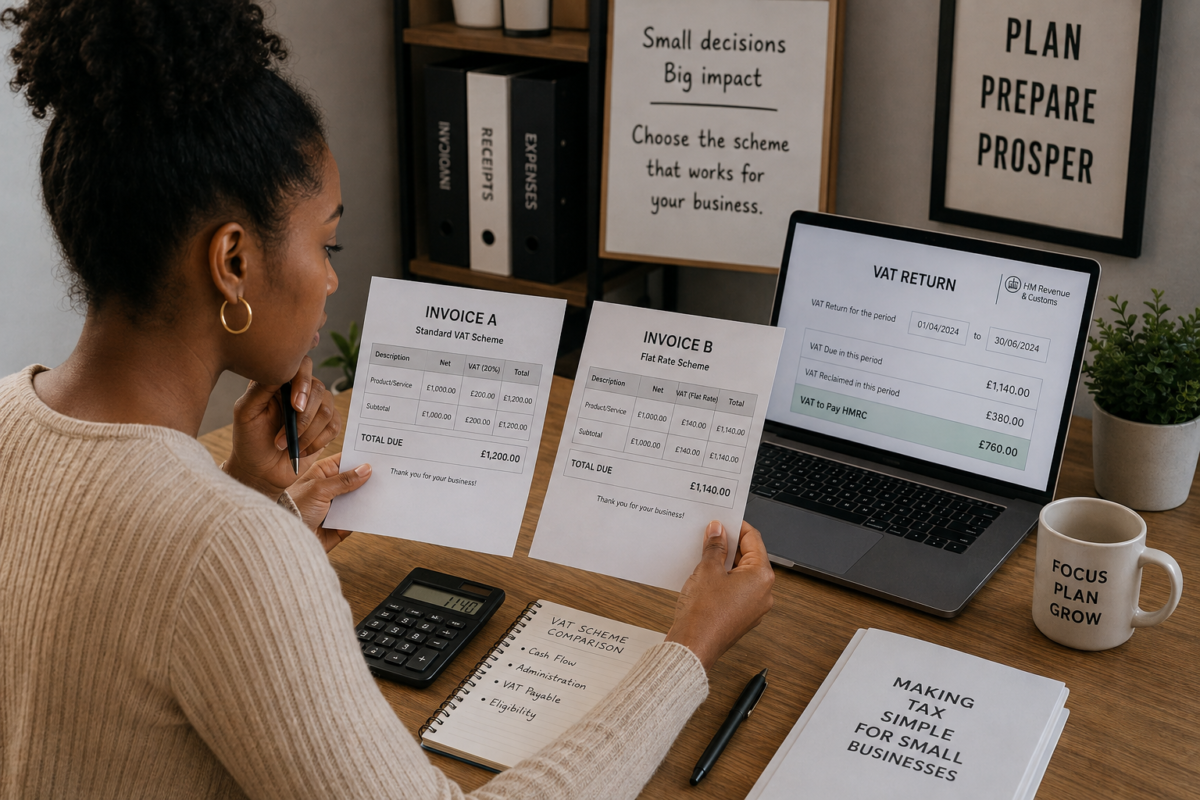
Under standard VAT accounting, you charge VAT on your sales (output VAT) and reclaim VAT on your business purchases (input VAT). Each quarter, you pay HMRC the difference between the two — output VAT minus input VAT. This means every invoice and receipt genuinely matters, since your VAT bill depends directly on tracking both sides accurately. For businesses with significant purchase costs, such as those buying stock, equipment or materials, this is usually the more financially favourable option, because you’re able to reclaim the VAT you’ve paid out.
How the VAT Flat Rate Scheme Works
The VAT Flat Rate Scheme (FRS) simplifies the calculation considerably. You still charge customers VAT at the standard rate — usually 20% — but instead of separately tracking input VAT on purchases, you pay HMRC a single fixed percentage of your VAT-inclusive turnover. The percentage is set by HMRC according to your business sector and is always below 20%, so the gap between what you charge and what you hand over effectively stays in the business.
For example, if your sector’s flat rate is 12% and you invoice a client £10,000 plus £2,000 VAT (a total of £12,000), you’d pay HMRC 12% of £12,000, which is £1,440, keeping the remaining £560 rather than reclaiming input VAT separately.
To join the scheme, your VAT-taxable turnover generally needs to be £150,000 or less (excluding VAT) in the next 12 months, and you must leave once your total VAT-inclusive turnover exceeds £230,000 on the anniversary of joining, or if you expect it to exceed that figure within the next 12 months.
The First-Year Discount
If you’re in your first year of VAT registration, HMRC applies a 1% discount to your flat rate percentage. So a business with a standard sector rate of 12% would pay just 11% during that first year, from the date of VAT registration until the first anniversary of joining the scheme.
The Limited Cost Trader Rule: Why the Flat Rate Scheme Can Backfire
This is the single most important rule to understand before choosing the Flat Rate Scheme. If your business spends very little on goods — broadly, less than 2% of your VAT-inclusive turnover, or under £250 per quarter — you’re classed as a “limited cost trader” and must apply a flat rate of 16.5%, regardless of your actual sector. Because 16.5% of VAT-inclusive turnover is very close to the full 20% VAT you’re charging, the scheme can end up leaving you with barely any benefit, or in some cases costing more than standard VAT accounting would have.
This catches out a lot of consultants, contractors, agencies and other service businesses with genuinely low goods spend — think office supplies and a laptop, rather than stock or materials. If that describes your business, it’s worth running the comparison carefully before committing to the Flat Rate Scheme.
What You Can Still Reclaim Under the Flat Rate Scheme
There’s one notable exception to the “no input VAT reclaim” rule on the Flat Rate Scheme: capital assets costing £2,000 or more (including VAT) can still have their input VAT reclaimed separately, even while you’re on the scheme. This matters if you’re planning a larger one-off purchase, such as equipment or machinery, as it can meaningfully change the maths.
Comparing the Two: A Practical Framework
| Factor | Standard VAT Scheme | VAT Flat Rate Scheme |
|---|---|---|
| Admin burden | Higher — every purchase and sale tracked | Lower — one percentage applied to turnover |
| Reclaiming VAT on purchases | Yes, in full (subject to normal rules) | No, except capital assets over £2,000 |
| Best suited to | Businesses with significant purchase/stock costs | Low-cost service businesses not caught by the 16.5% rule |
| Risk factor | More record-keeping errors possible | Limited cost trader rule can erode the benefit |
Which Businesses Tend to Benefit From the Flat Rate Scheme?
- Service businesses with a sector flat rate meaningfully below 20% that aren’t caught by the limited cost trader rule
- Businesses that want simpler quarterly VAT returns and are willing to accept a slightly less precise calculation in exchange for reduced admin
- New businesses in their first year of VAT registration benefiting from the 1% discount
Which Businesses Tend to Benefit From Standard VAT Accounting?
- Businesses with regular, significant purchases where reclaiming input VAT makes a real financial difference
- Businesses whose main activity would place them in, or close to, the 16.5% limited cost trader category under the Flat Rate Scheme
- Businesses that want the VAT return to reflect the actual, precise VAT position rather than a fixed-percentage approximation
Don’t Forget Making Tax Digital
Regardless of which VAT scheme you choose, VAT-registered businesses are required to keep digital records and file VAT returns through Making Tax Digital-compatible software. This has applied to all VAT-registered businesses for some time now, so the choice between schemes doesn’t affect whether MTD applies — only how the underlying VAT calculation is worked out.
How This Applies to Property and Landlord Businesses
Most residential letting income is exempt from VAT, so many individual landlords never need to register at all. However, property developers, those providing furnished holiday lettings on a commercial scale, or businesses with a mix of taxable and exempt property income can face more complex VAT decisions. Our guide on VAT and property in the UK and our article on VAT implications for property developers and investors cover this in more detail if your situation involves property alongside a wider small business.
How Felix Accountants Can Help
Choosing between the Flat Rate Scheme and standard VAT accounting isn’t a one-size-fits-all decision — it depends on your actual sector rate, your typical spending on goods, and your growth plans. We run the comparison for clients using real business figures rather than rules of thumb, and handle the registration, scheme selection and ongoing VAT return filing. See our wider taxation services for how we support small businesses beyond VAT.
Frequently Asked Questions
Can I switch between the Flat Rate Scheme and standard VAT accounting?
Yes, you can leave the Flat Rate Scheme at any time, though once you leave you generally can’t rejoin for at least 12 months. Moving to the Flat Rate Scheme from standard VAT is also possible if you meet the eligibility criteria.
What is a limited cost trader?
A limited cost trader is a business that spends less than 2% of its VAT-inclusive turnover on goods (not services) in a VAT period, or less than £250 per quarter. Limited cost traders must apply a 16.5% flat rate, regardless of their actual business sector.
Do I still charge customers 20% VAT on the Flat Rate Scheme?
Yes. The flat rate percentage only affects how much VAT you hand over to HMRC, not the rate you charge customers, which remains the normal rate applicable to your goods or services.
Is the Flat Rate Scheme always simpler, even if it isn’t cheaper?
Generally yes, since you don’t need to analyse every purchase invoice for VAT. However, “simpler” doesn’t always mean “cheaper,” so it’s worth weighing the admin saving against the potential extra VAT cost, particularly under the 16.5% limited cost trader rate.
Does my VAT scheme choice affect Making Tax Digital requirements?
No. Making Tax Digital applies to all VAT-registered businesses regardless of which VAT scheme they use — it governs how records are kept and returns are filed, not which scheme calculates the VAT owed.
Let’s work out which VAT scheme actually suits your business. Book your free 15-minute consultation with Felix Accountants today.