
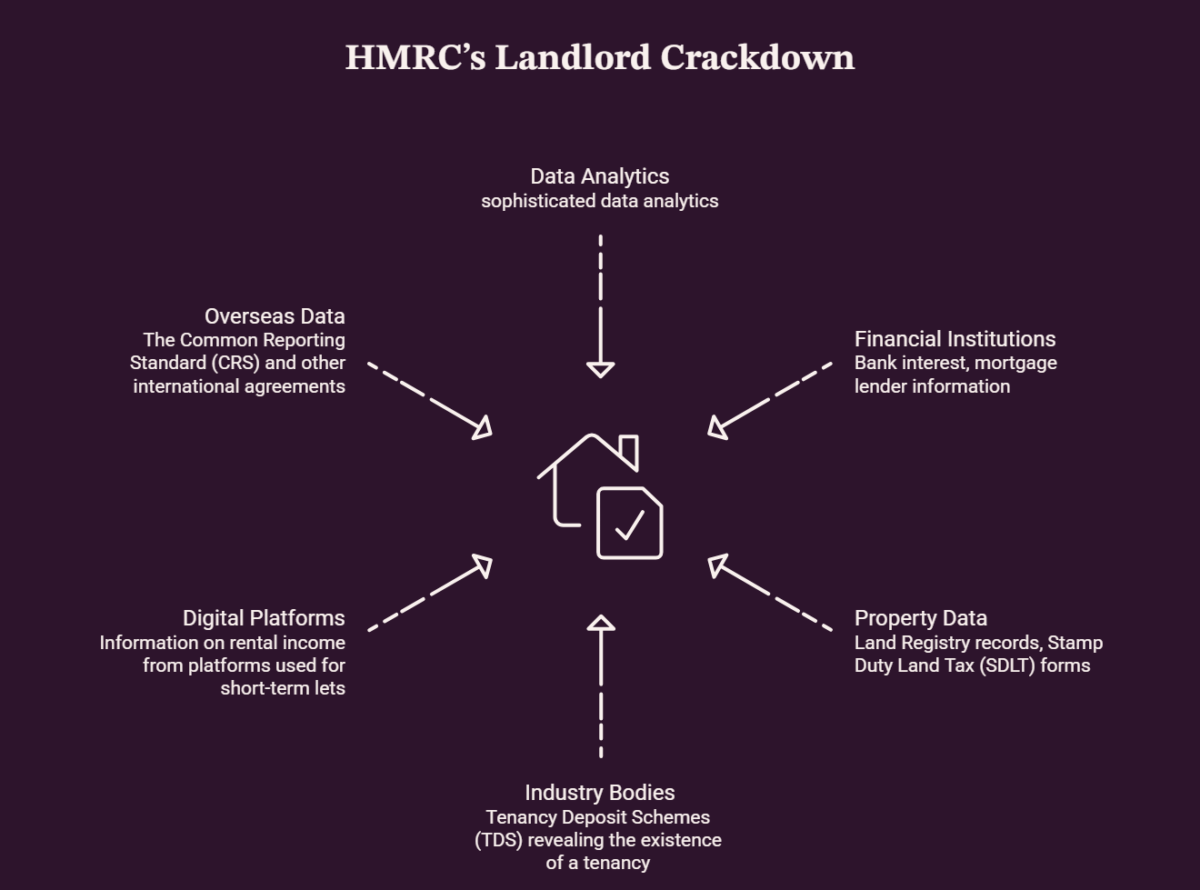
HM Revenue & Customs (HMRC) has unequivocally ramped up its efforts to tackle tax non-compliance in the private rented sector (PRS). Using sophisticated data analytics, matching information from the Land Registry, local authorities, deposit schemes, and third-party platforms, HMRC is closing the net on landlords who have undeclared rental income or have underpaid tax. The Heat is On: HMRC’s Landlord Crackdown and the Urgency of Voluntary Disclosure
The message is clear: the era of ‘flying under the radar’ is over.
In this intensified compliance environment, letting agents are being called upon to play a crucial, proactive role. They are the key link between the authorities and the landlords, and they must now urge their clients with undisclosed liabilities to use the dedicated route for correction: the Let Property Campaign (LPC), a form of voluntary disclosure. Failure to do so exposes landlords to severe penalties and agents to reputational risk within an increasingly regulated industry. This article outlines the severity of the crackdown, the advantages of voluntary disclosure, and the vital steps letting agents must take immediately.
Why the Pressure on Landlords is Unprecedented
HMRC’s crackdown is underpinned by advanced data-matching technology and a focused enforcement strategy. The results speak for themselves, with the amount of unpaid tax recovered through compliance activities rising significantly year-on-year.
The Data Advantage and Increased Risk
HMRC’s ability to identify non-compliant landlords has never been greater. They have the power to cross-reference data from multiple sources:
- Financial Institutions: Bank interest, mortgage lender information.
- Property Data: Land Registry records, Stamp Duty Land Tax (SDLT) forms.
- Industry Bodies: Tenancy Deposit Schemes (TDS) revealing the existence of a tenancy.
- Digital Platforms: Information on rental income from platforms used for short-term lets.
- Overseas Data: The Common Reporting Standard (CRS) and other international agreements for landlords with offshore properties or bank accounts.
If a landlord’s tax return (or lack thereof) does not match the information HMRC holds, they will issue a ‘Nudge Letter’—a clear signal that the landlord has been identified and must take action. At this stage, the opportunity for reduced penalties through voluntary disclosure becomes more restricted.
The High Cost of Discovery vs. Disclosure
The difference in penalties for a landlord who is ‘prompted’ by HMRC (i.e., receives a letter) versus one who makes a ‘unprompted’ voluntary disclosure is vast and financially significant.
| Circumstance | Penalty Range (% of Unpaid Tax) | Disclosure Route |
| Voluntary Disclosure | 0%–30% | Let Property Campaign (LPC) |
| Prompted Disclosure (After ‘Nudge Letter’) | 20%–70% | Formal Enquiry |
| Deliberate Concealment | Up to 100% (or 200% for offshore income) | Formal Enquiry/Prosecution |
The key advantage of the LPC is the mitigation of penalties. A full, cooperative, and honest voluntary disclosure, made before HMRC’s intervention, offers the best possible terms for regularising tax affairs.
The Letting Agent’s New Role: Promoter of Compliance
Letting agents operate at the heart of the rental transaction and are in a unique position of trust and influence with their landlord clients. Their professional duty of care now extends to providing robust, general guidance on tax compliance.
Three Essential Actions for Letting Agents
Letting agents must proactively steer their clients toward compliance, not just to protect the landlord but to safeguard their own professional reputation and adhere to their professional bodies’ standards.
- Integrate Tax Awareness into Onboarding:
- Mandate of Disclosure: Ensure all new landlord agreements explicitly state that the landlord is responsible for declaring all rental income to HMRC.
- General Advisory: Provide a generic, written warning (disclaimer) in welcome packs or management contracts about the requirement to declare income and the penalties for non-compliance, directing them to the LPC. Crucially, agents should not offer specific tax advice, only general guidance to seek professional counsel.
- Actively Promote the Let Property Campaign (LPC):
- Client Communication: Issue a targeted communication campaign to all existing landlords, highlighting HMRC’s crackdown data and the financial benefits of the LPC.
- Referral Network: Establish relationships with specialist tax advisors who can handle LPC disclosures, providing a professional and safe pathway for clients.
- Maintain Meticulous Records:
- Data Readiness: Agents should assume that HMRC will eventually ask for their complete records. Ensure all transactional data—rent received, expenses paid, start/end dates of tenancies—is accurate and readily available. This protects the agent and helps the landlord with their disclosure.
Addressing Common Landlord Misconceptions
Many landlords fall into non-compliance not through deliberate evasion, but through ignorance or simple oversight. Agents must address these common points:
- ‘Accidental Landlords’: The myth that renting out a single inherited property or one that couldn’t be sold is not ‘commercial’ and therefore doesn’t need to be declared. All rental income must be declared.
- ‘Zero Profit’: The belief that because allowable expenses (like mortgage interest) reduce profit to zero, there is no need to file a tax return. The income must still be reported on a Self Assessment tax return.
- The Agent Reports It: The mistaken belief that the letting agent is responsible for reporting the rental income to HMRC. The legal responsibility always rests with the individual landlord.
Navigating the Let Property Campaign (LPC) for a Client
For any landlord who has undeclared rental income from UK or overseas residential property, the LPC is the formal path to resolution. Agents should guide clients through the process:
- Notification: The landlord (or their tax advisor) must notify HMRC of their intention to disclose using the online Digital Disclosure Service (DDS). HMRC will then issue a Disclosure Reference Number (DRN).
- Calculation: The landlord has 90 days from the date of the DRN to calculate the full undeclared income, allowable expenses, and the resultant unpaid tax for all relevant years. The period covered can be up to 20 years if the error was deliberate, but often less for careless mistakes (up to 6 years) or genuine errors (up to 4 years).
- Disclosure & Payment: The full disclosure form and payment of the tax, interest, and calculated penalty must be submitted within the 90-day window.

Voluntary Disclosure
By pushing for the LPC now, letting agents help their clients avoid a future costly, stressful, and potentially public formal investigation by HMRC, reinforcing the agent’s position as a trustworthy and compliant partner in property management.
Frequently Asked Questions (FAQs) for Landlord Voluntary Disclosure
What is the HMRC Let Property Campaign (LPC)?
The LPC is a voluntary disclosure initiative by HMRC that encourages individual landlords (who own residential property in the UK or abroad) to ‘come clean’ about undeclared or underpaid rental income on the best possible penalty terms.
How far back must a landlord disclose under the LPC?
The disclosure period depends on the landlord’s behaviour:
- 4 years for genuine mistakes (reasonable care taken).
- 6 years for careless errors.
- Up to 20 years for deliberate tax evasion or concealment.
What are the penalties if HMRC finds undeclared income before I disclose?
If HMRC discovers the unpaid tax before the landlord makes a disclosure (known as a ‘prompted’ disclosure), the penalty is significantly higher, typically ranging from 20% to 70% of the tax due, and up to 100% or more for deliberate offshore non-compliance. Voluntary disclosure offers much lower, often zero, penalties for unprompted, cooperative disclosures.
Can a letting agent give me tax advice for the LPC?
No. Letting agents are not qualified or regulated to provide specific tax advice. Their role is to provide general guidance about compliance and strongly urge the landlord to seek specialist advice from a qualified accountant or tax solicitor to handle the complex LPC submission.
Does the LPC cover commercial properties or undeclared business income?
No. The LPC is specifically for income from residential property lettings. Disclosures for commercial property or other types of undeclared income must be made through HMRC’s general Digital Disclosure Service (DDS).
What is a ‘Nudge Letter,’ and how should a landlord respond?
A ‘Nudge Letter’ is a communication from HMRC informing a landlord that their data suggests they have undeclared rental income. This counts as a prompted intervention. A landlord should immediately seek professional tax advice, as the penalties will be higher than a truly unprompted voluntary disclosure, but action is essential to avoid a full, much more severe investigation.