
If you’ve been renting out property in the UK without declaring all of your rental income to HMRC, you are not alone — and you may still have the opportunity to put things right before the taxman comes to you. The HMRC Let Property Campaign is a government-backed voluntary disclosure scheme specifically designed for residential landlords with undeclared rental income. Understanding it — and acting on it quickly — could save you thousands of pounds in penalties and protect you from serious legal consequences.
In this guide, we explain exactly what the Let Property Campaign is, how it works, what penalties you could face, and how working with an experienced Let Property Campaign accountant can make the whole process as straightforward as possible.
| What is the Let Property Campaign? (Featured Snippet) The Let Property Campaign is an HMRC voluntary disclosure scheme for UK landlords who have undeclared rental income. It allows landlords to come forward, declare outstanding tax liabilities, pay what they owe (including interest), and typically receive lower penalties than if HMRC investigates first. The campaign has been open since 2013 and remains active. |
What Is the HMRC Let Property Campaign?
The Let Property Campaign (LPC) was launched by HMRC in September 2013 as a targeted initiative to bring UK residential landlords who owe tax on rental income back into compliance. Unlike a full HMRC investigation — which can be costly, stressful, and result in heavy penalties — the LPC offers a structured, more forgiving route for landlords to disclose unpaid tax themselves.
It applies to landlords who rent out one or more residential properties in the UK and have not correctly declared their income to HMRC. This includes landlords who have filed no tax return at all, those who have understated their income, and those who have claimed ineligible expenses. You can find HMRC’s official guidance on the scheme at gov.uk.
The campaign is not a tax amnesty — you will still pay the tax you owe, plus interest. But landlords who come forward voluntarily under the LPC benefit from reduced penalty rates compared to those who wait for HMRC to come to them.
Who Does the Let Property Campaign Apply To?
The campaign is open to any UK individual landlord letting out residential property. This includes:
- Landlords who have never registered for self-assessment
- Landlords who filed returns but omitted or understated rental income
- Landlords who inherited property and have since rented it out
- Landlords with overseas rental income not declared in the UK
- Landlords who rent out a room in their main residence beyond the Rent-a-Room allowance
The LPC does not cover commercial property, partnerships, or companies — for those cases, HMRC has separate disclosure routes.
How Far Back Does the Let Property Campaign Go?
One of the most common questions we receive at Felix Accountants is: “How far back does the Let Property Campaign go?” The answer depends on the nature of the non-disclosure.
HMRC applies a tiered look-back period based on the perceived intent of the landlord:
- Innocent error (careless): 4 years back from the current tax year
- Careless or negligent behaviour: 6 years back
- Deliberate non-disclosure: 20 years back
For most landlords who simply didn’t realise they needed to declare rental income, the look-back period is typically 4 to 6 years. However, if HMRC decides the failure was deliberate, they can go back up to 20 years, which can result in a very significant tax bill.
Why Landlords Should Decline to Sign
- Creates High Penalty Exposure Under Schedule 24 Finance Act 2007The certificate requires a formal declaration that your tax affairs are correct and up to date to the best of your knowledge and belief. If you sign this declaration and HMRC subsequently identifies undeclared income or an error—even an inadvertent mistake regarding allowable expenses or mortgage interest restrictions—HMRC can treat the false declaration as evidence of deliberate misleading conduct. Under Schedule 24 to the Finance Act 2007, deliberate penalties are significantly higher than penalties for a simple failure to take reasonable care, potentially reaching up to 100% of the tax due for domestic income (and up to 200% for offshore assets).
- No Reciprocal Legal Protection or Settlement FinalitySigning the certificate creates a binding declaration for the taxpayer without providing any legal immunity or closing agreement in return. It does not prevent HMRC from making a formal discovery assessment under Section 29 TMA 1970 for past tax years, nor does it force HMRC to accept your self-assessment of your tax position as final.
- Restricted Binary StatementsThe options on the certificate require rigid, binary statements that rarely accommodate complex property transactions. For instance, declaring that all rental income was fully disclosed leaves zero legal room for genuine technical disputes over capital versus revenue repairs, replacement of domestic items relief, or fractional ownership splits. If HMRC later challenges your tax treatment of these items, your signed certificate can be used against you as a false representation.
- Unnecessary Risk of Criminal LiabilitySubmitting a signed statement that turns out to be inaccurate risks exposure under Section 5 of the Perjury Act 1911 (or equivalent common law rules regarding false statements to public officials). While HMRC rarely pursues criminal prosecution for standard property disclosures, signing an unnecessary formal declaration unnecessarily elevates your legal risk.
The Appropriate Response
| Important: Coming forward under the Let Property Campaign proactively — before HMRC contacts you — is classified as ‘unprompted’. This gives you the most favourable penalty treatment and signals to HMRC that you are acting in good faith. |
Let Property Campaign Penalties: What Will You Actually Pay?
Many landlords delay disclosing undeclared rental income because they worry about the financial hit. But the penalty structure under the Let Property Campaign is designed to reward early, voluntary disclosure — meaning the sooner you act, the less you pay.
Penalty Rates at a Glance
Here is how the penalty rates break down depending on your disclosure type:
| Disclosure Type | Penalty Range | Typical Scenario |
| Unprompted | 0% – 30% | Landlord comes forward voluntarily |
| Prompted | 15% – 30% | HMRC contacts landlord first |
| Prompted (deliberate) | 30% – 70% | Deliberate non-disclosure |
| Offshore/concealment | Up to 200% | Offshore assets or deliberate concealment |
In addition to penalties, HMRC charges interest on unpaid tax from the date the tax was due. This is currently calculated at the Bank of England base rate plus 2.5%, which means the longer you leave it, the more the interest builds up. A qualified Let Property Campaign accountant can use HMRC’s online tools to calculate the exact interest and penalty figures before you make a formal disclosure.
Prompted vs Unprompted Disclosure
These two terms matter enormously when it comes to your penalties. An unprompted disclosure means you contact HMRC before they contact you. A prompted disclosure means you only come forward after receiving a nudge letter, a compliance check, or direct contact from HMRC.
The difference can be dramatic: unprompted disclosures for non-deliberate errors attract penalties starting at 0%, while prompted disclosures for the same error can attract 15% or more. If you have received an HMRC nudge letter, do not delay — act immediately.
Step-by-Step: How to Make a Let Property Campaign Disclosure
The process has four main stages. Getting each one right is critical to minimising your tax bill and avoiding further investigation.
At a Glance: Your 30-Day Response Timeline
- Days 1 to 7: Gather Documentation
Collect all bank statements, letting agent annual summaries, mortgage interest certificates, and repair receipts across all unfiled tax years. Do not complete or return HMRC’s Certificate of Tax Position. - Days 8 to 14: Review & Behavior Assessment
Calculate your net rental profit for each tax year and assess whether your non-disclosure falls under reasonable care, carelessness, or deliberate behavior to establish your look-back window (4, 6, or 20 years). - Days 15 to 21: Formal Notification
Submit your notification of intent to disclose via HMRC’s online portal. Acquiring your unique disclosure reference number locks in your 90-day window to complete the filing and secures unprompted penalty rates. - Days 22 to 30: Compute & Finalize
Run final tax, interest, and penalty calculations using HMRC’s disclosure tool, prepare your narrative statement explaining the background, and finalize your submission package.
Step 1 – Notify HMRC
Before you can make a formal disclosure, you must notify HMRC of your intention to disclose. You do this online at gov.uk. HMRC will then issue you with a unique disclosure reference number.
Step 2 – Gather All Relevant Records
This is where most landlords need professional help. You will need records of all rental income received, any eligible expenses you wish to claim, bank statements and tenancy agreements, and records of any mortgage interest (though the rules here changed significantly from 2017 onwards).
Step 3 – Calculate the Tax, Interest, and Penalties Owed
Using HMRC’s disclosure calculator — or more accurately, working with an experienced Let Property Campaign specialist — you will calculate the precise amount owed for each tax year in the look-back period. This includes income tax on net rental profit, National Insurance if applicable, interest on the unpaid tax, and any penalties applied at the appropriate rate.
Step 4 – Submit the Disclosure and Pay
Once the figures are agreed and your disclosure reference number is in hand, you submit the full disclosure to HMRC online and make payment. HMRC gives you 90 days from your initial notification to complete the process.
| Pro tip from Felix Accountants: Do not attempt a Let Property Campaign disclosure without professional guidance. Errors in your disclosure — overstating income, missing eligible deductions, or misclassifying expenses — can result in a higher tax bill than necessary, or flag your case for further investigation. |
Why You Need a Let Property Campaign Accountant
The LPC process appears straightforward on paper. In practice, calculating the correct figures, understanding which expenses are allowable, navigating post-2017 mortgage interest relief restrictions, and presenting your disclosure in the most favourable light requires genuine expertise. The wrong approach can cost you significantly more than the accountant’s fees.
At Felix Accountants, our Let Property Campaign specialists have helped landlords across London, Windsor, Slough, Reading, and Oxford navigate the process smoothly and cost-effectively. We advise on:
- Which tax years need to be included in your disclosure
- How to calculate your allowable expenses correctly, including repairs, letting agent fees, and insurance
- How mortgage interest restrictions apply to your specific situation
- Whether any wear and tear allowances or capital allowances apply
- How to present your disclosure to minimise your penalty exposure
- How to respond if HMRC asks further questions after your disclosure
Whether you are based in London or use our specialist services in Windsor, Oxford, Reading, or Slough, our team provides clear, fixed-fee guidance so you know exactly what you will pay before we begin.
Ready to get started? Schedule a free consultation with our Let Property Campaign experts here.
Let Property Campaign: Reasonable Excuse — Can You Avoid Penalties Entirely?
HMRC does recognise the concept of a “reasonable excuse” — a genuine reason why you failed to declare your rental income. If accepted, it can reduce or even eliminate your penalties entirely. However, HMRC applies the standard strictly.
What HMRC may accept as a reasonable excuse:
- Bereavement of a close family member around the time returns were due
- Serious or life-threatening illness preventing you from managing your affairs
- A fire, flood, or theft that destroyed your financial records
- Genuine uncertainty about whether income was taxable (in limited circumstances)
What HMRC will typically not accept:
- Not knowing you had to register for self-assessment
- Relying on someone else who failed to act on your behalf
- Forgetting to file or pay
- Lack of funds to pay
If you believe you have a reasonable excuse, document it thoroughly. Our team at Felix Accountants can advise on whether your circumstances are likely to be accepted and how to present your case effectively.
Is the Let Property Campaign Still Running in 2026?
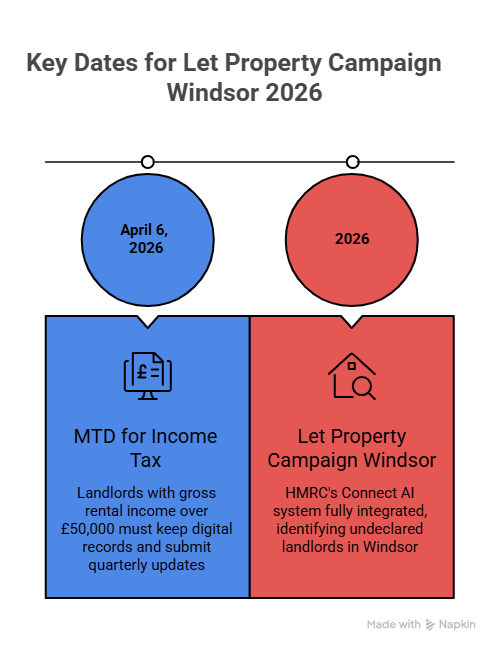
Yes. As of 2026, the HMRC Let Property Campaign is still open and active. There is currently no announced end date for the scheme. However, HMRC has significantly increased its data-matching capabilities in recent years — using information from letting agents, Land Registry records, deposit protection schemes, and overseas disclosures — which means it is becoming increasingly likely that undeclared landlords will be identified proactively.
The window of opportunity to benefit from the most favourable penalty treatment is narrowing. If you are a landlord with any undeclared rental income, now is the time to act — not when an HMRC letter arrives on your doormat.
Pros and Cons of Using the Let Property Campaign
Advantages of Making a Voluntary Disclosure
- Lower penalties — potentially 0% for unprompted non-deliberate disclosures
- Avoidance of a full HMRC investigation, which can be far more intrusive and costly
- Peace of mind and removal of a significant source of financial and legal stress
- Ability to correct the record and move forward with a clean compliance history
- More control over the process compared to being investigated by HMRC
Potential Drawbacks to Be Aware Of
- You will pay all the tax owed plus interest — there is no reduction in the underlying liability
- If HMRC finds errors in your disclosure, it can prompt further scrutiny
- The 90-day window to complete disclosure after notifying HMRC can feel tight
- Without professional help, it is easy to overclaim or underclaim expenses
A Real-World Example: What a Let Property Campaign Disclosure Looks Like
| Case Study (anonymised): A landlord in Windsor came to Felix Accountants after letting out two buy-to-let properties for six years without filing self-assessment returns. Combined rental income over the period was approximately £78,000. After allowable expenses, the taxable profit was significantly lower. We prepared a full 6-year look-back disclosure, correctly applied mortgage interest restrictions, and filed an unprompted disclosure with HMRC. The final settlement included back taxes and interest — but zero penalties, saving the client over £4,500 compared to a prompted disclosure at standard penalty rates. |
Related Articles You May Find Useful
If you found this guide helpful, you may also want to read our detailed resources on the Let Property Campaign on the Felix Accountants website:
- HMRC Let Property Campaign — Expert Overview from Felix Accountants
- Let Property Campaign — Full Guidance & Disclosure Help
- Felix Accountants — Landlord Tax Specialists
For independent technical guidance, the ACCA’s overview of the Let Property Campaign is also a valuable reference.
Frequently Asked Questions About the Let Property Campaign
1. How far back can HMRC go under the Let Property Campaign?
HMRC can typically look back 4 years for innocent errors, 6 years for careless non-disclosure, and up to 20 years for deliberate evasion. Most landlords fall into the 4–6 year category, but your specific situation should be assessed by a qualified accountant before you notify HMRC.
2. What are the penalties for not declaring rental income?
Penalties range from 0% for unprompted voluntary disclosures of innocent errors up to 200% for deliberate offshore concealment. In addition to penalties, HMRC charges interest on all unpaid tax from the date it was originally due. Acting voluntarily before HMRC contacts you will always produce the lowest penalty outcome.
3. Can I use the Let Property Campaign if HMRC has already contacted me?
Yes, but your disclosure will be classified as ‘prompted’, which means higher minimum penalty rates apply. Even so, making a full and accurate disclosure remains far better than ignoring HMRC’s contact. If you have received a nudge letter or compliance check notice, contact a Let Property Campaign specialist immediately.
4. How much does it cost to use a Let Property Campaign accountant?
Fees vary depending on the number of years involved, the complexity of your property portfolio, and the work required to reconstruct records. At Felix Accountants, we offer transparent, fixed-fee packages for Let Property Campaign disclosures. A free initial consultation will give you a clear quote before any work begins.
5. What happens after I submit my Let Property Campaign disclosure?
HMRC will review your disclosure and, in most cases, accept it and issue a statement of account for payment. In some cases, they may ask clarifying questions. If your disclosure is accurate and complete, the process typically concludes smoothly. You should retain all supporting records for at least 5 years in case HMRC follows up.
6. Is the Let Property Campaign the same as a tax amnesty?
No. The Let Property Campaign is not an amnesty — you will still pay all the tax you owe plus statutory interest. The benefit is in the reduced penalties compared to what HMRC would impose following a formal investigation. It is best understood as a structured, lenient route back into compliance rather than a debt write-off.
7. Can overseas rental income be disclosed under the Let Property Campaign?
Yes, but it is more complex. Overseas rental income may also be subject to double taxation agreement provisions, foreign tax credits, and additional HMRC reporting requirements. Felix Accountants has specific experience with overseas property disclosures under the LPC — contact us if you have international rental income to declare.
Get Expert Help With Your Let Property Campaign Disclosure Today
Whether you are a landlord in London, Windsor, Slough, Reading, or Oxford — or anywhere else in the UK — Felix Accountants offers specialist Let Property Campaign advice and full disclosure management. Our team combines deep HMRC compliance knowledge with a practical, client-first approach.
We cover:
- Let Property Campaign & Landlord Tax for Windsor landlords
- Oxford Let Property Campaign & Landlord Tax specialists
- London Let Property Campaign & Landlord Tax support
- Reading Let Property Campaign & Landlord Tax specialists
- HMRC Let Property Campaign experts in Slough
The sooner you act, the lower your penalties. Don’t wait for HMRC to come to you.
>>> Schedule Your Free Consultation with Felix Accountants <<<
Visit us at felixaccountants.com or call our team directly. We make the Let Property Campaign process simple, transparent, and as cost-effective as possible for every landlord we work with.
Felix Accountants are specialist Let Property Campaign accountants serving landlords across London, Windsor, Slough, Reading and Oxford. This article is for general guidance only and does not constitute formal tax or legal advice. Always consult a qualified professional before making a disclosure to HMRC.
Published by Felix Accountants | Let Property Campaign Specialists across London, Windsor, Slough, Reading & Oxford