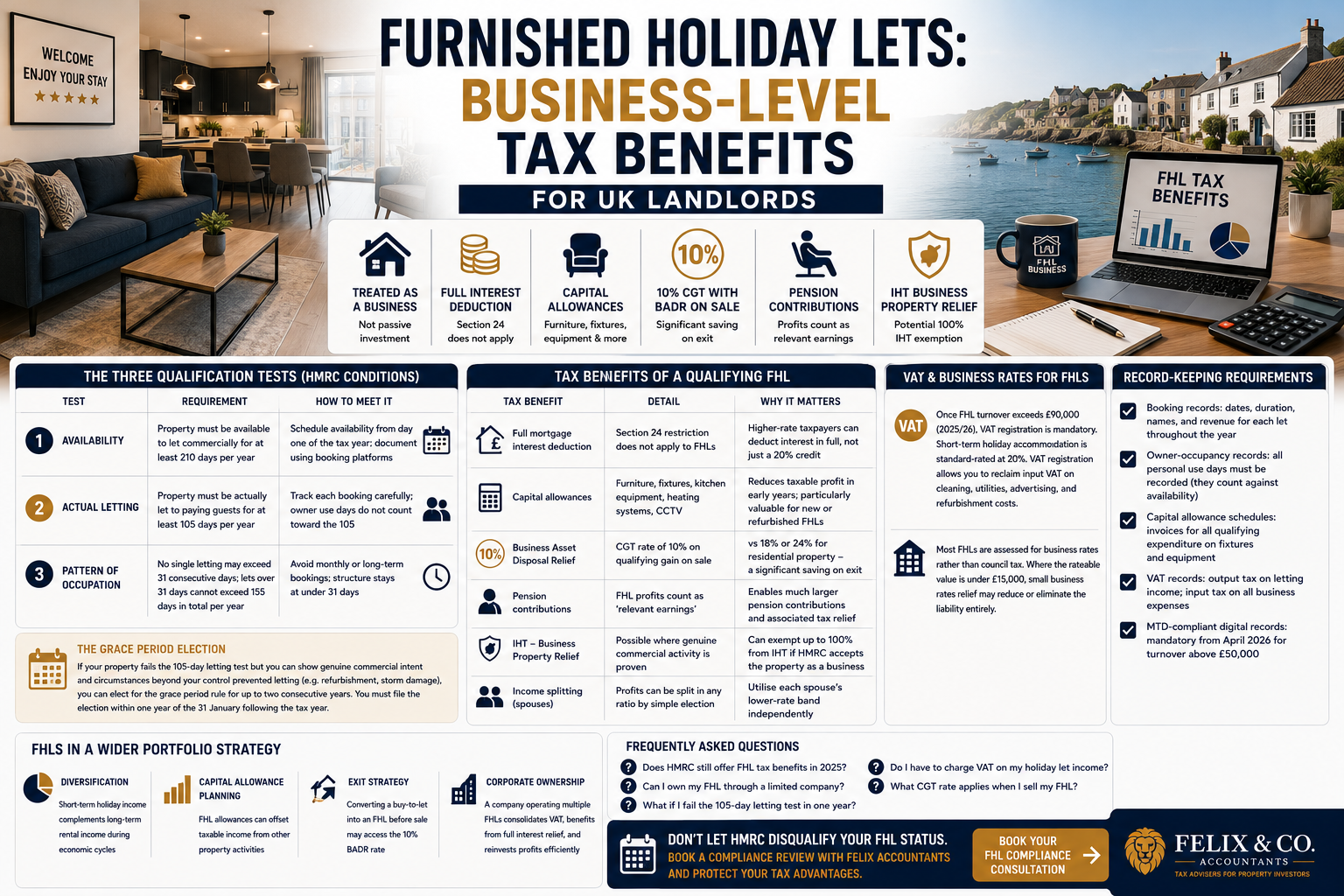
Furnished Holiday Lets occupy a uniquely privileged position in the UK tax system. Unlike standard residential rentals — which are treated as passive investment income — qualifying FHLs are treated as a business, unlocking capital allowances, full finance cost relief, and Business Asset Disposal Relief at 10% CGT on sale. The catch: HMRC’s qualification tests are specific, and failure to meet them costs all these advantages.
Furnished Holiday Let HMRC Qualification Rules
| Test | Requirement | How to Meet It |
| 1. Availability | Property must be available to let commercially for at least 210 days per year | Schedule availability from day one of the tax year; document using booking platforms |
| 2. Actual letting | Property must be actually let to paying guests for at least 105 days per year | Track each booking carefully; owner use days do not count toward the 105 |
| 3. Pattern of occupation | No single letting may exceed 31 consecutive days; lets over 31 days cannot exceed 155 days in total per year | Avoid monthly or long-term bookings; structure stays at under 31 days |
| The Grace Period Election | ||
| If your property fails the 105-day letting test but you can show genuine commercial intent and circumstances beyond your control prevented letting (e.g. refurbishment, storm damage), you can elect for the grace period rule for up to two consecutive years. You must file the election within one year of the 31 January following the tax year. | ||
Furnished Holiday Let Tax Benefits
| Tax Benefit | Detail | Why It Matters |
| Full mortgage interest deduction | Section 24 restriction does not apply to FHLs | Higher-rate taxpayers can deduct interest in full, not just a 20% credit |
| Capital allowances | Furniture, fixtures, kitchen equipment, heating systems, CCTV | Reduces taxable profit in early years; particularly valuable for new or refurbished FHLs |
| Business Asset Disposal Relief | CGT rate of 10% on qualifying gain on sale | vs 18% or 24% for residential property — a significant saving on exit |
| Pension contributions | FHL profits count as ‘relevant earnings’ | Enables much larger pension contributions and associated tax relief |
| IHT — Business Property Relief | Possible where genuine commercial activity is proven | Can exempt up to 100% from IHT if HMRC accepts the property as a business |
| Income splitting (spouses) | Profits can be split in any ratio by simple election | Utilise each spouse’s lower-rate band independently |
Furnished Holiday Let VAT and Business Rates
Once FHL turnover exceeds £90,000 (2025/26), VAT registration is mandatory. Short-term holiday accommodation is standard-rated at 20%. Being VAT-registered allows you to reclaim input VAT on cleaning, utilities, advertising, and refurbishment costs.
Most FHLs are assessed for business rates rather than council tax. Where the rateable value is under £15,000, small business rates relief may reduce or eliminate the liability entirely.
Furnished Holiday Let Record-Keeping Requirements
- Booking records: dates, duration, names, and revenue for each let throughout the year
- Owner-occupancy records: all personal use days must be recorded (they count against availability)
- Capital allowance schedules: invoices for all qualifying expenditure on fixtures and equipment
- VAT records: output tax on letting income; input tax on all business expenses
- MTD-compliant digital records: mandatory from April 2026 for turnover above £50,000
FHLs in a Wider Portfolio Strategy
- Diversification: short-term holiday income complements long-term rental income during economic cycles
- Capital allowance planning: FHL allowances can offset taxable income from other property activities
- Exit strategy: converting a buy-to-let into an FHL before sale may access the 10% BADR rate
- Corporate ownership: a company operating multiple FHLs consolidates VAT, benefits from full interest relief, and reinvests profits efficiently
Related Reading
Serviced accommodation and HMO tax guide | VAT and property — when does it apply? | Property records and Making Tax Digital
Frequently Asked Questions
Does HMRC still offer FHL tax benefits in 2025?
Yes. Despite consultation on reform, the FHL tax regime remains in place for 2025/26. Qualifying properties continue to benefit from full interest relief, capital allowances, BADR on sale, and pension contribution eligibility. Always check for any legislative updates in the annual Budget or Finance Act.
Can I own my FHL through a limited company?
Yes. A company owning FHL properties benefits from full interest deductibility, can VAT-register the business, and reinvests post-tax profits at 19–25% rather than the owner’s personal rate. The BADR 10% CGT rate applies only to individuals — companies pay their standard corporation tax rate on any gain.
What if I fail the 105-day letting test in one year?
If your FHL fails the actual-letting test for one year but you intended to meet it and were prevented by circumstances outside your control (e.g. flood damage, forced refurbishment), you can elect for the grace period rule for that year, retaining FHL status without penalty.
Do I have to charge VAT on my holiday let income?
Only once your annual FHL and short-term accommodation turnover exceeds £90,000 (2025/26 VAT registration threshold). Below this, voluntary registration may still be beneficial if you incur significant VAT on refurbishment or ongoing costs.
What CGT rate applies when I sell my FHL?
Where Business Asset Disposal Relief applies — which requires the FHL to have been run commercially for at least two years immediately before sale — the CGT rate is 10% on qualifying gains. Without BADR, the standard residential property CGT rates of 18% (basic rate) and 24% (higher rate) apply.
| Don’t let HMRC disqualify your FHL status. Book a compliance review with Felix Accountants and protect your tax advantages. |
JSON-LD Schema Markup