Categories
Articles Articles Blogs Let Property Campaign

Undeclared Rental Income From a Former Home: How Can Landlords Correct Their Tax Position?

It’s one of the most common ways people become landlords without ever really deciding to: you move in with a partner, relocate for work, or upsize to a bigger house, and rather than sell your old property, you rent it out. It feels like a sensible, low-key decision at the time — and often nobody mentions that the rent needs to be declared to HMRC. Years can pass before it becomes clear that this “temporary” arrangement has created a genuine, and growing, tax liability. The good news is that this is a well-recognised situation, and there’s a clear, structured way to correct it.

Rented out your old home without realising you needed to declare it? Book a free 15-minute consultation with Felix Accountants and we’ll help you get back on the right side of HMRC. Find a time here.

Why This Situation Is So Common

Most people who fall into this position never set out to become a landlord. Common scenarios we see regularly include:

  • Moving in with a partner and letting out a previous flat or house rather than selling it
  • Relocating for work and renting the family home while abroad or in another part of the UK
  • Inheriting a property, moving in briefly, and then letting it out once circumstances changed
  • Buying a new main residence and keeping the old one as a rental “for now”

In every one of these cases, the person’s mental model is often “this is still basically my house,” which makes it easy to overlook that HMRC treats rental income exactly the same way regardless of how the letting arrangement came about. Our guide on being an accidental landlord covers this pattern in more depth, including the specific triggers that most often catch people out.

Why the Rent-Only-Covers-the-Mortgage Myth Is So Costly

A particularly common misconception is believing that if the rent received roughly matches the mortgage payment, there’s no taxable profit and therefore nothing to declare. This isn’t correct, for two reasons. First, only the interest element of a mortgage payment is an allowable expense — the capital repayment portion isn’t deductible at all. Second, since 2020, tax relief for mortgage interest on residential lettings held personally has been restricted to a basic-rate tax credit rather than a full deduction against income. This means many landlords who genuinely believed they were breaking even are, in fact, sitting on a taxable rental profit they’ve never reported.

Correcting the Position Through the Let Property Campaign

The Let Property Campaign is HMRC’s dedicated voluntary disclosure route for exactly this situation. It allows individual landlords to come forward, calculate what’s owed across the relevant tax years, and pay it — typically with significantly lower penalties than if HMRC discovers the income independently and opens an enquiry. The process generally involves three stages: notifying HMRC of your intention to disclose, calculating the tax owed for each relevant year (including interest), and submitting a formal disclosure, usually within 90 days of notifying.

Working Out How Many Years to Go Back

The number of years you need to include depends on why the income wasn’t declared, not simply how long you’ve been letting the property. For most people in this situation — where the omission genuinely stemmed from not realising the obligation existed, rather than any attempt to conceal income — the look-back period is typically four to six years. Our detailed guide on how many years you need to declare explains how this is determined and why getting it right matters, since under-disclosing can itself create problems later.

What About the Original Main Residence Relief?

Because the property was once your main home, it’s worth understanding how that history interacts with your tax position going forward, particularly around Capital Gains Tax if you eventually sell. Private Residence Relief can reduce or eliminate Capital Gains Tax for the period the property was genuinely your main residence, plus a final period of ownership, even though it’s since been let out. Our guide on maximising main residence relief explains how this relief interacts with a period of letting, which is a separate but closely related consideration alongside sorting out the undeclared rental income itself.

What If HMRC Has Already Written to You?

If you’ve received a nudge letter from HMRC about rental income, the position changes slightly. A disclosure made after HMRC has already contacted you is classed as “prompted” rather than “unprompted,” which generally attracts a higher penalty percentage than coming forward first. Our comparison of prompted versus unprompted disclosures sets out exactly how the two are treated differently, and it’s still almost always better to respond promptly and constructively than to ignore the letter or delay further.

What You’ll Need to Pull Together

  • The date you moved out and started letting the property
  • Rent received each year, from bank statements or a letting agent’s annual statement
  • Mortgage interest statements for the letting period
  • Records of repairs, insurance, letting agent fees, and any other allowable running costs
  • Details of any period the property was genuinely your main residence, for the Capital Gains Tax position if it’s later sold

If some of this is missing, that’s a common and manageable problem — a reasonable, well-documented estimate is generally acceptable where original records genuinely can’t be recovered.

Why Acting Now Is Better Than Waiting

HMRC’s ability to identify undeclared rental income has grown substantially through data from letting agents, deposit protection schemes, the Land Registry, and information-sharing arrangements with online letting platforms. The longer an undeclared rental arrangement continues, the larger the eventual liability becomes, and the greater the risk that HMRC identifies it independently before you’ve had the chance to disclose voluntarily and secure the lower penalty treatment available for unprompted disclosures.

How Felix Accountants Can Help

We regularly help people in exactly this position — landlords who never intended to be landlords, and who simply want to get their tax affairs straight without unnecessary stress. We’ll help you work out the correct number of years to disclose, calculate what’s owed, and manage the process with HMRC on your behalf through our undisclosed rental income reporting service.

Frequently Asked Questions

Do I need to declare rental income if it just covers my mortgage payment?

Yes. Only the interest portion of a mortgage payment is an allowable cost, and mortgage interest relief for individual landlords is now given as a basic-rate tax credit rather than a full deduction, so many landlords in this position do have a taxable profit even if it doesn’t feel that way.

How many years of rental income will I need to declare for my old home?

This depends on the reason for non-disclosure. Where the omission stemmed from a genuine misunderstanding rather than deliberate concealment, the look-back period is typically four to six years.

Will I lose the tax relief for the years the property was my main home?

No. Private Residence Relief still applies to the period the property was genuinely your main residence, plus a final period of ownership, and this is separate from correcting the undeclared rental income for the letting period.

What if I’ve already had a letter from HMRC about this property?

You can still disclose, but it will generally be treated as a prompted disclosure, which typically carries a higher penalty than an unprompted one. It’s still better to respond and disclose than to ignore the letter.

Is it worth using an accountant for this, or can I do it myself?

You can make a disclosure yourself, but the calculations involving mortgage interest restrictions, allowable expenses and the correct look-back period are easy to get wrong. An accountant experienced with the Let Property Campaign can help ensure the disclosure is accurate and complete the first time.

Ready to put your old home’s rental income right? Book your free 15-minute consultation with Felix Accountants today.


Categories
Articles Articles Blogs Let Property Campaign

VAT Flat Rate vs Standard VAT Scheme: Which Could Suit a Small Business?

Once your business is VAT-registered, one of the first practical decisions you’ll face is which VAT scheme to use. The two most common options for small businesses are the standard VAT scheme and the VAT Flat Rate Scheme, and the right choice can genuinely affect both your admin burden and your bottom line. This guide compares how each works, who tends to benefit, and the one rule that catches out a lot of service-based businesses on the Flat Rate Scheme.

Not sure which VAT scheme actually saves you money? Book a free 15-minute consultation with Felix Accountants and we’ll run the numbers for your business. Book your free call here.

How Standard VAT Accounting Works

Under standard VAT accounting, you charge VAT on your sales (output VAT) and reclaim VAT on your business purchases (input VAT). Each quarter, you pay HMRC the difference between the two — output VAT minus input VAT. This means every invoice and receipt genuinely matters, since your VAT bill depends directly on tracking both sides accurately. For businesses with significant purchase costs, such as those buying stock, equipment or materials, this is usually the more financially favourable option, because you’re able to reclaim the VAT you’ve paid out.

How the VAT Flat Rate Scheme Works

The VAT Flat Rate Scheme (FRS) simplifies the calculation considerably. You still charge customers VAT at the standard rate — usually 20% — but instead of separately tracking input VAT on purchases, you pay HMRC a single fixed percentage of your VAT-inclusive turnover. The percentage is set by HMRC according to your business sector and is always below 20%, so the gap between what you charge and what you hand over effectively stays in the business.

For example, if your sector’s flat rate is 12% and you invoice a client £10,000 plus £2,000 VAT (a total of £12,000), you’d pay HMRC 12% of £12,000, which is £1,440, keeping the remaining £560 rather than reclaiming input VAT separately.

To join the scheme, your VAT-taxable turnover generally needs to be £150,000 or less (excluding VAT) in the next 12 months, and you must leave once your total VAT-inclusive turnover exceeds £230,000 on the anniversary of joining, or if you expect it to exceed that figure within the next 12 months.

The First-Year Discount

If you’re in your first year of VAT registration, HMRC applies a 1% discount to your flat rate percentage. So a business with a standard sector rate of 12% would pay just 11% during that first year, from the date of VAT registration until the first anniversary of joining the scheme.

The Limited Cost Trader Rule: Why the Flat Rate Scheme Can Backfire

This is the single most important rule to understand before choosing the Flat Rate Scheme. If your business spends very little on goods — broadly, less than 2% of your VAT-inclusive turnover, or under £250 per quarter — you’re classed as a “limited cost trader” and must apply a flat rate of 16.5%, regardless of your actual sector. Because 16.5% of VAT-inclusive turnover is very close to the full 20% VAT you’re charging, the scheme can end up leaving you with barely any benefit, or in some cases costing more than standard VAT accounting would have.

This catches out a lot of consultants, contractors, agencies and other service businesses with genuinely low goods spend — think office supplies and a laptop, rather than stock or materials. If that describes your business, it’s worth running the comparison carefully before committing to the Flat Rate Scheme.

What You Can Still Reclaim Under the Flat Rate Scheme

There’s one notable exception to the “no input VAT reclaim” rule on the Flat Rate Scheme: capital assets costing £2,000 or more (including VAT) can still have their input VAT reclaimed separately, even while you’re on the scheme. This matters if you’re planning a larger one-off purchase, such as equipment or machinery, as it can meaningfully change the maths.

Comparing the Two: A Practical Framework

FactorStandard VAT SchemeVAT Flat Rate Scheme
Admin burdenHigher — every purchase and sale trackedLower — one percentage applied to turnover
Reclaiming VAT on purchasesYes, in full (subject to normal rules)No, except capital assets over £2,000
Best suited toBusinesses with significant purchase/stock costsLow-cost service businesses not caught by the 16.5% rule
Risk factorMore record-keeping errors possibleLimited cost trader rule can erode the benefit

Which Businesses Tend to Benefit From the Flat Rate Scheme?

  • Service businesses with a sector flat rate meaningfully below 20% that aren’t caught by the limited cost trader rule
  • Businesses that want simpler quarterly VAT returns and are willing to accept a slightly less precise calculation in exchange for reduced admin
  • New businesses in their first year of VAT registration benefiting from the 1% discount

Which Businesses Tend to Benefit From Standard VAT Accounting?

  • Businesses with regular, significant purchases where reclaiming input VAT makes a real financial difference
  • Businesses whose main activity would place them in, or close to, the 16.5% limited cost trader category under the Flat Rate Scheme
  • Businesses that want the VAT return to reflect the actual, precise VAT position rather than a fixed-percentage approximation

Don’t Forget Making Tax Digital

Regardless of which VAT scheme you choose, VAT-registered businesses are required to keep digital records and file VAT returns through Making Tax Digital-compatible software. This has applied to all VAT-registered businesses for some time now, so the choice between schemes doesn’t affect whether MTD applies — only how the underlying VAT calculation is worked out.

How This Applies to Property and Landlord Businesses

Most residential letting income is exempt from VAT, so many individual landlords never need to register at all. However, property developers, those providing furnished holiday lettings on a commercial scale, or businesses with a mix of taxable and exempt property income can face more complex VAT decisions. Our guide on VAT and property in the UK and our article on VAT implications for property developers and investors cover this in more detail if your situation involves property alongside a wider small business.

How Felix Accountants Can Help

Choosing between the Flat Rate Scheme and standard VAT accounting isn’t a one-size-fits-all decision — it depends on your actual sector rate, your typical spending on goods, and your growth plans. We run the comparison for clients using real business figures rather than rules of thumb, and handle the registration, scheme selection and ongoing VAT return filing. See our wider taxation services for how we support small businesses beyond VAT.

Frequently Asked Questions

Can I switch between the Flat Rate Scheme and standard VAT accounting?

Yes, you can leave the Flat Rate Scheme at any time, though once you leave you generally can’t rejoin for at least 12 months. Moving to the Flat Rate Scheme from standard VAT is also possible if you meet the eligibility criteria.

What is a limited cost trader?

A limited cost trader is a business that spends less than 2% of its VAT-inclusive turnover on goods (not services) in a VAT period, or less than £250 per quarter. Limited cost traders must apply a 16.5% flat rate, regardless of their actual business sector.

Do I still charge customers 20% VAT on the Flat Rate Scheme?

Yes. The flat rate percentage only affects how much VAT you hand over to HMRC, not the rate you charge customers, which remains the normal rate applicable to your goods or services.

Is the Flat Rate Scheme always simpler, even if it isn’t cheaper?

Generally yes, since you don’t need to analyse every purchase invoice for VAT. However, “simpler” doesn’t always mean “cheaper,” so it’s worth weighing the admin saving against the potential extra VAT cost, particularly under the 16.5% limited cost trader rate.

Does my VAT scheme choice affect Making Tax Digital requirements?

No. Making Tax Digital applies to all VAT-registered businesses regardless of which VAT scheme they use — it governs how records are kept and returns are filed, not which scheme calculates the VAT owed.

Let’s work out which VAT scheme actually suits your business. Book your free 15-minute consultation with Felix Accountants today.


Categories
Articles Blogs Let Property Campaign

Corporation Tax Accounting Periods Explained for UK Companies

Every UK limited company has a Corporation Tax accounting period, and understanding exactly what it is — and how it differs from your company’s financial year — is essential to avoiding late filing penalties and interest charges. It’s a surprisingly common source of confusion, particularly for new directors, because the accounting period isn’t always the same length as the company’s financial year shown at Companies House. This guide sets out clearly what a Corporation Tax accounting period is, how it’s set, and what deadlines follow from it.

Not sure when your Corporation Tax is actually due? Book a free 15-minute consultation with Felix Accountants and we’ll confirm your exact deadlines. Book your free call here.

What Is a Corporation Tax Accounting Period?

A Corporation Tax accounting period is the period HMRC uses to calculate how much Corporation Tax your company owes. It’s usually 12 months long and generally matches your company’s financial year, which runs to your accounting reference date set at Companies House. However, the two aren’t automatically identical — HMRC’s rules cap a single Corporation Tax accounting period at 12 months, so if your company’s financial year is longer than 12 months (which can happen in a company’s first year of trading), HMRC splits it into two separate accounting periods for tax purposes.

Financial Year vs Accounting Period: What’s the Difference?

These two terms are often used interchangeably, but they serve different purposes:

  • Financial year (accounting reference period): the period covered by your statutory accounts, filed at Companies House. This can be up to 18 months for a company’s first set of accounts.
  • Corporation Tax accounting period: the period HMRC uses to assess Corporation Tax. This is capped at 12 months, so a longer financial year is split accordingly.

For example, a company incorporated on 1 July 2025 with an accounting reference date of 31 March 2026 would have a first financial year of nine months (1 July 2025 to 31 March 2026), which in this case fits within the 12-month cap, so financial year and accounting period would match. But a company with a longer first period — say, 15 months from incorporation to its first accounting reference date — would need to split that into a 12-month Corporation Tax accounting period followed by a shorter second period covering the remaining months, each requiring its own calculation and, where applicable, its own CT600 return.

How Your First Accounting Period Is Set

Your first Corporation Tax accounting period begins on the date your company starts trading, not necessarily the date it was incorporated. Many companies are incorporated some time before they actually begin trading — for example, a property investment company might be set up months before it acquires its first property. Corporation Tax obligations, including the requirement to register with HMRC, generally begin once trading activity actually starts, so it’s important to notify HMRC within three months of trading commencing.

If you’re setting up a company to hold or invest in property, our guide on property investment through a limited company covers some of the wider considerations around structuring, alongside the accounting period rules covered here.

The Three Key Deadlines That Follow From Your Accounting Period

Once your accounting period is established, three separate deadlines follow from its end date:

  • Corporation Tax payment: due 9 months and 1 day after the end of the accounting period
  • Company Tax Return (CT600): due 12 months after the end of the accounting period
  • Companies House annual accounts: due 9 months after the end of the financial year for most private companies (21 months from incorporation for a first set of accounts)

Note that the tax payment deadline actually falls before the CT600 filing deadline — a common point of confusion. For example, for an accounting period ending 31 March 2026, Corporation Tax would be due by 1 January 2027, while the CT600 return wouldn’t be due until 31 March 2027. Directors sometimes assume that because the return isn’t due yet, the payment isn’t either, which can lead to interest charges on genuinely late tax.

Why Splitting an Accounting Period Matters in Practice

When a financial year longer than 12 months is split into two Corporation Tax accounting periods, each period requires its own profit calculation, its own set of allowances and reliefs applied proportionately, and potentially its own CT600 submission. This most commonly affects newly incorporated companies with an unusually long first trading period, and it’s an area where getting the split wrong can lead to an incorrect tax calculation or a missed filing obligation for the second, shorter period. This is particularly relevant for companies formed to hold buy-to-let or investment property, where the gap between incorporation and the first accounting reference date can sometimes exceed 12 months.

Can You Change Your Accounting Period?

Yes, a company can shorten or extend its accounting reference date at Companies House, which in turn affects the Corporation Tax accounting periods that follow. This might be done to align the company’s year-end with a parent company, a calendar year, or simply for administrative convenience. Any change should be considered carefully, since it can affect both the Companies House filing deadline and how HMRC treats the corresponding tax periods, and once shortened, some restrictions apply to changing it again too frequently.

What Happens if You Miss an Accounting Period Deadline?

Missing the Companies House accounts deadline triggers an automatic penalty, starting from £150 for filings up to one month late and rising with the length of the delay, doubling if you were also late the previous year. Separately, missing the CT600 filing deadline triggers its own fixed penalties from HMRC, and missing the tax payment deadline results in daily interest accruing on the outstanding amount. Because these are three distinct obligations with three distinct deadlines, it’s entirely possible to file your accounts on time but still incur penalties for a late Corporation Tax payment, or vice versa.

Dormant Companies Aren’t Exempt

Even if your company hasn’t started trading, it still has an accounting reference period for Companies House purposes and must file dormant accounts on the same schedule as a trading company. Once trading does begin, the Corporation Tax accounting period clock starts, and HMRC registration becomes necessary within three months.

How Felix Accountants Can Help

We help directors of trading companies and property investment companies alike get their accounting periods, deadlines and filings right from day one, whether that’s registering a newly trading company with HMRC, managing a split accounting period in year one, or simply confirming when your next Corporation Tax payment is actually due. See our wider business tax services for how we support companies through the full filing cycle.

Frequently Asked Questions

Is my Corporation Tax accounting period the same as my financial year?

Usually, yes, but not always. A Corporation Tax accounting period can never exceed 12 months, so if your company’s financial year is longer than 12 months, it will be split into two separate accounting periods for Corporation Tax purposes.

When does my first accounting period start?

Your first Corporation Tax accounting period begins when your company starts trading, which is not necessarily the same as its incorporation date.

What’s the deadline to pay Corporation Tax?

Corporation Tax is generally due 9 months and 1 day after the end of your accounting period, which is earlier than the deadline to file your CT600 return.

Do I need to file a CT600 if my company hasn’t traded yet?

If your company is genuinely dormant, you’ll still need to file dormant accounts at Companies House, but a CT600 is only required once the company has started trading and been registered with HMRC for Corporation Tax.

Can I change my company’s accounting reference date?

Yes, you can shorten or extend your accounting reference date via Companies House, though this affects your future Corporation Tax accounting periods and filing deadlines, so it’s worth getting advice before making the change.

Get clarity on your company’s exact filing deadlines. Book your free 15-minute consultation with Felix Accountants.


Categories
Articles Articles Blogs Let Property Campaign

Bookkeeping for Landlords: How to Organize Rental Income and Property Records

Good bookkeeping is the difference between a stress-free Self Assessment season and a scramble every January to remember which repair bill belonged to which property. For UK landlords, keeping rental income and expenses organised throughout the year isn’t just good practice — with Making Tax Digital for Income Tax rolling out from April 2026, it’s becoming a legal requirement for many. This guide sets out a practical, low-effort system for organising your rental records properly, whether you own one buy-to-let or a small portfolio.

Want help setting up a bookkeeping system that actually works for your properties? Book a free 15-minute consultation with Felix Accountants. Find a time here.

Why Bookkeeping Matters More Than Ever for Landlords

Historically, many landlords managed with a shoe-box of receipts and an annual spreadsheet pulled together just before the Self Assessment deadline. That approach is becoming increasingly risky, and not just because it’s stressful. Making Tax Digital for Income Tax Self Assessment is being introduced from 6 April 2026 for landlords and sole traders with qualifying income over £50,000, dropping to £30,000 from April 2027, and further down again in later years. Under STD, you’ll need to keep digital records of rental income and expenses and submit quarterly updates to HMRC, rather than a single annual return. Our guide on the top five things landlords need to know about STD covers the roll out in more detail.

Separate Your Property Finances From Personal Finances

The single most effective bookkeeping habit is running rental income and expenses through a dedicated bank account, separate from your personal spending. This doesn’t need to be a business account if you’re a sole individual landlord — a simple second personal current account is enough for most people with one or two properties. The benefit is immediate clarity: every transaction in that account relates to the property, so you’re not trying to remember months later whether a payment was rent, a personal transfer, or something else entirely.

What Records You Actually Need to Keep

At a minimum, landlords should retain records covering:

  • Rental income: the date, amount, and source of every rent payment received
  • Mortgage interest: statements showing the interest element of mortgage payments, which is treated differently from the capital repayment for tax purposes
  • Repairs and maintenance: invoices and receipts, kept separate from any capital improvement costs
  • Letting agent fees and management costs
  • Insurance: landlord and buildings insurance premiums
  • Ground rent and service charges, where applicable to leasehold properties
  • Utility bills, where paid by the landlord rather than the tenant
  • Travel costs genuinely incurred managing or maintaining the property

Our detailed guide to allowable expenses for property investors breaks down what can and can’t be claimed against rental income, and our broader guide to landlord accounting covers how these figures ultimately feed into your tax return.

Choose a System That Matches Your Portfolio Size

Bookkeeping doesn’t need to be complicated to be effective. A sensible approach scales with how many properties you manage:

  • One property, straightforward finances: a well-structured spreadsheet with a tab per property, updated monthly, may be sufficient — provided it captures every transaction with a date, amount, category and property reference.
  • Multiple properties or growing complexity: dedicated landlord bookkeeping software (many of which are STD-compatible) makes it far easier to track income and expenses per property, generate reports, and export figures at year end.
  • Portfolio landlords or those approaching the STD threshold: cloud accounting software linked directly to your bank account removes most manual data entry and creates the kind of transaction-level digital trail STD requires.

Whichever system you choose, the golden rule is consistency: recording transactions weekly or monthly, rather than trying to reconstruct a year’s worth of activity in one sitting.

Getting Ready for Making Tax Digital

If your combined property and self-employment income is likely to exceed £50,000, you’ll need STD-compatible software from April 2026 to keep digital records and submit quarterly updates, followed by a Final Declaration each year. Our April 2026 STD deadline guide explains the practical steps to prepare. Even if you’re currently below the threshold, it’s worth adopting STD-style habits now, since the qualifying income threshold is set to fall to £30,000 from April 2027 and is expected to reduce further in subsequent years, gradually bringing more landlords into scope.

Common Bookkeeping Mistakes Landlords Make

  • Mixing personal and rental transactions in the same bank account
  • Confusing capital improvements (which aren’t deductible against rental income in the same way as repairs) with genuine repair and maintenance costs
  • Losing receipts for cash payments to tradespeople
  • Failing to record the mortgage interest figure separately, which matters given the restricted way interest relief is now given to individual landlords
  • Waiting until January to reconcile a full year of transactions in one go

Our article on the top five bookkeeping mistakes to avoid covers several of these in more depth, alongside practical fixes.

A Simple Monthly Routine That Works

Rather than an elaborate system, most landlords do well with a short monthly routine:

  1. Log into your dedicated property bank account and record any new rent received
  2. Enter any expenses paid that month, categorising each one (repairs, insurance, agent fees, etc.)
  3. Photograph or scan paper receipts and store them digitally, linked to the relevant transaction
  4. Note any capital works separately from routine repairs
  5. Once a quarter, review the running totals against your budget or previous year, to catch anything unusual early

Twenty minutes a month is almost always less painful — and far more accurate — than several hours of reconstruction under deadline pressure.

How Felix Accountants Can Help

We help landlords set up bookkeeping systems that fit their portfolio, whether that’s a simple spreadsheet template or full cloud accounting software integration ahead of Making Tax Digital. We also review historic records to make sure nothing has been missed, and prepare Self Assessment returns based on properly organised figures rather than last-minute estimates. See our guide on how to file taxes as a landlord for how good bookkeeping feeds directly into a smoother tax return.

Frequently Asked Questions

Do I need a separate bank account for my rental property?

It isn’t a legal requirement for individual landlords, but it’s strongly recommended. A dedicated account makes it far easier to track income and expenses accurately and separates rental activity from personal spending.

How long should I keep landlord bookkeeping records?

HMRC generally requires records to be kept for at least five years after the 31 January submission deadline for the relevant tax year, so records should typically be retained for around six years in total.

Do I need accounting software as a landlord, or is a spreadsheet enough?

A well-maintained spreadsheet can be sufficient for a single property, but landlords approaching the Making Tax Digital threshold will need STD-compatible software to keep digital records and submit quarterly updates.

What’s the difference between a repair and a capital improvement for bookkeeping purposes?

A repair restores something to its original condition (such as fixing a broken boiler) and is generally deductible against rental income. A capital improvement enhances the property beyond its original state (such as adding an extension) and is treated differently for tax purposes.

When does Making Tax Digital start affecting landlords?

STD for Income Tax Self Assessment begins on 6 April 2026 for landlords and sole traders with qualifying income above £50,000, with the threshold reducing in later years to bring more landlords into scope.

Get your rental bookkeeping under control before the next deadline. Book your free 15-minute consultation with Felix Accountants today.


Categories
Articles Articles Corporation Tax

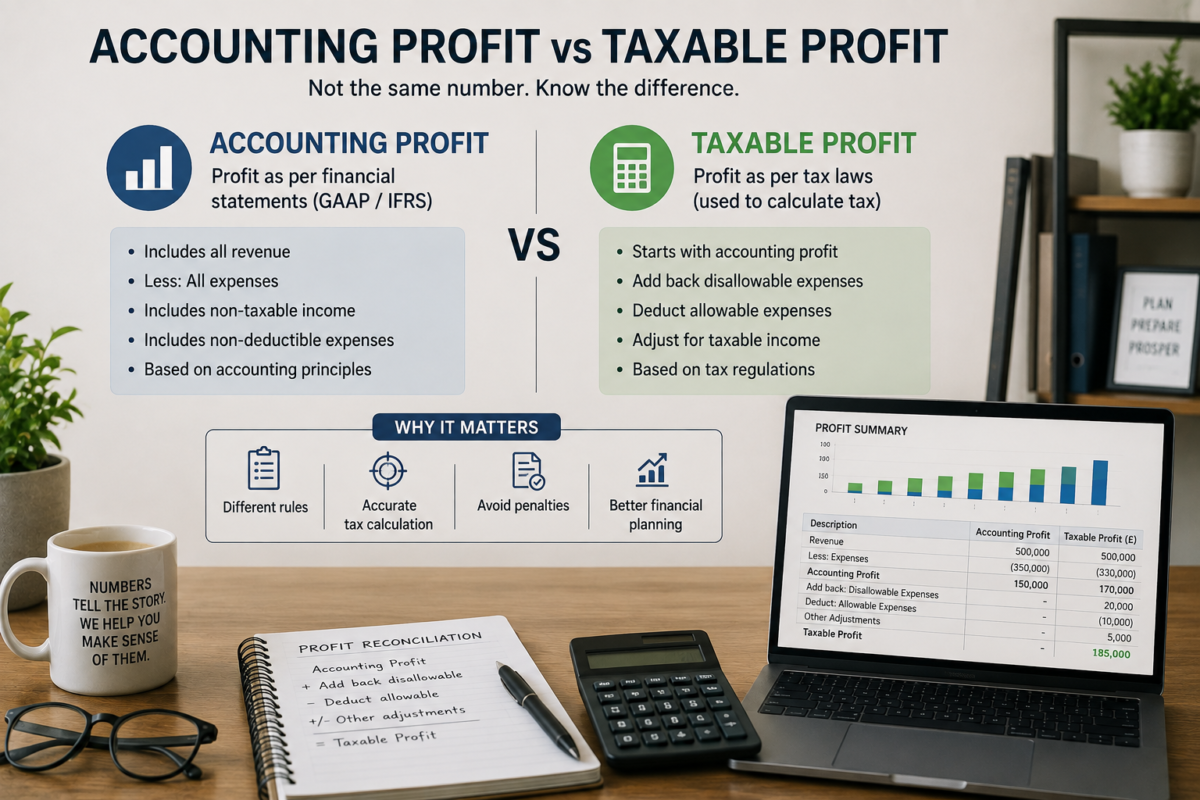
Accounting Profit vs Taxable Profit: Corporation Tax Explained

If you’ve ever looked at your company’s profit and loss account and then been surprised by the Corporation Tax bill that follows, you’re not alone. The profit in your accounts and the profit HMRC actually taxes are rarely the same figure, and understanding why is one of the most useful things a director can learn about how Corporation Tax actually works.

Want a second opinion on your Corporation Tax computation before you file? Book a free 15-minute consultation with Felix Accountants and we’ll take a look.

What Is Accounting Profit?

Accounting profit is the figure shown in your statutory accounts, prepared under standard accounting frameworks such as FRS 102 or FRS 105. It reflects your income less all costs recognised during the accounting period, including things like depreciation, which spreads the cost of an asset over its useful life for accounting purposes.

What Is Taxable Profit?

Taxable profit — more precisely, “taxable total profits” for Corporation Tax purposes — starts with your accounting profit and adjusts it according to tax law. Some costs that are perfectly valid in your accounts simply aren’t deductible for tax, and some tax reliefs don’t appear in your accounts at all. The result, after these adjustments, is the figure your Corporation Tax is actually calculated on.

Why Depreciation Gets Added Back

Depreciation is an accounting estimate of how an asset loses value over time, and estimates aren’t something tax law is willing to rely on directly. Instead, depreciation is added back in full in the tax computation, and capital allowances — a set of HMRC-defined rates and allowances — are used instead to give tax relief on qualifying capital expenditure. The Annual Investment Allowance, for example, currently allows many businesses to deduct the full cost of qualifying plant and machinery in the year of purchase, up to a set limit, with writing down allowances covering amounts above that.

Common Disallowable Expenses

Beyond depreciation, several other costs that appear in your accounts must be added back because they aren’t allowable for Corporation Tax:

  • Client entertainment costs
  • Fines and penalties, including parking tickets and HMRC penalties
  • Costs that don’t meet the “wholly and exclusively” test for business purposes
  • Certain provisions that haven’t yet crystallised into an actual liability

For a fuller list of what is and isn’t deductible for a limited company, see our guide to allowable limited company expenses.

A Worked Example

ItemAmount
Profit per accounts£60,000
Add back: depreciation+£8,000
Add back: client entertaining+£1,200
Less: capital allowances-£6,500
Taxable total profits£62,700

Notice that the taxable figure here is higher than the accounting profit, even though the company hasn’t earned any additional cash — it’s purely the effect of the add-backs and reliefs working differently in the two calculations. In other cases, generous capital allowances can push taxable profit below accounting profit instead.

Why This Distinction Matters for Directors

Understanding the gap between accounting and taxable profit matters for more than just curiosity. It affects how much cash you should be setting aside for your Corporation Tax bill, and it’s also a completely separate question from how much profit is legally available to pay out as dividends, which is governed by company law and your accounting profit and reserves, not your tax computation. Paying dividends from profits that don’t actually exist can result in an illegal dividend — our guide on illegal dividends explains this risk in more detail.

Common Misunderstandings

  • Assuming your Corporation Tax bill should match a simple percentage of your accounting profit
  • Forgetting that capital expenditure isn’t deducted as it’s spent, but relieved through capital allowances instead
  • Treating distributable reserves and taxable profit as the same thing when deciding on dividends
  • Missing available reliefs, such as R&D relief, because they don’t automatically appear in the accounting figures

How Felix Accountants Can Help

We prepare Corporation Tax computations that correctly reconcile your accounting profit to your taxable profit, make sure you’re claiming every allowance and relief you’re entitled to, and help you plan cash flow around your actual tax liability rather than guesswork.

Frequently Asked Questions

Why is my Corporation Tax bill higher than expected based on my accounts?

This usually happens because disallowable expenses, like depreciation or client entertaining, have been added back in the tax computation, increasing your taxable profit above your accounting profit.

Do capital allowances always reduce my tax bill more than depreciation would?

Not necessarily in every year, but capital allowances are the only mechanism HMRC recognises for tax relief on capital expenditure, so understanding and claiming them correctly is essential regardless of how they compare to your accounting depreciation charge in any given year.

Can I pay dividends based on my accounting profit even if my taxable profit is lower?

Dividends must be paid from distributable reserves under company law, which relate to your accounting position, not your taxable profit figure. The two calculations serve different purposes and shouldn’t be confused when deciding what can legally be paid out.

Does every company need a formal tax computation separate from its accounts?

Yes. Even small companies need to prepare a Corporation Tax computation that adjusts accounting profit for tax purposes as part of the CT600 filing process, regardless of how straightforward the underlying accounts are.

Categories
Articles Articles Blogs Self Assessment Taxation Services

What Happens If You Discover an Error in a Previous UK Tax Return?

Spotting a mistake on a tax return you’ve already submitted is more common than you might think — a missed expense, an omitted source of income, or a figure that simply doesn’t add up. The important thing is what you do next, because HMRC treats a self-corrected error very differently from one it uncovers itself.

Not sure whether you’re still within the amendment window, or how to approach HMRC about an older error? Book a free 15-minute consultation with Felix Accountants and we’ll help you work out the best next step.

Step One: Work Out Which Deadline Applies

How you correct the error depends on how long ago you filed the return in question.

Within 12 Months of the Filing Deadline

If you’re within 12 months of the normal Self Assessment filing deadline for that return, you can simply amend it yourself. For an online return, log back into your HMRC account, update the relevant figures, and resubmit — the system recalculates your bill automatically, showing whether you owe more or are due a refund. For example, a 2024/25 return filed by the 31 January 2026 deadline can generally be amended up to 31 January 2027.

More Than 12 Months After the Deadline

Once the 12-month window has closed, you can no longer amend the return online. Instead, you’ll need to write to HMRC explaining the correction, or make a formal overpayment relief claim if the error means you paid too much tax. Overpayment relief claims can generally be made up to four years after the end of the tax year the return relates to.

What to Include in a Written Correction or Overpayment Relief Claim

  • The tax year the correction relates to
  • A clear explanation of what was wrong and why
  • The amount you believe was overpaid or underpaid
  • Supporting evidence (invoices, statements, calculations)
  • A signed declaration confirming the details are correct and complete to the best of your knowledge

If the Error Means You Owe More Tax

If correcting the mistake increases your tax bill, it’s best to notify HMRC and pay the difference as soon as you’re aware of it. Interest accrues from the original due date, and coming forward yourself, before HMRC identifies the discrepancy independently, generally puts you in a much stronger position on penalties than waiting to be caught out. This is the same underlying principle behind voluntary disclosure routes like the Let Property Campaign for landlords with undeclared rental income specifically.

If the Error Means You Overpaid

If you’re due a refund, amending within the 12-month window is the most straightforward route — HMRC recalculates your position and processes the repayment. Outside that window, an overpayment relief claim achieves the same result but requires a more formal written submission with supporting evidence.

Genuine Mistakes vs Careless or Deliberate Errors

HMRC distinguishes between an honest, reasonable mistake and one caused by carelessness or deliberate action, and this distinction affects whether a penalty applies at all. If you took reasonable care and made a genuine error in good faith, you’re unlikely to face a penalty for correcting it — HMRC generally responds far more favourably to taxpayers who put things right themselves. If the error was significant, spanned several years, or involved undeclared income you knew about, professional advice is worth getting before you approach HMRC, since the correct classification affects both the penalty and how many years need correcting.

What If HMRC Corrects the Error First?

HMRC can amend a return itself within nine months of the date you filed it, typically to correct obvious errors, and will notify you of any change. If HMRC identifies a more significant discrepancy through a compliance check, the process moves from a simple correction into a formal enquiry, and the potential penalties for the same underlying mistake are usually higher than if you’d corrected it proactively.

A Practical Example

Suppose you filed your 2023/24 return in January 2025 and later realise, in mid-2026, that you forgot to include some rental income. Since more than 12 months have passed since the 31 January 2025 deadline, you can’t amend the return online — you’d need to write to HMRC, or, if the omission relates to rental income specifically, consider whether the Let Property Campaign disclosure process is the more appropriate route, since it’s specifically designed for this kind of correction.

How Felix Accountants Can Help

Whether you’re inside the 12-month amendment window or need to make a formal overpayment relief claim or voluntary disclosure, we’ll help you work out the right process, prepare accurate figures, and manage the correspondence with HMRC on your behalf.

Frequently Asked Questions

How long do I have to amend a Self Assessment tax return?

You generally have 12 months from the normal filing deadline for that tax year. For example, a return with a 31 January 2027 deadline can usually be amended up to 31 January 2028.

What is overpayment relief?

Overpayment relief is a formal claim you can make to recover tax you’ve overpaid, once the standard 12-month amendment window has passed. It must generally be made within four years of the end of the relevant tax year and requires a written submission with supporting evidence.

Will I be penalised for correcting my own mistake?

If the error was a genuine mistake made despite taking reasonable care, a penalty is unlikely. Penalties are more commonly applied where HMRC considers the error careless or deliberate, and coming forward yourself before HMRC identifies the issue generally results in a lower penalty than waiting.

Can HMRC change my tax return without telling me?

HMRC can make certain corrections within nine months of your filing date, but it will notify you of any change made. Anything beyond a simple correction, such as a discrepancy found through a compliance check, involves a more formal process where you’re kept informed and can respond.

Categories
Articles Articles Blogs Self-Assessment Taxation Services

Self Assessment for First-Time Taxpayers: How to Register and File Your First Return

Filing a Self Assessment tax return for the first time can feel intimidating, mostly because nobody explains the process until you’re already up against a deadline. The good news is that once you understand the sequence — register, get your reference number, then file — it’s a manageable, one-time learning curve.

If you’d rather have someone check your registration and return before you submit, book a free 15-minute consultation with Felix Accountants — it’s a quick way to make sure your first return is right.

Who Needs to Register for Self Assessment?

You generally need to register if, in the tax year in question, you had income from self-employment over £1,000, rental income, foreign income, capital gains, dividends or savings above certain thresholds, or if you need to pay the High Income Child Benefit Charge. Self Assessment isn’t limited to the self-employed — many first-time filers are landlords, company directors, or people with a side income alongside employment.

The Registration Deadline

If you need to file for the first time, you must register with HMRC by 5 October following the end of the tax year in which the income arose. For example, if you started earning untaxed income at any point between 6 April 2025 and 5 April 2026 (the 2025/26 tax year), you need to register by 5 October 2026. Miss this and you can still register late, but you risk penalties if it causes you to miss the return deadline too.

How to Register: Step by Step

  1. Decide your category. HMRC’s registration route differs slightly depending on whether you’re self-employed, a landlord, a partner in a business, or none of the above but still need to file.
  2. Register online with HMRC. Use the appropriate GOV.UK registration service for your circumstances and set up a Government Gateway account or sign in with GOV.UK One Login.
  3. Receive your Unique Taxpayer Reference (UTR). HMRC posts this, usually within around 10 working days in the UK (longer if you’re abroad). You cannot file a return without it.
  4. Activate your online account. A separate activation code arrives by post, which you’ll need to complete sign-in for the online filing service.
  5. Set up your personal tax account. This is worth doing early — see our guide on how to set up your personal tax account for the details.

Filing Deadlines You Need to Know

DeadlineWhat it’s for
5 OctoberRegister for Self Assessment for the tax year just ended
31 OctoberPaper return deadline
31 January (following year)Online return deadline and balancing payment due

Our guide to the UK tax year and key dates covers how these deadlines fit into the wider tax calendar, including payments on account.

What Happens If You Miss the Deadline?

Missing the registration deadline alone doesn’t always trigger an automatic penalty, particularly if you don’t end up owing tax. Missing the filing deadline is different: HMRC applies an automatic £100 penalty even if you owe no tax, rising to daily penalties after three months. Full details are in our article on HMRC’s £100 fine for missing the tax deadline.

Common First-Time Filer Mistakes

  • Leaving registration until September or October and getting caught out by UTR postal delays
  • Not keeping records of income and expenses from day one, making the return far harder to complete accurately
  • Forgetting to declare all sources of income, not just the “main” one — for example, a small amount of rental income alongside employment
  • Assuming Self Assessment is only for the self-employed and missing the deadline as a first-time landlord
  • Not budgeting for payments on account, which can catch new filers by surprise in year two

Record-Keeping From the Start

Good record-keeping makes your first return far less stressful and gives you a solid foundation for every year after. Keep invoices, receipts, bank statements and any correspondence relevant to your income and expenses as you go, rather than trying to reconstruct a year’s activity in January.

How Felix Accountants Can Help

We help first-time filers register correctly, understand what they can and can’t claim, and get their first return submitted well ahead of the deadline — taking the guesswork out of a process that only gets easier the second time around.

Frequently Asked Questions

How long does it take to get a UTR number?

HMRC typically posts your Unique Taxpayer Reference within around 10 working days if you’re in the UK, or up to 21 working days if you’re abroad. It’s sensible to register well before the 5 October deadline to allow for this.

Do I need to register for Self Assessment if I’m already employed and pay tax through PAYE?

Yes, if you have additional untaxed income — such as self-employment earnings, rental income, or significant dividends — on top of your PAYE employment. Self Assessment and PAYE aren’t mutually exclusive.

What if I register late?

You can still register after 5 October, but if this causes you to also miss the filing deadline, you may face penalties. It’s best to register as soon as you realise you need to, rather than waiting.

Can I file my first return on paper instead of online?

Yes, but the paper deadline (31 October) is earlier than the online deadline (31 January), so most first-time filers find it easier to register for online filing.

Categories
Articles Articles Blogs Let Property Campaign

Airbnb Rental Income Disclosure: What UK Hosts Should Check

An Airbnb rental income disclosure starts with a check of what you received and what you previously reported. Some digital platforms may collect information and report host income to HMRC, but this does not mean every payment is taxable or that the platform has filed your personal tax return. Review the booking records and the tax years involved. A common question we hear is whether the Let Property Campaign can be used to put things right — and the answer is generally yes, but with some important nuances.

Unsure whether your Airbnb income should have been declared, or how far back you need to go? Book a free 15-minute call with Felix Accountants to talk it through confidentially.

Is Airbnb Income Taxable?

Yes. Income from letting a property, or even a spare room, on a short-term basis is taxable in the same way as any other rental income, subject to any reliefs you’re entitled to. Depending on your circumstances, the property allowance or Rent a Room Scheme may affect whether tax is due or income needs reporting. They have different conditions and cannot simply be added together.

Does the Let Property Campaign Cover Short-Term Lets?

The LPC applies to individual landlords with undeclared tax on residential property income, and this generally includes short-term and holiday-style lettings of residential property, whether booked through Airbnb, Booking.com, Vrbo or direct. Whether the Let Property Campaign is the right route depends on who received the income and whether the activity is property letting or a separate trade. A listing on a booking platform is not, by itself, enough to answer that question.

If your short-term letting activity has grown into something closer to running a guest house, with significant services provided, HMRC may view it as a trade rather than a property business, which changes how it’s taxed and may take it outside the scope of the LPC. This is a grey area worth getting professional input on before you disclose.

What Changed With Furnished Holiday Lets?

Until 6 April 2025, properties meeting certain letting and availability conditions could qualify as Furnished Holiday Lets (FHLs), unlocking more generous tax treatment, including fuller mortgage interest relief and access to certain capital allowances. That regime was abolished from the 2025/26 tax year, and short-term let income is now taxed under the same rules as standard rental property income, including the mortgage interest restriction that already applied to other landlords. If you’ve been disclosing historic years, it’s important to apply the rules that were in force for each specific tax year rather than today’s rules retrospectively.

How Far Back Do You Need to Go?

The years to review depend on when you received the income, which returns were filed, and the applicable HMRC assessment and disclosure rules. Different years may need different tax treatment, particularly around the former furnished holiday lettings regime. Our guide on how many years of rental income landlords must disclose sets out the general time limits in more detail.

Accidental Hosts and First-Time Disclosures

Many people who let out a property short-term didn’t set out to become landlords in the tax sense — perhaps you started renting a spare property while working away, or began hosting guests after downsizing. If that sounds like you, our page on becoming an accidental landlord covers how HMRC treats these situations and what you need to do to get compliant.

Practical Steps If You Haven’t Declared Airbnb Income

  • Pull together booking records, payout statements and platform tax summaries for each relevant tax year
  • Work out which years the Furnished Holiday Let rules did or didn’t apply, since this affects your allowable deductions
  • Check whether the Rent a Room Scheme or property allowance already covers part of your income
  • Consider whether your behaviour is likely to be classed as careless or deliberate, since this affects the penalty rate and the years you must disclose
  • Make your disclosure before HMRC contacts you, to secure unprompted disclosure treatment and a lower penalty

Common Mistakes Hosts Make

The most frequent error we see is hosts assuming that because Airbnb “already takes its cut” or issues a summary, the income has somehow already been reported to HMRC on their behalf. A platform statement is useful evidence, but it is not a substitute for checking whether you must report property income to HMRC. Reconcile each platform payout with the bookings, fees and other rent you received before preparing your tax figures. Another common mistake is applying FHL-style deductions to years after the regime ended, which can trigger its own correction later.

How Felix Accountants Can Help

We regularly help hosts and landlords work out exactly what’s owed across multiple tax years, apply the correct rules for each year, and submit an accurate Let Property Campaign disclosure that stands up to HMRC scrutiny.

Frequently Asked Questions

Do I need to declare Airbnb income if I only host occasionally?

If your gross rental income from all sources is under £1,000 in a tax year, the property allowance may mean you don’t need to declare it. Above that, it generally needs to be reported, even if hosting is occasional.

Can I still get Furnished Holiday Let tax treatment for a current listing?

No. The Furnished Holiday Let regime was abolished from 6 April 2025, so short-term let income from the 2025/26 tax year onward is taxed under the standard property income rules.

Does the Let Property Campaign cover overseas short-term lets?

It can, in certain circumstances, though overseas income brings in additional considerations such as double taxation relief. It’s best to get specific advice if your undeclared income relates to a property outside the UK.

What if my short-term letting is really more like running a guest house?

If you provide substantial additional services, HMRC may treat the activity as a trade rather than a property business, which can affect both how it’s taxed and whether the Let Property Campaign is the right disclosure route.

Can the property allowance cover Airbnb income?

The property allowance can sometimes simplify the reporting of small amounts of property income, but eligibility depends on your situation. It is based on gross property income, not just the cash left after paying platform commission. You cannot automatically claim the allowance as well as deducting actual expenses, and some landlords cannot use it where they claim residential property finance-cost relief.

Renting a furnished room in your main home may instead fall within the separate Rent a Room Scheme. Review each year individually and include income from your other property lettings when assessing the position. Do not assume that occasional bookings are exempt simply because you call them a side income.

What if Airbnb statements cover calendar years, not tax years?

Many booking websites provide summaries from January to December. UK personal tax returns are normally prepared by tax year, which runs from 6 April to 5 April. Download the underlying transaction list, not just the annual dashboard total, and group bookings and relevant receipts into the appropriate UK tax years. Keep a separate column for cancellations, refunds, fees and any payments received outside the platform.

If you hosted through more than one site, combine the records without double-counting the same booking. This gives you a clearer starting point for checking the income already declared and any amounts missing. HMRC specifically advises people using online platforms to consider the difference between platform calendar-year summaries and UK tax years.

Capital Gains Tax on UK Property: 7 Essential Facts

Book Your Comprehensive Property Tax Review

Categories
Articles Blogs Let Property Campaign

Let Property Campaign vs Tax Investigation: Choosing the Right Route

If you’ve fallen behind on declaring rental income, you’ve probably come across two very different-sounding terms: the let property campaign vs tax investigation. They can lead to the same place — you paying the tax you owe — but the route, the paperwork, the Let Property Campaign and an HMRC compliance check are different procedures for dealing with tax that may be unpaid. Which route is open to you, and how penalties are assessed, depends on the facts and whether HMRC has already begun enquiries.


Not sure which route applies to you, or whether you should come forward before HMRC contacts you? Book a free 15-minute consultation with Felix Accountants and we’ll talk through your specific circumstances, in confidence, with no obligation.

What Is the HMRC Let Property Campaign?

The Let Property Campaign (LPC) is a voluntary disclosure facility that HMRC has run since 2013. It allows individual UK landlords with undeclared or under-declared rental income to come forward, calculate what they owe, and pay it — usually on more favourable terms than if HMRC discovered the problem itself. It applies to residential property income only; landlords holding property through a limited company or trust cannot use the LPC.

Once you notify HMRC of your intention to disclose, you’re generally given 90 days to work out the tax, interest and any penalty due and submit your disclosure. It’s a structured, self-managed process, and it is entirely optional — nobody forces you into the LPC.

What Is an HMRC Tax Investigation?

A tax investigation, by contrast, is something HMRC initiates. It isn’t voluntary, An HMRC enquiry involves formal questions and requests for information. You still have rights and responsibilities, including the right to take professional advice, but the response process is driven by HMRC’s enquiries.

Formal Compliance Checks and Enquiries

These are opened when HMRC has reason to believe a return is wrong — often triggered by data mismatches from sources like the Land Registry, letting agents, mortgage lenders or short-term letting platforms. HMRC will typically request records, ask questions, and can go back several years depending on the behaviour involved.

Code of Practice 9 (COP9)

Code of Practice 9 is reserved for cases where HMRC suspects deliberate tax fraud. It’s a civil process, offered as an alternative to criminal prosecution, but under Code of Practice 9, HMRC may offer the Contractual Disclosure Facility where it suspects fraud. Acceptance involves contractual obligations to disclose deliberate behaviour fully and accurately; the details and consequences must be reviewed before any decision.

and disclose everything in full. It carries much higher stakes than either the LPC or a standard compliance check, and professional representation is essential from the outset.

Key Differences at a Glance

LPC: You notify HMRC of the intention to disclose previously unpaid rental tax and, if accepted, follow the campaign’s disclosure and payment process.

HMRC enquiry: HMRC asks questions and may formally investigate a return or other tax matter. Penalties under either route depend on the type of error, the relevant rules and the quality of disclosure. Eligibility for the LPC cannot be assumed once HMRC has notified an intention to open a compliance check.”

Why Timing Matters: Prompted vs Unprompted Disclosure

This is the single biggest factor in how much you’ll ultimately pay. Under HMRC’s penalty rules, an unprompted disclosure — one made before HMRC has any reason to believe it’s about to find the error — attracts a far lower penalty than a prompted disclosure made after contact from HMRC. For a careless error, an unprompted disclosure can start at 0%, while a prompted one is very rarely below 15%.

HMRC’s prompted or unprompted classification depends on what you had reason to believe it had discovered or was about to discover. Receiving a letter is an important fact, but the exact wording and circumstances must be reviewed.

Which Route Applies to You?

In practice, most landlords who haven’t yet heard from HMRC are free to use the LPC on an unprompted basis. If you’ve already received a nudge letter, you can generally still use the LPC, but your disclosure will be treated as prompted, meaning a higher minimum penalty. If HMRC has gone further and opened a formal enquiry — or suspects deliberate concealment, HMRC says LPC disclosures are unlikely to be accepted where it has already notified its intention to open an enquiry or compliance check before you notified under the campaign. If an enquiry is open, speak to the HMRC officer or obtain professional advice before choosing a disclosure route.

Working out exactly how many years of rental income need to be disclosed also depends on which category your behaviour falls into — careless errors generally require fewer years back than deliberate non-disclosure.

What Happens If You Do Nothing?

Leaving an unpaid tax position unresolved can lead to additional interest and may leave HMRC to identify the issue later. Check the records and respond to any HMRC request within the stated time frame.

HMRC’s Connect system cross-references data from letting agents, banks, mortgage applications and property platforms, so undeclared rental income is increasingly likely to surface on its own. If it does, you lose the ability to make an unprompted disclosure entirely, and any subsequent enquiry starts from a position where HMRC is already suspicious.

Common Mistakes Landlords Make

  • Waiting to see if HMRC “actually finds out” rather than disclosing proactively
  • Assuming the LPC applies to a property held in a limited company (it doesn’t)
  • Submitting a partial disclosure and leaving out a property or income stream, which HMRC can treat as deliberate concealment if later discovered
  • Trying to negotiate a COP9 case without professional representation

How Felix Accountants Can Help

Whether you’re weighing up an unprompted LPC disclosure, responding to a nudge letter, or facing a formal enquiry, getting the behaviour classification right from the outset has a direct impact on your final bill. We handle the calculations, the correspondence with HMRC, and the disclosure itself, so you’re not navigating it alone.

Frequently Asked Questions

Can HMRC open an investigation while I’m in the middle of an LPC disclosure?

Generally, if your LPC disclosure is accurate, complete and submitted in good faith, HMRC treats it as a self-contained process and won’t open a parallel enquiry into the same rental income. However, HMRC does reserve the right to investigate further if the disclosure appears incomplete or inconsistent with information it already holds.

Does the Let Property Campaign apply to companies?

No. The LPC is only available to individual landlords with undeclared income from residential property. Landlords who hold property through a limited company need to correct their position through Corporation Tax filings instead.

What if I’ve already received a nudge letter?

You can usually still use the Let Property Campaign, but your disclosure will be classed as prompted, which generally means a higher minimum penalty than if you’d come forward first. It’s still typically far better than waiting for a formal enquiry to open.

Will using the Let Property Campaign guarantee I avoid prosecution?

No. HMRC’s Let Property Campaign guidance does not promise immunity from prosecution. It explains that a complete, unprompted disclosure is an important factor when HMRC decides whether to pursue civil or criminal action. COP9 has separate contractual terms and should not be confused with an ordinary LPC disclosure.

What should I do if HMRC has already opened an enquiry?

First read the letter carefully to understand which tax years and issues HMRC is asking about, the date by which it expects a reply, and whether a named officer is dealing with the case. Preserve the letter and the underlying records. HMRC’s LPC guidance explains that a campaign disclosure is unlikely to be accepted if HMRC notified its intention to open an enquiry or compliance check before the landlord notified under the campaign.

The correct next step may therefore be to respond within that existing procedure rather than start a separate LPC notification. Do not ignore the request or assume that a different online form will stop the enquiry. If the letter raises deliberate behaviour or suspected fraud, obtain suitable specialist advice promptly. Felix & Co. can review the correspondence and help identify the issues that need attention.

Is an HMRC nudge letter the same as a formal enquiry?

Not necessarily. An HMRC letter asking you to check property income may be an invitation to review your tax position, while a formal enquiry is a specific compliance process. Do not decide what the letter means from the phrase ‘nudge letter’ alone. Check the document, any statutory references, what information is requested and the reply date.

If you are unsure whether HMRC has formally opened a check, ask HMRC or obtain professional advice before submitting a disclosure. The distinction can affect which process is available and how the disclosure is classified for penalties. Keep a copy of everything you send and a record of your correspondence. If you have received an HMRC property-income letter, ask Felix & Co. to review it with you before you respond.

When does COP9 need different specialist advice?

Code of Practice 9 is a formal HMRC procedure for suspected tax fraud. It should not be treated as an ordinary version of the Let Property Campaign. HMRC may offer a Contractual Disclosure Facility under which the taxpayer has to decide whether to accept particular disclosure obligations.

The decision can have serious consequences, and HMRC sets out specific time limits and requirements in its guidance. If an envelope or email refers to COP9 or the Contractual Disclosure Facility, avoid replying with an ordinary LPC-style statement before you have read the documents and taken appropriate advice. Keep every letter, make a chronology of relevant events and preserve supporting records

Categories
Articles Blogs

Let Property Campaign 2026: The Complete Guide for Landlords & Property Owners

If you’ve earned rental income from a UK residential property and it hasn’t been fully declared to HMRC, you’re not alone — and there’s a structured, HMRC-endorsed way to fix it before it becomes a bigger problem. The Let Property Campaign (LPC) is HMRC’s voluntary disclosure route specifically for landlords, and coming forward through it is almost always cheaper and less stressful than waiting to be found.

With HMRC’s data-matching capability now cross-referencing letting agents, land registries, tenancy deposit schemes, and bank records, the odds of an undisclosed letting going unnoticed are shrinking every year. This guide covers who the campaign is for, what income it covers, the disclosure process step by step, real penalty figures, and the mistakes that most often cost landlords money.


Not sure if the Let Property Campaign applies to your situation? Get a free discovery call with our team and we’ll talk through your exact position.

👉 Book your free discovery call


What the Let Property Campaign Actually Is

Launched by HMRC in September 2013, the Let Property Campaign gives individual landlords a route to voluntarily correct undeclared or under-declared UK rental income. Landlords who use it before HMRC opens an enquiry can benefit from:

  • Meaningfully reduced penalties
  • Protection from criminal prosecution in genuine, cooperative cases
  • A more efficient, less adversarial resolution than a full compliance check

Why HMRC Runs This Campaign

HMRC’s rationale is straightforward: property income is unusually easy to detect. Letting agent records, land registry filings, council tax data, tenancy deposit scheme registrations, and even bank deposit patterns can all flag an undisclosed letting without the landlord ever coming forward. Add in AI-driven data-matching campaigns targeting Airbnb hosts, agent-managed lettings, and council-tax-registered non-payers, and the picture is clear: HMRC increasingly finds these cases on its own. The campaign exists to reward the landlords who get there first.

The numbers back this up. Over 40,000 disclosures have now been made through the campaign, recovering more than £180 million in previously unpaid tax.

What Income Is Covered Under the LPC

The campaign covers a broad range of residential letting situations, not just traditional buy-to-let. You should be looking at the LPC if any of the following apply to you:

Letting out residential property — a single flat or a full portfolio, whether it came about deliberately or by accident (inheritance, relocation for work), located in the UK or abroad, as long as the income is subject to UK tax.

Short-term and holiday lets — Airbnb income, serviced accommodation, furnished holiday lettings, and any seasonal or short-term letting income.

Rent-a-room and subletting — income from letting a room in your own home once you exceed the £7,500 rent-a-room threshold, or subletting arrangements not already reflected on your return.

Inherited or temporarily let property — a property you’ve inherited and started renting, or letting your own home during a period abroad or a temporary absence.

Previously missed or under reported periods — years where the property was let but the income wasn’t declared, even briefly, or where a return was filed with errors.

Overseas and international lettings — UK residents with rental income from property abroad, and non-UK residents with rental income from UK property.

Who Should Use the LPC

The campaign is designed for landlords who:

  • Have rental income that’s never been declared to HMRC
  • Made errors on previous returns — under reported income, over-claimed expenses
  • Didn’t realise rental income needed reporting at all, regardless of whether it generated a profit

One point catches a lot of landlords out: even if allowable expenses wipe out your taxable profit entirely, you’re still legally required to report the income and expenses. Making no profit is not the same as having nothing to declare.

Common real-world scenarios

  • Inheriting a parent’s home and renting it out without telling HMRC
  • Becoming a landlord while working abroad, letting your UK home without realising it still needs reporting
  • Renting a spare room informally, assuming the amount is too small to matter
  • Moving in with a partner and letting your previous home without updating HMRC
  • Assuming a letting agent was handling the tax reporting (HMRC holds the landlord personally responsible, not the agent)
  • Misapplying mortgage interest relief rules, particularly following the 2020 change to a 20% tax credit
  • Jointly owned property where reporting responsibilities weren’t clearly split between owners

Who’s Eligible — and Who Isn’t

You’re eligible if you’re:

  • An individual (not a company, trust, or partnership)
  • Earning income from UK residential letting — including buy-to-let, Airbnb, accidental landlord situations, and non-resident landlords with UK property
  • Willing to disclose fully and voluntarily, before HMRC has opened an enquiry — meaning a complete declaration of all under-reported income, full transparency on years and documentation, and a genuine willingness to resolve what’s owed

You’re excluded if:

  • HMRC has already opened a compliance check or raised questions about your rental income — in this case you must respond directly to that enquiry instead
  • Your income comes from non-residential property (offices, shops, industrial units) — the LPC covers residential letting only
  • You’re a company, trust, or partnership, which need to use a different HMRC disclosure route

Worth noting: if you hold a mixed portfolio, only the residential portion qualifies for LPC — commercial property needs separate arrangements. Joint owners each need to make their own individual disclosure for their share of the income, and non-UK residents with UK rental income remain eligible if they meet the other criteria.

The Disclosure Process, Step by Step

1. Register your intent with HMRC Access the LPC service on GOV.UK and submit your details, including your National Insurance number, through the Digital Disclosure Service (DDS). HMRC issues a Disclosure Reference Number (DRN) and Payment Reference Number (PRN) — keep both, as they’re needed throughout.

2. Gather your information Pull together rental income figures for every relevant year, including years spent abroad or where the property stood empty part-time. Supporting documents matter here — tenancy agreements, mortgage interest records, utility bills, maintenance invoices, council tax records, and bank statements.

3. Calculate what’s owed Work out gross rental income, allowable expenses, and any capital allowances. HMRC’s online calculators can help, though complex cases usually benefit from a tax advisor. Don’t forget interest on the late tax — and be aware that penalties will be set according to your behaviour category (careless, deliberate, or concealed).

4. Submit your disclosure Complete the full disclosure through the DDS portal, explaining clearly why the errors or omissions occurred and what you’ve done to correct them. You have 90 days from receiving your DRN to submit.

5. Pay what’s due Once you’ve registered your intent, you’ll receive a payment reference to settle the total tax, interest, and penalty — either in full or through an agreed payment arrangement discussed directly with HMRC beforehand.

6. Confirmation and closure HMRC reviews the disclosure; honest, thorough submissions tend to close fastest. If further information is needed, respond promptly. Once accepted, HMRC issues a closing letter confirming the total amount payable, the period covered, any payment arrangement, and that the case is closed provided the terms are met.

Staying Compliant After Your Disclosure

Closing an LPC case isn’t the end of the story. Going forward, you’ll need to:

  • Declare all rental income and expenses on your annual Self Assessment return, regardless of profit or loss
  • Keep organised records for at least six years — receipts, agreements, correspondence — in case HMRC requests them later
  • File and pay by the 31 January deadline each year to avoid fresh penalties and interest
  • Stay current with HMRC guidance, since rules on allowable expenses and digital filing do change — HMRC’s Property Rental Toolkit is a useful reference
  • Revisit your position with a tax advisor whenever circumstances shift — new properties, overseas lettings, changes in tax residency

Our tax-saving strategies guide is a good next step once you’re back in good standing, for legitimate ways to manage the ongoing liability.

Real Disclosure Examples

The accidental landlord. Emma inherited her mother’s flat and let it out from 2018 without informing HMRC. Realising the gap in 2025, she disclosed £6,000 of undeclared rent through the LPC and, because she came forward voluntarily, paid only a 10% penalty with no further action.

The overseas landlord. Ajay relocated to Spain for work and let out his former UK home, unaware of his ongoing UK tax obligations as a non-resident. After receiving a nudge letter from HMRC, he used the LPC — working with a tax advisor to declare five years of rental profit — and secured a low penalty rate.

The inherited property. James inherited a house in 2017, let it out, and only recognised the reporting requirement in 2025. He used the LPC to settle seven years of unpaid tax plus interest, with a 15% penalty.

For a deeper look at how the maths plays out with real figures, our article on Let Property Campaign voluntary disclosure walks through two full case studies comparing voluntary versus prompted disclosure costs.

How Long Does a Disclosure Take?

Most LPC disclosures run 12–16 weeks from initial registration to final resolution, covering preparation, submission, and any follow-up queries or payment arrangements. Complex cases or gaps in documentation can extend this considerably.

Are LPC Cases Increasing?

Yes. In 2023, HMRC flagged over 18,000 property-related cases for compliance review — a figure expected to keep climbing as digital data-matching against letting agent returns, land records, and banking data becomes more sophisticated. The wider the net gets, the more voluntary, proactive disclosure makes financial sense.

How Penalties Are Actually Calculated

Penalties depend on several factors working together: the nature of the error (careless, deliberate, or deliberate and concealed), whether the disclosure was unprompted or prompted by HMRC contact, how long the omission persisted, and the quality of your cooperation.

There are two broad scenarios that trigger penalties — failure to notify HMRC of taxable income at all, and inaccurate returns where income was filed but understated. Both are calculated as a percentage of the additional tax owed (the “Potential Lost Revenue”), and a high-quality disclosure can cut that percentage by up to 90% within its range.

Voluntary, honest disclosure typically sits in the 0–20% penalty range — the lowest available — provided you’re fully cooperative, prompt, and transparent.

Prompted disclosure, where HMRC contacts you first, loses access to that leniency: rates run higher, sometimes double the voluntary range, even with full cooperation afterwards.

Deliberate or concealed behaviour carries the steepest penalties, typically 35–100% of the tax owed, and in the most serious cases can lead to criminal prosecution.

Reasonable care cases — genuine mistakes made despite taking sensible steps to get things right — can, in some circumstances, see the penalty waived entirely.

Key Takeaways

  • Voluntary disclosure before HMRC makes contact consistently produces the lowest penalty range, typically 0–20% of the tax owed
  • The quality of your disclosure — being open, prompt, and thorough — drives further reductions within that range
  • Genuine mistakes made with reasonable care can sometimes avoid a penalty altogether
  • Deliberate concealment carries the harshest consequences, both financially and legally
  • Professional guidance consistently improves outcomes — accurate figures, complete documentation, and a well-presented case all reduce the eventual penalty

Common Mistakes to Avoid

Only declaring recent years. HMRC can require disclosure going back up to 20 years for deliberate or concealed errors — review every year with missing or inaccurate figures, not just the obvious ones.

Misclassifying allowable expenses. Since April 2020, mortgage interest relief works as a 20% tax credit rather than a straight deduction — a common source of error.

Leaving out overseas property. Worldwide rental income is re-portable if you’re UK tax resident, not just UK-based lettings.

Doing the calculations yourself. Self-calculated figures frequently miss reliefs or misstate the tax owed — a second set of eyes from a qualified accountant catches this before HMRC does.

Missing the 90-day window. Once you’ve registered, the clock is running — late submission can forfeit the penalty reductions you’d otherwise qualify for.

Assuming the letting agent handles it. The legal responsibility for reporting sits with the landlord, regardless of what an agent manages day to day.

Assuming no profit means nothing to declare. All rental income needs reporting even where allowable expenses bring the taxable profit to zero.

Waiting to be contacted. A disclosure made after a nudge letter is a prompted disclosure — and loses the best penalty terms by definition.

Incomplete documentation. Missing tenancy agreements or bank statements can stall a disclosure or undermine its credibility — keep thorough records for every property and year involved.

When to Bring In Professional Help

Certain situations tend to benefit most from specialist advice:

  • More than four years of undeclared income, where the calculations and documentation requirements get more complex
  • Multiple properties or overseas lettings, which can introduce double taxation questions and varying expense rules
  • Complicated expense positions — joint ownership, furnished holiday lettings, or major repair and improvement claims

As one chartered tax advisor puts it, the Let Property Campaign is a genuine opportunity to regularise your affairs on favourable terms — provided the disclosure is accurate and the communication with HMRC stays open throughout.

Frequently Asked Questions

Do I need to use the LPC if I’ve already reported my rental income? No — the campaign is specifically for correcting income that wasn’t declared, or was declared incorrectly. If your returns are already accurate, there’s nothing to disclose.

Who can use the LPC? Individual landlords — not companies, trusts, or partnerships — with undeclared or under-declared UK residential rental income, whether they’re UK resident or overseas.

What happens if HMRC contacts me first? You move from a voluntary to a prompted disclosure, which carries higher penalty rates and less flexibility, though cooperation still helps.

What if I can’t afford to pay what’s owed right now? Contact HMRC’s LPC helpline before submitting your disclosure or any payment — they can discuss a realistic payment arrangement based on your financial position.

What expenses can I claim against my rental income? Allowable expenses generally include letting agent fees, repairs and maintenance, insurance, and a mortgage interest tax credit (since the 2020 rule change) — a tax advisor can confirm what applies to your specific setup.

How many years do I need to disclose? It depends on why the income wasn’t declared — careless errors typically mean up to six years, deliberate or concealed behaviour can extend that to twenty. Our guide on which years to declare breaks this down in detail.

Will I be prosecuted? Prosecution is reserved for the most serious, deliberate, and concealed cases. Honest, cooperative voluntary disclosures are very rarely treated this way.

Quick Reference Tips

  • Joint landlords each need to submit their own individual disclosure
  • Overseas landlords should check whether double taxation arrangements apply to their situation
  • Keep documentation for at least six years after your disclosure is closed
  • If older records genuinely don’t exist, explain this within the disclosure — HMRC will generally work from a reasonable best estimate
  • Get advice from a specialist tax advisor if your case involves overseas property, joint ownership, or inheritance complexities

Final Thoughts

The Let Property Campaign remains one of the most practical routes HMRC offers landlords to put things right. With data-matching only getting sharper, waiting to be contacted is the more expensive option in almost every case. Whether your situation started as an honest oversight, a life event like an inheritance, or something more complicated, coming forward on your own terms keeps you in control of the outcome.

Ready to work out exactly where you stand?

👉 Book a free discovery call