Categories
Articles Blogs FAQs Guides News

How Do I Set Up My Personal Tax Account?

Table of Contents

How Do I Set Up My Personal Tax Account 

  1. What Can I Do with My Personal Tax Account? 
  2. What are the Benefits of setting up a Personal Tax Account? 
  3. Is it easy to Set up My Personal Tax Account in the UK? 
  4. How can I create my personal tax account?
  5. Can mPersonal Tax Account Help Review my National Insurance Record? 
  6. Can my Personal Tax Account Help Review my Employment Records? 
  7. Can Personal Tax Accounts Provide Information on PAYE codes? 
  8. Is your Personal Information Secure? 
  9. How Can I Ensure Nobody Accessed My Account? 
  10. Does HMRC Ask for Personal and Financial Detail? 
  11. Conclusion 
  12. Recent Posts

A personal tax account is an HMRC-initiated system to make the tax system in the UK more efficient and transparent. This system facilitates you to access all your tax-related personal information in one place. Through your tax account, you can solve your tax issues on time by yourself without writing or calling the HMRC. You are probably wondering, how do I set up my personal tax account? 

If you have access to your personal tax account, it means you can save a great deal of your time and energy. You can manage and handle your tax matters in a much better way. The personal tax account system was started in 2015 and it has been a splendid success since then as it saves countless hours by dealing with everything online. Surely, it is for the best that you set up your personal tax account.  

What Can I Do with My Personal Tax Account? 

The list of services for the personal tax account is constantly expanding and growing. Therefore, you can avail of many useful financial services from your personal tax account that include:  

  • Checking income tax code. 
  • Finding the national insurance number. 
  • Organising tax credits. 
  • Claiming a tax refund. 
  • Checking your income tax estimates. 
  • Paying overdue taxes. 
  • Updating or checking your marriage allowance. 
  • Checking the latest updates on the value of the state pension. 
  • Adding a family member or other trustworthy person to manage your account on your behalf. 
  • Viewing your self-assessment tax calculation, which might be helpful in applying for credit.  

If there is any error or miscalculation in anything like details or anything else, you can change it by yourself. This guide will help you comprehend how do I set up my personal tax account

What are the Benefits of setting up a Personal Tax Account? 

The personal tax account system is an attempt by the HMRC to make the taxation system more transparent and efficient. With the use of this taxation system, it becomes easier for you to update the HMRC about the changes to your circumstances, like getting married, having a baby, and changing your address. It enables you to change your child’s benefits circumstances, such as if the child joins or leaves education or training. If you are a parent, then you can keep track of child track credits. you can check or update the benefits you get from your work such as car insurance, or company car details.  

The major benefit of the personal tax account is that everything relating to your tax affairs will be online in one place. Hence, you will not have to spend time finding out different papers to get the details of your taxes.  

Also, creating your personal tax account enables you to monitor your tax-related affairs to make sure that your records are accurate and up to date.  

It is less time-consuming, more transparent, less difficult, more immediate, and entirely paperless. This process does not require lengthy letters but easy texting messages or emails- so you will be doing good for the environment too. Thus, it is an ideal situation.  

Is it easy to Set up My Personal Tax Account in the UK? 

Certainly, it is human nature to envisage every new thing as difficult until becoming familiar with it. But setting up your personal tax account with HMRC is like something easier done than said.  

Setting up a personal tax account is not time-taking or technicalities involving the job at all. According to HMRC, it should only take 5-10 minutes. 

Personal Tax Account

To start with, you must log in to your government gateway account.  

The form online available is itself much easier to follow as it simply involves inputting your information and setting up security protocol. At this stage, the time factor entirely depends on the organization of the paperwork you start with. The more your paperwork is organized, the less time will it takes. Let’s discuss the paperwork you require to understand how I set up my personal tax account.  

What do you need to Apply for the Paperwork?  

  • National insurance number. 
  • Recent pay slip. 
  • UK passport (must be on date) or most recent P60. 
  • Landline number or your mobile number, as part of the two-step security.  
  • Choose the email address you want to attach to the account.  

Now, you have acquired all the needed information to set up your personal account. Just go to the government gateway, and select either individual, (if you represent your own business) or agent (if you represent other people in financial matters to the government) to start the registration process.  

How can I create my personal tax account?

There are a few steps to set up your personal tax account. We share those steps one by one in a largely simplified way.  

1. Registration 

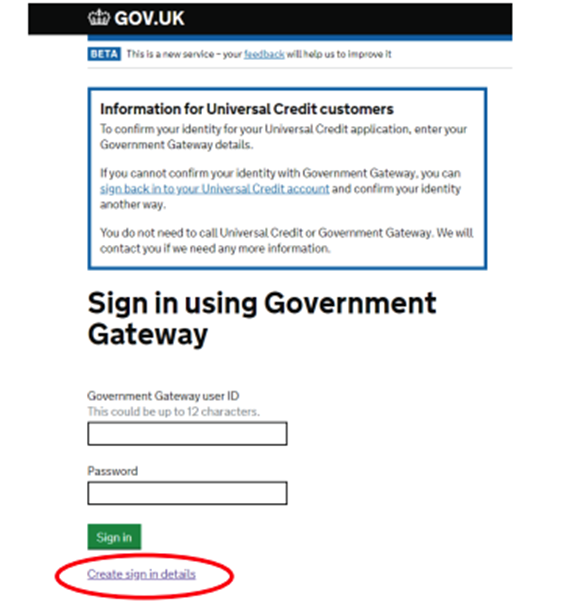
You will need to register online by using this link on the official website of the HMRC to access the personal tax account.  

Click the ‘create sign-in details’ link given below the sign-in button to begin the registration process.  
Then you will have to enter your email address. After doing so, select Continue. 
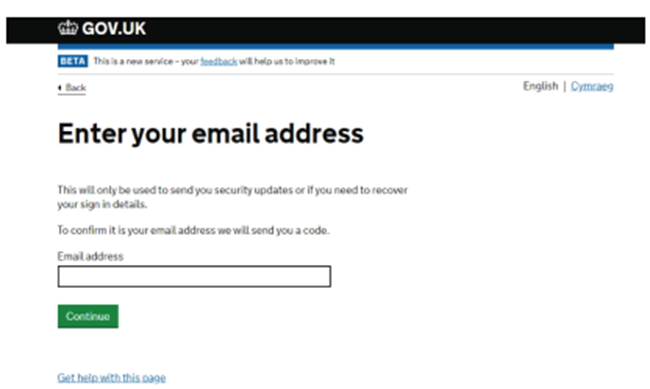
You will receive a code of 6 characters from HMRC at this email address. 

Once you have entered the details in the given box, HMRC will prompt you to enter your full name and create a password. Then you will see your Government Gateway ID number.  

2. Setting up your account 

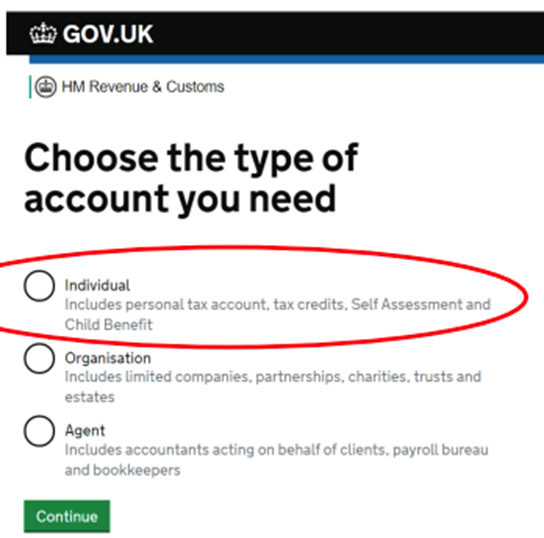
Here the HMRC will ask you to select the type of account you need. Please select “individual” and then click the green button of “continue”.
Now the HMRC will ask you to set up a method to receive an access code. It is important to know that select a method you are quite comfortable with because HMRC will use this method to send you an access code, every time you sign by using your Government Gateway user ID. 
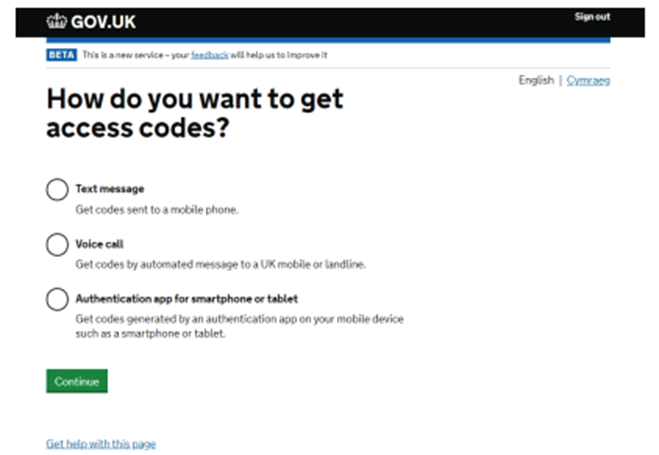
After selecting the method, you are most convenient with, click on the green button of “continue”.  

Then HMRC will ask you to enter the 6 digits access code it has provided you with.  

Kindly, enter the code and then click the green button “continue”.  

Now HMRC will ask you to confirm your identity, please provide the details where asked and then click the green button of “continue”. 

Now HMRC will ask you the way you want your identity o be confirmed by the HMRC. If you are a UK passport holder, you are recommended to use this option.  

HMRC will ask you to share the same detail you have on your passport. Please enter the required details and then click the green button of “continue”.  

Now HMRC will confirm whether the details you entered are correct and whether the personal tax account has been successfully set up. After its confirmation, you will be asked whether you would like to receive your correspondence regarding your tax affairs electronically or post via your Personal Tax Account. please select the option which is most suitable to you and select the green “continue” button.  Now you will be taken to the Personal Tax Account home page.  

3. Recovering Login Details 

If you have previously used the online services of the government Gateway or HMRC to submit your tax returns electronically via the website of HMRC. You must log in by using those account details. But if you have forgotten the details of those accounts then please select one of the links given at the bottom of the sign-in page depending on the details you need to recover.  

Now HMRC will take you, according to its process to recover your Government Gateway user ID or password. 

If you face any difficulty with the process, you can easily contact HMRC for help.  

Safety and security with your Personal Tax Account 

After completing the registration procedure, you are the only person to have access to your personal tax account with your user ID and password.  

Therefore, that answers your question, how do I set up my personal tax account? 

Can my Personal Tax Account Help Review my National Insurance Record? 

When it comes to reviewing your National Insurance record, your personal tax account can be particularly helpful. You can easily review your national insurance record that covers your entire working history by accessing your personal tax account. Reviewing your National Insurance record helps you ensure that your entire record is accurate and up to date. It also identifies any gaps in your contributions that might need to be addressed.  

After that, when you reach the pension age, you can ensure that you have the correct credits to receive a full pension. If you find any discrepancies and gaps, the best option is to contact HMRC for investigation.  

Can my Personal Tax Account Help Review my Employment Records? 

Yes, your personal tax account gives you the additional benefit of reviewing your employment records.  

It’s another benefit is that if you cannot obtain a copy of your P60 from your employer, you get it from your personal tax account. Once you understand how I set up my personal tax account, you can move forward with these steps.  

Can Personal Tax Accounts Provide Information on PAYE codes? 

Another useful feature of a personal tax account is that it enables you to view the PAYE codes use applied to your employment.  

Moreover, you also have the option to modify your PAYE code directly from your personal tax account.  

Is your Personal Information Secure? 

When it comes to security, HMRC takes it seriously and uses firewall protection for all its systems. This is like a bulwark to provide maximum protection for your information because its detective capacity is strong enough to detect any unauthorized entry. All the data that you share with HMRC is encrypted and nobody can see your data except yourself.  

Furthermore, you also must be conscious and vigilant of your online safety. Avoid sharing your user ID or password with anybody. If you cannot remember it and want to note it down, then ensure to keep it in a discrete place. Surely, you now have a clear idea of how I set up my personal tax account

How Can I Ensure Nobody Accessed My Account? 

One of the easiest ways, you must know whether someone accessed your account or not is the security measure of the system that shows you the time and date you logged into your personal tax account. Check this list frequently, if see any such thing that does not look right, immediately contact HMRC through their website.  

Another safety measure built into the system is automatic logging out of your account if it is not active after 15 minutes. If you are forgetful, don’t worry, the system will secure your account. 

Does HMRC Ask for Personal and Financial Detail? 

It is important to know, and HMRC often emphasizes to be mindful of the procedure of HMRC that it does not ask for any personal or financial details by email, phone, or text. Always be on watch to protect yourself from the scammer, if notice any such thing as suspicious, report it to the HMRC, even if you have not lost anything. Undoubtedly, it is in your best interest to do so.   

Shortly speaking, setting up a personal tax account offers a wide range of benefits by saving you a great deal of energy and time that you can utilize in something more productive and creative.  You can easily check state pensions, national insurance contributions, and many other tax affairs online without standing in long queues on helplines or doing related paperwork. It keeps you updated and informed about your tax status. And through it, you can also keep HMRC timely updated and informed about your circumstances. Most importantly, your financial information is safe and secure. 

FAQs

How do I activate my UTR number?

If your UTR (Unique Taxpayer Reference) is inactive, you can reactivate it by:

  1. Contacting HMRC – Call the Self Assessment helpline and request reactivation.
  2. Providing Personal Details – You may need to confirm your full name, address, National Insurance number, and date of birth.
  3. Waiting for Confirmation – HMRC will confirm reactivation, usually via letter or phone.

How to check income tax?

You can check your income tax by:

  1. Logging into your HMRC Personal Tax Account – View your tax payments, liabilities, and tax code.
  2. Using the HMRC App – Check your tax status on the go.
  3. Contacting HMRC – If you have queries about your tax records, call them for assistance.

How to file income tax?

To file your income tax return:

  1. Register for Self Assessment if you haven’t already.
  2. Gather Necessary Documents – Income records, expenses, and other tax-related details.
  3. Complete Your Tax Return – Log in to your HMRC account and fill out the SA100 form.
  4. Submit Before the Deadline – The deadline for online submissions is usually 31 January.

How do I create a UTR account?

To get a UTR number:

  1. Register for Self Assessment with HMRC.
  2. Provide Personal Information – Full name, address, date of birth, and National Insurance number.
  3. Wait for UTR to Arrive – It is usually sent by post within 10 working days in the UK.

How do I check if my UTR is active?

You can check if your UTR is active by:

  1. Logging into your HMRC account to view your Self Assessment status.
  2. Calling HMRC – Provide your UTR and ask if it is active.

How to set up self-employed?

  1. Register with HMRC for Self Assessment.
  2. Keep Records of your income and business expenses.
  3. Submit Your Tax Returns Annually to pay the correct amount of tax and National Insurance.

How do I check my UTR online?

You can find your UTR number by:

  1. Logging into your HMRC account – Your UTR is listed in your tax documents.
  2. Checking Previous HMRC Letters – It appears on tax returns and payment reminders.

How do I check my active tax status?

  1. Use Your HMRC Personal Tax Account – Check your tax payments and liabilities.
  2. Contact HMRC – If you’re unsure about your status, they can confirm it.

How long does it take to get a UTR?

HMRC usually issues a UTR within 10 working days if you’re in the UK or 21 days if you’re abroad.

How much money do you have to make as a self-employed person?

If you earn over £1,000 per tax year from self-employment, you must register with HMRC and file a tax return.

How do self-employed get money?

Self-employed individuals earn money by:

  • Charging clients/customers directly for services.
  • Selling products online or in-store.
  • Receiving payments through invoices, bank transfers, or platforms like PayPal.

How can I make money from home self-employed?

Options for making money from home include:

  • Freelancing – Writing, graphic design, programming, etc.
  • E-commerce – Selling on platforms like eBay, Etsy, or Amazon.
  • Affiliate Marketing – Promoting products for commissions.
  • Online Courses – Teaching skills through platforms like Udemy or Teachable.

How to earn $1,000 per day from home?

Earning $1,000 per day requires high-income skills or scalable businesses:

  • Dropshipping or E-commerce – Selling trending products online.
  • Stock Trading or Cryptocurrency – Requires experience and risk management.
  • Freelance Consulting – High-ticket services like business coaching.
  • Online Courses & Digital Products – Selling valuable knowledge at scale.

What is the fastest way to become self-employed?

  1. Identify a skill or service you can offer immediately.
  2. Register as self-employed with HMRC.
  3. Find clients through online platforms like Fiverr, Upwork, or LinkedIn.
  4. Start small and reinvest earnings to grow your business.

How to earn money from Google at home?

Google offers multiple ways to make money:

  • Google AdSense – Earn from ads on a blog or YouTube channel.
  • Google Play Store – Develop and sell apps.
  • Google Opinion Rewards – Get paid for surveys.
  • YouTube Partner Program – Monetize videos through ads and memberships.

click here for more

Categories
Articles Articles Blogs Guides

Property Records and Making Tax Digital: What UK Landlords Must Do Before April 2026

Making Tax Digital for Income Tax Self Assessment (MTD ITSA) becomes mandatory for many UK landlords from 6 April 2026. Landlords with annual property income above £50,000 will need to maintain digital records, use HMRC-compliant software and submit quarterly updates to HMRC. This is far more than a paperwork change — it requires a complete shift to digital record-keeping and ongoing reporting. Landlords who prepare early will find the transition straightforward, while those who delay risk penalties, errors and last-minute compliance pressures.

Making Tax Digital

Making Tax Digital Timeline for Landlords

Date Threshold Who Is Affected
6 April 2026 Gross property/self-employment income >£50,000 Higher-income landlords and self-employed individuals
6 April 2027 Income threshold reduces to £30,000 Mid-income landlords added to scope
6 April 2028 Income threshold reduces to £20,000 Majority of active landlords now within scope
TBC (2030s) MTD for Corporation Tax Companies including property SPVs — date under consultation


What Making Tax Digital Requires in Practice

  1. Keep digital records of all income and expenses using HMRC-approved software
  2. Submit quarterly updates to HMRC (summarising income and expenditure for each property)
  3. Submit an End-of-Period Statement (EOPS) at year end to finalise figures
  4. File a Final Declaration (replacing the traditional annual self-assessment return)
What HMRC Means by ‘Digital Link’
HMRC requires that data flows electronically from its point of origin to the HMRC submission — without manual re-entry. This means you cannot use a spreadsheet to calculate figures and then re-key them into submission software. The connection must be digital throughout the chain.


Records You Must Keep for Each Property

Record Category Examples Retention Period
Rental income Bank statements, rent receipts, tenant invoices, deposit records 5 years after filing deadline
Allowable expenses Repair invoices, insurance certificates, management fee statements 5 years after filing deadline
Finance costs Mortgage statements (interest element), loan agreements 5 years after filing deadline
Capital items Receipts for improvements (for CGT records) Indefinitely while property is held + 5 years
Legal & tenancy documents Tenancy agreements, safety certificates, notices Life of tenancy + 5 years


Recommended Digital Accounting Platforms

  • QuickBooks Online — strong bank-feed integration; suitable for multi-property portfolios
  • Xero — excellent reporting and multi-entity management for company portfolios
  • FreeAgent — designed for smaller property portfolios and sole traders
  • Landlord Vision / Arthur Online — property-specific platforms with direct HMRC integration


Making Tax Digital Compliance Mistakes to Avoid

  • Using spreadsheets alone without an HMRC-approved digital link to the submission system
  • Mixing personal and property business transactions in the same bank account
  • Recording expenses retrospectively from memory rather than at the time of payment
  • Ignoring small receipts — mileage logs, postage, cleaning supplies all add up significantly
  • Failure to reconcile bank feeds monthly, leading to duplicates and errors in submissions

Related Reading

Allowable expenses for property investors | Serviced accommodation and HMO tax guide | Furnished Holiday Let tax benefits and compliance

Frequently Asked Questions

Do I have to use MTD if I earn less than £50,000 from property?

Not from April 2026, but the threshold reduces to £30,000 from April 2027 and £20,000 from April 2028. Starting to use compliant digital software now means the transition will be seamless when your threshold is reached.


Can I continue using a spreadsheet for my property records?

Only if it uses a HMRC-compliant bridging solution that maintains a digital link to the submission platform. A spreadsheet used in isolation and then re-keyed into another system will not meet the MTD requirements.


What does a quarterly MTD submission contain?

Each quarterly submission summarises total income and total expenses for the period. It is not a tax return — you are not paying tax quarterly. It simply updates HMRC’s view of your position throughout the year, with the Final Declaration at year-end confirming the total.


Are limited companies included in MTD ITSA?

No. MTD ITSA covers individual landlords and self-employed people. Companies (including property SPVs) will be subject to a separate Making Tax Digital for Corporation Tax regime, which is still under consultation and expected later in the decade.


What are the penalties for non-compliance with MTD?

HMRC operates a points-based penalty system for late MTD submissions. Each missed quarterly update accrues a penalty point, and a financial penalty is triggered once a threshold is reached. The penalties escalate for persistent non-compliance.


Don’t leave your MTD compliance to chance. Felix Accountants provides end-to-end digital bookkeeping support for UK landlords.

Get MTD-Ready with Felix Accountants


JSON-LD Schema Markup

Categories
Articles Articles Blogs Guides

Furnished Holiday Lets: Business-Level Tax Benefits for UK Landlords

Furnished Holiday Lets occupy a uniquely privileged position in the UK tax system. Unlike standard residential rentals — which are treated as passive investment income — qualifying FHLs are treated as a business, unlocking capital allowances, full finance cost relief, and Business Asset Disposal Relief at 10% CGT on sale. The catch: HMRC’s qualification tests are specific, and failure to meet them costs all these advantages.

furnished holiday

Furnished Holiday Let HMRC Qualification Rules

Test Requirement How to Meet It
1. Availability Property must be available to let commercially for at least 210 days per year Schedule availability from day one of the tax year; document using booking platforms
2. Actual letting Property must be actually let to paying guests for at least 105 days per year Track each booking carefully; owner use days do not count toward the 105
3. Pattern of occupation No single letting may exceed 31 consecutive days; lets over 31 days cannot exceed 155 days in total per year Avoid monthly or long-term bookings; structure stays at under 31 days
The Grace Period Election
If your property fails the 105-day letting test but you can show genuine commercial intent and circumstances beyond your control prevented letting (e.g. refurbishment, storm damage), you can elect for the grace period rule for up to two consecutive years. You must file the election within one year of the 31 January following the tax year.


Furnished Holiday Let Tax Benefits

Tax Benefit Detail Why It Matters
Full mortgage interest deduction Section 24 restriction does not apply to FHLs Higher-rate taxpayers can deduct interest in full, not just a 20% credit
Capital allowances Furniture, fixtures, kitchen equipment, heating systems, CCTV Reduces taxable profit in early years; particularly valuable for new or refurbished FHLs
Business Asset Disposal Relief CGT rate of 10% on qualifying gain on sale vs 18% or 24% for residential property — a significant saving on exit
Pension contributions FHL profits count as ‘relevant earnings’ Enables much larger pension contributions and associated tax relief
IHT — Business Property Relief Possible where genuine commercial activity is proven Can exempt up to 100% from IHT if HMRC accepts the property as a business
Income splitting (spouses) Profits can be split in any ratio by simple election Utilise each spouse’s lower-rate band independently


Furnished Holiday Let VAT and Business Rates

Once FHL turnover exceeds £90,000 (2025/26), VAT registration is mandatory. Short-term holiday accommodation is standard-rated at 20%. Being VAT-registered allows you to reclaim input VAT on cleaning, utilities, advertising, and refurbishment costs.

Most FHLs are assessed for business rates rather than council tax. Where the rateable value is under £15,000, small business rates relief may reduce or eliminate the liability entirely.

Furnished Holiday Let Record-Keeping Requirements

  • Booking records: dates, duration, names, and revenue for each let throughout the year
  • Owner-occupancy records: all personal use days must be recorded (they count against availability)
  • Capital allowance schedules: invoices for all qualifying expenditure on fixtures and equipment
  • VAT records: output tax on letting income; input tax on all business expenses
  • MTD-compliant digital records: mandatory from April 2026 for turnover above £50,000


FHLs in a Wider Portfolio Strategy

  • Diversification: short-term holiday income complements long-term rental income during economic cycles
  • Capital allowance planning: FHL allowances can offset taxable income from other property activities
  • Exit strategy: converting a buy-to-let into an FHL before sale may access the 10% BADR rate
  • Corporate ownership: a company operating multiple FHLs consolidates VAT, benefits from full interest relief, and reinvests profits efficiently

Related Reading

Serviced accommodation and HMO tax guide | VAT and property — when does it apply? | Property records and Making Tax Digital

Frequently Asked Questions

Does HMRC still offer FHL tax benefits in 2025?

Yes. Despite consultation on reform, the FHL tax regime remains in place for 2025/26. Qualifying properties continue to benefit from full interest relief, capital allowances, BADR on sale, and pension contribution eligibility. Always check for any legislative updates in the annual Budget or Finance Act.


Can I own my FHL through a limited company?

Yes. A company owning FHL properties benefits from full interest deductibility, can VAT-register the business, and reinvests post-tax profits at 19–25% rather than the owner’s personal rate. The BADR 10% CGT rate applies only to individuals — companies pay their standard corporation tax rate on any gain.


What if I fail the 105-day letting test in one year?

If your FHL fails the actual-letting test for one year but you intended to meet it and were prevented by circumstances outside your control (e.g. flood damage, forced refurbishment), you can elect for the grace period rule for that year, retaining FHL status without penalty.


Do I have to charge VAT on my holiday let income?

Only once your annual FHL and short-term accommodation turnover exceeds £90,000 (2025/26 VAT registration threshold). Below this, voluntary registration may still be beneficial if you incur significant VAT on refurbishment or ongoing costs.


What CGT rate applies when I sell my FHL?

Where Business Asset Disposal Relief applies — which requires the FHL to have been run commercially for at least two years immediately before sale — the CGT rate is 10% on qualifying gains. Without BADR, the standard residential property CGT rates of 18% (basic rate) and 24% (higher rate) apply.


Don’t let HMRC disqualify your FHL status. Book a compliance review with Felix Accountants and protect your tax advantages.

Book Your FHL Compliance Consultation


JSON-LD Schema Markup

Categories
Articles Articles Blogs Guides

How to Legally Reduce Stamp Duty on Property Purchases: The Complete 2025 UK Guide

If you want to reduce Stamp Duty UK property taxes legally in 2025, several SDLT reliefs and exemptions may be available. Understanding the rules before you buy can save thousands of pounds and prevent costly mistakes. Stamp Duty Land Tax (SDLT) is one of the most significant costs in UK property acquisition — and one of the most frequently miscalculated. From April 2025, the temporary thresholds introduced in 2022 have reverted, making SDLT planning more important than ever. This guide covers every legitimate relief available to UK property investors.

Reduce Stamp Duty

SDLT Rates From April 2025 (England and Northern Ireland)

Portion of Purchase Price Standard Rate Additional Dwelling Rate (+3%)
Up to £125,000 0% 3%
£125,001 – £250,000 2% 5%
£250,001 – £925,000 5% 8%
£925,001 – £1,500,000 10% 13%
Over £1,500,000 12% 15%
Additional Surcharges to Note
Non-UK residents pay an additional 2% surcharge on residential purchases. Companies buying residential property for £500,000+ face a flat 15% rate — unless the purchase is for genuine letting, development, or employee housing purposes. SDLT must be filed and paid within 14 days of completion.


Strategy 1: Reduce Stamp Duty Through Mixed-Use Classification

Non-residential and mixed-use properties (with both commercial and residential elements) attract much lower SDLT rates and are exempt from the 3% surcharge. A building with a ground-floor commercial unit and flats above qualifies as mixed-use — a detail that can save tens of thousands on a single purchase.

SDLT Band (Non-Residential) Rate
Up to £150,000 0%
£150,001 – £250,000 2%
Above £250,000 5%


Strategy 2: Reduce Stamp Duty Using Multiple Dwellings Relief

When purchasing more than one dwelling in a single or linked transaction, MDR allows SDLT to be calculated on the average price per dwelling rather than the total. This consistently produces a lower bill on portfolio purchases and property conversions.

MDR Example: Two Flats at £500,000 Total
Without MDR: SDLT calculated on £500,000 at residential rates + 3% surcharge. With MDR: Average price = £250,000 per flat; SDLT calculated on £250,000 × 2 = substantial saving. MDR requires each dwelling to have its own entrance, kitchen, and bathroom facilities — annexes must genuinely qualify as separate dwellings.


Strategy 3: Reduce Stamp Duty Through Main Residence Relief

If you sell your main residence and buy a replacement within three years, the 3% additional-dwelling surcharge on the new purchase can be reclaimed. This relief requires careful timing — sell before you buy to avoid the surcharge entirely, or claim a refund afterwards if you buy first.

Strategy 4: Reduce Stamp Duty by Avoiding the 15% Company Rate

Companies purchasing residential property for £500,000+ face a flat 15% SDLT rate — unless an exemption applies. Exemptions include properties held for qualifying property rental businesses, properties acquired by property development companies, and properties occupied by employees as conditions of employment.

Strategy 5: Reduce Stamp Duty on Commercial Property with TOGC

On commercial property acquisitions, structuring the purchase as a TOGC eliminates VAT from the purchase price. Since SDLT is calculated on the total consideration (including VAT where applicable), eliminating VAT also eliminates SDLT on the VAT element — a compounding saving on large commercial deals.

Common Mistakes That Prevent You From Reducing Stamp Duty

  • Classifying mixed-use properties as purely residential — common and costly
  • Failing to claim MDR on annexes or separate dwellings within a single purchase
  • Missing the three-year window to reclaim the 3% surcharge on main-residence replacement
  • Not evidencing business intent for corporate purchases facing the 15% rate
  • Missing the 14-day filing deadline — late filing attracts automatic penalties
How SDLT Reviews Can Help Reduce Stamp Duty Costs
HMRC allows amendments to SDLT returns within 12 months of the filing date. If you believe you have overpaid — for example, by missing MDR or a mixed-use classification — a professional SDLT review can often recover significant sums within this window.


Related Reading

Transfer property into a company without paying tax | Property development SPV structures | Property portfolio demergers — splitting your holdings

Frequently Asked Questions

What is the 3% SDLT surcharge and when does it apply?

The 3% additional-dwelling surcharge applies whenever a purchaser owns (or part-owns) another residential property at the end of the day of purchase, and the new purchase is not their replacement main residence. First-time buyers are not exempt from this surcharge if they already own a rental property.


Can I reclaim SDLT if I overpaid?

Yes, within 12 months of the filing date (14 days after completion). You can amend the SDLT return or make a standalone claim. Common grounds include missed MDR, incorrect mixed-use classification, or changed circumstances (e.g. a sale that qualified as a TOGC).


Does Multiple Dwellings Relief still apply in 2025?

Yes, MDR applies for purchases completed in England and Northern Ireland up to the current legislation. Scotland has its own Land and Buildings Transaction Tax (LBTT) rules — see felixaccountants.com/land-and-buildings-transaction-tax-mdr-guide-for-scotland-2025/ for Scottish relief guidance.


What SDLT do I pay as a non-UK resident buying UK property?

Non-UK residents pay a 2% surcharge in addition to all other applicable rates. For a buy-to-let purchase at £400,000, this means standard rates + 3% surcharge + 2% non-resident surcharge — making pre-purchase planning essential.


Is there SDLT relief for incorporating a property portfolio?

Yes, potentially. SDLT partnership relief (Schedule 15 FA 2003) can eliminate SDLT on property transferred from a genuine business partnership into a company. The partnership must be proven through formal accounts, SA800 returns, and a separate bank account. See our incorporation relief article for full details.


Never pay more SDLT than you legally owe. Proper planning can help you reduce Stamp Duty legally and keep more of your investment returns. Book a consultation with Felix Accountants before exchanging contracts.

Book Your SDLT Consultation


JSON-LD Schema Markup

Categories
Articles Articles Blogs Guides

How to Structure Property Development Projects Using SPVs: The 2025 UK Guide

Property development offers the highest potential returns of any property strategy — but it also carries the most risk and tax complexity. A poorly structured development project can expose profits to unnecessary corporation tax, personal liability, and HMRC challenge. Using a Special Purpose Vehicle (SPV) resolves most of these risks at the cost of disciplined administration.

property development

Property Development SPV Structures Explained

An SPV is a company created solely to undertake a specific development project. It holds the land, contracts with builders and professionals, receives the sales proceeds, and closes (or lies dormant) once the project is complete. Lenders almost always prefer SPVs because security can be taken against a clean, ring-fenced entity without exposure to your other activities.

Why Property Development Projects Use SPVs

  • Legal and financial separation between each project
  • Clean accounting: performance is measurable per project
  • Lender confidence: security is limited to the SPV’s assets
  • Insolvency isolation: failure of one project does not contaminate others
  • Flexible profit extraction: dividends, management fees, or capital distribution on wind-up


Tax Treatment of an SPV

An SPV is taxed as a standalone company. Corporation tax at 19–25% applies to profits. The critical distinction in a development context is whether the company is developing properties for sale (trading) or for long-term retention (investment).

Activity Type Tax Treatment Key Implication
Development for sale (trading stock) Profits are trading income — corporation tax at 19–25% No CGT relief; full cost deduction including land and build
Development then retained for letting (investment) Property is a capital asset; rental income taxed; gain on disposal is CG Capital allowances may apply; different accounting rules
Mixed: develop some, retain some Requires careful apportionment between trading and investment Transfer to investment subsidiary should be at market value


Funding and Ownership Structures

Development projects are rarely fully equity-funded. Common structures include a sole-shareholder SPV (developer provides all capital and management); a joint-venture SPV (multiple shareholders in agreed proportions); and a development management structure (developer earns a fee from the SPV rather than a profit share). Where outside investors are involved, a shareholders’ agreement must document profit-sharing, decision rights, and exit mechanisms.

VAT Registration for SPVs
Register the SPV for VAT promptly — ideally before the first professional invoice. New residential construction is zero-rated, allowing full input VAT recovery on all build costs. Registering late means losing VAT on early-stage costs permanently.


SDLT on Land Acquisition

When the SPV acquires the development land, SDLT is payable on the purchase price. Non-residential SDLT rates apply to bare development land, which are considerably lower than residential rates and carry no additional-dwelling surcharge.

SDLT Band (Non-Residential) Rate
Up to £150,000 0%
£150,001 – £250,000 2%
Above £250,000 5%


How to Extract Profits from a Property Development SPV

Once a development is complete and proceeds received, profits can be extracted via: (1) dividends to shareholders after corporation tax; (2) management fees to a parent service company; or (3) capital distribution on formal winding up of the SPV — potentially qualifying for lower capital gains rates if structured correctly as a distribution in specie.

Related Reading

VAT and property — when does it apply? | Advanced company structures for property entrepreneurs | How to reduce stamp duty legally

Property Development SPV FAQS

Do I need a new SPV for every development project?

It is best practice to use a separate SPV for each significant project. This ring-fences risk, simplifies accounting, and satisfies lender requirements. For small projects, one SPV can handle multiple phases if risk profiles are similar — but seek advice first.


Can I use an LLP instead of a limited company as an SPV?

Yes. An LLP SPV is used where flexible profit allocation between partners is important, or where the development involves joint venture parties who need income-taxed rather than dividend-taxed returns. LLPs are tax-transparent — profits flow to members and are taxed personally.


How is development profit taxed versus rental income?

Development profit (from sales of developed property) is taxed as trading income under corporation tax (19–25%). Rental income from retained properties is investment income — taxed differently, with different expense rules and no capital allowances on buildings.


What happens to SDLT when land is transferred into an SPV?

SDLT is payable on land acquisition by the SPV at non-residential rates (lower than residential). Where the land is transferred from a related partnership or group company, group relief or reconstruction relief may reduce or eliminate SDLT.


Can my SPV borrow against land it acquires before planning is granted?

Yes. Bridging finance on development land pre-planning is common, though rates are higher. The SPV’s ability to borrow is ring-fenced to its own assets and the developer’s guarantee — another reason why SPV structure is valued by lenders.


Structure your next development correctly from day one. Book a consultation with Felix Accountants — specialist property development advisers.

Speak to a Property Development Tax Specialist


JSON-LD Schema Markup

Categories
Articles Articles Blogs Guides

VAT and Property UK: When Does VAT Apply and How Can You Recover It?

This VAT and property UK guide 2025 explains when VAT applies to residential and commercial property, how VAT recovery works, and when landlords should consider opting to tax.. Many investors assume it simply doesn’t apply to residential letting — and for standard long-term lettings they are correct — but this assumption becomes expensive the moment they venture into commercial property, development projects, or short-term letting.

VAT and Property UK

The Four VAT Categories for Property Transactions

VAT Category What It Means Property Examples VAT Recovery on Costs?
Exempt No VAT charged on income; no VAT recovered on costs Standard residential letting, sale of existing residential property No
Zero-rated (0%) No VAT charged on income; full VAT recovered on costs Construction/first sale of new dwellings Yes — full recovery
Reduced rate (5%) VAT at 5% charged; costs partially recoverable Certain conversions of non-residential to residential Yes — at 5% rate
Standard-rated (20%) VAT at 20% charged; full recovery on costs New commercial premises, opted-to-tax properties Yes — full recovery
The Critical Distinction: Exempt vs Zero-Rated
Both categories result in zero VAT being charged to the customer — but the difference in financial outcome is enormous. Exempt = you cannot recover VAT you paid on your costs. Zero-rated = you can recover all VAT you paid on costs. For a £500,000 development project, this difference can be £80,000–£100,000.


VAT and Property UK: Residential Property Rules

The letting or sale of existing residential property is generally exempt from VAT. This means you charge no VAT on rent or sale proceeds, but you also cannot reclaim VAT incurred on repairs, maintenance, or professional fees.

However, newly built dwellings are zero-rated when first sold or let on a long lease. A developer building residential units from bare land can reclaim all VAT on construction costs and professional services — a powerful financial advantage that must be structured correctly from the outset.

VAT and Property UK: Commercial Property and the Option to Tax

Commercial property transactions are generally standard-rated at 20%. However, older commercial properties (3+ years old) are exempt by default unless the owner makes an Option to Tax election (HMRC form VAT1614A).

When to Consider Opting to Tax

  • You have incurred substantial VAT on refurbishment or development of commercial property
  • Your tenants are VAT-registered and can recover the VAT you charge them
  • You intend to sell the property and the buyer is VAT-registered
  • You want to prevent irrecoverable VAT from eroding your returns
Option to Tax Warning
An Option to Tax, once made, normally lasts 20 years and cannot easily be revoked. If you option a property and then let it to an unregistered business (a GP surgery, charity, or small retailer, for example), your VAT charge will increase their costs with no recovery possible — making your property less competitive.


VAT and Property UK: Transfer of a Going Concern (TOGC)

A TOGC applies when a property rental business is sold as a going concern, with tenants in place and the buyer continuing the same letting activity. When conditions are met, the sale is outside the scope of VAT entirely — no VAT is charged and the buyer avoids paying large amounts up front. Both parties must be VAT-registered and the seller must have opted to tax (where applicable).

Serviced Accommodation and Short-Term Lets

Short-term holiday accommodation and serviced apartments are treated as standard-rated supplies (20% VAT). Once turnover exceeds £90,000 (2025 threshold), VAT registration is mandatory. This allows recovery of VAT on cleaning, utilities, and maintenance — but requires charging 20% on income.

Related Reading

Property development SPV structures | Furnished Holiday Let tax benefits | Serviced accommodation and HMO tax guide

Frequently Asked Questions

Do I need to register for VAT if I only let residential property?

No. Residential lettings are exempt from VAT, so rental income does not count towards the £90,000 registration threshold. You would only need to register if you have additional taxable income streams (e.g. commercial lets, serviced accommodation) that collectively exceed the threshold.


What is the option to tax and should I use it?

The option to tax converts an otherwise exempt commercial property into a standard-rated supply, allowing you to recover VAT on costs. It is beneficial when your tenants are VAT-registered and can recover the VAT, or when you have substantial development costs you want to reclaim. It is less suitable for mixed commercial/residential use or where tenants are unregistered.


Can I recover VAT on costs for a new-build residential development?

Yes. The construction and first sale of new dwellings is zero-rated, meaning you charge no VAT on the sale but can reclaim all VAT incurred on construction, professional fees, and materials. This is a significant cash-flow and cost benefit for residential developers.


What is TOGC and how does it save VAT?

Transfer of a Going Concern (TOGC) applies when a property rental business is sold with tenants in occupation and the buyer continues the same business. The sale falls outside VAT scope, meaning no VAT is charged and the buyer doesn’t pay VAT on the purchase price. Both parties must be VAT-registered for it to apply.


Does VAT apply to mixed-use development projects?

Mixed-use buildings (e.g. ground-floor commercial with flats above) require a partial exemption calculation. You can only recover the proportion of input VAT that relates to your taxable (commercial or opted-to-tax) income stream. Professional VAT advice at the planning stage is essential.


This VAT and property UK guide 2025 highlights why understanding exempt, zero-rated and standard-rated transactions is essential before making property investment or development decisions.VAT planning decisions made before the first invoice save far more than corrections made afterwards. Book your consultation with Felix Accountants.

Book Your VAT Planning Consultation


JSON-LD Schema Markup

Categories
Articles Articles Blogs Guides

Transfer Property Into a Limited Company Without Paying Tax UK: Incorporation Relief Explained

Many landlords ask whether they can transfer property into a limited company without paying tax in the UK. While incorporation can improve long-term tax efficiency, the transfer itself is treated as a disposal for tax purposes and may trigger Capital Gains Tax (CGT) and Stamp Duty Land Tax (SDLT). However, incorporation relief and SDLT partnership relief can significantly reduce or defer these charges when the correct conditions are met.

transfer property

What Happens When You Transfer Property Into a Limited Company?

HMRC treats an incorporation as if you sold the properties to the company at market value, and the company simultaneously bought them at that same value. Two tax charges therefore arise simultaneously:

Tax Charge Who Pays Basis of Calculation
Capital Gains Tax (CGT) You (the individual) Market value minus original acquisition cost and improvements
Stamp Duty Land Tax (SDLT) The company Market value of the property, potentially with 3% surcharge


Incorporation Relief (Section 162 TCGA 1992)

This relief defers the capital gain that would otherwise crystallise on transfer. Instead of paying CGT immediately, the gain is ‘rolled over’ into the base cost of the shares you receive in the new company. No tax is paid now — it is deferred until you eventually sell the shares.

Four Conditions to Transfer Property Into a Limited Company Without Paying Tax

Condition Requirement Practical Implication for Landlords
1. A business must exist Transferring a business, not merely an investment Passive rent collection rarely qualifies — active management is required
2. Whole business transferred All assets (except cash) must transfer together All properties, leases, and contracts move to the company
3. Shares received as consideration Transfer is wholly or partly in exchange for shares You receive shares equal in value to net assets transferred
4. Same beneficial ownership Proportional share allocation Co-owners receive shares in the same ratio as their property interests


The Business Test — Ramsay v HMRC [2013]
The Upper Tribunal confirmed in Ramsay v HMRC [2013] UKUT 0226 (TCC) that ‘mere ownership and rent collection is not sufficient’ to constitute a business. HMRC expects: 4+ properties, 20+ hours per week of active management, organised systems, third-party services, and documented activity records.


How the CGT Deferral Works: A Worked Example

Step Amount
Original portfolio purchase price £600,000
Current market value £1,000,000
Potential capital gain £400,000
CGT payable without relief (at 24%) £96,000
CGT with incorporation relief £0 — deferred into share base cost
Base cost of shares issued £600,000 (market value £1m minus deferred gain £400k)


SDLT Partnership Relief (Schedule 15 FA 2003)

Even where CGT is deferred, the company acquiring the property may owe SDLT. However, where the properties were held in a genuine business partnership, Schedule 15 of the Finance Act 2003 can eliminate or significantly reduce this SDLT charge.

Pre-Incorporation Ownership SDLT on Incorporation
Sole ownership Full SDLT on market value (including 3% surcharge)
Genuine partnership (e.g. husband and wife) Potential SDLT relief if partnership existed as a business before incorporation
LLP converting to Ltd Co Relief may apply depending on continuity of ownership
Critical Requirement for Partnership Relief
HMRC expects formal evidence of the partnership before incorporation: a partnership tax return (SA800), a separate bank account in the partnership name, and documented partnership accounts. Without this evidence, HMRC will deny relief and charge full SDLT on the market value.


Director’s Loan Account Benefit

Where the company assumes your outstanding mortgage, this creates a Director’s Loan Account (DLA) in your favour — equivalent to the equity you transferred. This balance can be drawn back from the company completely tax-free, providing an additional extraction route post-incorporation.

Related Reading

Personal vs company property ownership — 2025 guide | How to reduce SDLT legally on property purchases | Property portfolio demergers — splitting your holdings

Transfer Property Into a Limited Company FAQs

Do I pay CGT when I transfer my properties into a limited company?

Not immediately, if incorporation relief (s.162 TCGA 1992) applies. The gain is deferred into the base cost of your shares. However, the business test must be met — passive ownership does not qualify.


What CGT rate applies on eventual disposal of the shares?

Disposal of shares in a close company holding investment property will typically be subject to CGT at 20% (higher-rate taxpayers) under current rules. Business Asset Disposal Relief at 10% is unlikely to apply to purely investment portfolios.


What is the minimum number of properties needed for incorporation relief?

There is no statutory minimum, but HMRC and tribunal decisions suggest that four or more properties, combined with significant management activity (20+ hours/week), typically constitute a business for relief purposes.


Can I refinance the mortgages when I incorporate?

Existing lenders must consent to transfer their mortgages from personal to company name. Most residential buy-to-let lenders will require a full application and will charge arrangement fees. Bridging finance is sometimes used to facilitate the transition.


Is there a deadline for incorporating my portfolio?

There is no statutory deadline, but the sooner you incorporate (where it is beneficial), the sooner you benefit from lower corporation tax on profits. Additionally, the longer you wait, the larger the deferred gain that will crystallise on eventual share disposal.


Before you transfer property into a limited company, it is important to review both the CGT and SDLT implications.. Book a consultation with Felix Accountants to stress-test your position before you commit.

Book Your Property Tax Consultation


JSON-LD Schema Markup

Categories
Articles Articles Blogs Guides

How Should I Pay Myself From My Property Company? Salary, Dividends and Pensions Explained

Once you have a property company generating profits, the next strategic question is equally important: how do you get the money out efficiently? Paying yourself incorrectly can convert a corporation-tax saving into a personal income-tax disaster. This article sets out the 2025/26 rules and the optimal approach for property company directors.

property company

Property Company Corporation Tax: What Comes First?

Your company must settle its HMRC corporation tax liability before distributions can be made. For periods from 1 April 2025: 19% applies to profits up to £50,000 (small profits rate); 25% applies to profits above £250,000 (main rate); and marginal relief applies between £50,001 and £250,000.

Taking a Salary from Your Property Company

A salary is the company’s deductible expense — it reduces the taxable profit and therefore the corporation tax bill. However, it attracts both employer’s (13.8%) and employee’s (8% or 2%) National Insurance Contributions.

The Optimal Salary Strategy
Many property company directors pay themselves a salary at the National Insurance Lower Earnings Limit (£6,396 for 2025/26) to retain state benefit entitlement, or at the Personal Allowance level (£12,570) to minimise total NIC cost. A salary of £12,570 avoids employee NIC while still triggering employer NIC — a specialist accountant will run the precise numbers.


Taking Dividends from a Property Company

Dividends are paid from post-corporation-tax profits. They are not subject to NICs, making them more efficient than salary for most director-shareholders. However, they do not reduce the company’s corporation tax bill.

Tax Band Income Range (2025/26) Dividend Tax Rate
Basic rate Up to £50,270 8.75%
Higher rate £50,271 – £125,140 33.75%
Additional rate Above £125,140 39.35%
Dividend allowance First £500 of dividends 0%


Property Company Pension Contributions

Employer pension contributions paid by the company are deductible before corporation tax — and they are not a benefit-in-kind for the director receiving them. This makes pension contributions arguably the most tax-efficient extraction method available.

  • Company deducts contribution: saves 19–25% corporation tax
  • No income tax or NICs on the contribution going in
  • Growth within the pension is free from income tax and CGT
  • Annual allowance: £60,000 per individual (2025/26), reduced under tapering for high earners


Optimising Your Extraction Mix: The Three-Layer Approach

Layer Method Why It Works
Layer 1 Small salary (£6,396–£12,570) Preserves state benefit entitlement; company gets deduction
Layer 2 Pension contributions (up to £60,000) Maximum corp tax deduction; no personal tax now
Layer 3 Dividends (remaining profit) Lower effective rate than employment income; no NICs


Compliance Requirements

  • Dividends require board minutes documenting the declaration — even if you are sole director
  • Dividends can only be paid from distributable (post-tax) reserves — not from projected future profits
  • PAYE must be registered and returns filed in real time via RTI if any salary is paid
  • Family shareholder arrangements must not fall foul of the settlement rules (S.619 ITTOIA 2005)


Related Reading

Should you buy property in a company or personally? | Transfer properties into a company without paying tax | Advanced company structures for property entrepreneurs

Property Company FAQs

Is it better to take salary or dividends from my property company?

In most cases, a combination is most efficient: a low salary (£6,396–£12,570) to preserve state benefits and create a corporation tax deduction, then dividends for the remainder. Pension contributions should be maximised before dividends are considered.


Can I pay my spouse a salary or dividends from my property company?

Yes, provided they hold shares or perform genuine work. Dividend distribution to spouse-shareholders is permissible but subject to the settlement rules if their shares do not carry genuine rights. Take professional advice before structuring family arrangements.


What are distributable reserves and why do they matter?

Distributable reserves are accumulated after-tax profits that can legally be paid as dividends. If your company has made losses or hasn’t yet produced accounts, a dividend paid without distributable reserves is unlawful and may be reclassified as a loan to the director.


How much can my company pay into my pension each year?

There is no company contribution limit per se, but total pension input (employer plus employee) must not exceed the annual allowance — £60,000 for 2025/26 — nor exceed the individual’s relevant UK earnings if claiming personal tax relief. Company employer contributions bypass the earnings cap.


What happens if I draw too much from the company?

Drawings without a corresponding salary, dividend, or loan agreement create an overdrawn director’s loan account. If this exceeds £10,000 or is not repaid within nine months of the year-end, Section 455 tax (33.75%) is charged on the outstanding balance.


Understanding the most tax-efficient way to extract profits from a property company can save thousands in tax over time. Book a consultation with Felix Accountants today.

Book Your Free Consultation


JSON-LD Schema Markup

Categories
Articles Articles Blogs Guides

What Expenses Can I Legally Claim as a Property Investor? The Complete 2025 UK Guide

For a property investor, claiming every allowable expense is one of the most straightforward routes to improving net returns — no new strategy required, just disciplined record-keeping and a clear understanding of HMRC rules. Yet surveys consistently show that landlords underclaim, leaving significant tax savings unclaimed each year.property investor

The Core Rule: ‘Wholly and Exclusively’


Under HMRC’s Property Income Manual (PIM2010), an expense is deductible only if it is incurred wholly and exclusively for the purpose of letting the property. A dual-purpose cost — partly personal, partly business — is either apportioned or disallowed entirely depending on the nature of the expense.

Example: Apportionment in Practice
If your mobile phone is used 60% for property management and 40% personally, you may claim 60% of the annual contract cost. Broadband costs, home-office costs, and vehicle use can be treated similarly — but HMRC will challenge estimates that cannot be substantiated.


Allowable Expenses Every Property Investor Can Claim

Expense Category What Is Deductible HMRC Reference
Repairs & maintenance Routine repairs to restore original condition (e.g. fixing boiler, repainting, replacing broken windows) PIM2020
Insurance premiums Buildings, contents, liability, rent guarantee insurance PIM2100
Letting agent fees Tenant-find fees, rent collection, property management fees PIM2065
Legal & professional fees Lease renewals under 1 year, pursuing rent arrears, accountancy fees PIM2135
Utilities paid by landlord Gas, electricity, water, broadband, council tax if borne by landlord PIM2110
Advertising costs Online listings, photography, ‘to let’ boards PIM2065
Ground rent & service charges If leasehold property, these are deductible PIM1070
Replacement of domestic items Like-for-like replacement of furniture, white goods (Replacement Domestic Items Relief) PIM3210


Section 24 Tax Rules for Property Investors

Individual landlords cannot fully deduct mortgage interest. Since 6 April 2020, the restriction has been at 100% — you receive only a 20% tax credit on finance costs. This makes holding property personally significantly less efficient for higher-rate taxpayers.

Ownership Type Finance Cost Treatment Example: £10,000 Interest, 40% Taxpayer
Personal ownership 20% tax credit only Tax saved: £2,000 (not £4,000)
Limited company Full deduction before corporation tax Tax saved: £2,500 (at 25% CT)


Capital vs Revenue — A Critical Distinction

Not everything that costs money on a property is deductible as a revenue expense. Capital expenditure — improvements that enhance the property beyond its original state — is not deductible against rental income. It may, however, be added to the base cost of the property for CGT purposes on eventual disposal.

Revenue (Deductible) vs Capital (Not Deductible)

  • Replacing a broken boiler with an equivalent model = revenue (deductible)
  • Installing an air-source heat pump in a property that had none = capital (not deductible)
  • Repainting and patching walls = revenue (deductible)
  • Extending the kitchen = capital (add to base cost for CGT)


The £1,000 Property Income Allowance

Individuals with gross rental income below £1,000 need not report it. Where income is slightly above this, they can opt to use the allowance instead of claiming actual expenses — but not both simultaneously. For most active landlords with genuine costs, detailed expenses will produce a better result.

Property Investor Expense Checklist

Before year-end: (1) collect all invoices and receipts, (2) reconcile bank statements, (3) apportion dual-purpose costs, (4) calculate total finance costs separately, (5) identify any missed capital items for CGT records, (6) review whether any losses can be carried forward.


Expenses Property Investors Cannot Claim

  • Capital mortgage repayments (only the interest element qualifies for the 20% credit)
  • Personal insurance not connected to the letting business
  • Improvements and extensions to the property
  • Costs relating to personal occupation periods in a let property
  • Legal fees for initial property purchase


Related Reading

Personal vs company property ownership — 2025 guide | How to pay yourself from your property company | Property records and Making Tax Digital compliance

Property Investor FAQs

Can I deduct my mortgage payments from rental income?

No. Capital repayments are never deductible. For individually-owned properties, you receive a 20% tax credit on the interest portion only. Limited companies can deduct the full interest before corporation tax.


Is travel to inspect my property tax-deductible?

Yes, provided the travel is wholly and exclusively for the purpose of managing or inspecting the property. Personal commuting or journeys with a dual purpose cannot be claimed. Keep a mileage log with dates and reasons.


Can I claim accountancy fees as a property expense?

Yes. Accountancy and bookkeeping fees directly related to your rental business are allowable under PIM2135. Fees for personal tax matters unrelated to the property are not.


What is Replacement Domestic Items Relief?

This relief (introduced in 2016) allows landlords to deduct the cost of replacing furnishings and domestic appliances with equivalent items. It applies to residential let properties and replaces the old Wear and Tear Allowance.


Can I carry forward a property loss?

Yes. If allowable expenses exceed rental income in a tax year, the resulting loss is carried forward against future rental income from the same property business. It cannot offset general earned income unless the activity qualifies as a trade.


Understanding allowable expenses is one of the easiest ways for a property investor to reduce their tax bill legally.

Book Your Consultation


JSON-LD Schema Markup

Categories
Articles Articles Blogs Guides

Should I Buy Property in My Own Name, a Company, or an LLP? A 2025 UK Tax Guide

One of the most consequential decisions any UK property investor faces is deceptively simple to state: should you buy property in your personal name, through a limited company, or via a Limited Liability Partnership (LLP)? The answer will shape your tax bill, your mortgage options, your estate planning, and your long-term wealth for decades. This guide sets out the 2025/26 framework clearly so you can make the right call for your circumstances.

Should I buy Property in my Personal Name, Limited Company or LLP

Key Insight
At 2025 rates, a basic-rate taxpayer might save very little by incorporating — but a higher-rate investor with four or more properties and long-term reinvestment plans could save tens of thousands in tax annually through a corporate structure.


The 2025/26 UK Property Tax Landscape

Before choosing a structure, understand the current rates that frame the decision.

Tax Type Rate (2025/26) Applies To
Corporation tax 19% (profits ≤£50k) — 25% (profits >£250k) Limited companies
Income tax 20% / 40% / 45% Individual landlords
Dividend tax 8.75% / 33.75% / 39.35% (£500 free) Company profit extraction
Mortgage interest relief 20% tax credit only Individual landlords
SDLT surcharge 3% on additional dwellings All investors


Option 1: Should I Buy Property in Your Personal Name?

Advantages

  • No Companies House filings, statutory accounts, or director duties
  • Rental profits are directly accessible — no dividend procedures
  • Broader mortgage market with often better rates for individuals
  • Personal allowance (£12,570) means the first portion of profit may be tax-free

Disadvantages

  • Rental profits above £50,270 are taxed at 40–45% income tax
  • Mortgage interest relief restricted to a 20% tax credit (Section 24, Finance Act 2015)
  • Full property value sits in your IHT estate at 40% above the nil-rate band

HMRC reference: PIM2054 — Finance costs restriction for individual landlords (gov.uk/hmrc-internal-manuals/property-income-manual/pim2054).


Option 2: Should I Buy Property Through a Limited Company?

Advantages

  • Full mortgage interest deduction — no Section 24 restriction
  • Corporation tax rates of 19–25% vs personal income tax of 40–45%
  • Profits retained pre-extraction compound more efficiently
  • Shares can be transferred gradually for succession planning without SDLT

Disadvantages

  • Extraction of profits incurs double taxation (corp tax + dividend tax)
  • Fewer mortgage lenders; rates typically 0.5–1% higher
  • Annual accounts, CT600, and Companies House compliance required


Option 3: Should I Buy Property Through an LLP?

An LLP blends the limited liability of a company with the tax transparency of a partnership. Profits flow directly to members and are taxed at their personal rates — but full interest deduction is available where HMRC accepts the activity as a genuine property business.

Factor Personal Ownership Limited Company LLP
Tax on profits 20–45% income tax 19–25% corp tax + dividend tax on extraction Members’ personal tax 20–45%
Interest relief 20% tax credit only Fully deductible Deductible if business activity proven
Reinvestment potential Taxed first, then reinvest Reinvest at 19–25% CT rate Taxed on members before reinvestment
Succession planning Complex — CGT/SDLT on transfer Shares transferable flexibly New members easily added
Administration Low Moderate to high Moderate


Which Structure Is Right for You?

Run these five questions before deciding:

  1. Will I live off the income now, or reinvest for portfolio growth?
  2. Am I investing alone or with a partner, spouse, or family?
  3. How important is limiting personal liability?
  4. Do I intend to pass the portfolio to family?
  5. Is this buy-to-let, serviced accommodation, or active development?
Felix’s Practical Tip
Start with the end in mind. The structure you choose today determines how easily you can borrow, grow, and eventually pass on your wealth. Once you hold multiple properties personally, restructuring is expensive — SDLT and CGT can bite hard. Choose for the future, not for today’s convenience.


Related Reading

How to pay yourself from your property company | Transferring property into a company without paying tax | Advanced company structures for property entrepreneurs

Frequently Asked Questions on How to Buy Property in the UK

Is it better to buy property in my own name or through a company in 2025?

For higher-rate taxpayers planning long-term portfolio growth, a limited company typically provides superior tax efficiency through lower corporation tax rates and full mortgage interest deduction. Personal ownership is simpler and may suffice for one or two properties with low gearing.


Can I move properties from my personal name into a company?

Yes, but this is treated as a disposal at market value, potentially triggering CGT and SDLT. Incorporation Relief (s.162 TCGA 1992) can defer CGT if the activity qualifies as a business. See our dedicated guide at felixaccountants.com/transfer-property-into-company-without-paying-tax/


What is Section 24 and does it affect my decision on how to buy property?

Section 24 (Finance Act 2015) restricts individual landlords to a 20% tax credit on mortgage interest rather than a full deduction. Limited companies are unaffected. This restriction is often the primary driver for incorporation decisions.


Does an LLP pay corporation tax when they buy property?

No. An LLP is tax-transparent — profits are allocated directly to members and taxed at their personal income tax rates. This means no corporation tax at entity level, but also no benefit from the lower 19–25% corporate rates.


What SDLT surcharge applies when you buy property through a company?

Companies purchasing residential property for £500,000 or more face a flat 15% SDLT rate unless the property is held for genuine letting or development purposes. The standard 3% additional-dwelling surcharge also applies to corporate purchases below that threshold.


Ready to choose the right structure? Let Felix Accountants map out your optimal ownership model.

Speak to a Property Tax Specialist


Categories
Articles Blogs FAQs Guides

Tax Deductions: How LLC Owners Legally Lower 2026 Liability

Maximizing legitimate tax deductions remains the most effective action an enterprise leader can take to protect corporate revenue. Pass-through business structures provide excellent operational flexibility, but they naturally expose your net profits to aggressive self-employment levies. Every dollar you fail to account for represents an unnecessary transfer of wealth directly to the federal government.

Following extensive updates codified under the One, Big, Beautiful Bill Act (OBBBA), legal avoidance requires a precise understanding of evolving depreciation rules, structural changes, and administrative frameworks. Many founders assume standard accounting applications capture every available offset, yet software only interprets the information it receives. You must actively implement structural tax reduction mechanisms to ensure your company keeps its hard-earned capital.

Optimizing your annual filing requires shifting away from basic expense logging. By adjusting your entity classifications, implementing specialized corporate reimbursement frameworks, and maximizing retirement allocations, you can structurally reduce your taxable base.

Entity Restructuring and the S Corporation Mechanism

The default pass-through classification forces a single-member LLC to pay a 15.3% self-employment tax on 100% of its net operational profits. You can legally alter this financial trajectory by filing IRS Form 2553 to select an S corporation tax status. This structural optimization preserves your limited liability protections while shifting how the federal government assesses payroll taxes on your distributions.

Once the S corporation status takes effect, you divide your corporate earnings into two separate components: a W-2 salary and shareholder distributions. Your W-2 wage remains subject to standard FICA obligations, while the remaining operational profits flow to your personal return entirely free from self-employment taxes.

For example, under a standard LLC structure with a net income of $140,000, the entire amount is subject to the 15.3% self-employment tax, resulting in a total FICA tax liability of approximately $21,420. By optimizing as an S corporation, you can split that same $140,000 net income into a reasonable W-2 salary of $65,000 and a shareholder distribution of $75,000. FICA taxes only apply to the salary portion, while the distribution portion remains entirely exempt, saving you roughly $11,475 in self-employment taxes.

The Internal Revenue Service closely monitors S corporation business owners to ensure W-2 compensation matches industry averages for comparable roles. If you set an unrealistically low wage to maximize tax-exempt distributions, the government can reclassify your entire distribution pool during an audit. This strategy typically yields clear financial advantages once your company’s clean net income safely surpasses $75,000 annually.

Implementing Accountable Plans for Clear Deductions

Many managers distribute flat monthly stipends to cover team internet fees, mobile connections, or travel costs. The IRS explicitly treats undocumented monthly stipends as ordinary taxable wages, which increases your corporate payroll obligations.

To convert personal operational outlays into clean corporate tax deductions, your company must formalize a written Accountable Plan under IRS Publication 463. This administrative framework enables owners and staff to claim tax-free reimbursements for expenses incurred while advancing business operations.

An eligible reimbursement process demands absolute adherence to three core statutory requirements. First, the expense must have a clear commercial intent, meaning it is ordinary and necessary for your specific industry. Second, the claimant must provide proportional verification by submitting receipts, mileage records, or invoices within 60 days. Third, any excess funds advanced must return to the corporate account within 120 days.

By leveraging a formal accountable plan, your business can claim direct tax deductions for shared home utilities, digital tool subscriptions, and vehicle mileage without triggering employee-level income taxes.

Home Office Deductions and Boundary Management

The home office write-off offers a substantial tax benefit, yet many remote business owners avoid it out of audit anxiety. You can claim these tax deductions safely by maintaining clear physical and functional boundaries within your primary residence. The IRS demands that your workspace serve as your principal place of business and remain exclusively dedicated to commercial activity.

Dual-use areas do not qualify for this treatment. If your workspace contains a guest bed or double-functions as a family entertainment zone, the entire room loses its tax-deductible status. You can compute your deduction using the simplified method or the actual expense method.

Measurement Approach Calculation Metric Maximum Allowance Recordkeeping Rules
Simplified Method Fixed $5 per square foot Up to 300 sq. ft. ($1,500 maximum) Basic verification of area dimensions
Actual Expense Method Percentage of residential square footage applied to housing costs Proportional to total expenses Itemized records of rent, utilities, insurance

For companies leasing high-value residential property, tracking actual expenditures regularly generates far superior tax deductions. If your workspace occupies 25% of your home’s total area, you can write off 25% of your rent, electrical grid costs, and seasonal climate control bills.

Section 199A and the Pass-Through Shield

The Section 199A Qualified Business Income (QBI) deduction enables eligible pass-through owners to deduct up to 20% of their net business income before ordinary income taxes apply. For the 2026 tax year, the baseline threshold limits match inflation adjustments, sitting at $201,750 for single filers and $403,550 for married individuals filing joint returns.

When your pass-through net income exceeds these limits, complex statutory phase-outs apply based on your industry classification. If your firm operates as a Specified Service Trade or Business (SSTB)—such as a consulting agency, medical practice, law firm, or financial advisory—the deduction phases down and eventually hits zero. Under the OBBBA, the phase-in range itself has been liberalized, which gives business owners a larger cushion before the full limitation completely restricts the write-off.

For non-SSTB operations with revenues exceeding the caps, the deduction relies on a specific wage and property limitation:

Maximum Deduction =max left 50% text of corporate W-2 wages 25% text of W-2 wages + 2.5% of the property basis

If your service-based company approaches the threshold limit, you can protect your QBI deduction by intentionally reducing your personal Modified Adjusted Gross Income (MAGI). Directing corporate profits into pre-tax retirement structures lowers your personal taxable income, keeping your business beneath the phase-out boundary.

Maximizing 100% Bonus Depreciation under the OBBBA

Following the legislative implementation of the One Big Beautiful Bill Act (OBBBA), 100% bonus depreciation has been permanently restored for qualified business property placed in service during 2026. This adjustment provides an immediate cash flow benefit, completely reversing the previous phase-down timelines that threatened to phase the benefit out entirely.

When your company purchases qualifying assets like network servers, industrial machinery, field equipment, or specialized commercial software, you can write off the entire cost in the first year.

To secure this deduction, you must place the asset into active service before midnight on December 31. Purchasing equipment that remains in shipping crates until the following January postpones the entire tax write-off by a full calendar year. IRS Notice 2026-11 confirms that both the contract acquisition date and the operational placed-in-service date must comply with these timing rules to capture the full first-year value.

Frequently Asked Questions

How do LLC tax write offs work?

LLC tax write offs work by reducing your business’s net taxable income before profits flow through to your personal tax return. When you claim eligible tax deductions for ordinary and necessary business expenses, you lower the overall profit base that is subject to federal income and self-employment taxes.

How much can an LLC write off?

An LLC can write off any amount of eligible expenses, provided the costs are ordinary, necessary, and directly connected to running the business. There is no flat statutory limit on total operating tax deductions, but capital investments and startup costs must follow specific annual thresholds and depreciation schedules.

How do LLC owners avoid taxes?

LLC owners avoid taxes legally by maximizing deductions, establishing corporate accountable plans, and electing S corporation status to shield distributions from self-employment levies. They also utilize advanced asset depreciation strategies under the OBBBA framework and maximize pre-tax contributions to self-employed retirement accounts to lower their total adjusted gross income.

Can a single-member LLC write off expenses?

Yes, a single-member LLC can write off expenses directly by documenting ordinary and necessary business outlays on Schedule C of IRS Form 1040. These tax deductions lower the pass-through income figure that is ultimately subject to personal income tax and federal self-employment tax assessments.

Can you deduct LLC expenses on personal taxes?

You can deduct LLC expenses on personal taxes because default LLC structures operate as pass-through entities where all financial activities flow directly to your personal return. You report these business tax deductions on Schedule C or Schedule E, which ultimately reduces your overall personal tax obligation.

What is the difference between a deductible expense and a capital expenditure?

A deductible expense is an operational cost completely written off within the current tax year, such as office rent, marketing, or utilities. A capital expenditure represents an investment in a long-term asset that must be depreciated over its useful life, unless accelerated by Section 179 or bonus depreciation rules.

What documentation is required to support LLC write-offs?

To support LLC tax deductions, the IRS requires comprehensive documentation, including itemized receipts, corporate bank statements, canceled checks, paid invoices, and contemporaneous travel logs. These records must clearly demonstrate the exact amount, transaction date, vendor identity, and specific commercial purpose of each claimed expenditure.

What business expenses are tax deductible?

Business expenses are tax deductible if they are universally recognized as ordinary and necessary within your specific industry. Common examples include corporate software subscriptions, marketing campaigns, professional legal advice, dedicated home office facilities, employee payroll costs, and vehicle mileage accrued during commercial transport operations.

Learn More