
Categories
Articles Blogs Let Property Campaign

Corporation Tax Accounting Periods Explained for UK Companies

Every UK limited company has a Corporation Tax accounting period, and understanding exactly what it is — and how it differs from your company’s financial year — is essential to avoiding late filing penalties and interest charges. It’s a surprisingly common source of confusion, particularly for new directors, because the accounting period isn’t always the same length as the company’s financial year shown at Companies House. This guide sets out clearly what a Corporation Tax accounting period is, how it’s set, and what deadlines follow from it.

Not sure when your Corporation Tax is actually due? Book a free 15-minute consultation with Felix Accountants and we’ll confirm your exact deadlines. Book your free call here.

What Is a Corporation Tax Accounting Period?

A Corporation Tax accounting period is the period HMRC uses to calculate how much Corporation Tax your company owes. It’s usually 12 months long and generally matches your company’s financial year, which runs to your accounting reference date set at Companies House. However, the two aren’t automatically identical — HMRC’s rules cap a single Corporation Tax accounting period at 12 months, so if your company’s financial year is longer than 12 months (which can happen in a company’s first year of trading), HMRC splits it into two separate accounting periods for tax purposes.

Financial Year vs Accounting Period: What’s the Difference?

These two terms are often used interchangeably, but they serve different purposes:

  • Financial year (accounting reference period): the period covered by your statutory accounts, filed at Companies House. This can be up to 18 months for a company’s first set of accounts.
  • Corporation Tax accounting period: the period HMRC uses to assess Corporation Tax. This is capped at 12 months, so a longer financial year is split accordingly.

For example, a company incorporated on 1 July 2025 with an accounting reference date of 31 March 2026 would have a first financial year of nine months (1 July 2025 to 31 March 2026), which in this case fits within the 12-month cap, so financial year and accounting period would match. But a company with a longer first period — say, 15 months from incorporation to its first accounting reference date — would need to split that into a 12-month Corporation Tax accounting period followed by a shorter second period covering the remaining months, each requiring its own calculation and, where applicable, its own CT600 return.

How Your First Accounting Period Is Set

Your first Corporation Tax accounting period begins on the date your company starts trading, not necessarily the date it was incorporated. Many companies are incorporated some time before they actually begin trading — for example, a property investment company might be set up months before it acquires its first property. Corporation Tax obligations, including the requirement to register with HMRC, generally begin once trading activity actually starts, so it’s important to notify HMRC within three months of trading commencing.

If you’re setting up a company to hold or invest in property, our guide on property investment through a limited company covers some of the wider considerations around structuring, alongside the accounting period rules covered here.

The Three Key Deadlines That Follow From Your Accounting Period

Once your accounting period is established, three separate deadlines follow from its end date:

  • Corporation Tax payment: due 9 months and 1 day after the end of the accounting period
  • Company Tax Return (CT600): due 12 months after the end of the accounting period
  • Companies House annual accounts: due 9 months after the end of the financial year for most private companies (21 months from incorporation for a first set of accounts)

Note that the tax payment deadline actually falls before the CT600 filing deadline — a common point of confusion. For example, for an accounting period ending 31 March 2026, Corporation Tax would be due by 1 January 2027, while the CT600 return wouldn’t be due until 31 March 2027. Directors sometimes assume that because the return isn’t due yet, the payment isn’t either, which can lead to interest charges on genuinely late tax.

Why Splitting an Accounting Period Matters in Practice

When a financial year longer than 12 months is split into two Corporation Tax accounting periods, each period requires its own profit calculation, its own set of allowances and reliefs applied proportionately, and potentially its own CT600 submission. This most commonly affects newly incorporated companies with an unusually long first trading period, and it’s an area where getting the split wrong can lead to an incorrect tax calculation or a missed filing obligation for the second, shorter period. This is particularly relevant for companies formed to hold buy-to-let or investment property, where the gap between incorporation and the first accounting reference date can sometimes exceed 12 months.

Can You Change Your Accounting Period?

Yes, a company can shorten or extend its accounting reference date at Companies House, which in turn affects the Corporation Tax accounting periods that follow. This might be done to align the company’s year-end with a parent company, a calendar year, or simply for administrative convenience. Any change should be considered carefully, since it can affect both the Companies House filing deadline and how HMRC treats the corresponding tax periods, and once shortened, some restrictions apply to changing it again too frequently.

What Happens if You Miss an Accounting Period Deadline?

Missing the Companies House accounts deadline triggers an automatic penalty, starting from £150 for filings up to one month late and rising with the length of the delay, doubling if you were also late the previous year. Separately, missing the CT600 filing deadline triggers its own fixed penalties from HMRC, and missing the tax payment deadline results in daily interest accruing on the outstanding amount. Because these are three distinct obligations with three distinct deadlines, it’s entirely possible to file your accounts on time but still incur penalties for a late Corporation Tax payment, or vice versa.

Dormant Companies Aren’t Exempt

Even if your company hasn’t started trading, it still has an accounting reference period for Companies House purposes and must file dormant accounts on the same schedule as a trading company. Once trading does begin, the Corporation Tax accounting period clock starts, and HMRC registration becomes necessary within three months.

How Felix Accountants Can Help

We help directors of trading companies and property investment companies alike get their accounting periods, deadlines and filings right from day one, whether that’s registering a newly trading company with HMRC, managing a split accounting period in year one, or simply confirming when your next Corporation Tax payment is actually due. See our wider business tax services for how we support companies through the full filing cycle.

Frequently Asked Questions

Is my Corporation Tax accounting period the same as my financial year?

Usually, yes, but not always. A Corporation Tax accounting period can never exceed 12 months, so if your company’s financial year is longer than 12 months, it will be split into two separate accounting periods for Corporation Tax purposes.

When does my first accounting period start?

Your first Corporation Tax accounting period begins when your company starts trading, which is not necessarily the same as its incorporation date.

What’s the deadline to pay Corporation Tax?

Corporation Tax is generally due 9 months and 1 day after the end of your accounting period, which is earlier than the deadline to file your CT600 return.

Do I need to file a CT600 if my company hasn’t traded yet?

If your company is genuinely dormant, you’ll still need to file dormant accounts at Companies House, but a CT600 is only required once the company has started trading and been registered with HMRC for Corporation Tax.

Can I change my company’s accounting reference date?

Yes, you can shorten or extend your accounting reference date via Companies House, though this affects your future Corporation Tax accounting periods and filing deadlines, so it’s worth getting advice before making the change.

Get clarity on your company’s exact filing deadlines. Book your free 15-minute consultation with Felix Accountants.


Categories
Articles Articles Blogs Let Property Campaign

Bookkeeping for Landlords: How to Organize Rental Income and Property Records

Good bookkeeping is the difference between a stress-free Self Assessment season and a scramble every January to remember which repair bill belonged to which property. For UK landlords, keeping rental income and expenses organised throughout the year isn’t just good practice — with Making Tax Digital for Income Tax rolling out from April 2026, it’s becoming a legal requirement for many. This guide sets out a practical, low-effort system for organising your rental records properly, whether you own one buy-to-let or a small portfolio.

Want help setting up a bookkeeping system that actually works for your properties? Book a free 15-minute consultation with Felix Accountants. Find a time here.

Why Bookkeeping Matters More Than Ever for Landlords

Historically, many landlords managed with a shoe-box of receipts and an annual spreadsheet pulled together just before the Self Assessment deadline. That approach is becoming increasingly risky, and not just because it’s stressful. Making Tax Digital for Income Tax Self Assessment is being introduced from 6 April 2026 for landlords and sole traders with qualifying income over £50,000, dropping to £30,000 from April 2027, and further down again in later years. Under STD, you’ll need to keep digital records of rental income and expenses and submit quarterly updates to HMRC, rather than a single annual return. Our guide on the top five things landlords need to know about STD covers the roll out in more detail.

Separate Your Property Finances From Personal Finances

The single most effective bookkeeping habit is running rental income and expenses through a dedicated bank account, separate from your personal spending. This doesn’t need to be a business account if you’re a sole individual landlord — a simple second personal current account is enough for most people with one or two properties. The benefit is immediate clarity: every transaction in that account relates to the property, so you’re not trying to remember months later whether a payment was rent, a personal transfer, or something else entirely.

What Records You Actually Need to Keep

At a minimum, landlords should retain records covering:

  • Rental income: the date, amount, and source of every rent payment received
  • Mortgage interest: statements showing the interest element of mortgage payments, which is treated differently from the capital repayment for tax purposes
  • Repairs and maintenance: invoices and receipts, kept separate from any capital improvement costs
  • Letting agent fees and management costs
  • Insurance: landlord and buildings insurance premiums
  • Ground rent and service charges, where applicable to leasehold properties
  • Utility bills, where paid by the landlord rather than the tenant
  • Travel costs genuinely incurred managing or maintaining the property

Our detailed guide to allowable expenses for property investors breaks down what can and can’t be claimed against rental income, and our broader guide to landlord accounting covers how these figures ultimately feed into your tax return.

Choose a System That Matches Your Portfolio Size

Bookkeeping doesn’t need to be complicated to be effective. A sensible approach scales with how many properties you manage:

  • One property, straightforward finances: a well-structured spreadsheet with a tab per property, updated monthly, may be sufficient — provided it captures every transaction with a date, amount, category and property reference.
  • Multiple properties or growing complexity: dedicated landlord bookkeeping software (many of which are STD-compatible) makes it far easier to track income and expenses per property, generate reports, and export figures at year end.
  • Portfolio landlords or those approaching the STD threshold: cloud accounting software linked directly to your bank account removes most manual data entry and creates the kind of transaction-level digital trail STD requires.

Whichever system you choose, the golden rule is consistency: recording transactions weekly or monthly, rather than trying to reconstruct a year’s worth of activity in one sitting.

Getting Ready for Making Tax Digital

If your combined property and self-employment income is likely to exceed £50,000, you’ll need STD-compatible software from April 2026 to keep digital records and submit quarterly updates, followed by a Final Declaration each year. Our April 2026 STD deadline guide explains the practical steps to prepare. Even if you’re currently below the threshold, it’s worth adopting STD-style habits now, since the qualifying income threshold is set to fall to £30,000 from April 2027 and is expected to reduce further in subsequent years, gradually bringing more landlords into scope.

Common Bookkeeping Mistakes Landlords Make

  • Mixing personal and rental transactions in the same bank account
  • Confusing capital improvements (which aren’t deductible against rental income in the same way as repairs) with genuine repair and maintenance costs
  • Losing receipts for cash payments to tradespeople
  • Failing to record the mortgage interest figure separately, which matters given the restricted way interest relief is now given to individual landlords
  • Waiting until January to reconcile a full year of transactions in one go

Our article on the top five bookkeeping mistakes to avoid covers several of these in more depth, alongside practical fixes.

A Simple Monthly Routine That Works

Rather than an elaborate system, most landlords do well with a short monthly routine:

  1. Log into your dedicated property bank account and record any new rent received
  2. Enter any expenses paid that month, categorising each one (repairs, insurance, agent fees, etc.)
  3. Photograph or scan paper receipts and store them digitally, linked to the relevant transaction
  4. Note any capital works separately from routine repairs
  5. Once a quarter, review the running totals against your budget or previous year, to catch anything unusual early

Twenty minutes a month is almost always less painful — and far more accurate — than several hours of reconstruction under deadline pressure.

How Felix Accountants Can Help

We help landlords set up bookkeeping systems that fit their portfolio, whether that’s a simple spreadsheet template or full cloud accounting software integration ahead of Making Tax Digital. We also review historic records to make sure nothing has been missed, and prepare Self Assessment returns based on properly organised figures rather than last-minute estimates. See our guide on how to file taxes as a landlord for how good bookkeeping feeds directly into a smoother tax return.

Frequently Asked Questions

Do I need a separate bank account for my rental property?

It isn’t a legal requirement for individual landlords, but it’s strongly recommended. A dedicated account makes it far easier to track income and expenses accurately and separates rental activity from personal spending.

How long should I keep landlord bookkeeping records?

HMRC generally requires records to be kept for at least five years after the 31 January submission deadline for the relevant tax year, so records should typically be retained for around six years in total.

Do I need accounting software as a landlord, or is a spreadsheet enough?

A well-maintained spreadsheet can be sufficient for a single property, but landlords approaching the Making Tax Digital threshold will need STD-compatible software to keep digital records and submit quarterly updates.

What’s the difference between a repair and a capital improvement for bookkeeping purposes?

A repair restores something to its original condition (such as fixing a broken boiler) and is generally deductible against rental income. A capital improvement enhances the property beyond its original state (such as adding an extension) and is treated differently for tax purposes.

When does Making Tax Digital start affecting landlords?

STD for Income Tax Self Assessment begins on 6 April 2026 for landlords and sole traders with qualifying income above £50,000, with the threshold reducing in later years to bring more landlords into scope.

Get your rental bookkeeping under control before the next deadline. Book your free 15-minute consultation with Felix Accountants today.


Categories
Articles Blogs Let Property Campaign News

Let Property Campaign Disclosure: How Should Landlords Deal With Missing Rental Records?

One of the most common reasons landlords put off making a Let Property Campaign disclosure isn’t reluctance — it’s fear that they simply don’t have the paperwork to back it up. Old tenancy agreements have been lost, bank accounts have been closed, and receipts for repairs from six years ago were never kept. The reassuring truth is that missing records don’t stop you from making a valid disclosure; HMRC expects landlords in this position and accepts carefully reasoned estimates, provided they’re built on a sensible method rather than guesswork.

Missing paperwork doesn’t have to hold up your disclosure. Book a free 15-minute consultation with Felix Accountants and we’ll help you map out exactly what you can reconstruct. Grab a free slot here.

Why Missing Records Are So Common Among Landlords Disclosing Under the LPC

Most landlords who end up using the Let Property Campaign weren’t running a professional letting business from day one. Many became landlords by accident — inheriting a property, relocating for work, or renting out a former family home — and never set up formal bookkeeping. Years later, when it’s time to disclose, bank statements have often been archived beyond easy online access, letting agents have changed hands, and receipts were simply thrown away. This is normal, and it’s exactly the scenario HMRC’s disclosure process is built to accommodate.

Start With What You Can Actually Access

Before assuming records are gone for good, it’s worth checking a few sources that are often more complete than landlords expect:

  • Online banking archives: most UK banks retain digital statements for 6–7 years and can often provide older statements on request, sometimes for a small fee
  • Letting agent portals or year-end statements: agents typically issue annual income summaries, which are far easier to request than reconstructing every transaction
  • Mortgage statements: useful for establishing the interest paid, which is a major allowable cost
  • Insurance renewal documents: confirm landlord insurance costs and the dates the property was actually let
  • Land Registry and conveyancing paperwork: confirms purchase date, sale date (if applicable), and ownership history

Our guide to record keeping sets out the categories of documents HMRC typically expects landlords to retain, and is a useful checklist even when working backwards from an incomplete starting point.

When Records Genuinely Don’t Exist: Building a Reasonable Estimate

Where source documents can’t be recovered, HMRC allows landlords to use reasonable estimates, as long as the method is transparent and defensible. A sound approach usually involves:

  • Establishing the letting period from tenancy start/end dates, Land Registry records, or correspondence with a former letting agent
  • Using average local market rents for a comparable property over the relevant years as a cross-check against any partial records you do have
  • Applying a consistent, conservative approach to expenses — only claiming costs you can reasonably evidence or that are typical and proportionate for the property type
  • Documenting the assumptions behind every estimate in writing, so the methodology can be explained if HMRC asks questions later

This is where working with an accountant experienced in Let Property Campaign disclosures makes a real difference. We’ve supported landlords who arrived with almost nothing beyond a mortgage statement and a rough idea of when tenants moved in, and helped them build a disclosure that HMRC accepted without further challenge.

Missing Records Don’t Change Your Look-Back Period

It’s worth being clear that having incomplete records doesn’t reduce how many years you need to disclose. The look-back period is determined by the reason the income wasn’t declared — careless error, failure to take reasonable care, or deliberate non-disclosure — not by how much paperwork survives. Our article on how many years you need to declare explains this in more detail, and it’s a good starting point before you begin reconstructing figures, so you know exactly which tax years to focus on.

The 90-Day Window and Why Preparation Matters

Once you notify HMRC of your intention to disclose under the Let Property Campaign, you generally have 90 days to submit the full disclosure and calculate what’s owed. Trying to reconstruct several years of missing records within that window, under time pressure, is far harder than starting the reconstruction work before you notify HMRC. Our 90-day deadline prep guide walks through how to use that period efficiently if you’ve already notified, but the ideal approach is to begin gathering what you can before you formally start the clock.

What Counts as a Reasonable Excuse — and What Doesn’t

Missing records themselves aren’t usually accepted as a reason not to disclose at all, but the circumstances behind why records went missing can matter for how HMRC views your overall behaviour. Genuinely losing paperwork in a house move, a bereavement, or simply never having set up formal bookkeeping as an accidental landlord is treated very differently from deliberately destroying evidence. Being upfront about why records are incomplete, rather than presenting rough figures as if they were exact, tends to support a smoother disclosure.

Common Mistakes to Avoid When Records Are Incomplete

  • Rounding figures without any supporting logic, rather than using a documented estimation method
  • Ignoring years where you’re unsure of the exact rent, hoping HMRC won’t notice — this significantly increases risk if discovered later
  • Claiming expenses you can’t reasonably evidence or that seem disproportionate to the size of the letting
  • Waiting indefinitely to “find better records” instead of starting the disclosure with a reasonable, well-documented estimate

See our broader guide on the top bookkeeping mistakes landlords make for related pitfalls worth avoiding going forward.

How Felix Accountants Helps When Your Records Are Incomplete

We regularly work with landlords who come to us with partial, patchy, or almost non-existent records for the years in question. Our process involves piecing together what’s available, applying recognised estimation techniques where genuine gaps exist, and preparing a disclosure that stands up to scrutiny. You can read more in our LPC disclosure guide or get in touch directly to talk through your specific situation.

Frequently Asked Questions

Can I make a Let Property Campaign disclosure without any bank statements?

Yes, in principle. If bank statements aren’t available, other evidence such as letting agent statements, tenancy agreements, or a reasonable, documented estimate based on comparable market rents can be used instead.

Will HMRC reject my disclosure if some figures are estimates?

Not usually, provided the estimates are reasonable, consistently applied, and clearly explained as estimates rather than presented as exact figures without qualification.

Should I wait until I’ve found all my missing records before notifying HMRC?

Generally no. It’s better to begin the record-reconstruction process first, then notify HMRC once you have a workable picture, since the 90-day disclosure window starts as soon as you notify.

Does having incomplete records mean I’ll face higher penalties?

Not on its own. Penalties are primarily driven by whether the disclosure is prompted or unprompted and the underlying behaviour (careless versus deliberate), not simply by the state of your paperwork.

Can an accountant help reconstruct years of missing rental records?

Yes, this is one of the most valuable parts of working with an experienced property accountant during a Let Property Campaign disclosure, as we can apply consistent, defensible methods across multiple tax years.

Don’t let missing paperwork stop you from disclosing. Book your free 15-minute consultation with Felix Accountants and we’ll help you build a disclosure that works with what you actually have.


Categories
Articles Articles Corporation Tax

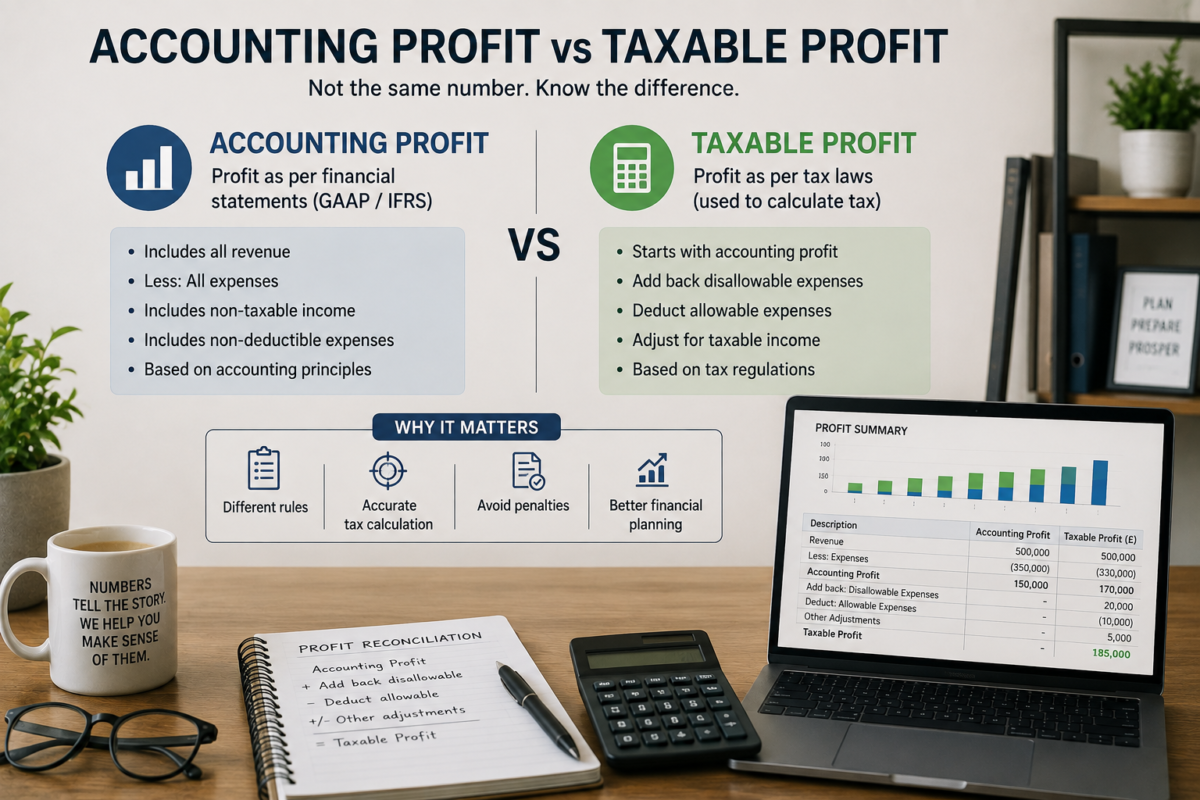
Accounting Profit vs Taxable Profit: Corporation Tax Explained

If you’ve ever looked at your company’s profit and loss account and then been surprised by the Corporation Tax bill that follows, you’re not alone. The profit in your accounts and the profit HMRC actually taxes are rarely the same figure, and understanding why is one of the most useful things a director can learn about how Corporation Tax actually works.

Want a second opinion on your Corporation Tax computation before you file? Book a free 15-minute consultation with Felix Accountants and we’ll take a look.

What Is Accounting Profit?

Accounting profit is the figure shown in your statutory accounts, prepared under standard accounting frameworks such as FRS 102 or FRS 105. It reflects your income less all costs recognised during the accounting period, including things like depreciation, which spreads the cost of an asset over its useful life for accounting purposes.

What Is Taxable Profit?

Taxable profit — more precisely, “taxable total profits” for Corporation Tax purposes — starts with your accounting profit and adjusts it according to tax law. Some costs that are perfectly valid in your accounts simply aren’t deductible for tax, and some tax reliefs don’t appear in your accounts at all. The result, after these adjustments, is the figure your Corporation Tax is actually calculated on.

Why Depreciation Gets Added Back

Depreciation is an accounting estimate of how an asset loses value over time, and estimates aren’t something tax law is willing to rely on directly. Instead, depreciation is added back in full in the tax computation, and capital allowances — a set of HMRC-defined rates and allowances — are used instead to give tax relief on qualifying capital expenditure. The Annual Investment Allowance, for example, currently allows many businesses to deduct the full cost of qualifying plant and machinery in the year of purchase, up to a set limit, with writing down allowances covering amounts above that.

Common Disallowable Expenses

Beyond depreciation, several other costs that appear in your accounts must be added back because they aren’t allowable for Corporation Tax:

  • Client entertainment costs
  • Fines and penalties, including parking tickets and HMRC penalties
  • Costs that don’t meet the “wholly and exclusively” test for business purposes
  • Certain provisions that haven’t yet crystallised into an actual liability

For a fuller list of what is and isn’t deductible for a limited company, see our guide to allowable limited company expenses.

A Worked Example

ItemAmount
Profit per accounts£60,000
Add back: depreciation+£8,000
Add back: client entertaining+£1,200
Less: capital allowances-£6,500
Taxable total profits£62,700

Notice that the taxable figure here is higher than the accounting profit, even though the company hasn’t earned any additional cash — it’s purely the effect of the add-backs and reliefs working differently in the two calculations. In other cases, generous capital allowances can push taxable profit below accounting profit instead.

Why This Distinction Matters for Directors

Understanding the gap between accounting and taxable profit matters for more than just curiosity. It affects how much cash you should be setting aside for your Corporation Tax bill, and it’s also a completely separate question from how much profit is legally available to pay out as dividends, which is governed by company law and your accounting profit and reserves, not your tax computation. Paying dividends from profits that don’t actually exist can result in an illegal dividend — our guide on illegal dividends explains this risk in more detail.

Common Misunderstandings

  • Assuming your Corporation Tax bill should match a simple percentage of your accounting profit
  • Forgetting that capital expenditure isn’t deducted as it’s spent, but relieved through capital allowances instead
  • Treating distributable reserves and taxable profit as the same thing when deciding on dividends
  • Missing available reliefs, such as R&D relief, because they don’t automatically appear in the accounting figures

How Felix Accountants Can Help

We prepare Corporation Tax computations that correctly reconcile your accounting profit to your taxable profit, make sure you’re claiming every allowance and relief you’re entitled to, and help you plan cash flow around your actual tax liability rather than guesswork.

Frequently Asked Questions

Why is my Corporation Tax bill higher than expected based on my accounts?

This usually happens because disallowable expenses, like depreciation or client entertaining, have been added back in the tax computation, increasing your taxable profit above your accounting profit.

Do capital allowances always reduce my tax bill more than depreciation would?

Not necessarily in every year, but capital allowances are the only mechanism HMRC recognises for tax relief on capital expenditure, so understanding and claiming them correctly is essential regardless of how they compare to your accounting depreciation charge in any given year.

Can I pay dividends based on my accounting profit even if my taxable profit is lower?

Dividends must be paid from distributable reserves under company law, which relate to your accounting position, not your taxable profit figure. The two calculations serve different purposes and shouldn’t be confused when deciding what can legally be paid out.

Does every company need a formal tax computation separate from its accounts?

Yes. Even small companies need to prepare a Corporation Tax computation that adjusts accounting profit for tax purposes as part of the CT600 filing process, regardless of how straightforward the underlying accounts are.

Categories
Articles Articles Blogs Self Assessment Taxation Services

What Happens If You Discover an Error in a Previous UK Tax Return?

Spotting a mistake on a tax return you’ve already submitted is more common than you might think — a missed expense, an omitted source of income, or a figure that simply doesn’t add up. The important thing is what you do next, because HMRC treats a self-corrected error very differently from one it uncovers itself.

Not sure whether you’re still within the amendment window, or how to approach HMRC about an older error? Book a free 15-minute consultation with Felix Accountants and we’ll help you work out the best next step.

Step One: Work Out Which Deadline Applies

How you correct the error depends on how long ago you filed the return in question.

Within 12 Months of the Filing Deadline

If you’re within 12 months of the normal Self Assessment filing deadline for that return, you can simply amend it yourself. For an online return, log back into your HMRC account, update the relevant figures, and resubmit — the system recalculates your bill automatically, showing whether you owe more or are due a refund. For example, a 2024/25 return filed by the 31 January 2026 deadline can generally be amended up to 31 January 2027.

More Than 12 Months After the Deadline

Once the 12-month window has closed, you can no longer amend the return online. Instead, you’ll need to write to HMRC explaining the correction, or make a formal overpayment relief claim if the error means you paid too much tax. Overpayment relief claims can generally be made up to four years after the end of the tax year the return relates to.

What to Include in a Written Correction or Overpayment Relief Claim

  • The tax year the correction relates to
  • A clear explanation of what was wrong and why
  • The amount you believe was overpaid or underpaid
  • Supporting evidence (invoices, statements, calculations)
  • A signed declaration confirming the details are correct and complete to the best of your knowledge

If the Error Means You Owe More Tax

If correcting the mistake increases your tax bill, it’s best to notify HMRC and pay the difference as soon as you’re aware of it. Interest accrues from the original due date, and coming forward yourself, before HMRC identifies the discrepancy independently, generally puts you in a much stronger position on penalties than waiting to be caught out. This is the same underlying principle behind voluntary disclosure routes like the Let Property Campaign for landlords with undeclared rental income specifically.

If the Error Means You Overpaid

If you’re due a refund, amending within the 12-month window is the most straightforward route — HMRC recalculates your position and processes the repayment. Outside that window, an overpayment relief claim achieves the same result but requires a more formal written submission with supporting evidence.

Genuine Mistakes vs Careless or Deliberate Errors

HMRC distinguishes between an honest, reasonable mistake and one caused by carelessness or deliberate action, and this distinction affects whether a penalty applies at all. If you took reasonable care and made a genuine error in good faith, you’re unlikely to face a penalty for correcting it — HMRC generally responds far more favourably to taxpayers who put things right themselves. If the error was significant, spanned several years, or involved undeclared income you knew about, professional advice is worth getting before you approach HMRC, since the correct classification affects both the penalty and how many years need correcting.

What If HMRC Corrects the Error First?

HMRC can amend a return itself within nine months of the date you filed it, typically to correct obvious errors, and will notify you of any change. If HMRC identifies a more significant discrepancy through a compliance check, the process moves from a simple correction into a formal enquiry, and the potential penalties for the same underlying mistake are usually higher than if you’d corrected it proactively.

A Practical Example

Suppose you filed your 2023/24 return in January 2025 and later realise, in mid-2026, that you forgot to include some rental income. Since more than 12 months have passed since the 31 January 2025 deadline, you can’t amend the return online — you’d need to write to HMRC, or, if the omission relates to rental income specifically, consider whether the Let Property Campaign disclosure process is the more appropriate route, since it’s specifically designed for this kind of correction.

How Felix Accountants Can Help

Whether you’re inside the 12-month amendment window or need to make a formal overpayment relief claim or voluntary disclosure, we’ll help you work out the right process, prepare accurate figures, and manage the correspondence with HMRC on your behalf.

Frequently Asked Questions

How long do I have to amend a Self Assessment tax return?

You generally have 12 months from the normal filing deadline for that tax year. For example, a return with a 31 January 2027 deadline can usually be amended up to 31 January 2028.

What is overpayment relief?

Overpayment relief is a formal claim you can make to recover tax you’ve overpaid, once the standard 12-month amendment window has passed. It must generally be made within four years of the end of the relevant tax year and requires a written submission with supporting evidence.

Will I be penalised for correcting my own mistake?

If the error was a genuine mistake made despite taking reasonable care, a penalty is unlikely. Penalties are more commonly applied where HMRC considers the error careless or deliberate, and coming forward yourself before HMRC identifies the issue generally results in a lower penalty than waiting.

Can HMRC change my tax return without telling me?

HMRC can make certain corrections within nine months of your filing date, but it will notify you of any change made. Anything beyond a simple correction, such as a discrepancy found through a compliance check, involves a more formal process where you’re kept informed and can respond.

Categories
Articles Articles Blogs Self-Assessment Taxation Services

Self Assessment for First-Time Taxpayers: How to Register and File Your First Return

Filing a Self Assessment tax return for the first time can feel intimidating, mostly because nobody explains the process until you’re already up against a deadline. The good news is that once you understand the sequence — register, get your reference number, then file — it’s a manageable, one-time learning curve.

If you’d rather have someone check your registration and return before you submit, book a free 15-minute consultation with Felix Accountants — it’s a quick way to make sure your first return is right.

Who Needs to Register for Self Assessment?

You generally need to register if, in the tax year in question, you had income from self-employment over £1,000, rental income, foreign income, capital gains, dividends or savings above certain thresholds, or if you need to pay the High Income Child Benefit Charge. Self Assessment isn’t limited to the self-employed — many first-time filers are landlords, company directors, or people with a side income alongside employment.

The Registration Deadline

If you need to file for the first time, you must register with HMRC by 5 October following the end of the tax year in which the income arose. For example, if you started earning untaxed income at any point between 6 April 2025 and 5 April 2026 (the 2025/26 tax year), you need to register by 5 October 2026. Miss this and you can still register late, but you risk penalties if it causes you to miss the return deadline too.

How to Register: Step by Step

  1. Decide your category. HMRC’s registration route differs slightly depending on whether you’re self-employed, a landlord, a partner in a business, or none of the above but still need to file.
  2. Register online with HMRC. Use the appropriate GOV.UK registration service for your circumstances and set up a Government Gateway account or sign in with GOV.UK One Login.
  3. Receive your Unique Taxpayer Reference (UTR). HMRC posts this, usually within around 10 working days in the UK (longer if you’re abroad). You cannot file a return without it.
  4. Activate your online account. A separate activation code arrives by post, which you’ll need to complete sign-in for the online filing service.
  5. Set up your personal tax account. This is worth doing early — see our guide on how to set up your personal tax account for the details.

Filing Deadlines You Need to Know

DeadlineWhat it’s for
5 OctoberRegister for Self Assessment for the tax year just ended
31 OctoberPaper return deadline
31 January (following year)Online return deadline and balancing payment due

Our guide to the UK tax year and key dates covers how these deadlines fit into the wider tax calendar, including payments on account.

What Happens If You Miss the Deadline?

Missing the registration deadline alone doesn’t always trigger an automatic penalty, particularly if you don’t end up owing tax. Missing the filing deadline is different: HMRC applies an automatic £100 penalty even if you owe no tax, rising to daily penalties after three months. Full details are in our article on HMRC’s £100 fine for missing the tax deadline.

Common First-Time Filer Mistakes

  • Leaving registration until September or October and getting caught out by UTR postal delays
  • Not keeping records of income and expenses from day one, making the return far harder to complete accurately
  • Forgetting to declare all sources of income, not just the “main” one — for example, a small amount of rental income alongside employment
  • Assuming Self Assessment is only for the self-employed and missing the deadline as a first-time landlord
  • Not budgeting for payments on account, which can catch new filers by surprise in year two

Record-Keeping From the Start

Good record-keeping makes your first return far less stressful and gives you a solid foundation for every year after. Keep invoices, receipts, bank statements and any correspondence relevant to your income and expenses as you go, rather than trying to reconstruct a year’s activity in January.

How Felix Accountants Can Help

We help first-time filers register correctly, understand what they can and can’t claim, and get their first return submitted well ahead of the deadline — taking the guesswork out of a process that only gets easier the second time around.

Frequently Asked Questions

How long does it take to get a UTR number?

HMRC typically posts your Unique Taxpayer Reference within around 10 working days if you’re in the UK, or up to 21 working days if you’re abroad. It’s sensible to register well before the 5 October deadline to allow for this.

Do I need to register for Self Assessment if I’m already employed and pay tax through PAYE?

Yes, if you have additional untaxed income — such as self-employment earnings, rental income, or significant dividends — on top of your PAYE employment. Self Assessment and PAYE aren’t mutually exclusive.

What if I register late?

You can still register after 5 October, but if this causes you to also miss the filing deadline, you may face penalties. It’s best to register as soon as you realise you need to, rather than waiting.

Can I file my first return on paper instead of online?

Yes, but the paper deadline (31 October) is earlier than the online deadline (31 January), so most first-time filers find it easier to register for online filing.

Categories
Articles Articles Blogs Let Property Campaign News

Let Property Campaign: Can You Disclose Rental Income From a Property You No Longer Own?

If you used to let out a property but have since sold it, gifted it, or moved back in yourself, you might assume that any undeclared rental income from those years is now somehow out of reach of HMRC. It isn’t. The good news is that selling the property doesn’t close the door on putting things right — you can still use the HMRC Let Property Campaign to disclose rental income from a property you no longer own, and doing so voluntarily is almost always better than waiting to be found.

Not sure where you stand with a property you’ve already sold? Book a free 15-minute consultation with Felix Accountants and we’ll talk through your situation in plain English, with no obligation. Reserve your free call here.

Does Selling a Rental Property Remove Your Obligation to Declare Past Rent?

No. Your obligation to report rental income relates to the tax years in which you actually received that income, regardless of whether you still own the property today. If you let out a property between, say, 2019 and 2023 and then sold it, you were still legally required to report the rent you received during those years on a Self Assessment tax return. Selling the property doesn’t erase that history — it simply means the disclosure now covers a property that no longer appears on your current asset list.

This is one of the most common misunderstandings we see at Felix Accountants. Landlords often believe that once a property is sold, any loose ends relating to it are automatically tidied up. In reality, HMRC’s Let Property Campaign was specifically designed to capture exactly this kind of situation — current landlords, former landlords, and anyone in between with unreported letting income.

Who Can Use the Let Property Campaign for a Former Rental Property?

The Let Property Campaign is open to individual landlords who have received undeclared rental income from residential property in the UK or abroad. This includes people who:

  • Sold the rental property some years ago but never declared the rent received while they owned it
  • Inherited a property, let it out for a period, and later sold it
  • Moved back into a property that was previously let to tenants
  • Gifted or transferred a rental property to a family member and stopped receiving rent from it
  • Were an accidental landlord for a short period before selling

In every one of these cases, the fact that the property has moved on doesn’t change the underlying tax history. What matters to HMRC is the income you received while you owned and let the property, not whether you still hold the title today.

How Far Back Do You Need to Declare?

The look-back period depends on why the income wasn’t declared in the first place, not on when you sold the property. As a general guide:

  • Genuine, careless error: typically up to 4–6 years
  • Failure to take reasonable care: up to 6 years
  • Deliberate non-disclosure: HMRC can go back as far as 20 years

We’ve written a more detailed breakdown of this in our guide on how many years you need to declare and our companion article on how many years of rental income landlords must disclose. If the property has since been sold, you’ll still need to work out the correct number of years based on when you first started letting it and when the undeclared income actually stopped, which for a sold property is usually the completion date.

What About Capital Gains Tax on the Sale Itself?

A disclosure through the Let Property Campaign covers rental income and any related expenses, not the sale of the property. However, if you sold the property at a profit, you may separately owe Capital Gains Tax on that sale, and UK residential property sales generally need to be reported to HMRC within 60 days of completion. If both the rental income and the sale itself were never reported, it’s sensible to deal with both matters together rather than treating them as separate problems, since HMRC will often be looking at your full history once a disclosure is opened.

Why Voluntary Disclosure Still Matters After the Sale

Coming forward voluntarily, before HMRC contacts you, generally results in significantly lower penalties than a prompted disclosure that follows an HMRC letter or enquiry. Our article on prompted versus unprompted disclosures sets out the practical difference in more detail, but the short version is this: HMRC has extensive data-matching capability drawn from Land Registry records, Stamp Duty Land Tax returns, letting agent reporting and platforms such as Airbnb, so a sold property is not invisible simply because you no longer own it. Making the first move, through our voluntary disclosure guidance, gives you more control over the outcome, the tone of the process and the penalty percentage applied.

What You’ll Need to Gather

Because you no longer own the property, you may not have easy access to the same records a current landlord would. It’s still worth trying to pull together:

  • Bank statements showing rent received during the letting period
  • Tenancy agreements or letting agent statements, if available
  • Records of allowable expenses such as mortgage interest, insurance, repairs and letting agent fees
  • The completion date of the sale, and the purchase and sale prices, in case a Capital Gains Tax position also needs reviewing

If some records are missing entirely, that’s a common and manageable problem — HMRC accepts reasonable estimates provided they’re clearly labelled and based on a sensible methodology, rather than guesswork presented as fact.

How Felix Accountants Can Help

We regularly help former landlords work through reporting undisclosed rental income to HMRC, including cases where the property has already been sold, gifted, or repossessed. We’ll help you reconstruct a reasonable income and expense history, calculate what’s owed, and manage the notification and disclosure process on your behalf so you’re not dealing with HMRC directly and unrepresented.

Frequently Asked Questions

Can I still be investigated if I sold the rental property years ago?

Yes. HMRC’s ability to open an enquiry into undeclared rental income isn’t affected by a subsequent sale. The tax liability relates to the years you received the income, and HMRC can pursue this regardless of your current ownership status.

Do I need to disclose if the rental profit was very small?

Generally yes. There’s no minimum threshold that exempts small amounts of rental profit from disclosure, although your allowable expenses and personal allowance may mean little or no tax is ultimately due once everything is calculated correctly.

What if I can’t find all my old records for a property I no longer own?

This is common, particularly for properties sold some years ago. HMRC accepts reasonable, clearly explained estimates where original records aren’t available. An accountant experienced with the Let Property Campaign can help you build a defensible estimate.

Will disclosing affect the sale I’ve already completed?

No. The sale itself is a separate, completed transaction. A Let Property Campaign disclosure deals with the historic rental income tax position and won’t unwind or affect the property sale.

Is it too late to make a voluntary disclosure?

It’s rarely too late to disclose voluntarily unless HMRC has already contacted you about the specific property. Acting before any HMRC letter arrives keeps your disclosure classed as unprompted, which generally attracts lower penalties.

Ready to sort out a property you’ve already sold? Felix Accountants specialises in Let Property Campaign disclosures for current and former landlords. Book your free 15-minute consultation and let’s work out exactly where you stand.


Categories
Articles Articles Blogs Let Property Campaign

Let Property Campaign Airbnb and Short-Term Rentals Eligibility

Airbnb and other short-term letting platforms now report host income directly to HMRC, so if you’ve been treating your listing as “just a bit of extra cash” rather than taxable rental income, it’s worth checking your position carefully. A common question we hear is whether the Let Property Campaign can be used to put things right — and the answer is generally yes, but with some important nuances.

Unsure whether your Airbnb income should have been declared, or how far back you need to go? Book a free 15-minute call with Felix Accountants to talk it through confidentially.

Is Airbnb Income Taxable?

Yes. Income from letting a property, or even a spare room, on a short-term basis is taxable in the same way as any other rental income, subject to any reliefs you’re entitled to. The only exceptions are the £1,000 property allowance (if your gross rental income is below that threshold) and the Rent a Room Scheme, which lets you earn up to £7,500 tax-free from letting a room in your own home, provided you live there too.

Does the Let Property Campaign Cover Short-Term Lets?

The LPC applies to individual landlords with undeclared tax on residential property income, and this generally includes short-term and holiday-style lettings of residential property, whether booked through Airbnb, Booking.com, Vrbo or direct. What matters for eligibility is that the property is held personally, not through a limited company, and that the income is genuinely rental-style rather than a trading business involving substantial additional services such as daily cleaning, meals or reception.

If your short-term letting activity has grown into something closer to running a guest house, with significant services provided, HMRC may view it as a trade rather than a property business, which changes how it’s taxed and may take it outside the scope of the LPC. This is a grey area worth getting professional input on before you disclose.

What Changed With Furnished Holiday Lets?

Until 6 April 2025, properties meeting certain letting and availability conditions could qualify as Furnished Holiday Lets (FHLs), unlocking more generous tax treatment, including fuller mortgage interest relief and access to certain capital allowances. That regime was abolished from the 2025/26 tax year, and short-term let income is now taxed under the same rules as standard rental property income, including the mortgage interest restriction that already applied to other landlords. If you’ve been disclosing historic years, it’s important to apply the rules that were in force for each specific tax year rather than today’s rules retrospectively.

How Far Back Do You Need to Go?

As with any Let Property Campaign disclosure, the number of years you need to cover depends on your behaviour: whether the non-disclosure was a genuine, reasonable mistake, careless, or deliberate. Our guide on how many years of rental income landlords must disclose sets out the general time limits in more detail.

Accidental Hosts and First-Time Disclosures

Many people who let out a property short-term didn’t set out to become landlords in the tax sense — perhaps you started renting a spare property while working away, or began hosting guests after downsizing. If that sounds like you, our page on becoming an accidental landlord covers how HMRC treats these situations and what you need to do to get compliant.

Practical Steps If You Haven’t Declared Airbnb Income

  • Pull together booking records, payout statements and platform tax summaries for each relevant tax year
  • Work out which years the Furnished Holiday Let rules did or didn’t apply, since this affects your allowable deductions
  • Check whether the Rent a Room Scheme or property allowance already covers part of your income
  • Consider whether your behaviour is likely to be classed as careless or deliberate, since this affects the penalty rate and the years you must disclose
  • Make your disclosure before HMRC contacts you, to secure unprompted disclosure treatment and a lower penalty

Common Mistakes Hosts Make

The most frequent error we see is hosts assuming that because Airbnb “already takes its cut” or issues a summary, the income has somehow already been reported to HMRC on their behalf. It hasn’t — platform reporting to HMRC is a compliance tool for HMRC, not a substitute for your own Self Assessment return. Another common mistake is applying FHL-style deductions to years after the regime ended, which can trigger its own correction later.

How Felix Accountants Can Help

We regularly help hosts and landlords work out exactly what’s owed across multiple tax years, apply the correct rules for each year, and submit an accurate Let Property Campaign disclosure that stands up to HMRC scrutiny.

Frequently Asked Questions

Do I need to declare Airbnb income if I only host occasionally?

If your gross rental income from all sources is under £1,000 in a tax year, the property allowance may mean you don’t need to declare it. Above that, it generally needs to be reported, even if hosting is occasional.

Can I still get Furnished Holiday Let tax treatment for a current listing?

No. The Furnished Holiday Let regime was abolished from 6 April 2025, so short-term let income from the 2025/26 tax year onward is taxed under the standard property income rules.

Does the Let Property Campaign cover overseas short-term lets?

It can, in certain circumstances, though overseas income brings in additional considerations such as double taxation relief. It’s best to get specific advice if your undeclared income relates to a property outside the UK.

What if my short-term letting is really more like running a guest house?

If you provide substantial additional services, HMRC may treat the activity as a trade rather than a property business, which can affect both how it’s taxed and whether the Let Property Campaign is the right disclosure route.

Categories
Articles Blogs Let Property Campaign

Let Property Campaign vs Tax Investigation: Choosing the Right Route

If you’ve fallen behind on declaring rental income, you’ve probably come across two very different-sounding terms: the let property campaign vs tax investigation. They can lead to the same place — you paying the tax you owe — but the route, the paperwork, the Let Property Campaign and an HMRC compliance check are different procedures for dealing with tax that may be unpaid. Which route is open to you, and how penalties are assessed, depends on the facts and whether HMRC has already begun enquiries.


Not sure which route applies to you, or whether you should come forward before HMRC contacts you? Book a free 15-minute consultation with Felix Accountants and we’ll talk through your specific circumstances, in confidence, with no obligation.

What Is the HMRC Let Property Campaign?

The Let Property Campaign (LPC) is a voluntary disclosure facility that HMRC has run since 2013. It allows individual UK landlords with undeclared or under-declared rental income to come forward, calculate what they owe, and pay it — usually on more favourable terms than if HMRC discovered the problem itself. It applies to residential property income only; landlords holding property through a limited company or trust cannot use the LPC.

Once you notify HMRC of your intention to disclose, you’re generally given 90 days to work out the tax, interest and any penalty due and submit your disclosure. It’s a structured, self-managed process, and it is entirely optional — nobody forces you into the LPC.

What Is an HMRC Tax Investigation?

A tax investigation, by contrast, is something HMRC initiates. It isn’t voluntary, An HMRC enquiry involves formal questions and requests for information. You still have rights and responsibilities, including the right to take professional advice, but the response process is driven by HMRC’s enquiries.

Formal Compliance Checks and Enquiries

These are opened when HMRC has reason to believe a return is wrong — often triggered by data mismatches from sources like the Land Registry, letting agents, mortgage lenders or short-term letting platforms. HMRC will typically request records, ask questions, and can go back several years depending on the behaviour involved.

Code of Practice 9 (COP9)

Code of Practice 9 is reserved for cases where HMRC suspects deliberate tax fraud. It’s a civil process, offered as an alternative to criminal prosecution, but under Code of Practice 9, HMRC may offer the Contractual Disclosure Facility where it suspects fraud. Acceptance involves contractual obligations to disclose deliberate behaviour fully and accurately; the details and consequences must be reviewed before any decision.

and disclose everything in full. It carries much higher stakes than either the LPC or a standard compliance check, and professional representation is essential from the outset.

Key Differences at a Glance

LPC: You notify HMRC of the intention to disclose previously unpaid rental tax and, if accepted, follow the campaign’s disclosure and payment process.

HMRC enquiry: HMRC asks questions and may formally investigate a return or other tax matter. Penalties under either route depend on the type of error, the relevant rules and the quality of disclosure. Eligibility for the LPC cannot be assumed once HMRC has notified an intention to open a compliance check.”

Why Timing Matters: Prompted vs Unprompted Disclosure

This is the single biggest factor in how much you’ll ultimately pay. Under HMRC’s penalty rules, an unprompted disclosure — one made before HMRC has any reason to believe it’s about to find the error — attracts a far lower penalty than a prompted disclosure made after contact from HMRC. For a careless error, an unprompted disclosure can start at 0%, while a prompted one is very rarely below 15%.

HMRC’s prompted or unprompted classification depends on what you had reason to believe it had discovered or was about to discover. Receiving a letter is an important fact, but the exact wording and circumstances must be reviewed.

Which Route Applies to You?

In practice, most landlords who haven’t yet heard from HMRC are free to use the LPC on an unprompted basis. If you’ve already received a nudge letter, you can generally still use the LPC, but your disclosure will be treated as prompted, meaning a higher minimum penalty. If HMRC has gone further and opened a formal enquiry — or suspects deliberate concealment, HMRC says LPC disclosures are unlikely to be accepted where it has already notified its intention to open an enquiry or compliance check before you notified under the campaign. If an enquiry is open, speak to the HMRC officer or obtain professional advice before choosing a disclosure route.

Working out exactly how many years of rental income need to be disclosed also depends on which category your behaviour falls into — careless errors generally require fewer years back than deliberate non-disclosure.

What Happens If You Do Nothing?

Leaving an unpaid tax position unresolved can lead to additional interest and may leave HMRC to identify the issue later. Check the records and respond to any HMRC request within the stated time frame.

HMRC’s Connect system cross-references data from letting agents, banks, mortgage applications and property platforms, so undeclared rental income is increasingly likely to surface on its own. If it does, you lose the ability to make an unprompted disclosure entirely, and any subsequent enquiry starts from a position where HMRC is already suspicious.

Common Mistakes Landlords Make

  • Waiting to see if HMRC “actually finds out” rather than disclosing proactively
  • Assuming the LPC applies to a property held in a limited company (it doesn’t)
  • Submitting a partial disclosure and leaving out a property or income stream, which HMRC can treat as deliberate concealment if later discovered
  • Trying to negotiate a COP9 case without professional representation

How Felix Accountants Can Help

Whether you’re weighing up an unprompted LPC disclosure, responding to a nudge letter, or facing a formal enquiry, getting the behaviour classification right from the outset has a direct impact on your final bill. We handle the calculations, the correspondence with HMRC, and the disclosure itself, so you’re not navigating it alone.

Frequently Asked Questions

Can HMRC open an investigation while I’m in the middle of an LPC disclosure?

Generally, if your LPC disclosure is accurate, complete and submitted in good faith, HMRC treats it as a self-contained process and won’t open a parallel enquiry into the same rental income. However, HMRC does reserve the right to investigate further if the disclosure appears incomplete or inconsistent with information it already holds.

Does the Let Property Campaign apply to companies?

No. The LPC is only available to individual landlords with undeclared income from residential property. Landlords who hold property through a limited company need to correct their position through Corporation Tax filings instead.

What if I’ve already received a nudge letter?

You can usually still use the Let Property Campaign, but your disclosure will be classed as prompted, which generally means a higher minimum penalty than if you’d come forward first. It’s still typically far better than waiting for a formal enquiry to open.

Will using the Let Property Campaign guarantee I avoid prosecution?

No. HMRC’s Let Property Campaign guidance does not promise immunity from prosecution. It explains that a complete, unprompted disclosure is an important factor when HMRC decides whether to pursue civil or criminal action. COP9 has separate contractual terms and should not be confused with an ordinary LPC disclosure.

What should I do if HMRC has already opened an enquiry?

First read the letter carefully to understand which tax years and issues HMRC is asking about, the date by which it expects a reply, and whether a named officer is dealing with the case. Preserve the letter and the underlying records. HMRC’s LPC guidance explains that a campaign disclosure is unlikely to be accepted if HMRC notified its intention to open an enquiry or compliance check before the landlord notified under the campaign.

The correct next step may therefore be to respond within that existing procedure rather than start a separate LPC notification. Do not ignore the request or assume that a different online form will stop the enquiry. If the letter raises deliberate behaviour or suspected fraud, obtain suitable specialist advice promptly. Felix & Co. can review the correspondence and help identify the issues that need attention.

Is an HMRC nudge letter the same as a formal enquiry?

Not necessarily. An HMRC letter asking you to check property income may be an invitation to review your tax position, while a formal enquiry is a specific compliance process. Do not decide what the letter means from the phrase ‘nudge letter’ alone. Check the document, any statutory references, what information is requested and the reply date.

If you are unsure whether HMRC has formally opened a check, ask HMRC or obtain professional advice before submitting a disclosure. The distinction can affect which process is available and how the disclosure is classified for penalties. Keep a copy of everything you send and a record of your correspondence. If you have received an HMRC property-income letter, ask Felix & Co. to review it with you before you respond.

When does COP9 need different specialist advice?

Code of Practice 9 is a formal HMRC procedure for suspected tax fraud. It should not be treated as an ordinary version of the Let Property Campaign. HMRC may offer a Contractual Disclosure Facility under which the taxpayer has to decide whether to accept particular disclosure obligations.

The decision can have serious consequences, and HMRC sets out specific time limits and requirements in its guidance. If an envelope or email refers to COP9 or the Contractual Disclosure Facility, avoid replying with an ordinary LPC-style statement before you have read the documents and taken appropriate advice. Keep every letter, make a chronology of relevant events and preserve supporting records

Categories
News

Voluntary Rental Income Disclosure: What Coming Forward Changes

HMRC is not standing still on undeclared rental income. If you have rental income that was not declared correctly, it is sensible to review the position rather than leave it unresolved. HMRC offers a route for eligible individual landlords to disclose previously unpaid tax. Your circumstances, including whether HMRC has already contacted you, can affect how penalties are considered to fund 500 new compliance officers, alongside £79 million earmarked for third-party debt collection over the next five years — on top of the 1,800 debt management roles already announced in the previous Autumn Budget. In plain terms: HMRC’s ability to find undeclared rental income is growing fast, and landlords who wait are taking on more risk with every month that passes.

The good news is that landlords who come forward under the Let Property Campaign before HMRC has reason to believe it has found the problem may affect the penalty range. It does not guarantee that HMRC will accept the figures without questions or that an investigation will never follow.


Why Timing Changes the Penalty You Pay

The single biggest lever landlords have over their own penalty bill is when they come forward. Disclose voluntarily, ahead of any HMRC enquiry, and the penalty bands sit meaningfully lower than if HMRC opens a compliance check first. Whether a disclosure is prompted depends on what the landlord had reason to believe HMRC knew or was about to find. HMRC contact is important, but it is not sensible to decide the classification from timing alone.

This applies whether your rental income was never reported to HMRC at all, or whether you filed a return but left the property income off it — HMRC treats these as two separate situations, each with its own behaviour categories.

How HMRC Classifies Your Behaviour

Where a landlord never registered for tax and never filed a return covering the rental income, HMRC groups the reason into one of three bands:

  • Non-deliberate — the omission stemmed from a genuine misunderstanding or circumstance, not an intent to avoid tax.
  • Deliberate (not concealed) — the landlord knew the income should have been reported and chose not to, but took no further steps to hide it.
  • Deliberate and concealed — the landlord not only withheld the income but actively worked to disguise it.

Where a return was filed but the rental income was left out or understated, a slightly different set of categories applies:

  • Reasonable care — HMRC doesn’t set a fixed test here; it’s judged case by case, but landlords are generally expected to seek advice when they’re unsure of the rules and to file accurate figures.
  • Careless — the return was wrong because reasonable steps weren’t taken to get it right, such as poor record keeping or overlooking a known obligation.
  • Deliberate — the landlord knew the figures were wrong and submitted the return anyway, for example by understating rental income or overstating costs.
  • Deliberate and concealed — the landlord not only filed an inaccurate return but took active steps to cover it up, such as producing a fabricated invoice for repair work that never happened.

What Actually Reduces Your Penalty

Beyond the behaviour category, HMRC also looks at the quality of the disclosure itself when setting the final penalty. A strong disclosure is scored across three elements:

  • HMRC considers how openly you tell them about the error, the help you give in explaining it, and access to supporting records. The reduction and any penalty depend on the applicable rules and the individual facts.
  • Helping HMRC understand what happened — worth up to 40%
  • Giving HMRC access to the records behind it — worth up to 30%

The more complete and cooperative the disclosure, the more the penalty can be reduced from the maximum. For landlords weighing up their overall position, our tax-saving strategies guide covers the legitimate ways to manage the ongoing liability once everything is up to date.

Worked calculations can vary substantially between landlords. A reliable calculation separates rental income, allowable costs, tax due for each year, interest and any penalty. It also checks whether recent years belong on tax returns rather than within the LPC disclosure. A tailored calculation is more useful than relying on historic example totals.”

Ben has owned eight rental properties generating income since the 2016/17 tax year, and never filed a tax return covering any of it. His annual rental income sat around £45,000, with net profits — after deductions and mortgage interest — starting near £33,000 and rising year on year. His PAYE employment income began at £80,000 and grew by roughly 3% annually.

Once the calculation runs through to 2022/23, Ben’s total unpaid tax comes to £113,969. Assuming his behaviour is classed as non-deliberate and he cooperates fully, working through the applicable penalty rates:

  • Voluntary disclosure (before HMRC contacts him): total cost of £155,710
  • Prompted disclosure (after HMRC contacts him): total cost of £167,107

That’s a difference of £11,397 — purely down to coming forward first.

There’s a further wrinkle: HMRC generally won’t accept the most recent tax year as part of a Let Property Campaign disclosure. So a landlord disclosing for 2023/24, for example, would typically be asked to file that year’s return separately, which then carries its own late filing and late payment penalties.

If that 2023/24 return were filed six months late, the numbers would look like this:

Late filing penalties:

  • Initial penalty: £100
  • Daily penalties (up to 90 days): £900
  • Six-month penalty (the greater of £300 or 5% of unpaid tax): £999.30

Total late filing penalties: £1,990.30

Late payment:

  • 5% surcharge on unpaid tax: £999.30
  • Interest on the late payment: £771

Total estimated penalties for 2023/24 alone: £4,759.90

Landlords in Ben’s position want to know their exact exposure before they disclose, not after — this is exactly the kind of number our specialists work through on a discovery call.

An incorrect Self Assessment return may need a different correction from a year in which no return was filed. Check the year concerned, whether HMRC issued a return, any amendment window and the rules that apply to the underlying error. Do not assume an older example or deadline still applies to a new disclosure.”

Ms Kim runs a consultancy business that returned trading profits of £130,000 in 2018/19, growing at around 5% a year since. Alongside that, she owns two rental properties, cash-purchased with no mortgage, which brought in £28,000 gross in 2018/19 — £21,000 after £7,000 of allowable expenses. That rental income was never included on her Self Assessment return, and stayed missing from every year since, with income and costs both rising roughly 7% annually.

By 2022/23, her total unpaid tax comes to £59,409.

Her 2023/24 position is different, because a return for that year has already been filed. Since it’s within the amendment window (open until 31 January 2026), she can correct it directly without incurring additional late-filing penalties — though because the original payment deadline was 31 January 2025, late payment penalties and interest still apply.

Working through the penalty rates for the earlier years:

  • Voluntary disclosure: total cost of £85,443
  • Prompted disclosure: total cost of £94,354

A difference of £8,911 simply for disclosing before HMRC gets there first.

For 2023/24 specifically, if paid promptly:

  • Late payment penalty (5% of £12,614): £631
  • Interest on late payment: £355

Total tax, interest and penalty for 2023/24: £13,600

What If You Can’t Pay Everything Up Front?

HMRC expects payment in full at the point of disclosure — but that’s not always realistic, and it’s not a reason to delay. If you can’t cover the whole amount, the correct move is to contact HMRC’s Let Property Campaign helpline before you submit your disclosure or make any payment.

HMRC will want to understand your financial position to agree a realistic payment plan. Be ready to provide:

  • Your disclosure reference number
  • How and when you plan to pay what’s owed
  • Your current income and outgoings, weekly or monthly
  • What you own — property, vehicles, savings, investments
  • What you owe — mortgages, loans, credit cards

If full payment is not possible, contact HMRC before submitting the disclosure or payment and discuss your financial circumstances. HMRC says payment arrangements must be made by the date on the notification acknowledgement. Do not assume that a particular repayment term will be agreed.

The Bottom Line

HMRC’s enforcement capacity is only growing, and If an earlier tax liability remains unpaid, interest may continue to accrue. The sensible next step is to check the tax years, supporting records and your position with HMRC, then make a complete disclosure through the correct route. and if HMRC gets there first significantly higher penalties. Whether the gap in your case was an honest oversight or something more deliberate, the Let Property Campaign rewards landlords who come forward on their own terms rather than waiting to be found.

FAQs

Will I still owe interest if I disclose voluntarily?

A voluntary disclosure does not cancel the underlying tax or interest. HMRC explains that interest generally runs from the date the tax should have been paid until it is paid. Any penalty is considered separately and depends on the circumstances of the error and the way it is disclosed.

That means it is useful to work out the liability tax year by tax year, rather than estimate one overall bill. Start with rent received, allowable costs and other income that affects the tax calculation. Then identify the original payment dates and calculate interest using HMRC’s current guidance. If records are incomplete, explain the method used for any estimate. Ask Felix & Co. to review your figures before a disclosure is submitted.

What if I have not worked out the full tax bill yet?

You do not have to know the final tax figure merely to notify HMRC of an intention to disclose. HMRC’s Let Property Campaign guidance says the initial notification does not require the amount of undeclared income or the estimated tax. After you receive the notification acknowledgement, however, there is a deadline for completing the disclosure and dealing with payment.

Before notifying, consider what records are available, how many properties and tax years may be involved, and whether you need help reconstructing older figures. A sensible preparation list includes bank statements, agent reports, tenancy agreements, mortgage interest statements and details of other taxable income. Where information is missing, make a note of the gap and try to recover it. Felix & Co. can help review the records needed for an accurate submission.

What happens after HMRC receives my voluntary disclosure?

HMRC acknowledges a disclosure and reviews the information provided. It may ask for documents or explanations, particularly where figures require clarification. An acknowledgement is not the same as acceptance of the offer. If HMRC accepts the disclosure, it will issue an acceptance letter under the campaign’s terms.

If you discover that an important amount or property was omitted after sending it, contact HMRC promptly about correcting the disclosure. Keep a complete copy of what was submitted, your payment reference and the records supporting the figures. A careful file will also help with future tax returns. If you would like help assessing what to do next, ask Felix & Co. for a confidential review of your rental tax position.

Ready to find out what your voluntary disclosure would actually cost?👉 Book a free discovery call